Futures prop firms have strict rules to ensure fair trading and protect their capital. Violating these rules can lead to account termination, profit forfeiture, or permanent bans. Common prohibited practices include:
- Risk Mismanagement: Gambling with "all-in" trades, exceeding 2% risk per trade, or using the Daily Loss Limit as a stop-loss.
- Manipulative Strategies: Account rolling, Martingale, one-sided betting, or inconsistent position sizing.
- Hedging and Reverse Trading: Opening opposing positions on the same asset or across accounts.
- Copy Trading: Using signals, trade replication, or coordinated group trading.
- System Exploitation: Latency arbitrage, exploiting simulated fills, or using bots for high-frequency trading.
- Market Abuse: Grid trading, spoofing, or trading during illiquid periods to exploit simulated environments.
To stay compliant, traders must follow firm-specific rules, manage risk effectively, and avoid strategies that exploit simulated conditions. Tools like stop-loss orders, consistent contract sizing, and real-time compliance dashboards can help maintain good standing. Always review the top futures prop firms and their policies to avoid costly violations.
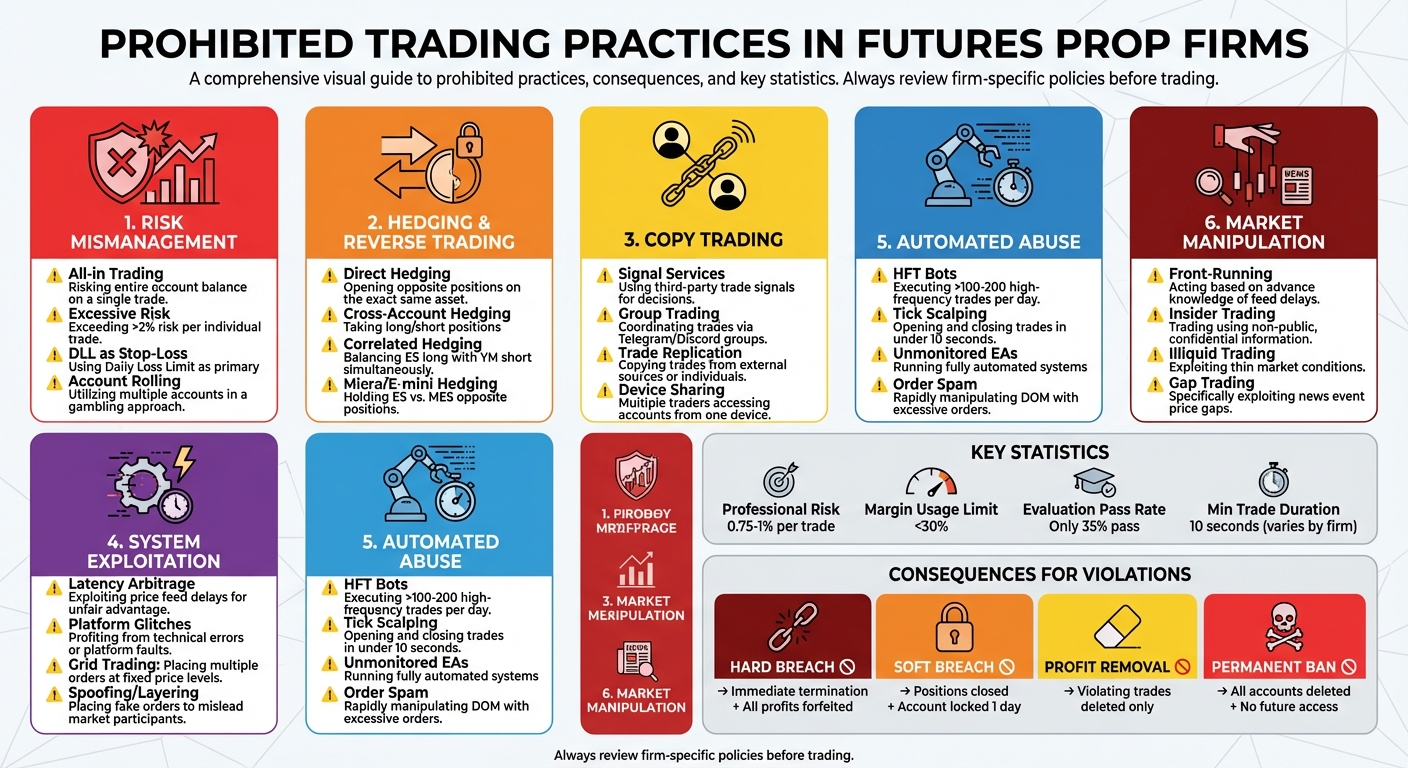
Prohibited Trading Practices in Futures Prop Firms: Complete Violation Guide
1. Gambling and High-Risk Trading: Breaching Core Risk Protocols
Risk Management Violations
Futures prop firms draw a clear line between calculated risk-taking and outright gambling. One of the biggest red flags? "All-in" trading – putting your entire account balance or maximum drawdown on a single trade and treating the Daily Loss Limit (DLL) as a stop-loss [5][7].
"Using maximum leverage on a single position and using DLL [Daily Loss Limit] as a stop loss will not be tolerated." – Alpha Futures [5]
Professional traders typically risk 0.75% to 1% per trade and keep margin usage within 30% [2]. Prop firms also enforce strict rules: no single trade should risk more than 2% of initial capital, even if spread across multiple positions [2]. Exceeding these limits signals gambling rather than disciplined trading. Beyond poor risk management, some aggressive tactics are outright banned.
Prohibited Trading Strategies
Certain strategies cross the line, violating the principles of responsible trading. Account rolling is a prime example. This involves buying multiple evaluation accounts, deliberately sacrificing most while aggressively trading one to pass through sheer luck [5][6].
"Account rolling undermines the integrity of the evaluation process by bypassing the core principles of responsible trading." – FundedNext Futures [6]
Another banned approach is the Martingale strategy, where traders double their position size after a loss in an attempt to recover [7]. Similarly, one-sided betting – taking repeated positions in one direction without proper analysis – is flagged as speculative behavior [2]. These methods often exploit simulated environments, ignoring real-world factors like slippage and market conditions, making them unsustainable in live trading [5][6].
| Practice | Definition | Consequence |
|---|---|---|
| Account Rolling | Using multiple accounts to pass one through luck-based trading | Account Termination/Restrictions |
| Martingale | Doubling position size after a loss to recover | Forfeiture of profits/Termination |
| All-in Trading | Risking the entire account on one trade idea | Hard breach/Account closure |
| One-sided Betting | Directional bias without market analysis | Flagged as speculative/Termination |
To stay compliant, always use manual stop-losses for individual trades. Relying on a firm’s automated liquidation levels as your safety net is a risky move [5][4]. Additionally, maintain consistent contract sizing – sudden shifts, like trading 12 contracts one day and only 3 the next without a clear strategy, can lead to payout issues [2]. Avoid trading during high-impact news events or in illiquid market periods to reduce unnecessary risks [2].
sbb-itb-46ae61d
2. Hedging and Reverse Trading
System Exploitation or Manipulation
Hedging involves opening opposing positions on the same asset, a practice that most futures prop firms strictly prohibit, regardless of whether it’s done by an individual trader or through collaboration with others[7][6][8].
"Hedging is defined as the act of opening two opposite positions on the same asset, regardless of differences in lot size or calculated risk. This policy is in place to ensure fair and transparent trading practices… Hedging can lead to confusion in risk management and may create unfair advantages or disadvantages for traders." – Goat Funded Trader [7]
While hedging might appear profitable in evaluation accounts due to favorable simulated fills, it often performs poorly in live market conditions[5][1][6].
Prohibited Trading Strategies
Reverse trading takes this a step further, involving opposing positions across different accounts to guarantee success in one account while sacrificing the other. For example, Alpha Futures explicitly bans strategies like "Long NQ and short MNQ on the same account", labeling it as reverse trading and prohibiting it in both the Evaluation and Qualified phases[5][6].
Correlated hedging is another banned practice. This includes strategies like buying S&P 500 futures while shorting YM futures, as such actions cancel out risk and undermine the purpose of evaluating a trader’s skills[6]. Similarly, trading E-mini and Micro versions of the same asset (e.g., ES and MES) in opposite directions is classified as hedging and is strictly prohibited[1][4].
"Reverse Hedging is a manipulative strategy where a trader opens opposite positions in different accounts to artificially hedge risk, creating an illusion of controlled exposure while exploiting reward structures." – FundedNext Futures [6]
These strategies distort performance metrics and consistency rules and compromise the ability to assess a trader’s actual risk management abilities.
Risk Management Violations
Hedging, whether executed individually or as part of a group strategy, bypasses genuine risk management and fails to reflect authentic market analysis skills[7][6]. Group trading, where multiple traders coordinate opposing positions to manipulate outcomes, is treated just as seriously as individual hedging violations[5][1][6]. Violations typically result in severe consequences, including immediate account termination, forfeiture of profits, and permanent bans from the platform[5][8][6].
3. Copy Trading and Signal Services
Ethical and Compliance Breaches
Prop firms assess traders on their ability to make independent decisions and manage risks effectively. Copying trades distorts this evaluation process by presenting a false image of a trader’s skills and achievements[6]. This undermines the purpose of the evaluation, which is to identify traders who can demonstrate discipline and sustain profitability over time.
"Relying on others – either through signal services or coordination with other traders – misrepresents a trader’s true capabilities and undermines fair competition." – FundedNext Futures[6]
Using external resources like signal providers or coordinating trades through platforms like Telegram or Discord violates the principle of individual accountability, which is central to most prop firm evaluations.
Prohibited Trading Strategies
Prop firms have strict rules against trade replication from external sources. Subscribing to third-party signal services or engaging in group trading, where multiple traders execute identical trades at the same time, is considered a major violation. These practices can create misleading market signals in simulated trading environments.
Automated tools that replicate trades from accounts not registered under your name are also banned. Firms use detection systems to flag accounts with identical trade parameters – such as opening and closing prices, lot sizes, and symbols – across unrelated traders. Additionally, firms like MyFundedFutures explicitly prohibit device sharing among traders, as it may indicate unauthorized collaboration.
"Each individual trader is required to maintain their own individual trading activity. Meaning, entering, exiting and cancelling their own trade executions." – MyFundedFutures[1]
Such violations compromise the integrity of the evaluation process and lead to broader issues of system manipulation.
System Exploitation or Manipulation
Coordinated trading in simulated environments can create artificial market activity, which doesn’t mirror real-world liquidity and conditions. Relying on external signals for trades can result in unmonitored activity, making it harder to assess a trader’s genuine risk management skills.
Interestingly, some firms allow traders to copy trades across their own accounts, as long as all accounts are registered under the same legal name. For example, FundedNext Futures permits this form of self-copying, distinguishing it from prohibited third-party trade replication. This exception ensures that evaluations still focus on personal trading abilities rather than automated strategies.
Risk Management Violations
Violating these rules comes with serious consequences. Traders caught using external signals or engaging in prohibited practices face immediate account termination, forfeiture of profits, and even permanent bans. During the evaluation phase, using external signals can lead to disqualification, even if performance metrics are met. Some firms may also void any progress or credits earned through such activities.
To stay compliant, rely solely on your own trading strategy and personally manage all trade decisions. If you use semi-automated indicators, ensure you remain actively involved in monitoring and managing each trade. Avoid participating in passing services or signal groups altogether – firms like Apex Trader Funding and Alpha Futures enforce strict zero-tolerance policies for these practices.
4. Latency Arbitrage and Platform Exploitation
System Exploitation or Manipulation
Latency arbitrage targets the time lag between price updates on different trading platforms or data feeds. Traders using this approach act on price changes from faster feeds before slower ones catch up, aiming to secure quick profits [6][8]. While this might seem profitable in simulations, real-world trading introduces slippage and latency that often erode these gains.
"Latency Arbitrage is a high-risk trading strategy that exploits price delays between platforms, relying on speed advantages rather than market analysis." – FundedNext Futures [6]
Prop firms strictly prohibit latency arbitrage because it takes advantage of the simulated fill algorithms used in evaluation accounts. These systems lack the complexities and frictions of actual market conditions [1][5][6][12]. Other related tactics include acting on outdated information from slower platforms, using ultra-tight bracket orders for "perfect" fills, and exploiting system glitches or frozen data feeds to gain an unfair edge [6][8].
"Any attempt to take advantage of errors, delays, mispricings, or lags in the broker’s feed, the charting platform, or any associated systems will result in immediate account breach." – Top One Futures [8]
Prohibited Trading Strategies
To counter these exploitation tactics, firms enforce strict measures. For example, Top One Futures requires a minimum trade duration of 10 seconds to discourage high-frequency trading that mimics latency arbitrage. If over 50% of a trader’s profits come from trades violating this rule, those profits are forfeited [8]. Similarly, FundedNext Futures prohibits trading within 2% of CME price limits to prevent gains in low-liquidity conditions near market halts.
Other flagged behaviors include "Multi-Order Spam" in the Depth of Market (DOM), where traders place and cancel orders rapidly to create misleading supply and demand signals [5][6]. Using unauthorized data feeds for a speed advantage is also considered system abuse [4]. Compliance teams actively monitor for these issues, especially during evaluations, to ensure fair trading practices before granting funded accounts [1][5][12].
Ethical and Compliance Breaches
These practices aren’t just technical violations – they raise ethical concerns as well. Prop firms view latency arbitrage as a shortcut that undermines genuine trading skill [6]. Consequently, firms like Alpha Futures and Apex Trader Funding respond to such breaches with immediate account termination and forfeiture of all profits [1][5][6][8].
"Certain trading strategies may exploit the simulated fill algorithm, performing well in the evaluation stage but inevitably resulting in losses when transitioned to live markets." – MyFundedFutures [1]
These rules aim to ensure a fair and balanced environment for all traders participating in futures prop trading evaluations.
To stay compliant, focus on strategies based on market trends, volatility, or trading volume instead of relying on speed-based methods. Avoid bracket trading or micro-scalping techniques designed purely for quick execution advantages, as these are often flagged during account reviews [6][12]. If you encounter platform issues like data freezes or errors, report them immediately instead of trying to capitalize on them – attempting to profit from such situations typically leads to permanent bans [13][14].
5. Account Manipulation and Churning
System Exploitation or Manipulation
Account churning involves executing trades without a genuine strategy – rapidly flipping contracts just to meet activity benchmarks [4][8]. Traders engaging in this practice open and close positions within seconds, not to seize real market opportunities but to satisfy predefined activity requirements.
A related tactic, batch account creation, sees traders opening multiple evaluation accounts and taking oversized risks, hoping one account succeeds by chance. In 2024, Top One Futures uncovered a trader who bought 9 accounts on Day 1 and breached all within 24 hours. Undeterred, the same trader purchased 7 more accounts on Day 2 and repeated the process, employing a gambling-like approach instead of demonstrating real trading ability [8].
"Excessive account creation within a short timeframe… is indicative of toxic trading strategies… intended to exploit asymmetric risk at scale." – Top One Futures [8]
Prohibited Trading Strategies
Churning often goes hand in hand with manipulative tactics like inconsistent position sizing. Firms closely monitor for this behavior, as it’s often used to manipulate payouts. For instance, a trader might use 12 contracts to quickly hit a profit target, then scale back to just 3 contracts for the remaining trading days to protect gains while still meeting time-based rules [2].
Hola Prime enforces strict rules against such practices. They define a "single trade idea" violation as opening a new position in the same direction within 10 minutes of closing a previous one, if the combined risk exceeds 2% of the initial balance. Violating this rule results in immediate account termination [2].
"Making sudden, inconsistent, drastic changes in contract sizes with the sole purpose to manipulate payouts or the evaluation process will result in termination of the account." – Hola Prime [2]
Ethical and Compliance Breaches
These manipulative approaches undermine the integrity of the evaluation process. Firms like Apex Trader Funding and Alpha Futures respond by terminating accounts and confiscating profits [5][1][4]. At Top One Futures, if over 50% of a trader’s profits come from trades that violate minimum duration rules, those profits are forfeited entirely [8].
To maintain compliance, traders need to adopt consistent position sizing tied to a clear strategy. Each trade should include a defined entry, stop-loss, and exit plan [4]. Additionally, purchasing multiple accounts in a short timeframe is considered a serious violation, with firms actively monitoring for such patterns [8].
6. Grid Trading and Market Manipulation
Prohibited Trading Strategies
Grid trading works by placing multiple long and short orders at fixed price levels, aiming to profit from market movements within a specific range – without needing to predict the direction [6]. While this might sound like a neutral approach, many futures prop firms strictly forbid it. For instance, In a comparison of FundedNext and FundingTicks, it is noted that FundedNext Futures bans grid trading because it can distort genuine supply and demand by creating artificial trading activity [6].
This strategy also comes with steep risks. If the market trends strongly in one direction, traders could face consecutive losses, possibly leading to margin calls or even liquidation [6].
"Grid trading is prohibited because it can lead to market manipulation and create artificial trading activity. This strategy also significantly increases risk, as a strong market movement in one direction can trigger multiple consecutive losses." – FundedNext Futures [6]
System Exploitation or Manipulation
Prop firms often view grid trading as a way to exploit conditions in simulated trading environments that don’t accurately mirror live markets. Alpha Futures notes that strategies effective in simulations often fail in real-world trading [5].
Other manipulative practices – like spoofing, layering, and wash trading (simultaneous buying and selling) – are also strictly prohibited [6][11]. These tactics disrupt market order, and CME Group Rule 575 explicitly bans such activities [15].
"Certain trading practices can exploit the simulated environment, but lose when transferred to live markets. We intend to maintain the integrity of our simulated markets." – Alpha Futures [5]
Risk Management Violations
Grid trading also presents serious risk management issues. These strategies often result in large, uncontrolled positions due to the lack of proper stop-loss mechanisms, leaving traders highly vulnerable during trending markets [6][16]. Additionally, trading too close to CME price limits – within 2% – is generally prohibited because of the unpredictability of order execution in those scenarios [6].
To stay compliant, traders are encouraged to adopt directional strategies with clear entry, stop, and exit points. Avoid using automated grid bots, as accounts generating over 100 trades per day through such systems are frequently flagged [5]. Instead, focus on positions driven by genuine market analysis rather than pre-set price intervals [4][16].
7. Arbitrage Across Firms or Platforms
Prohibited Trading Strategies
Arbitrage strategies that span multiple firms or platforms often exploit price or data feed discrepancies, and they’re heavily scrutinized. A common example is hedge arbitrage, where a trader takes opposing positions – like going long on ES at one firm and shorting ES at another. This eliminates market risk while attempting to profit from differences in payout structures or price lags.
Another variation involves capitalizing on mispricings between platforms. For instance, Top One Futures explicitly bans traders from using arbitrage to gain an edge between their platform and another.
"Arbitrage or hedge arbitrage (Simultaneously entering opposing positions with different firms) is an unethical practice and works against fair market conditions." – Hola Prime
System Exploitation or Manipulation
Latency arbitrage is another tactic often associated with cross-platform strategies. This involves exploiting temporary price feed lags, technical glitches, or order routing issues to gain an advantage. For example, traders might use unauthorized data feeds to pinpoint price gaps between firms. Such actions violate the integrity of platforms and are treated as serious breaches of compliance.
The same strict standards discussed in earlier sections apply here. Exploiting system vulnerabilities is not only unethical but also undermines the trust between traders and firms.
Ethical and Compliance Breaches
Prop firms regard arbitrage as a way to "game the system" rather than showcasing genuine trading skill. Much like other banned tactics, cross-firm arbitrage skews performance metrics and undermines the evaluation process. It also risks damaging relationships with liquidity providers by creating "toxic flow" through practices like targeting slippage or mass quote stuffing. These behaviors are unsustainable in real-market conditions and fail to reflect the independent market analysis that firms value.
Modern compliance systems at firms like Apex Trader Funding and Take Profit Trader are designed to detect suspicious activity. Abnormal trading patterns, inconsistent position sizes, or synchronized trades indicative of arbitrage or collusion are flagged quickly. Violations typically result in account termination, forfeiture of payouts, and permanent bans.
To maintain compliance, every trade should be based on independent market analysis, whether technical or fundamental. Avoid using multiple accounts at different firms to hedge risks, as this behavior is easily detected and strictly prohibited. Focus on strategies that reflect genuine market expertise rather than exploiting minor discrepancies across platforms.
8. Automated Trading and Bots
Prohibited Trading Strategies
Futures prop firms often enforce strict rules to differentiate between acceptable automation and banned bot usage. One of the most common violations is high-frequency trading (HFT), typically defined as executing more than 100 trades daily. For example, Alpha Futures explicitly states, "Alpha Futures & Alpha Prime team are not interested in working with strategies taking 100+ trades per day, automated or not" [5]. Similarly, FundedNext Futures flags accounts exceeding 200 trades or 2,000 server messages in a single day, treating such activity as a clear violation [13].
Tick scalping bots are another major concern. These bots exploit simulated environments by using ultra-tight bracket orders or holding trades for less than two minutes to secure fills that wouldn’t occur in live markets. For instance, Top One Futures enforces a 10-second minimum holding time. If more than 50% of a trader’s profits come from trades breaking this rule, those profits are entirely removed [10]. Additionally, third-party Expert Advisors (EAs) marketed to “pass challenges” are universally banned unless you can prove you own the source code [17].
System Exploitation or Manipulation
Automated bots designed to manipulate the order book are strictly prohibited. Techniques like spoofing – placing fake orders to create a false impression of supply or demand – and layering multiple orders at varying price levels to mislead traders are serious violations. These actions align with CME Rule 575, which bans entering orders without genuine intent to execute [18].
Exploiting the absence of slippage in demo accounts is another red flag. Bots that use tight brackets to gain favorable fills in simulations are considered abusive rather than skillful. For example, MyFundedFutures explicitly states, "Exploiting the absence of slippage and utilizing tight brackets to gain from favorable fills are not permitted" [1]. Similarly, grid trading bots, which place multiple orders at predefined levels, are banned due to their potential for market manipulation [6].
Ethical and Compliance Breaches
The issue with automated trading isn’t the technology itself – it’s the lack of human oversight and the attempt to bypass individual skill evaluation. For example, PropShopTrader allows automation only if the trader is actively monitoring the activity and can intervene manually at any time [4]. Running bots in a fully hands-off manner or continuously for 24 hours violates this requirement, as seen in firms like Apex Trader Funding and Take Profit Trader.
To avoid compliance issues, use automation as a tool for signal generation – such as custom indicators – while executing trades manually. Stick to the allowed trading frequency, ensure trades meet the minimum holding time, and be ready to verify ownership of any EA you use. Prioritize strategies that showcase genuine market analysis over exploiting technical loopholes in simulated settings.
9. Front-Running and Insider Trading
System Exploitation or Manipulation
Front-running and insider trading are tactics that erode trust in simulated trading environments. Similar to other banned methods like latency arbitrage and grid trading, these strategies exploit system vulnerabilities for an unfair advantage. Front-running, for instance, takes advantage of feed delays to predict and act on price changes before others can. According to 17 CFR § 38.152, this practice is classified as abusive due to its manipulative nature [9].
In simulated trading, the absence of slippage often amplifies these discrepancies, making the exploitation even more pronounced. As outlined in the terms of Alpha Capital Group:
"Prohibited trading strategies include: Taking advantage of unrealistic prices or unrealistic trade opportunities, such as arbitrage, latency, front‐running price feeds, and exploiting mispricing" [19].
Insider trading operates in a similar vein, leveraging access to non-public information to gain an edge, which undermines the fairness of trading environments.
Prohibited Trading Strategies
Insider trading involves using confidential or non-public information, such as financial disclosures or insider news, to predict price movements and trade accordingly. This is explicitly prohibited by firms like Top One Futures, which states in its policies:
"Trading based on information not available to the general public, including insider news or confidential financial disclosures" [8].
Federal regulations, specifically 17 CFR § 155.4, also mandate that brokers implement controls to prevent the misuse of pending order information, ensuring it is only disclosed when necessary for execution [20].
Ethical and Compliance Breaches
Engaging in these practices not only violates ethical standards but also risks severe penalties, including immediate account termination and forfeiture of profits. Prop firms prioritize traders who can seamlessly transition from simulated to live markets. As Alpha Futures emphasizes:
"Certain trading practices can exploit the simulated environment, but lose when transferred to live markets. We intend to maintain the integrity of our simulated markets" [5].
To avoid compliance issues, base your trading decisions on sound technical or fundamental analysis rather than exploiting glitches or unauthorized data. If you encounter price feed delays or server errors, report them to the firm’s support team promptly. This approach ensures a fair and transparent trading environment for all participants.
9 Hidden PropFirm Rules That Are Making You Fail (Must Watch)
10. Trading in Illiquid or Gapped Markets
This section dives into the challenges and ethical concerns of trading in markets with low liquidity or significant price gaps, where simulated fill algorithms can be exploited.
Risk Management Concerns
Trading in illiquid or gapped markets often leads to unpredictable trade executions and extreme slippage. To mitigate these risks, many firms, like FundedNext Futures, enforce strict rules. For example, they prohibit trading within 2% of CME price limits to prevent forced liquidations [6].
Additional restrictions include avoiding trades during volatile periods. Firms often ban positions within two hours of market close [3] and require traders to close positions at least 30 minutes before the CME daily break at 3:30 PM CT [2]. These measures aim to ensure stability and reduce the risk of manipulation, especially when market conditions are unpredictable.
Exploitation of Simulated Fills
Illiquid markets are particularly susceptible to strategies that exploit simulated fills. As MyFundedFutures explains:
"Certain trading strategies may exploit the simulated fill algorithm, performing well in the evaluation stage but inevitably resulting in losses when transitioned to live markets" [1].
One example of this is profiting from isolated fills – trades that occur outside the context of actual market depth. This practice is considered system abuse. Alpha Futures emphasizes:
"Initiating trades to profit from isolated fills in gapped or illiquid markets is not allowed" [5].
The period between the U.S. market close and the start of the Asian session, often referred to as the "dead zone", is especially vulnerable to such exploitative tactics [13].
Banned Trading Strategies
Gap trading – placing trades in anticipation of major news events, macroeconomic updates, or corporate earnings – is strictly prohibited when these events are expected to cause sharp price swings [3][6]. Similarly, trading during non-liquid hours to exploit thin liquidity is also flagged as abusive [2].
Another red flag is executing trades that last under two minutes during illiquid periods, as this is often seen as an attempt to manipulate simulated fills [5]. To stay compliant, traders are encouraged to:
- Use a buffer of 30 seconds to 5 minutes before and after high-impact news events.
- Always set stop-loss orders to manage risks from sudden slippage during volatile times [2][4].
These guidelines are essential for maintaining ethical and stable trading practices in challenging market conditions.
Consequences of Rule Violations
Breaking the rules at a prop firm can lead to serious penalties, often cutting off your access to trading capital immediately. The most severe outcome is a "hard breach", where your account is closed on the spot, you lose access to all funds, and any profits you’ve earned are wiped out [8][4].
Not all violations result in instant account termination, though. Some infractions lead to profit removal instead. For instance, at Top One Futures, if over 50% of your profits come from trades lasting less than 10 seconds, those profits are revoked. While your account remains active, your earnings disappear [8]. Lesser violations might trigger a "soft breach", where your open positions are closed, pending orders are canceled, and your account is locked until the next trading day [21].
However, more severe breaches – like gambling, exploiting system vulnerabilities, or manipulating accounts – can lead to permanent bans. As Top One Futures warns:
"Any trader found to be violating our rules or exploiting platform vulnerabilities will have their account breached and all associated profits forfeited" [8].
In some cases, bans extend beyond a single account, affecting all accounts linked to your name or device [2][4].
Here’s a quick breakdown of the different penalties:
| Consequence Type | Outcome | Impact on Profits | Future Access |
|---|---|---|---|
| Hard Breach | Account closed immediately | All profits forfeited | Must restart evaluation |
| Soft Breach | Positions flattened, account locked | Usually retained | Restored next trading day |
| Profit Removal | Specific trades deleted | Only violating profits removed | Account stays active |
| Permanent Ban | Account and profile deleted | All funds/profits forfeited | No future access allowed |
The severity of the penalty often depends on the firm’s policies, the nature of the violation, and your past behavior. For instance, Topstep reviews prohibited actions "on a case-by-case basis", tailoring the response to the seriousness of the infraction and your prior history [21]. On the other hand, firms like Alpha Futures and Apex Trader Funding enforce stricter policies to safeguard their capital and maintain compliance. Clearly understanding these consequences and using a consistency calculator is essential for protecting your trading career and avoiding costly mistakes.
How to Stay Compliant with Top Futures Prop Firms
Staying within the rules of a futures prop firm is essential to maintaining your trading privileges. Since each firm has its own set of guidelines, it’s crucial to understand them thoroughly. For instance, while PropShopTrader allows news trading with caution, Hola Prime enforces a strict 10-minute restriction around high-impact news releases – 5 minutes before and after the event[2][4]. To avoid surprises, take time to review futures prop firm reviews and guides for each firm before you begin trading. These initial steps are key before diving into advanced compliance tools.
Using compliance tools can help you monitor your trades in real time. Platforms like DamnPropFirms provide resources such as a Consistency Rule Calculator, which ensures your contract sizes and profit distribution align with firm-specific requirements before you request a payout[23]. This is especially important for firms like Hola Prime, where abrupt changes in position sizing – like moving from 12 contracts to 3 without a clear reason – can lead to account termination and loss of profits[2]. Other platforms, such as Tradeify and Lucid Trading, offer risk dashboards that alert traders when they approach violation thresholds[22].
Pay close attention to trade durations and execution timing. At Top One Futures, for example, closing a trade at exactly 10.00 seconds is considered a violation, while 10.01 seconds is acceptable[8]. Similarly, Alpha Futures has strict rules against "Tick Scalping", which they define as trades held for less than two minutes or capturing fewer than 10 ticks[5][6]. Additionally, it’s wise to close positions before the daily CME break (usually 3:30 PM CT) to avoid triggering hard breaches[2].
Stay up to date with policy changes. Firms like Apex Trader Funding, Take Profit Trader, FundedNext Futures, and Topstep frequently revise their policies. What was acceptable last month might no longer be allowed. To stay informed, use resources like DamnPropFirms, which offers updated reviews, discount codes, and detailed compliance breakdowns.
Automated risk controls can also help you avoid costly violations. Use stop-loss orders and monitor your margin usage to steer clear of over-leveraging – keeping margin usage under 30% and risking only 0.75–1% per trade is a good rule of thumb[2]. If you rely on automated strategies, consider running them on a VPS with 99.999% uptime to minimize latency issues that could lead to compliance problems[22]. Above all, stick to a consistent and well-defined trading strategy. Avoid impulsive moves, as firms often flag such behavior as "gambling"[4].
Conclusion
Following prohibited trading guidelines is key to building a long-term trading career. These rules help filter out strategies that might work in simulated environments but fail in real markets. By aligning with firm-specific policies, you develop a disciplined approach that sets you apart from the competition. As MyFundedFutures puts it:
"Ensuring a fair, transparent, and equitable trading environment is paramount to us, and as such, we’ve established policies to safeguard against practices that exploit the simulated environment or misalign with ethical trading" [1].
Adhering to these rules showcases the discipline, consistency, and risk management skills that firms value in professional traders.
Consider this: only 35% of traders pass evaluations [2], which highlights how critical compliance is. Top One Futures offers reassurance to traders:
"Honest traders have nothing to worry about. If you trade fairly, follow the rules, and respect our community standards, we will stand behind you 100%" [8].
While breaking the rules can lead to serious consequences, staying compliant opens doors to greater opportunities and continued funding. Successful traders often risk just 0.75–1% per trade and keep margin usage under 30% [2]. These practices are not only rewarded by prop firms but also foster sustainable growth. Importantly, many compliance reviews aim to correct rather than punish, helping traders realign with professional standards and regain eligibility [4].
To stay on top of compliance and trading best practices, tools like DamnPropFirms can be invaluable. They offer up-to-date reviews, firm-specific compliance guidelines, and even a Consistency Rule Calculator to help you monitor your trades. Whether you’re considering firms like Apex Trader Funding, FundedNext Futures, or exploring instant funding options like Tradeify and Lucid Trading, staying informed ensures you remain within the rules.
FAQs
What counts as “gambling” in a futures prop firm?
In futures prop firms, "gambling" describes risky, speculative trading practices that break the rules or take advantage of the system. This can include activities like excessive high-frequency trading, arbitrage, spoofing, or trading in illiquid markets. Such behaviors often carry extreme risks or involve attempts to manipulate the market. To maintain fairness and discipline, most firms strictly forbid these actions. Traders who engage in them risk account suspension or termination, as these practices can compromise market integrity.
Can I hedge or take opposite trades across accounts?
Most proprietary trading firms strictly forbid hedging, which means taking opposing trades across multiple accounts. This rule also applies to setting up accounts with different firms and placing contradictory trades to ensure a win. Such actions are viewed as violations and could lead to account suspension or forfeiture of profits.
Will automation or trade-copying get my account banned?
Automation and trade-copying might lead to account bans if they violate certain regulations. Activities like high-frequency trading, spoofing, quote stuffing, or using fully automated systems without proper oversight are often flagged. Many prop firms and exchanges strictly forbid these practices. Always double-check the rules to ensure you’re operating within the guidelines.