Updated July 2026
Choosing between Apex Trader Funding and Topstep depends on your trading style and goals. Here’s the quick breakdown:
- Apex: Ideal for experienced traders seeking flexibility. Features include a one-step evaluation, no daily loss limits, up to 20 simultaneous accounts, and 100% profit retention forever. However, its intraday trailing drawdown can be challenging during market pullbacks, however now in 2026 Apex Trader Funding now offers End of Day drawdown accounts as well.
- Topstep: Best for beginners or those preferring structure. Offers a two-step evaluation, daily loss limits, end-of-day drawdowns, and educational resources. Traders keep 100% of the first $5,000–$10,000. Restrictions include no overnight trades and limited accounts.
Quick Comparison
| Feature | Apex Trader Funding | Topstep |
|---|---|---|
| Founded | 2021 | 2010 |
| Evaluation Process | Single-step, 6% profit target | One-Step, 6% profit target |
| Profit Retention | 100% profit split forever | 100% of first $5,000–$10,000, then 90/10 |
| Drawdown | Intraday trailing or End-of-Day Trailing | End-of-day trailing |
| Daily Loss Limits | None | User Set Limits |
| Account Sizes | $25K–$150K | $50K, $100K, $150K |
| Simultaneous Accounts | Up to 20 | Up to 5 |
| Trading Rules | No restrictions on news/holidays | No overnight trades, no news trading |
| Payout Frequency | Every 5 Winning Days | Daily after 5 winning days |
| Evaluation Cost (100K) | ~$19.90–$79.90 (with discounts) | ~$109-$209/month |
Bottom Line: Apex suits traders seeking speed and scale, while Topstep offers structure and support for long-term growth.
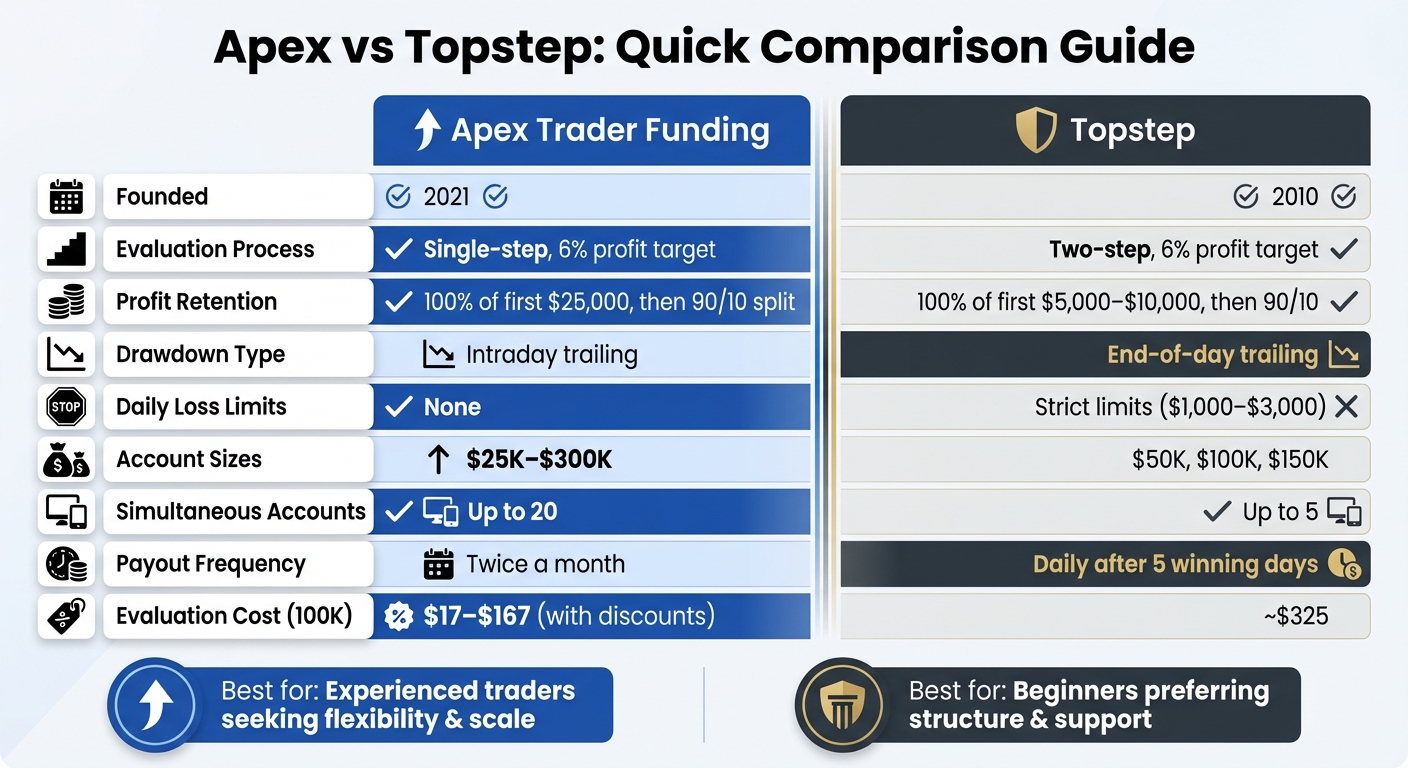
Apex vs Topstep Trading Platforms Comparison Chart
Evaluation Process and Account Funding
Evaluation Structure and Requirements
Apex keeps things straightforward with its single-step evaluation process. Traders need at least 7 trading days (or just 1 day during special promotions) to hit a 6% profit target. For example, that’s $3,000 on a $50,000 account. The process is free from daily loss limits and consistency rules, but traders must avoid breaching the trailing drawdown by using a futures risk management planner[6].
Topstep, on the other hand, uses a one-step evaluation system called the Trading Combine. This takes a minimum of 2 days and also requires a 6% profit target. However, it comes with stricter rules, including a now optional daily loss limit ranging from $1,000 to $3,000 based on account size. Additionally, a consistency rule caps any single day’s profits at 50% of the total[6]. One notable feature is Topstep’s end-of-day drawdown policy, which updates only after the market closes. This allows traders more breathing room during volatile periods. As Team Topstep puts it:
“Topstep’s end-of-day drawdown allows trades to play out without constant pressure”[5].
Account Sizes and Scaling Options
Apex provides a broader selection of initial account sizes, starting at $25,000 and going up to $150,000, giving traders access to larger capital from the outset[4]. In comparison, Topstep offers three account size options: $50,000, $100,000, and $150,000[4]. Apex also stands out by granting immediate access to full contract sizes once the account is funded. Meanwhile, Topstep uses a gradual scaling approach through its “Dynamic Live Risk Expansion” system, which increases contract limits over time. Typically, traders are limited to managing up to 5 accounts at once with Topstep[6][7].
Apex takes scaling a step further, allowing traders to stack up to 20 funded accounts simultaneously, which can amount to $3.0 million in total funding[8][6]. As Sarah Edwards from Benzinga highlights:
“Apex gives traders a variety of scaling plans that reward consistency in profits. As long as traders stick to Apex evaluation rules, there’s no maximum to what they can earn”[7].
These differences in evaluation methods and funding opportunities significantly impact payout structures and trading expenses for participants.
sbb-itb-46ae61d
Apex vs Topstep: Account Sizes & Scaling Plans Compared
Both firms limit how many contracts you can trade based on your account balance — but the mechanics are completely different, and Apex rebuilt its entire scaling system with the “All New Apex” launch on March 1, 2026. Here’s exactly how account sizes and scaling plans stack up, verified directly from apextraderfunding.com and topstep.com in July 2026.
Account Sizes at a Glance
| Apex Trader Funding | Topstep | |
|---|---|---|
| Account sizes | $25K, $50K, $100K, $150K | $50K, $100K, $150K |
| Drawdown type | Your choice: Intraday Trailing or End-of-Day Trailing | End-of-day trailing Maximum Loss Limit on every account |
| Max active accounts | Up to 20 accounts | Up to 5 Express Funded Accounts |
| When scaling applies | Performance Account (funded stage) — built-in Tier Levels | Express Funded Account only — the Combine uses fixed contract caps |
| Micro contract ratio | 10 micros = 1 mini | 10 micros = 1 mini (TopstepX) |
The headline difference: Apex gives you a smaller $25K entry point and four times the account stacking room, while Topstep keeps its lineup tighter at three sizes and five funded accounts.
Trade Alongside 4,000+ Funded Traders
Live deal alerts, payout proof, and real answers on Apex, Topstep, and every firm we test — free in the Damn Good Trading Discord.
The Apex Scaling Plan: Tier Levels Explained
On the new Apex products, every Performance Account (PA) runs on built-in scaling called Tier Levels. Your tier is set once per day from your closing balance at 4:59:59 PM ET, and it controls two things for the next session: your maximum position size and your Daily Loss Limit. Grow the balance and you tier up — more contracts, bigger DLL. Give profits back and you tier down. There’s a floor at Level 1 (your limits never shrink below it) and a ceiling at each account’s max tier (limits stop growing no matter how much more you make). Tiers never change mid-session, and orders that would exceed your max size are simply rejected — no violation, no penalty.
| Apex PA Size | Starting Limits (Level 1) | Max Limits (Top Tier) | Balance Needed for Max Tier |
|---|---|---|---|
| $25K | 1 contract · $500 DLL | 2 contracts · $1,250 DLL | $2,000+ in profit |
| $50K | 2 contracts · $1,000 DLL | 4 contracts · $3,000 DLL | $6,000+ in profit |
| $100K | 3 contracts · $1,750 DLL | 6 contracts · $3,500 DLL | $10,000+ in profit |
| $150K | 4 contracts · $2,500 DLL | 10 contracts · $4,000 DLL | $10,000+ in profit |
Between the start and the top tier there are intermediate levels at set profit thresholds — the $100K and $150K accounts run five tiers each. The tier-down mechanic is the part traders miss: unlike the old Apex half-contracts rule, your buying power now moves in both directions with your balance.
The Topstep Scaling Plan: How the XFA Works
Topstep splits things by stage. In the Trading Combine, contract caps are fixed for the whole evaluation — 5 minis (50 micros) on the $50K, 10 minis (100 micros) on the $100K, and 15 minis (150 micros) on the $150K. No scaling, full size from day one.
The Scaling Plan kicks in once you pass and activate an Express Funded Account. Every XFA starts at a $0 balance, and your maximum position size is tied to that balance: you begin at the lowest level of the plan and unlock more contracts as profits stack up. Like Apex, limits refresh for the next session — hitting a threshold mid-session doesn’t release buying power until the following day. Micros count at a 10:1 ratio on TopstepX, and Topstep notes it may temporarily tighten limits on specific products during extreme volatility.
One more wrinkle: the Scaling Plan disappears entirely at the Live Funded Account stage, where Topstep replaces it with Dynamic Live Risk Expansion — a profit-tiered system for real-money accounts.
Which Scaling Model Fits Your Trading?
If you want maximum flexibility on size and stacking, Apex wins this category: a cheaper $25K entry, a choice between intraday and EOD trailing drawdown, and up to 20 accounts running the same strategy. If you’d rather trade full size during the evaluation and only deal with scaling after you’re funded, Topstep’s fixed Combine caps are the cleaner experience — you just accept the 5-account ceiling and the $0-start XFA grind.
For the full rule-by-rule breakdown of each firm, check our Apex Trader Funding review and Topstep review, or grab the current best pricing on the Apex discount page.
Payout Policies and Profit Splits
Profit Retention and Split Percentages
Apex allows traders to keep 100% of all payouts, while Topstep offers full retention on the first $10,000 [8]. Once traders surpass these thresholds, only Topstep shifts to a 90/10 profit split, where traders retain 90% of their earnings moving forward.
Apex adds an extra layer to its policy with a 50% Consistency Rule for funded accounts. This means no single day’s profit can exceed 50% of the total profits when requesting a payout . This rule reflects Apex’s focus on managing risk effectively. On the other hand, Topstep does not enforce such a cap after traders meet the initial requirement of achieving a winning day with a different type of consistency rule only after the 1st payout. These differences highlight the contrasting approaches each firm takes toward profit retention and risk management.
Payout Frequency and Requirements
The two firms also differ in how and when traders can access their earnings. Topstep offers daily payouts once traders achieve 30 winning days with at least $150 each. Apex, however, processes payouts every 5 winning days and has stricter requirements: traders need 5 winning days, a Safety Net buffer equal to the account’s max drawdown plus $100 for the first 6 payouts.
As Team Topstep puts it:
“Topstep rewards progress, not perfection… You only need 5 winning days of $150 or more to request your first payout.” [5]
Topstep’s Express Funded Accounts bypass the Safety Net buffer entirely. Since its launch in 2022, Apex has paid out over $753.89 million to traders, while Topstep processed more than 81,177 payouts in 2024 alone [4].
Trading Rules and Risk Management
Drawdown Limits and Consistency Requirements
Both Apex Trader Funding and Topstep use specific risk management rules to safeguard capital and influence trading behavior. The biggest difference lies in how they handle drawdowns. Apex employs an intraday trailing drawdown that adjusts in real time if you choose that account type. As soon as a trade becomes profitable, the drawdown level locks at its peak. This approach can lead to account liquidation during normal market pullbacks, even if the trader is still within their overall risk limits.
Topstep, on the other hand, calculates drawdown only after the market closes. This method allows traders to ride out intraday fluctuations without the drawdown tightening prematurely. Additionally, Topstep offers an option for a strict daily loss limit, helping to prevent significant losses in a single trading session. Apex does not impose a daily loss limit, giving traders more flexibility but also potentially exposing them to higher risk.
As Team Topstep puts it:
“At Apex, the intraday trailing drawdown means every uptick permanently tightens the space between your position and your liquidation point.” [5]
Apex applies a 50% Consistency Rule on accounts purchased after March 2026. This means no single trading day can account for more than 50% of your total accumulated profit at the time of a payout request. For example, if a trader has a $1,000 winning day, they need at least $2,000 in total accumulated profit before they can request a payout. Legacy accounts (purchased before March 2026) still operate under the original 30% rule, where a $1,000 winning day would require $3,333 in total profit. In contrast, Topstep does not impose payout consistency requirements on its funded accounts, offering more straightforward access to profits.
Trading Restrictions and Limitations
The two firms also differ in their trading restrictions. Topstep requires traders to stick to day trading, enforce a 50% consistency rule in the Topstep Combine, and gradually increases contract size in funded accounts (XFAs) as traders demonstrate consistent performance. Apex takes a very similar approach with their new tier based scaling in the funded accounts.
Apex also stands out by allowing trading during holidays without requiring traders to close positions daily. It supports algorithmic trading and enables traders to manage up to 20 accounts simultaneously using trade copying platforms. Topstep, on the other hand only allows for a maximum of 5 funded accounts. When it comes to available markets, Apex offers a wider selection, including cryptocurrency and additional futures instruments. Topstep focuses on standard indices, metals, and energy markets.
Costs and Fee Structures
Evaluation Fees and Available Discounts
Apex Trader Funding offers a 100K evaluation for $399 one time fee, but with promotional codes like code DGT, this can drop as low as $39.90 – up to 90% off. On the other hand, Topstep’s 100K evaluation costs around $159 per month. For a 50K evaluation, Apex’s price can go down to $24.90 during sales, while Topstep’s ranges between $49 and $109. Additionally, Apex includes Level 1 CME data in their pricing, whereas Topstep charges an extra $39 per month for advanced data access [9][8]. As Fred Harrington, Founder of Vetted Prop Firms, puts it:
“Apex is significantly cheaper for most traders” [2].
Long-Term Costs and Total Expenses
The differences between the two firms become even more apparent when looking at long-term costs. All Topstep evaluations are on a monthly subscription. After passing the evaluation, Topstep imposes a flat $149 activation fee. In contrast, Apex offers more flexibility, with one-time lifetime fee between $79 and $109, which eliminates recurring charges altogether.
Topstep’s ongoing fees include monthly Trading Combine costs plus $39 for market data [8][2]. Over six months, maintaining a 50K account with Topstep can cost between $677 and $1,241, while Apex’s lifetime option keeps the total between $98.9 and $160 [7][11].
Reset fees also differ: Apex moved away from reset fees and just recommends to buy a new account for as little as $19.90 while Topstep’s reset fee varies per account size to an average of $99. Apex further allows traders to manage up to 20 funded accounts simultaneously, whereas Topstep limits users to 5 accounts.
Which Firm Fits Different Trading Styles
Best for Active and Flexible Traders
Apex is a solid choice for experienced traders who value independence and have a proven track record. Its one-step evaluation can be completed in as little as a single day, a stark contrast to Topstep’s minimum 2 trading days.
One of Apex’s standout features is its scaling potential. Traders can manage up to 20 active paid accounts simultaneously using futures copy trading tools. This setup allows for expanding earning opportunities horizontally, rather than waiting to unlock additional contracts. As Ngan Pham from H2T Funding explains:
“Apex Trader Funding operates as a robust funding partner for confident, experienced traders… stripping away the hand‐holding to offer raw leverage and flexibility” [10].
Other perks include no daily loss limits, the ability to trade during news events, and support for VPN usage [10]. However, the live trailing drawdown, which updates in real time, can lead to liquidations during typical market pullbacks [10]. This system rewards traders who are disciplined but can penalize those who hesitate.
For traders who prefer more structured guidance, Topstep might be a better fit.
Best for Beginners and Structured Traders
If you’re new to live trading or prefer a structured environment, Topstep provides a well-rounded approach to development [13]. The firm uses an End-of-Day drawdown, which only updates based on your closed balance at the end of the day. This gives traders more room to manage positions during intraday fluctuations [5].
Topstep emphasizes building strong risk management habits by giving you the option to set daily loss limits and enforcing specific position sizes. These rules align with its broader focus on disciplined trading, as covered in earlier sections [9]. Additionally, traders benefit from coaching, webinars, TopstepTV, and a supportive community – hallmarks of the Topstep experience [13].
“Topstep positions itself as a genuine talent incubator, prioritizing long-term trader development” [10].
Payouts are accessible even for newer traders. After just 5 winning days with a net profit of $150 or more, you can request a withdrawal, with no restrictions on daily consistency [5]. Topstep’s reputation for fairness is underscored by its recognition as “Best Rules” among futures firms in the 2025 Prop Firm Match Awards [5]. However, the firm does have limitations: traders are capped at 5 active accounts, overnight holding is prohibited, and limits on certain numbers of blown accounts in a month.
 💎 Topstep vs Apex Trader Funding 2026: ⚠️ The BRUTAL FACE-OFF Traders Must See!
Conclusion
Select the firm that aligns with your trading style and objectives. As Select Prop Firms explains:
“The firm that remains is the correct choice for your trading psychology, not for marketing reasons” [1].
Apex caters to seasoned traders with its one-step evaluation process, absence of daily loss limits, and the option to manage up to 20 accounts simultaneously for faster profit opportunities. Traders benefit from keeping 100% of their initial profits and can take advantage of frequent discounts to reduce entry costs [3][1]. That said, its live trailing drawdown system requires careful risk management – it adjusts based on unrealized equity highs and can lead to account liquidation during routine pullbacks [1].
On the other hand, Topstep focuses on fostering long-term trader development. Its structured environment, including an end-of-day drawdown and daily loss limits, is ideal for beginners or those who prefer a more disciplined approach [1]. Resources like TopstepTV and performance analytics provide continuous learning support [4]. Payouts are accessible after just five winning days with $150 in profit [5]. However, traders are limited to managing five active accounts and cannot hold positions overnight [10].
Both firms are highly rated [3], but their philosophies differ significantly. As Select Prop Firms puts it:
“Apex exposes weaknesses quickly and rewards discipline with speed and scale. Topstep suppresses weaknesses gradually and rewards consistency with longevity” [1].
This comparison underscores that each firm’s policies and strategies are designed to suit distinct trading preferences. Your decision ultimately depends on whether you value flexibility and speed or structure and consistency.
Apex vs Topstep FAQs
What is the Apex scaling plan?
On the new Apex products (post-March 1, 2026), every Performance Account uses built-in scaling called Tier Levels. Your closing balance at 4:59:59 PM ET sets your tier for the next session, and that tier controls your maximum position size and Daily Loss Limit. Profits tier you up, losses tier you down, and each account size has a Level 1 floor and a fixed max tier — the $150K account, for example, starts at 4 contracts and scales to 10.
Does Topstep have a scaling plan?
Yes, but only in the Express Funded Account. The Trading Combine gives you fixed contract caps for the entire evaluation — 5 minis on the $50K, 10 on the $100K, 15 on the $150K. Once funded, your XFA starts at a $0 balance and the Scaling Plan ties your maximum position size to that balance, unlocking more contracts as profits grow. At the Live Funded stage, the Scaling Plan is replaced by Dynamic Live Risk Expansion.
What account sizes do Apex and Topstep offer?
Apex offers four sizes — $25K, $50K, $100K, and $150K — with your choice of intraday or end-of-day trailing drawdown. Topstep offers three — $50K, $100K, and $150K — all using an end-of-day trailing Maximum Loss Limit. Apex’s $25K account is the cheapest entry point between the two firms.
How many funded accounts can I run at once?
Apex allows up to 20 accounts, making it the go-to for traders who stack copies of the same strategy. Topstep caps you at 5 active Express Funded Accounts, and that number can shrink further if you’re placed in the Focused Trader Program. If account stacking is core to your approach, that’s a 4x difference.
Which drawdown type is easier to manage: intraday or end-of-day?
End-of-day, for most traders. An intraday trailing drawdown follows your open equity in real time — including unrealized profit — so one spike against you mid-trade can breach the account even if you’d have closed green. An EOD drawdown only recalculates at market close, letting you ride intraday swings without instant consequences. Apex lets you pick either type at checkout; every Topstep account is EOD.
How do payout rules affect when I can withdraw profits?
Payout rules decide how fast earned profit becomes withdrawable cash. Apex requires 5 trading days between payout requests and applies a 50% consistency rule, but pays 100% of requested rewards in the funded sim stage with no payout denials. Topstep pays from the Express Funded Account once you log 5 winning days of $150+ (Standard) or 3 trading days under the 40% Consistency path, with a 90/10 split and per-request caps by account size. Neither firm lets you withdraw during the evaluation itself.
What should I consider before running multiple accounts?
Time, rule overlap, and emotional load. Every account tracks its own drawdown, scaling tier, and consistency math, so a strategy that’s clean on one account can quietly violate rules on another. Stacking also multiplies stress and mistake risk — the traders who succeed with it run strict routines and tooling rather than winging it. Start with one or two accounts, prove the process, then scale the account count the same way you’d scale position size.