The Micro E-mini Nasdaq-100 (MNQ) futures contract offers a smaller, more accessible way to trade the Nasdaq-100 Index. With a $2 multiplier, each tick (0.25 index points) equals $0.50, making it 1/10th the size of the standard E-mini Nasdaq-100 (NQ). This smaller size allows traders to manage risk more precisely and requires less capital, with margins as low as $50 intraday depending on the broker.
Key details:
- Tick Size: 0.25 index points
- Tick Value: $0.50 per tick
- Notional Value: Index level × $2
- Trading Hours: Sunday 5:00 p.m. to Friday 4:00 p.m. CT
- Expiration: Quarterly, on the third Friday of March, June, September, and December
This contract is especially suited for traders with smaller accounts or those participating in futures prop firm evaluations, offering flexibility in position sizing and risk management. MNQ’s smaller tick value and lower margin requirements make it an ideal choice to trade the tech-heavy Nasdaq-100 Index efficiently.
MNQ Tick Size and Tick Value Explained
MNQ Tick Size: 0.25 Index Points
The MNQ tick size is 0.25 index points, which represents the smallest price movement the contract can make. On your trading platform, you’ll notice prices shifting in increments of 0.25 – for example, from 16,500.00 to 16,500.25, then to 16,500.50, and so on.
The CME Group determines these tick sizes based on factors such as liquidity and volatility. Since one full index point equals four ticks (0.25 x 4 = 1), price changes occur in these quarter-point steps throughout the trading session. Now, let’s dive into how this tick size works with the multiplier to determine the tick value.
How to Calculate MNQ Tick Value
The MNQ contract has a $2 multiplier, meaning that each full index point equates to $2. To calculate the tick value, you multiply the tick size by the multiplier: 0.25 x $2 = $0.50 per tick.
"You can find out how much an instrument’s price per movement would be by multiplying the tick size by the point size. For MNQ that would be 0.25 * 2 which is 0.5$ per tick." – NinjaTrader_Jesse, NinjaTrader Customer Service
Each tick movement impacts your profit or loss (P&L) by $0.50 per contract. For instance, a 10-point move would result in a $20 change per contract, while a 50-point move would translate to $100. Knowing how to calculate this is essential for managing your trade risk, as we’ll discuss next.
How Tick Value Affects Your Trading
The $0.50 tick value plays a critical role in risk management. For example, if you’re risking $50 per trade, you can absorb a 25-point move per contract (25 points x $2 = $50). Compared to NQ contracts, which have a $5 tick value, MNQ’s smaller tick value offers more flexibility. This allows traders to scale into positions with multiple MNQ contracts rather than committing to a single NQ contract.
For those trading with firms like Apex Trader Funding or Take Profit Trader, understanding the tick value helps you stay within daily loss limits while maintaining exposure to the Nasdaq-100. This precision is invaluable for setting realistic profit targets, placing effective stop-losses, and calculating exactly how much capital is at risk on each trade. Risk management is the cornerstone of successful trading, and mastering these calculations is a key step toward achieving consistency.
How to Trade Micro E Mini Nasqad 100 Futures – MNQ
MNQ Contract Specifications

MNQ vs NQ Futures Contract Specifications Comparison
Basic Contract Details
The MNQ, listed on the CME with the symbol MNQ, represents $2 × the Nasdaq-100 Index. It has a tick size of 0.25 index points, which translates to a tick value of $0.50. Trading hours run from Sunday at 5:00 p.m. to Friday at 4:00 p.m. CT, with a daily maintenance break between 4:00 and 5:00 p.m. CT.
This cash-settled contract is based on the Nasdaq-100 Index value at expiration. Contracts are available quarterly (March, June, September, December) and extend out to five consecutive quarters. Expiration occurs at 9:30 a.m. ET on the third Friday of the contract month. These details are essential for understanding how MNQ operates and how it fits into broader trading strategies.
Margin Requirements and Notional Value
The notional value of an MNQ contract reflects the total dollar exposure it represents. It’s calculated by multiplying the index level by the $2 multiplier. For instance, if the Nasdaq-100 Index is at 25,624.25, the notional value equals 25,624.25 × $2 = $51,248.50 per contract. This figure helps traders gauge the size of their exposure, particularly when operating under proprietary trading firm rules.
Margin requirements vary depending on the broker and trading style. As of December 2025, a typical overnight margin is approximately $3,680, with a maintenance margin of $3,346. Some brokers offer intraday margins as low as $50, allowing traders to leverage their capital more effectively during the trading day. While lower margins can help traders control larger positions with less upfront capital, they also amplify both potential profits and losses.
MNQ vs. NQ: Contract Comparison
When comparing MNQ to the standard E-mini Nasdaq-100 (NQ) contract, the key difference lies in their size. The NQ contract is ten times larger than the MNQ. Both contracts track the same Nasdaq-100 Index and share the same 0.25 tick size, but their multipliers differ – $20 for NQ versus $2 for MNQ. This results in a tick value of $5.00 for NQ compared to $0.50 for MNQ.
Here’s a quick breakdown of the differences:
| Feature | MNQ | NQ |
|---|---|---|
| Contract Size | $2 × Nasdaq-100 Index | $20 × Nasdaq-100 Index |
| Tick Value | $0.50 | $5.00 |
| Notional Value (at 25,500 Index Points) | $51,000 | $510,000 |
| Typical Overnight Margin | $3,680 | Higher (varies by broker) |
| Best For | Smaller accounts, precise position sizing | Larger accounts, full-size exposure |
For traders with smaller accounts, the MNQ contract offers more flexibility in terms of position sizing and risk management. On the other hand, the NQ contract is better suited for traders seeking larger, full-sized market exposure. Both contracts serve different needs, making it easier for traders to align their strategies with their account size and risk tolerance.
sbb-itb-46ae61d
Trading MNQ with Futures Prop Firms
Why Traders Choose MNQ for Prop Firm Evaluations
The MNQ contract has become a favorite for traders participating in prop firm evaluation programs. Its $0.50 tick value and smaller contract size allow for precise risk management, making it an attractive option. When Micro E-mini futures were introduced in May 2019, they quickly gained traction, with over 11.25 million contracts traded in the first month alone. This surge in popularity highlighted the demand for instruments that offer more manageable position sizing.
"Micro E-mini Nasdaq 100 Futures (MNQ) are a smaller-sized version of the popular E-mini Nasdaq 100 Futures contract… MNQ contracts are ideal for traders who want to trade tech-heavy indices with lower margin requirements and reduced financial exposure." – Ironbeam
The contract’s features align well with the needs of prop firms. High liquidity ensures smooth trade execution with minimal slippage, while the Nasdaq-100’s volatility creates opportunities for trend-based strategies and profit potential. These attributes encourage disciplined trading and effective risk management – key traits for traders aiming to secure funding. Together, these advantages make MNQ a strategic choice for traders, especially when precise position sizing comes into play.
Calculating Position Size and Managing Risk
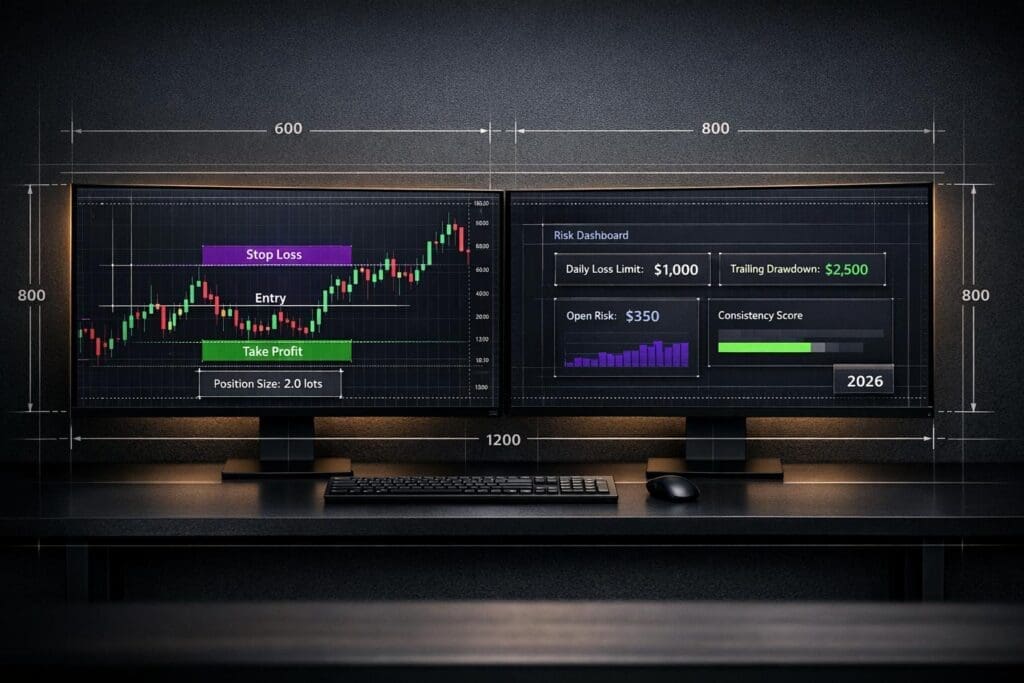
To trade MNQ effectively, start by determining the maximum risk per trade allowed by your prop firm’s guidelines. Then, calculate your stop loss distance in index points from the entry price.
Multiply the stop loss distance by the $2 contract multiplier to find the dollar risk per contract. For example, if your stop loss is 10 index points away, the risk per contract would be 10 × $2 = $20. If your prop firm allows a maximum risk of $100 per trade, you would divide $100 by $20, resulting in 5 contracts (rounding down to the nearest whole number).
"At 1/10th the size of the standard E-mini contract, Micro E-mini futures allow traders to access the highly liquid equity index futures markets with reduced costs and margins as low as $50." – NinjaTrader
Starting with fewer contracts and gradually increasing as you gain confidence and consistency can help meet the expectations of prop firms. By calculating risk clearly, traders can take full advantage of MNQ’s flexibility while adhering to prop firm requirements.
MNQ at Top Futures Prop Firms
Many top futures prop firms, such as Apex Trader Funding, TickTickTrader, Take Profit Trader, and Tradeify, support MNQ in their evaluation programs.
The smaller contract size of MNQ offers funded traders the ability to manage risk precisely and adjust position sizing with ease. This makes it an excellent tool for testing and refining trading strategies in real market conditions while keeping potential losses relatively controlled.
Summary: MNQ Tick Value and Contract Specs
The Micro E-mini Nasdaq-100 (MNQ) futures contract is designed with a 0.25 index point tick size, where each tick is worth $0.50. This is calculated using its $2 multiplier, making it 1/10th the size of the standard E-mini Nasdaq-100 (NQ), which has a $20 multiplier and a $5.00 tick value.
This smaller contract size comes with lower margin requirements and reduced financial exposure, making it more accessible for traders with smaller accounts. It also enables more precise position sizing, as traders can use multiple contracts to scale in or out of positions.
"Since their introduction a year ago, Micro E-mini Equity futures have benefited market participants of all types, who have used them to scale their equity index exposure up or down or more precisely hedge existing equity portfolio positions", – Tim McCourt, CME Group Global Head of Equity Index and Alternative Investment Products
For traders, understanding these specifications is crucial for accurate profit and loss calculations and managing risk. Each 0.25 index point move translates to $0.50 per contract. While the initial investment is lower, it’s important to remember that futures trading involves leverage, meaning even small market moves can result in significant losses.
With deep liquidity, reduced capital requirements, and the ability to fine-tune position sizes, MNQ is an excellent tool for gaining trading experience, testing strategies, and meeting prop firm evaluation criteria. These features highlight MNQ’s role in helping traders manage risk effectively and refine their strategies for success.
FAQs
What makes trading MNQ futures more appealing than standard NQ futures?
Trading MNQ futures offers traders a way to engage with the Nasdaq-100 market while keeping financial exposure and risk at a more manageable level. Thanks to its smaller tick sizes and lower point values, MNQ gives you the ability to fine-tune your risk management without needing the larger capital outlay required for standard NQ futures.
This makes MNQ particularly appealing for beginners or anyone experimenting with new strategies. It provides a cost-effective way to participate in the Nasdaq-100 market while minimizing potential losses.
How do MNQ margin requirements impact trading strategies?
The lower margin requirements for Micro E-mini Nasdaq-100 (MNQ) futures open the door for traders to participate with less capital. This makes it easier to explore various trading strategies while keeping risk management in check.
With reduced upfront costs, traders can experiment with strategies, tweak their positions, or spread out their trades without needing to invest large amounts. This setup also allows traders to leverage positions while keeping tighter control over potential losses. For those working with smaller accounts or fine-tuning their trading methods, MNQ’s cost structure is a practical solution.
Why is the MNQ contract a popular choice for traders during prop firm evaluations?
The MNQ, short for Micro E-mini Nasdaq-100 futures contract, has become a go-to option for traders navigating prop firm evaluations. Why? It’s all about its low cost and adaptability. With a tick value of just $0.50 and a smaller contract size, the MNQ lets traders keep risk in check while needing less capital to get started.
Its lower margin requirements are a big plus, especially for those with smaller accounts. This makes it easier for traders to experiment with and fine-tune their strategies without putting too much on the line financially. Thanks to this balance of affordability and practicality, the MNQ appeals to both beginners testing the waters and seasoned traders looking for efficient tools.