Phidias Futures Trading Prop Firm Review
Updated: April 2026
Phidias Prop Firm is a futures‑only prop firm offering live funded futures accounts with static drawdown, end‑of‑day (EOD) drawdown, and true swing‑trading accounts for traders who want to hold overnight. In this Phidias Prop Firm review, I’ll walk you through the exact Phidias evaluation rules, payout rules, drawdown rules, withdrawal process, trading platforms, discount code, and account limits so you know exactly what you’re signing up for. If you’re searching “Phidias prop firm,” “Phidias prop firm review,” “is Phidias prop firm legit,” or “Phidias discount code,” this guide is built to answer every question in one place.
Phidias Prop Firm at a Glance
- Founded: 2023 futures prop firm focused on live funded futures accounts.
- Instruments: Exchange‑traded futures only (CME and others) via Rithmic and dxFeed.
- Platforms: NinjaTrader, Quantower, Sierra Chart, MotiveWave, ATAS, Bookmap and other platforms that connect through Rithmic/dxFeed (check their current “authorised products” list).
- Main programs:
- 25K Static account (static drawdown).
- Fundamental accounts (50K–150K, EOD drawdown).
- Swing accounts (50K–150K, EOD drawdown + overnight).
- 10K Drawdown account (trailing EOD drawdown).
- Profit split: Starts at 80/20 and can scale up to 90% to the trader on some programs after successful payout cycles.
- Max accounts: Roughly 15–16 accounts across Static, Fundamental, Swing and 10K per trader, with updated docs and community guides pointing to up to 20 funded accounts plus a Master and 10K account per tax household / internet connection.
- Key features: Static drawdown on 25K, EOD drawdown on larger accounts, swing accounts, news trading allowed, on‑demand payouts via Phidias Wallet, flexible payout rules, and no hard mechanical consistency rule.


Phidias Prop Firm Pros and Cons
Phidias Pros
- Static drawdown on the 25K Static account: $500 maximum loss and a $1,500 profit target is a clean, transparent way to pass your first Phidias evaluation quickly.
- End‑of‑day drawdown on Fundamental and Swing accounts instead of aggressive intraday trailing drawdown.
- Dedicated Swing accounts that let you hold trades overnight and over the weekend, which is rare in the futures prop firm space.
- News trading allowed, so you’re not handcuffed around major economic events.
- Fast, on‑demand payouts through Phidias Wallet with buffer withdrawal logic instead of rigid payout windows.
- Multiple activation fee structures (monthly vs lifetime “CASH” style) for traders who prefer subscriptions or one‑time activation.
- No strict “Phidias consistency rule” that forces you to spread profits evenly across days, as long as you respect max loss and drawdown rules.
Phidias Cons
- Futures only: Phidias does not offer forex, CFDs, or crypto for traders who want multi‑asset prop firm exposure.
- Activation fees and monthly fees on Fundamental and Swing accounts can add up if you hold many accounts or upgrade to lifetime CASH activation.
- The rulebook is long: EOD drawdown, buffer thresholds, payout caps in early months, and account minimum thresholds can be confusing the first time you read it.
- Maximum accounts and allocation are still capped, and some limits apply per household or IP address, which matters if you run large copy‑trading setups.
- Brand recognition still trails bigger names like Apex Trader Funding and Take Profit Trader, even though the rules and payout structure are competitive.
What Is Phidias Prop Firm?
Phidias Prop Firm is a Gibraltar‑based futures prop firm that funds traders on live futures accounts once they pass a Phidias evaluation or pay an activation fee on specific live programs. Instead of risking your own entire futures account, you trade a Phidias evaluation account, respect their risk and drawdown rules, hit the profit target, and then convert into a funded futures account with an 80/20 profit split that can climb to 90%.
Phidias stands apart from typical forex “prop” shops by focusing purely on real futures contracts on exchanges like CME, via data feeds such as Rithmic and dxFeed. You can connect through supported futures platforms like NinjaTrader, Quantower, Sierra Chart, MotiveWave, ATAS and other Rithmic/dxFeed‑compatible platforms listed in their “authorised products” section. If you’re specifically looking for a futures prop firm challenge with static drawdown, EOD drawdown, swing trading, and clear payout rules, Phidias is a serious contender.
Is Phidias Prop Firm Legit or a Scam?
Let’s address the big one: is Phidias Prop Firm legit or a scam? Phidias launched in 2023 and has quickly racked up hundreds of verified trader reviews on sites like Trustpilot and other review portals. Their contracts, rule pages, and help center documents are publicly available and spell out exactly how drawdown, payouts, activation fees, and account limits work.
Community reviews, YouTube breakdowns, and independent written reviews all show real traders receiving payouts under the Phidias payout rules, including early payout caps and newer on‑demand payouts via Phidias Wallet. Like any prop firm, there is still business‑model and counterparty risk, and you should never treat a prop firm as a regulated broker or bank. But based on the evidence—public contracts, transparent rules, and payout proof—Phidias Prop Firm is operating as a legitimate futures prop firm rather than a classic prop firm scam.
Phidias Account Sizes, Types, and Maximum Allocation
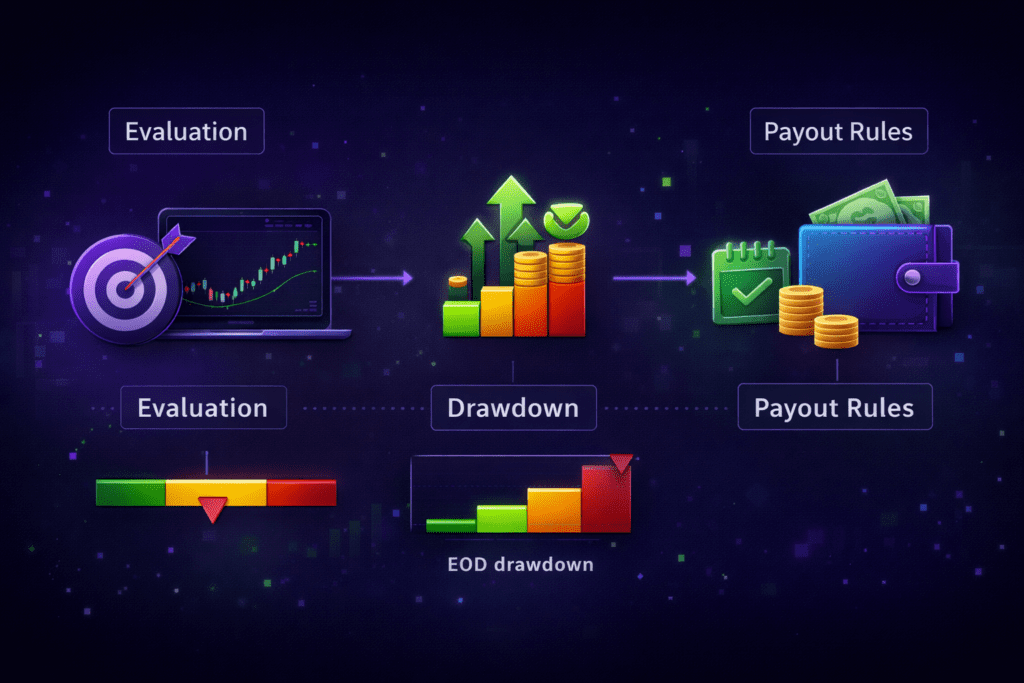
Phidias structures its futures prop firm accounts into four main buckets: 25K Static, Fundamental accounts, Swing accounts, and a 10K Drawdown program.
Phidias 25K Static Account (Static Drawdown)
The 25K Static is the most popular starter program and one of the cleanest evaluation structures in the futures prop firm space.
- Account size: $25,000 evaluation
- Profit target: $1,500
- Maximum loss: $500 static drawdown (never moves from the starting balance)
- Drawdown type: Static drawdown (no EOD or intraday trailing)
- Max position: 2 minis or 20 micros (typical contract limit for this program)
- Minimum trading days: Can be passed in as little as 1 trading day, although trading more days is safer.
- News trading: Allowed
- Best for: Traders who want a simple, static drawdown challenge with clear maximum loss rules.
Phidias Fundamental Accounts (50K–150K, EOD Drawdown)
Fundamental accounts are classic day‑trading futures prop firm accounts using end‑of‑day drawdown.
Typical structure (numbers scale with size; always check the current accounts page for precise values):
- Account sizes: 50K, 100K, 150K Fundamental accounts.
- Drawdown: EOD drawdown—updates once per day based on highest end‑of‑day equity, not intraday peaks.
- Daily loss: No hard daily loss limit on most Fundamental programs (you just cannot breach overall EOD drawdown / maximum loss).
- Holding: Intraday only; positions must be flat by the end of the trading session.
- News trading: Allowed.
- Minimum trading days: Usually 3 trading days.
- Best for: Futures day traders and scalpers who want EOD drawdown and no daily loss limit.
Phidias Swing Accounts (50K–150K, EOD Drawdown + Overnight)
Swing accounts are designed for futures traders who want to hold overnight and over the weekend while still benefitting from EOD drawdown instead of trailing drawdown.
- Account sizes: 50K and 100K Swing (and in some setups, 150K Swing).
- Drawdown: EOD drawdown identical to Fundamental logic.
- Holding: Overnight and weekend holding is allowed up to specified contract limits.
- News trading: Allowed, subject to general rules.
- Minimum trading days: Typically 3 trading days.
- Best for: Futures swing traders and intraday traders who want maximum flexibility.
Phidias 10K Drawdown Program
The 10K Drawdown (often referred to as a full‑margin or aggressive account) uses a tighter trailing EOD drawdown model and is meant for advanced futures traders who know how to manage risk.
- Account size: 10K
- Drawdown: Trailing EOD drawdown that moves based on your end‑of‑day equity.
- Best for: Experienced traders who understand how trailing drawdown interacts with margin and open risk.
Phidias Max Accounts and Scaling Plan
Phidias allows traders to scale across multiple funded accounts, but there are hard caps you need to know.
- Official docs and third‑party reviews show typical limits of up to 5 accounts per program type (Static, Fundamental, Swing, 10K).
- Many traders reference a combined maximum of around 15–16 funded accounts across all programs, and updated rules mention up to 20 funded accounts plus a Master and a 10K account per tax household or internet connection.
- Phidias also supports copy trading across authorized accounts, but all accounts must remain within the official “number of authorized accounts and copy trading” limits in the rulebook.
Always cross‑check the current accounts page and the “number of authorized accounts” section in the Phidias rules before scaling aggressively or running large copy‑trading setups.
Phidias Account Types & Core Rules
| Account Type | Sizes | Drawdown | Hold Overnight/Weekend | Min Trading Days | Profit Target (typical) | Notes |
|---|---|---|---|---|---|---|
| Fundamental (Intraday) | $50K / $100K / $150K | EOD (trails daily) | No (must flatten by close) | 3+ | $4K–$9K | News trading allowed; funded EOD stops at start+100. |
| Swing (Overnight/Weekend) | $50K / $100K / $150K | EOD (trails daily) | Yes (position limits apply) | 3+ | $4K–$9K | Only firm with true swing accounts in the futures space. |
| Static 25K | $25K | Static $500 (no trailing) | No (intraday only unless specifically agreed) | No minimum | $1,500 | Direct upgrade path to Live after target; no consistency; payouts from D+1 on CASH. |
Phidias Pricing, Activation Fees, and Discount Code
Phidias pricing combines evaluation fees with activation fees and gives you the choice between monthly funding and lifetime “CASH” activation on many account types.
Evaluation Fees and Monthly Costs
Evaluation fees change frequently with promos, but the structure is consistent across programs:
- Each account size (25K Static, 50K Fundamental, 100K Fundamental, 50K Swing, 100K Swing, 10K Drawdown) has a base evaluation price.
- Fundamental and Swing accounts often use a monthly subscription model during the evaluation stage.
- The 25K Static is typically positioned as a simple, lower‑cost entry with a clear activation fee once you pass.
Because Phidias updates evaluation prices and promos, always refer to the Phidias accounts and rules pages for exact current pricing before you sign up.
Activation Fees and Lifetime “CASH” Options
After you pass the Phidias evaluation, you’ll pay an activation fee to turn your evaluation account into a funded live account. Phidias also offers lifetime “CASH” options where you pay a higher up‑front activation fee and avoid ongoing monthly live‑account fees.
Examples from independent breakdowns (these are approximate and change with promos, so treat them as ballpark, not fixed numbers):
- 25K Static: around $83 lifetime activation (CASH style, no monthly).
- 50K Fundamental: options around ~$86/month or ~$174 lifetime combined evaluation + activation.
- 100K Fundamental: around ~$107/month or ~$217 lifetime.
- 50K Swing: around ~$107/month or ~$217 lifetime.
- 100K Swing: around ~$107/month or ~$270 lifetime.
Before you join, check Phidias’ live activation fee table in the official rules or accounts page, because these numbers are marketing examples and can move with promotions, taxes, or fee changes.
Phidias Discount Code (Coupon / Promo Code)
Phidias runs regular promos through partners, so getting a Phidias discount code or Phidias coupon code is almost mandatory if you want the best pricing.
On DamnPropFirms, you can use our Phidias discount code DGT at checkout to save money on your evaluation or activation fees (we keep this Phidias promo code updated when deals change). When you search “Phidias discount code,” “Phidias promo code,” or “Phidias coupon code,” make sure you’re getting a current code tied to live promotions—not an expired ad.
| Account Type | Evaluation + Activation (Total Cost) | One-Time Payment (OTP) | OTP with Code DGT (Up to 80% OFF*) |
|---|---|---|---|
| 25K Static |
$83 Activation + $139 Evaluation = $222 Total ($88.80 with DGT 60% OFF) |
$277 (No Activation Fee) | $55.40* |
| 50K Fundamental |
$149 Activation + $299 Evaluation = $448 Total ($179.20 with DGT 60% OFF) |
$580 (No Activation Fee) | $116* |
| 100K Fundamental ⭐ Best Value |
$149 Activation + $399 Evaluation = $548 Total ($219.20 with DGT 60% OFF) |
$723 (No Activation Fee) | $144.60* |
| 150K Fundamental |
$169 Activation + $499 Evaluation = $668 Total ($267.20 with DGT 60% OFF) |
$863 (No Activation Fee) | $172.60* |
| 50K Swing |
$149 Activation + $399 Evaluation = $548 Total ($219.20 with DGT 60% OFF) |
$723 (No Activation Fee) | $144.60* |
| 100K Swing |
$149 Activation + $499 Evaluation = $648 Total ($259.20 with DGT 60% OFF) |
$900 (No Activation Fee) | $180* |
| 150K Swing |
$169 Activation + $599 Evaluation = $768 Total ($307.20 with DGT 60% OFF) |
$1,123 (No Activation Fee) | $224.60* |
*Discounted OTP pricing shown with Code DGT applied, based on typical Phidias promo campaigns of up to 80% OFF during major sales.
Evaluation discounts are smaller, averaging around 60% OFF with the same code.
Always confirm live Phidias pricing and taxes on the checkout page, as prop firm terms and promos can change without notice.
Phidias Evaluation Rules Explained
Phidias evaluation rules are built around a clear profit target, strict maximum loss, minimum trading days, and drawdown rules that differ by program.
Profit Target and Maximum Loss
- 25K Static evaluation rules:
- Profit target: $1,500.
- Maximum loss: $500 static drawdown.
- Fundamental and Swing evaluation rules (exact numbers scale by account size):
- Profit targets increase with account size (for example, 50K and 100K Fundamental / Swing accounts use higher dollar targets).
- Maximum loss is defined by EOD drawdown; you cannot breach the EOD drawdown or fall below the account minimum thresholds specified in the rules.
Minimum Trading Days and Time Limits
- 25K Static: Can be passed in as little as 1 day, but you’re better off spreading risk over several sessions.
- Fundamental & Swing: Usually require at least 3 separate trading days.
- Time limits: Many Fundamental and Swing evaluations operate on a monthly cycle; always confirm the exact challenge period on the account page before you start.
Phidias Consistency Rule (or Lack of One)
Phidias does not enforce a harsh mechanical “consistency rule” like some prop firms do (for example, limiting how much of your total profit can be made in one day). Instead, they maintain a “Regularity, Policy of Consistency” section that encourages responsible risk but does not stop you from passing a Phidias evaluation quickly if you hit your profit target in just a few strong trading sessions. If you’re searching “Phidias consistency rule,” the short version is: there is guidance, but no hard mathematical consistency restriction as long as you respect the maximum loss and drawdown rules.
Phidias Drawdown Rules and Risk Limits
Understanding the Phidias drawdown rules is critical so you don’t violate your account by accident. Phidias uses three main drawdown models: static drawdown, EOD drawdown, and trailing EOD drawdown.
Static Drawdown on the 25K Static
- The 25K Static account uses a $500 static drawdown that never moves from the starting balance.
- If your equity drops $500 below the initial $25,000 start, you breach the account—there is no trailing or EOD calculation to worry about.
EOD Drawdown on Fundamental and Swing
- Fundamental and Swing accounts use an end‑of‑day (EOD) drawdown model.
- The drawdown level updates once per day based on your highest end‑of‑day equity, not intraday peaks, which is more trader‑friendly than intraday trailing drawdown.
- Each account size has a minimum equity threshold you must stay above after payouts (for example, some guides reference thresholds like $52,600 for certain 50K accounts and $103,700 for 100K accounts, but always confirm the latest numbers in the Phidias rules).
Trailing EOD Drawdown on 10K Drawdown
- The 10K Drawdown program uses a trailing EOD drawdown, which moves up with your end‑of‑day equity over time.
- This is more aggressive and best suited for experienced traders who understand trailing risk and margin usage.
Before you start trading, read the “All Phidias Propfirm Rules” and the contract PDF so you fully understand how EOD drawdown and maximum loss are calculated for your specific account type.
Phidias Payout Rules, Schedule, and Withdrawal Times
Payout structure is where Phidias Prop Firm really stands out. If you’re searching “Phidias payout rules,” “Phidias withdrawal rules,” or “how long do Phidias payouts take,” here’s what matters.
Payout Rules and Schedule
- Historically, Phidias used fixed payout windows with early‑stage payout caps (for example, around $2,000 per period on 50K, $2,500 on 100K, $2,750 on 150K during the first three payout months).
- With the launch of Phidias Wallet, payouts became on‑demand: you can request payouts whenever you meet the account minimum threshold and buffer rules, instead of waiting for a specific date.
- Payout caps may still apply during the first few payout cycles for risk management, then relax as your account proves consistent profits.
Profit Split and Buffer
- Standard Phidias profit split is 80% to the trader / 20% to the firm, with potential progression to 90% after several successful payout months on some programs.
- Each payout must respect Phidias’ buffer rules: you must leave the account above the stated minimum equity threshold for your size after withdrawal, otherwise you cannot request the full amount you want.
Withdrawal Methods and Processing Times
- Payouts are processed through Phidias Wallet and providers such as Rise, with traders often reporting payouts in around 1–3 business days.
- Phidias continues to refine its payout rules, so always check the “Payout requests” and “Wallet” sections in the latest rules for up‑to‑date minimums, caps, and supported withdrawal methods before requesting a payout.
If you’re hunting “Phidias payout proof,” look for recent trader screenshots and reviews—there are plenty of documented payouts under the newer wallet system as of 2025–2026.
Payouts & Thresholds
| Stage | Min Tradinga Days | Min Withdrawal | Threshold to Request | Post-Withdrawal Floor | Payout Frequency | Max Payout |
|---|---|---|---|---|---|---|
| 50K CASH (Fund/Swing) | 10 days | $500 | $52,600 | $50,100 | Per period; daily when Live | $2,000 |
| 100K CASH (Fund/Swing) | 10 days | $500 | $103,700 | $100,100 | Per period; daily when Live | $2,500 |
| 150K CASH (Fund/Swing) | 10 days | $500 | $154,500 | $150,100 | Per period; daily when Live | $2,750 |
Phidias Trading Platforms and Supported Tools
Phidias is a futures prop firm built around professional futures platforms, not MT4/MT5.
Phidias Trading Platforms
Phidias connects to real futures markets through Rithmic and dxFeed, and supports a wide range of compatible platforms, including:
- NinjaTrader
- Quantower
- Sierra Chart
- MotiveWave
- ATAS
- Bookmap
- Other Rithmic/dxFeed‑compatible futures platforms listed in the official “authorised products” section
If you’re searching “Phidias trading platforms,” “Phidias Rithmic,” “Phidias NinjaTrader,” or “Phidias TradingView,” the short answer is that you trade real exchange futures via professional platforms supported by those data feeds—not retail CFD platforms.
Copy Trading and Trade Copiers
Phidias’ rules include a “number of authorised accounts and copy trading” section that explicitly allows copy trading and trade copiers as long as:
- You stay within the maximum authorised account limits for your household / internet connection.
- You understand that Phidias is not responsible for any issues or latency caused by third‑party trade copiers.
That means you can use cloud‑based trade copiers to mirror trades across multiple Phidias funded accounts—or even across Phidias and other futures prop firms—if you configure everything correctly and stay inside their rules.
Authorized Accounts & Copy Trading Limits
| Category | Max Allowed | Counts As | Copy Trading | Notes |
|---|---|---|---|---|
| Funded (CASH) Fundamental | Up to 5 | 1× each | Allowed (3rd-party at your risk) | Flatten by close; news OK. |
| Funded (CASH) Swing | Up to 5 | 1× each | Overnight + weekend allowed (Rithmic only for holding). | |
| Funded (CASH) Static 25K | Up to 5 | 1× each | Direct Live credit accrues per validated 25K. | |
| 10K Drawdown (Live) | 1 | 1× | — | Special challenge; static; unique rules. |
| 150K Tiers | Max 2 Fundamental + 2 Swing (within category caps) | 2× each | — | 150K accounts count as two toward the caps. |
Phidias Trading Rules: News, Overnight, and Consistency
Finally, let’s break down the Phidias trading rules that matter day to day: news, overnight, weekend holding, and consistency.
Phidias News Trading Rules
Phidias allows news trading on its main programs, which is a big plus if your futures trading strategy is built around economic releases and volatility spikes. You still need to respect max loss and drawdown rules, but there is no blanket “no trading during news” restriction like you see at some prop firms.
Overnight and Weekend Rules
- Fundamental accounts: Intraday only—positions must be closed by the end of the trading session; no overnight or weekend holding.
- Swing accounts: Designed specifically for overnight and weekend holding; trades can remain open beyond the session as long as you respect contract limits and EOD drawdown.
- 25K Static and 10K Drawdown: Follow the specific overnight/holding rules listed in the account details and rules; most traders use these accounts intraday.
If you’re a “Phidias swing trader,” the Swing programs are where you want to be.
Contract Limits and Authorised Instruments
Each Phidias account has contract limits that scale with size. For example:
- 25K Static: up to 2 minis or 20 micros.
- Larger accounts: higher mini/micro limits, with details spelled out per size in the accounts page and rules.
The rules also include a “list of authorized products” and commission table by instrument, so you can see exactly which futures markets you can trade and what each contract costs.
Phidias Consistency / Regularity Policy
As noted earlier, there is no strict Phidias consistency rule that mathematically caps how much profit you can make in a single day. Instead, their “Regularity, Policy of Consistency” section is mostly about maintaining realistic risk and avoiding one‑trade gambling that could put the firm at risk. For you as a futures trader, that means you can pass a Phidias evaluation quickly if you hit your profit target and respect maximum loss, without worrying about failing due to a hidden consistency clause.
My Phidias Prop Firm Review: Who Is Phidias Best For?
Putting it all together, Phidias Prop Firm is best suited for:
- Futures traders who want static drawdown (25K Static) or EOD drawdown (Fundamental and Swing) instead of painful intraday trailing drawdown.
- Swing traders who need real overnight and weekend holding via Phidias Swing accounts.
- Traders who care about Phidias payout rules and want on‑demand withdrawals through Phidias Wallet rather than rigid payout windows.
- Advanced traders running multiple funded futures accounts and copy trading across up to 15 Phidias accounts within the authorized limits.
Phidias is not ideal if you want forex/CFDs, hate activation/monthly fees, or are brand‑new to futures trading and still learning how drawdown and risk really work. But if you’re a serious futures prop firm trader looking for static drawdown, EOD drawdown, swing accounts, and aggressive payout rules, Phidias Prop Firm absolutely deserves a spot in your funded‑account lineup.

Phidias Prop Firm Frequently Asked Questions
Is Phidias Prop Firm legitimate?
How many accounts can I have with Phidias?
As of the latest rules, the breakdown is:
– Up to 5 CASH Swing accounts
– Up to 5 CASH Fundamental accounts
– Up to 5 x 25K CASH / LIVE Static accounts
– Plus 1 x 10K Drawdown LIVE account
Certain 150K tiers count as two slots within this limit. Exceeding the authorised limit is a violation and payouts will not be made on extra accounts.
Does Phidias allow copy trading?
Can I hold trades overnight or through weekends?
– Fundamental accounts: Intraday only. All positions must be closed before 20:59 UTC. You can trade the night session from 22:00–20:59 UTC, but cannot hold over the weekend.
– Swing accounts: Yes, you are allowed to hold trades overnight and over the weekend within the contract limits and EOD drawdown rules.
– 25K Static / 10K Drawdown: Follow the specific overnight rules for each program; by default, these are used intraday unless otherwise agreed.
What is the minimum number of trading days I need before a payout?
How often can I make a withdrawal?
What are the payout limits by account size?
– $2,000 per payout period on a 50K account
– $2,500 per payout period on a 100K account
– $2,750 per payout period on a 150K account
These caps apply until you have withdrawn a cumulative total of $75,000 from your CASH accounts. Once that threshold is reached and your accounts remain above the required minimums, Phidias transitions you into a LIVE structure with no fixed maximum payout amount (still subject to minimum balance rules).
What is the minimum withdrawal amount with Phidias?
How does the 30% Phidias consistency rule work?
Can I trade during economic news events?
Which trading platforms does Phidias support?
How does End-of-Day (EOD) drawdown work at Phidias?
How do withdrawals and payouts work with Phidias?
– Complete at least 10 trading days before your first payout
– Respect the per‑period payout caps ($2,000 / $2,500 / $2,750 by size) during the first three withdrawals
– Keep your account above the
Once you transition to LIVE, you can typically request payouts more frequently (even daily), with no fixed maximum payout amount as long as you maintain the required minimum balance.
Is there a maximum number of days to reach the profit target?
Which countries are restricted at Phidias?
Phidias vs Apex Trader Funding
If you’ve been around futures prop firms for more than five minutes, you’ve seen Apex Trader Funding everywhere. So how does Phidias vs Apex Trader Funding really shake out for funded futures traders?
Quick Verdict: Phidias vs Apex
- Apex wins on brand recognition, aggressive discount cycles, and the “keep 100% of the first $25K” headline.
- Phidias wins on EOD drawdown, swing accounts, and on‑demand payouts with wallet‑style withdrawals and no fixed payout window.
If you hate trailing thresholds and love EOD drawdown plus swing trading, Phidias is the more trader‑friendly choice. If you love massive coupons and don’t mind a monthly Apex subscription with trailing drawdown, Apex is still a beast.
Phidias vs Apex: Rules & Drawdown
- Phidias
- 25K Static: $500 static drawdown (never moves), $1,500 profit target.
- Fundamental & Swing: EOD drawdown, no daily loss limit, news trading allowed.
- Apex Trader Funding
- One‑step evaluation with a trailing threshold in evaluation and funded phases.
- No daily drawdown, but the trailing threshold can feel like a stealth daily limit if you don’t understand it.
If you’re comparing Phidias drawdown rules vs Apex drawdown, Phidias’ EOD model and static drawdown on the 25K account are simply easier to live with than Apex’s trailing threshold.
Phidias vs Apex: Payout Rules
- Phidias payout rules:
- On‑demand payouts via Phidias Wallet, with buffer thresholds and some caps in early months, then more freedom as you build history.
- Standard 80/20 profit split with the ability to scale up to 90% on some programs.
- Apex payout rules:
- 100% of the first $25,000 in profit per account, then 90% after that.
- Payout processing is often reported as slower, commonly around 5–10 business days.
If you care about payout speed and on‑demand withdrawals, Phidias has the edge. If you want that headline “keep the first $25K” and are okay with trailing drawdown and slower payouts, Apex wins.
Phidias vs Apex: Pricing & Discount Code
- Phidias pricing: Lower starting evaluation prices, activation fees and lifetime CASH options, plus regular Phidias discount codes that bring costs down further.
- Apex pricing: Higher base monthly subscription, but Apex constantly runs 50–80% off coupon codes that make evaluations extremely cheap during sales.
If you’re price‑sensitive and timing your signup around sales, Apex coupons can be huge. If you want clearer ongoing activation pricing and live‑account costs, Phidias is easier to model.
Phidias vs Take Profit Trader
Take Profit Trader (TPT) is another futures prop firm heavily used by funded traders, so a lot of people search “Phidias vs Take Profit Trader” when deciding where to park their time and fees.
Quick Verdict: Phidias vs TPT
- TPT wins on simple EOD drawdown in evaluation and daily payouts once funded, but switches to trailing drawdown after funding.
- Phidias keeps EOD drawdown in funded phases for Fundamental and Swing accounts and layers on swing trading, news trading, and wallet‑based withdrawals.
If you want strict EOD drawdown at all stages and more flexible swing accounts, Phidias is a better long‑term home. If you want daily payouts and are okay with trailing drawdown once funded, TPT is still strong.
Phidias vs Take Profit Trader: Drawdown & Risk
- Phidias drawdown rules:
- 25K Static: static drawdown.
- Fundamental & Swing: EOD drawdown with no daily loss limit.
- TPT drawdown rules (per widely‑cited comparisons):
- EOD drawdown during evaluation.
- Switches to trailing drawdown once funded, which is harsher on funded accounts if you don’t manage risk tightly.
So if your priority is EOD drawdown on funded accounts, Phidias has the edge over TPT.
Phidias vs Take Profit Trader: Payouts and Withdrawals
- Phidias payout rules: On‑demand payouts via Phidias Wallet, fast withdrawals via partners like Rise, and buffer thresholds instead of fixed payout windows.
- TPT payout rules: Daily payouts and same‑day withdrawals for some traders, but more traditional funded‑account caps and stricter trailing rules.
If you want daily payouts specifically, Take Profit Trader wins. If you want wallet‑style on‑demand payouts with EOD drawdown and swing accounts, Phidias tends to be the better fit.
Phidias vs Take Profit Trader: Who Each Is Best For
- Choose Phidias if:
- You want EOD drawdown in funded accounts, swing accounts, and flexible copy‑trading across multiple futures prop accounts.
- Choose TPT if:
- You trade intraday, want daily payout options, and are comfortable managing trailing drawdown once funded.
Phidias vs Lucid Trading
Lucid Trading is a newer futures prop firm that’s gotten attention for its payout rules and consistency requirements. If you’re comparing Phidias vs Lucid Trading, you’re basically choosing between EOD‑style flexibility and stricter consistency rules.
Quick Verdict: Phidias vs Lucid
- Lucid is the new kid with competitive prices and an aggressive marketing push, but it leans heavily into consistency rules to control trader behavior.
- Phidias is more established in the futures prop niche with EOD drawdown, swing accounts, and no hard mathematical consistency rule, plus on‑demand payouts via Phidias Wallet.
If you hate being forced into strict consistency targets, Phidias will feel a lot more natural to trade.
Phidias vs Lucid: Consistency Rules
- Lucid Trading:
- Independent breakdowns highlight that Lucid bakes forced consistency targets into either the evaluation or the funded phase (you choose where you want to face them).
- You can’t just crush your profit target in one big day; you have to spread profit over time according to their consistency model.
- Phidias Prop Firm:
- No mechanical “consistency rule” with a hard formula limiting single‑day profit.
- Instead, Phidias uses a general “Regularity, Policy of Consistency” section aimed at discouraging all‑in gambling, but it does not stop you from passing quickly if you hit your target responsibly.
If you’re specifically afraid of oddball consistency rules, Phidias is safer than Lucid.
Phidias vs Lucid: Drawdown and Payouts
- Phidias: Static drawdown on 25K, EOD drawdown on Fundamental and Swing, trailing EOD on 10K; on‑demand payouts via wallet and fast payout timelines.
- Lucid: Positions itself similarly to Topstep and other legacy firms in terms of evaluation and payout structure, but with its own twist on consistency and risk controls.
Lucid’s full drawdown and payout rules evolve quickly, but the general feel is a more traditional “Topstep‑style” futures prop model with more emphasis on consistency and a more rigid rulebook.
Phidias vs Lucid: Which Should You Choose?
- Go Phidias if you want:
- Static/EOD drawdown, swing futures accounts, news trading, and on‑demand wallet payouts; plus no hyper‑strict consistency formula.
- Try Lucid Trading if you:
- Don’t mind structured consistency targets and prefer a more “Topstep‑like” futures challenge model with its own payout spin.
For most funded futures traders running multiple accounts and trade copiers, Phidias vs Lucid usually ends with Phidias winning on flexibility, copy‑trading‑friendliness, and rule transparency.
Ready to Trade with a Futures Prop Firm?
If Phidias Prop Firm’s static drawdown, EOD drawdown, and swing accounts fit your futures trading style, you can start your evaluation today with our latest Phidias discount code. Prefer to compare more firms first? Explore the best futures prop firms and see how Phidias stacks up against Apex, Take Profit Trader, Lucid, and more.
Use code DGT at checkout for the latest Phidias Prop Firm discount on futures prop firm evaluations and OTP funded accounts.