
When choosing between Apex Trader Funding and Topstep, the key differences come down to account size options, drawdown policies, and funding flexibility. Here’s a quick breakdown:
- Apex offers up to 20 accounts with a combined total of $6,000,000 in funding. It uses an intraday trailing drawdown and provides immediate access to full contract limits.
- Topstep limits traders to 5 accounts capped at $750,000. It features an End-of-Day (EOD) drawdown and structured scaling based on performance.
Key Highlights:
- Apex is ideal for experienced traders who want to manage multiple accounts and handle large capital pools.
- Topstep suits traders who prefer a structured approach with built-in risk limits and coaching resources.
Quick Comparison
| Feature | Apex Trader Funding | Topstep |
|---|---|---|
| Max Accounts | 20 | 5 |
| Max Funding | $6,000,000 | $750,000 |
| Drawdown Type | Intraday Trailing | End-of-Day (EOD) |
| Daily Loss Limit | None | Yes |
| Account Sizes | $25K to $300K | $50K, $100K, $150K |
| Profit Target ($100K) | $6,000 | $6,000 |
| Monthly Fee ($100K) | $167 (often discounted) | $99 |
Your decision should align with your trading style and goals. Apex is better for traders seeking flexibility and scale, while Topstep is ideal for those who value structure and gradual growth.
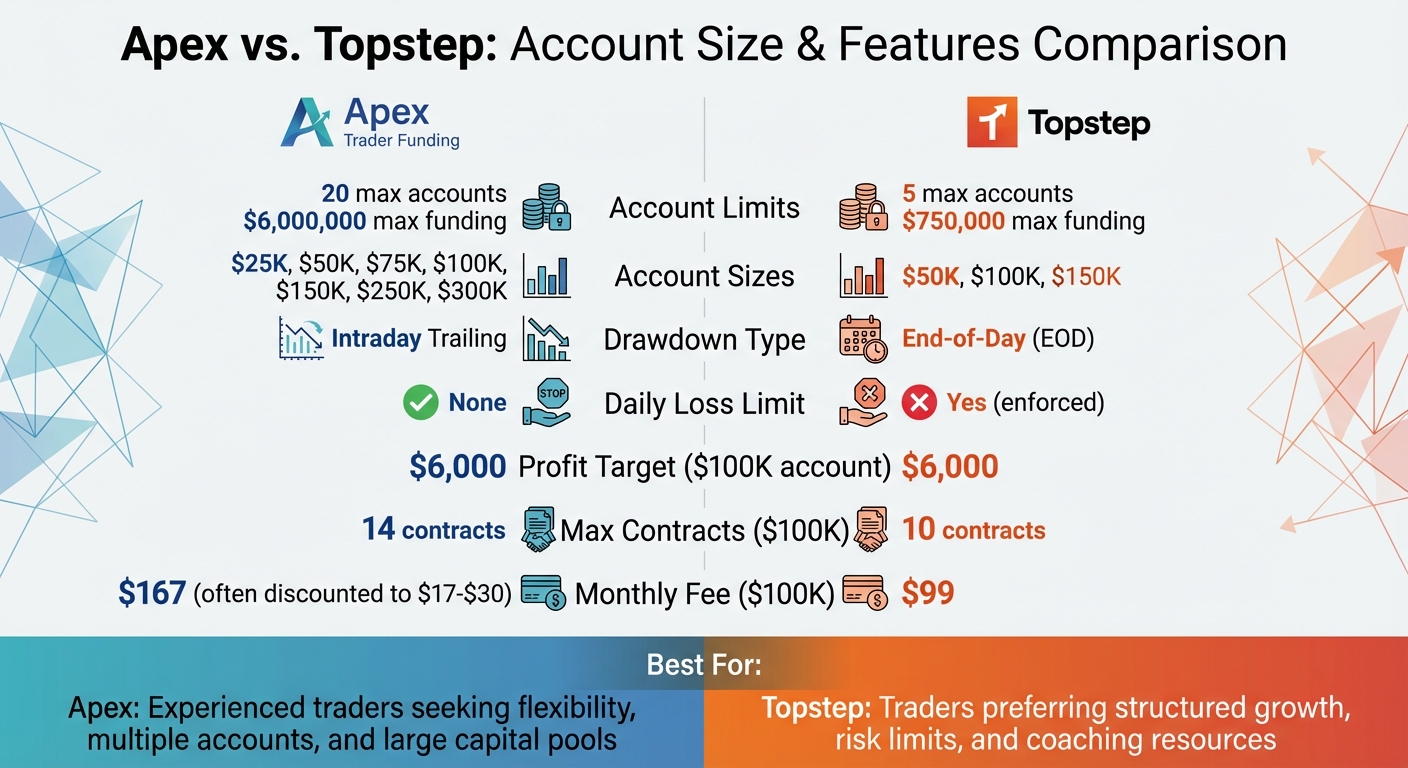
Apex vs Topstep Account Sizes and Features Comparison
Apex Trader Funding Account Sizes
Account Size Options
Apex Trader Funding offers eight account sizes, ranging from $25,000 to $300,000. These include $25K, $50K, $75K, $100K (available in both standard and Static versions), $150K, $250K, and $300K accounts. Monthly fees and contract limits vary depending on the account size and platform. For traders using Rithmic, fees start at $147 per month for the $25K account and go up to $657 for the $300K account. The $100K Static account, however, is priced slightly lower at $137 per month.
Contract limits are tied to the account size. For instance, the $25K account allows up to 4 mini contracts (or 40 micros), while the $300K account permits 35 mini contracts (or 350 micros). The Static $100K account has stricter limits, allowing only 2 mini contracts (or 20 micros). These variations in fees and limits are designed to cater to traders with different strategies and preferences.
Profit Targets and Trailing Drawdowns
Profit targets are scaled according to account size. For example, a $25K account requires a $1,500 profit to pass the evaluation, while a $300K account has a target of $20,000. Similarly, the trailing threshold – Apex’s term for the maximum drawdown – ranges from $1,500 for the smallest account to $7,500 for the largest. Most accounts use an intraday trailing drawdown, which adjusts in real time as unrealized profits accumulate during a trading session.
The $100K Static account stands out with its fixed drawdown of $625, which remains unchanged regardless of profits. This feature can be attractive to traders who favor strategies involving longer holding periods or larger pullbacks. These profit and drawdown structures highlight the adaptability of Apex’s offerings to different trading styles.
Scaling and Capital Allocation Rules
Apex allows traders to manage up to 20 accounts, giving access to a combined capital pool of up to $6,000,000. To simplify operations, traders can use trade copying software, enabling them to execute the same trades across multiple accounts while staying within the contract limits for each account.
The firm also applies a 30% consistency rule for funded accounts. This means that when requesting a payout, no single day’s profit can exceed 30% of the total profit. Additionally, traders must achieve at least 8 winning days before their first payout. For the first three payouts, they must maintain a balance above the "Safety Net", which is calculated as the starting balance plus the trailing threshold plus $100. These rules are designed to encourage disciplined trading and ensure long-term account stability. A comparison with Topstep’s features will follow in later sections.
sbb-itb-46ae61d
Topstep Account Sizes

Trading Combine Options
Topstep offers a straightforward evaluation process through its one-step Trading Combine, featuring three account sizes: $50,000, $100,000, and $150,000. The monthly subscription fees for these accounts are $49, $99, and $149, respectively. Instead of allowing traders to manage multiple accounts right away, Topstep employs a performance-based scaling system, where capital increases are tied to consistent trading success rather than managing multiple accounts from the start.
The progression system includes three stages: the Trading Combine (evaluation), the Express Funded Account (a simulated environment), and finally, the Live Funded Account. Traders can handle up to five Express Funded Accounts before transitioning to live capital. To reduce initial costs, Topstep now offers a No Activation Fee option; however, transitioning to funded status typically requires a $149 activation fee. This setup provides a clear path for traders to progress while maintaining a focus on performance.
Profit Targets and Drawdown Rules
Each account tier comes with specific profit targets and risk limits. For the $50K account, traders must achieve $3,000 in profits, with a $2,000 loss limit and a maximum of 5 contracts. The $100K and $150K accounts scale these requirements, with profit targets of $6,000 and $9,000, loss limits of $3,000 and $4,500, and maximum contracts of 10 and 15, respectively.
Topstep uses an End-of-Day (EOD) drawdown model, which calculates the maximum loss limit at the close of each trading day. This is a notable contrast to Apex’s intraday trailing drawdown, as it allows traders to handle typical market fluctuations without immediate penalties. Additionally, Topstep enforces a Daily Loss Limit (around $1,000 for the $50K account) that traders must adhere to during each trading session.
Scaling and Payout Rules
Topstep’s payout system has specific requirements. Before the first payout, traders must have 5 winning days, each with a minimum profit of $150. For subsequent withdrawals, traders need to meet the same 5-day rule and maintain profitability since their last payout balance. The payout structure is generous, with traders keeping 100% of their first $10,000 in profits and 90% of profits thereafter.
The "Back2Funded" program offers a safety net for traders, allowing them to reactivate a closed Express Funded Account within seven days. Fees for reactivation range from $499 to $729, depending on the account size. Once traders reach Live Funded status by demonstrating consistent performance, they can benefit from "Dynamic Live Risk Expansion", where daily loss limits grow based on trading success. Additionally, traders can earn over $250,000 in performance bonuses as their accounts grow. After achieving 30 winning days with at least $150 per day, traders gain access to daily payouts. These policies highlight Topstep’s structured approach, offering both challenges and opportunities that set it apart from competitors like Apex.
Apex vs. Topstep: Direct Comparison
Account Size Comparison Table
When comparing Apex Trader Funding and Topstep, the differences in account structures become clear. Apex provides five account sizes, ranging from $25,000 to $250,000, while Topstep limits its offerings to three tiers, starting at $50,000 and maxing out at $150,000. The decision ultimately depends on whether you prefer the flexibility of rapid scaling or the steadiness of a structured growth approach.
| Feature | Apex Trader Funding | Topstep |
|---|---|---|
| Account Sizes | $25K, $50K, $100K, $150K, $250K | $50K, $100K, $150K |
| Max Simultaneous Accounts | 20 | 5 |
| Max Total Funding | $6,000,000 | $750,000 |
| Drawdown Type | Intraday Trailing (Unrealized) | End-of-Day (EOD) |
| Daily Loss Limit | None | Yes (Enforced) |
| Scaling Plan | None (Full size immediately) | Enforced (Earned scaling) |
| Profit Target ($100K) | $6,000 | $6,000 |
| Max Contracts ($100K) | 14 | 10 |
| Evaluation Steps | 1-Step | 1-Step (Trading Combine) |
| Monthly Fee ($100K) | $167 (often $17-$30 with promos) | $99 |
Apex stands out by offering immediate access to full contract limits, skipping the need for scaling plans. However, its intraday trailing drawdown can pose challenges, as it tracks unrealized losses and may close accounts during typical market fluctuations. On the other hand, Topstep enforces a more gradual approach, with an End-of-Day (EOD) drawdown and daily loss limits, providing a safety net for traders who prefer a disciplined progression.
Fred Harrington, Founder of Vetted Prop Firms, captures this difference perfectly:
"Apex is built for traders who value speed and simplicity", while "Topstep prioritizes long-term trader development – not just quick wins".
These distinctions highlight how each firm caters to different trading styles, with Apex favoring experienced traders seeking freedom and Topstep appealing to those who thrive under structured growth. Both approaches can shape trading strategies in unique ways, often influenced by specific prop firm consistency rules that dictate payout eligibility.
Account Flexibility Differences
Apex Trader Funding Advantages
Apex Trader Funding stands out with its aggressive approach to growth. Traders can manage up to 20 funded accounts, giving them access to a combined capital of $6,000,000. This setup allows experienced traders to spread their strategies across multiple markets and timeframes, avoiding limitations that could hinder performance.
The platform also supports trading outside regular hours, including overnight, weekend, and holiday sessions. This is a big plus for those who prefer holding positions for extended periods. Apex further enhances flexibility by integrating with 14 trading platforms like NinjaTrader, TradingView, and WealthCharts, so traders can stick to the tools they know and trust.
Once funded, traders gain immediate access to full contract limits, letting them capitalize on their strategies right from the start. These features offer a stark contrast to Topstep’s more structured approach.
Topstep Advantages
Topstep takes a different route, focusing on providing structure and fostering trader development. One of its standout features is the End-of-Day (EOD) drawdown, which prevents account liquidation during normal intraday fluctuations, giving trades more room to play out.
Another highlight is the removal of the 30% consistency rule on funded accounts, allowing traders to withdraw profits without being restricted by single-day performance limits. With a low minimum withdrawal of $125, Topstep offers more frequent access to funds compared to some competitors.
Topstep has also gained recognition for its trader-friendly policies, winning the "Best Rules" award at the 2025 Prop Firm Match Awards. Its Back2Funded program is another helpful feature, letting traders reactivate a closed Express Funded Account within seven days for a fee, saving them from restarting the evaluation process.
To round it out, Topstep provides resources like TopstepTV coaching and access to a 150,000-member Discord community. These tools create a supportive space for traders looking to sharpen their skills and grow their accounts.
💎 Topstep vs Apex Trader Funding 2026: ⚠️ The BRUTAL FACE-OFF Traders Must See!
Conclusion: Apex vs. Topstep Account Sizes
Apex Trader Funding and Topstep offer traders distinctly different funded account options. Apex provides account sizes ranging from $25,000 to $300,000 and allows up to 20 accounts at once, catering to traders aiming for aggressive scaling. On the other hand, Topstep features a simpler three-tier system with $50,000, $100,000, and $150,000 accounts, limiting traders to five funded accounts. These differences in account sizes and funding structures directly influence how traders can expand their strategies.
Apex uses an intraday trailing drawdown, which adjusts in real time and impacts available margin. Topstep, however, employs an End-of-Day drawdown, giving traders more flexibility during the trading day. This rule difference earned Topstep the "Best Rules" award at the 2025 Prop Firm Match Awards.
Your choice will depend on your trading style. Traders who hold overnight positions, operate across multiple timeframes, or use trade copiers to manage several accounts may find Apex’s flexibility and combined funding potential of $6,000,000 appealing. Meanwhile, day traders seeking quicker payouts – available after just five profitable days (with a minimum of $150 per day) compared to Apex’s 8–10 winning day requirement – might prefer Topstep’s straightforward approach, which also lacks a consistency rule.
Pricing models also set these firms apart. Apex charges a one-time evaluation fee, often discounted by 50–90%, plus optional monthly or lifetime performance account fees, with market data included. Topstep operates on a monthly subscription starting at $49, alongside a $149 activation fee and an additional $39 per month for market data. These pricing structures reflect each platform’s unique approach to incentivizing traders.
Apex has paid out over $598 million to traders, including a record $2.5 million in a single day in 2025, and boasts a 4.5/5 Trustpilot rating. Both firms excel in their respective niches – Apex for traders seeking maximum flexibility and high capital access, and Topstep for those who prefer a structured, rules-driven environment. Ultimately, the best fit depends on whether you prioritize scaling aggressively or operating within a well-defined, risk-managed framework. For more details, check out our in-depth reviews of Apex Trader Funding and Topstep.
FAQs
Which drawdown type is easier to manage – intraday trailing or end-of-day?
End-of-day (EOD) drawdowns are often simpler to handle. With Topstep’s EOD drawdown, traders can let their trades develop naturally without needing to keep an eye on every move, which helps lower stress throughout the trading day. On the other hand, Apex’s intraday trailing drawdown demands close monitoring, as even routine pullbacks might result in account termination. For those looking for a calmer trading experience, EOD drawdowns tend to be a better fit.
How do I choose the right account size for my strategy?
Choosing the right account size is all about aligning it with your risk tolerance, trading experience, and financial goals. Larger accounts can deliver bigger profit opportunities, but they often come with stricter conditions, such as tighter limits on drawdowns. On the other hand, smaller accounts – starting around $50,000 or $100,000 – tend to be easier to manage for traders still honing their skills, thanks to more flexible evaluation criteria. The key is to strike a balance between managing risk and aiming for profits, ensuring the account size matches your trading style and experience level.
Can I scale faster by managing multiple accounts, and what are the limits?
Managing multiple accounts can indeed boost your trading potential, but the extent depends on the rules set by the firm you’re working with. For example, Apex Trader Funding permits up to 20 funded accounts, giving traders the opportunity to increase their trading capacity significantly. However, each account comes with its own set of rules, such as risk thresholds and scaling restrictions. To stay compliant and avoid any violations, it’s crucial to operate within the firm’s maximum account limits and strictly follow their policies.