When choosing between Apex Trader Funding and FundedNext Futures for futures trading, your decision depends on your trading style and priorities. Here’s a quick comparison:
- Apex Trader Funding: Best for traders seeking flexibility, aggressive scaling, and high-volume trading. Offers up to 20 funded accounts, a $6M combined funding limit, and no daily loss limits during evaluations. Profit split starts at 100% for the first $25,000 and shifts to 90% thereafter. Payouts every 8 trading days.
- FundedNext Futures: Ideal for traders prioritizing fast payouts and automated strategies. Features a 24-hour payout guarantee, scaling up to $4M per account, and flexible evaluation options. Profit splits range from 60% to 90%, depending on the challenge type. Allows automated trading and news trading.
Quick Comparison
| Feature | Apex Trader Funding | FundedNext Futures |
|---|---|---|
| Max Funding | $300K/account, up to $6M total | $4M/account via scaling |
| Profit Split | 100% (first $25K), then 90% | 60%-90% |
| Daily Loss Limit | None | Typically 5% |
| Payout Timing | Every 8 trading days | Bi-weekly, 24-hour processing |
| Platforms | NinjaTrader, Tradovate, Rithmic | NinjaTrader, Tradovate, TradingView |
| Automation | Allowed | Fully supported |
Apex is better for traders who value scalability and flexibility, while FundedNext suits those who prefer quick payouts and automated trading. Both firms cater to different trading needs, so pick the one that aligns with your strategy.
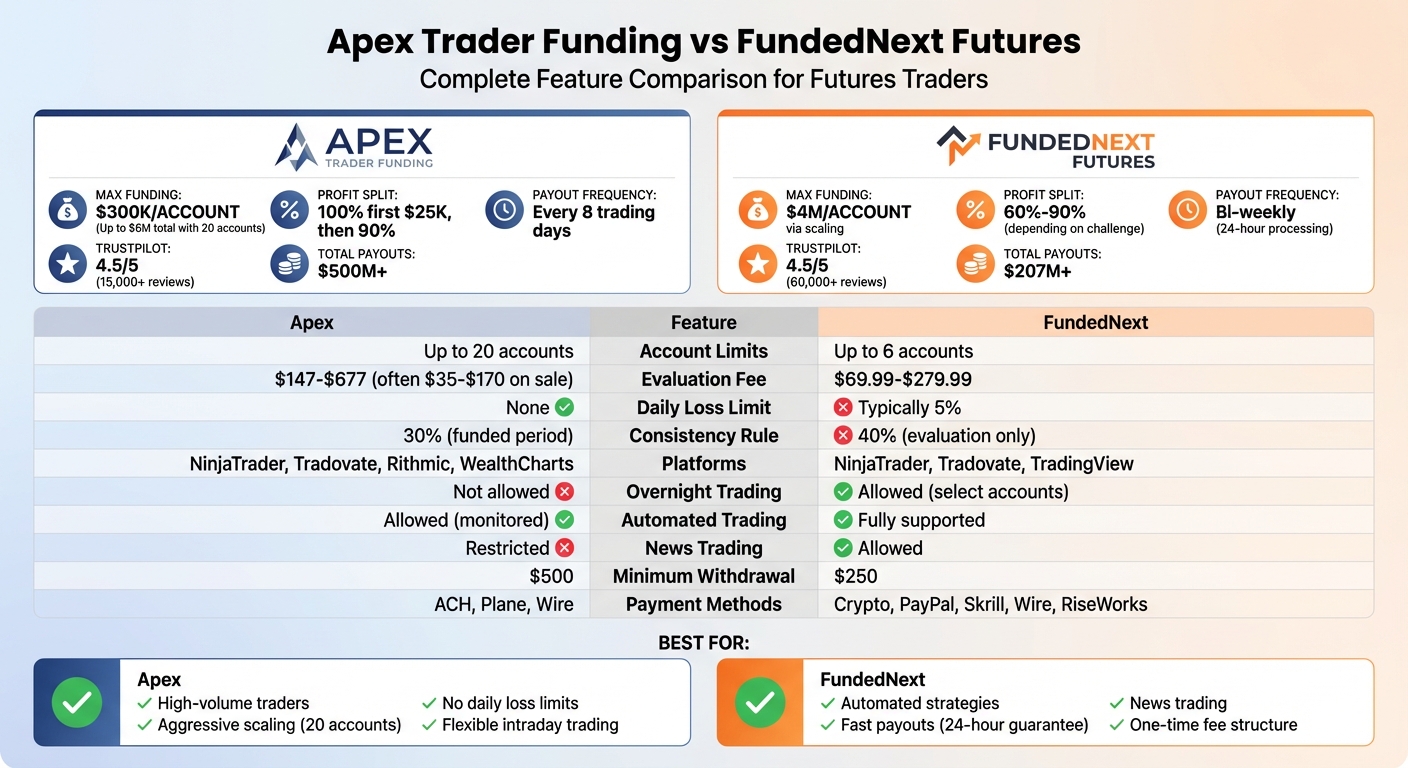
Apex vs FundedNext Futures: Complete Feature Comparison Chart
FundedNext Futures I Better than Topstep & Apex?
sbb-itb-46ae61d
Apex Trader Funding Overview
Apex Trader Funding operates with a one-step evaluation process that requires traders to meet a profit target while managing their risk. The firm offers account sizes ranging from $25,000 to $300,000 and supports up to 20 funded accounts simultaneously using copy-trading tools, giving traders access to a combined $6 million in buying power.
The profit-sharing model is simple: traders keep 100% of their first $25,000 in earnings per account. Beyond that, profits are split 90/10, with 90% going to the trader. Since its launch in 2022, Apex has paid out over $500 million to traders, including a record $2.5 million withdrawal by a trader named JadeCap. The firm maintains a strong reputation, boasting a 4.5/5 rating on Trustpilot from over 15,000 reviews.
Traders can work on platforms like NinjaTrader 8, Tradovate (integrated with TradingView), Rithmic (R|Trader Pro), or WealthCharts, with access to over 40 futures markets across CME, CBOT, COMEX, and NYMEX. These markets include indices, currencies, commodities, metals, and crypto futures.
Apex offers two types of drawdowns: "Full" accounts, which use a real-time trailing drawdown that moves with unrealized profits, and "Static" accounts, where the drawdown remains fixed. For full accounts, the trailing drawdown stops adjusting once the account balance exceeds the starting point by $100, creating a small safety net.
The following sections break down account features, evaluation criteria, and payout processes.
Features and Account Options
Apex’s one-step evaluation challenges traders to reach a profit target – ranging from $1,500 on a $25,000 account to $20,000 on a $300,000 account – while staying above the drawdown limit. There’s no time limit to complete the evaluation, but traders must trade on at least seven separate days to qualify for funding.
Evaluation fees range from $147 to $677, often reduced by 80-90% to $35–$170 during promotions. If a rule is violated, traders can reset their evaluation for a $100 flat fee. Once funded, traders pay either a monthly fee of $85 to $105 or a one-time lifetime activation fee of $85 to $145, depending on their chosen platform. Rithmic is popular for its low-latency execution and compatibility with tools like Sierra Chart and Bookmap, while Tradovate appeals to those seeking TradingView integration or mobile trading options.
The next section outlines the evaluation requirements in detail.
Evaluation Requirements
During the evaluation, traders are subject to a trailing end-of-day (EOD) drawdown, which adjusts based on their highest unrealized profit. For example, a $2,000 intraday gain increases the drawdown floor by $2,000. This means a reversal in a winning trade can quickly jeopardize the account. All positions must be closed by 4:59 PM ET, as overnight and weekend holdings are not allowed. Additionally, contract sizes are capped – for instance, a $100,000 account permits a maximum of 14 mini contracts.
Once funded, traders must follow the 30% consistency rule, which ensures no single day’s profit exceeds 30% of total profits at the time of a payout request. The Negative Risk Rule also applies, limiting unrealized losses on open positions to 30% of daily profits.
Funded Accounts and Payout Process
After successfully completing the evaluation, traders transition to a funded Performance Account (PA). Payouts can be requested every 8 trading days, provided the trader has logged at least 5 profitable days with a minimum profit of $50 each. The minimum withdrawal amount is $500. For the first five payouts, caps are applied based on account size – for example, a $50,000 account has a $2,000 payout cap. These caps are removed after the fifth payout.
Payout requests are accepted during two monthly windows: the 1st through the 5th and the 15th through the 20th. Once approved, funds typically reach traders within 3 to 7 business days via ACH (U.S.), Plane, or wire transfer.
In December 2024, trader Patrick Wieland received a payout of $608,000, while another trader documented a $2,464,822.90 wire transfer in 2025, pushing their total withdrawals to over $2.6 million.
FundedNext Futures Overview
FundedNext Futures offers a straightforward one-step evaluation process and has distributed an impressive $207 million across more than 265,000 accounts. With a 4.5/5 Trustpilot rating from over 60,000 reviews, it earned the title of the second-best futures prop firm in 2026 from BestPropFirms, scoring 83/100. Unlike Apex, FundedNext provides multiple evaluation paths, catering to various trading speeds and strategies.
Traders can choose from three options: the Legacy Challenge (structured scaling with 5 benchmark days), the Rapid Challenge (3-day payouts without benchmarks), or the Bolt $50K Challenge (a one-phase program with payouts starting on Day 1 of the funded phase). Account sizes range from $25,000 to $100,000, with profit splits beginning at 80% and reaching up to 100% for Legacy accounts after 30 benchmark days. A standout feature is the 15% profit share during the evaluation phase, which helps offset the initial challenge fee. Payouts are processed within 24 hours, with a $1,000 compensation offered if this timeframe is missed. Once funded, there are no activation or recurring monthly fees, and traders can manage up to five active funded accounts at once. Supported platforms include NinjaTrader, Tradovate, and TradingView (via Tradovate integration), though Rithmic is not supported. For traders who prioritize Rithmic or similar flexibility, comparing options like Tradeify Prop Firm can be beneficial. Additionally, traders are allowed to engage in news trading during high-impact economic events at all stages.
Features and Account Options
FundedNext keeps its evaluation fees transparent:
- Legacy Challenge: $79.99 for $25,000, $149.99 for $50,000, and $249.99 for $100,000 accounts.
- Rapid Challenge: $109.99, $199.99, and $279.99 for the same account sizes.
- Bolt Challenge: Available only at $50,000 for $69.99.
Commissions are set at $6 per round-turn contract ($3 per side), with an additional $1 fee when closing trades. A 40% consistency rule applies to most challenges, ensuring no single trading day contributes more than 40% of the total profit target. Contract limits depend on account size, such as 3 mini or 30 micro contracts for a $25,000 account, and up to 7 mini or 70 micro contracts for a $100,000 account.
Evaluation Requirements
Profit targets vary by account size:
- $25,000 accounts: $1,250–$1,500 target with $1,000–$3,000 trailing losses.
- $50,000 accounts: $2,500–$3,000 target.
- $100,000 accounts: $5,000–$6,000 target.
The Legacy and Rapid challenges have no daily loss limits, offering flexibility, while the Bolt Challenge imposes a $1,000 soft daily loss limit. All positions must be closed by 3:10 PM CT, and overnight or weekend holds are not allowed. Automated trading tools like Expert Advisors and bots are permitted, but anti-latency and copy-trading rules are enforced, with violations leading to account termination. Inactivity rules include deactivation after 7 days in challenge mode or 30 days for funded accounts.
Funded Accounts and Payout Process
Once funded:
- Legacy accounts require 5 Benchmark Days (minimum daily profit of $100–$200) before the first withdrawal.
- Rapid accounts allow payouts every 3 days without benchmarks.
- Bolt accounts enable withdrawals from Day 1, though total payouts are capped at $7,700 across five withdrawals before account closure.
The minimum withdrawal amount is $250, and payouts are processed within 5 hours. Payment options include RiseWorks (local currency or crypto), Bitcoin, Ethereum, USDT, USDC, PayPal, Skrill, Apple Pay, and Google Pay. A 40% consistency rule applies to Rapid accounts, while Legacy accounts opened after November 21, 2025, are exempt.
Features and Rules Comparison
This section breaks down the main differences between Apex and FundedNext. Below, you’ll find tables and explanations that outline their features, rules, and approaches to risk management – helping you make an informed choice.
Features Comparison Table
Apex and FundedNext differ significantly in terms of account structure, platform options, and funding limits. Apex Trader Funding focuses solely on futures, offering a maximum of $300,000 per account. New traders can often find an Apex Trader Funding discount code to reduce these initial costs. Traders can manage up to 20 accounts at once, giving them access to a combined funding potential of $6 million. On the other hand, FundedNext Futures provides a scaling option that allows a single account to grow up to $4,000,000, with a maximum of 6 accounts.
| Feature | Apex Trader Funding | FundedNext Futures |
|---|---|---|
| Max Funding | $300,000 per account (up to 20 accounts) | Up to $4,000,000 via scaling |
| Profit Split | 100% of first $25,000, then 90% | 60% to 90% |
| Account Limits | Up to 20 accounts | Up to 6 accounts |
| Platform Support | NinjaTrader, Tradovate, Rithmic, WealthCharts, TradingView | MT4, MT5, cTrader, TradingView |
| Tradable Instruments | Futures only (Equity, FX, Agricultural, Energy, Metals, Crypto) | Futures only (similar markets) |
Trading Rules Comparison Table
The trading rules reveal key differences in how both companies manage risk. Apex does not impose a daily loss limit during the evaluation phase, which offers more flexibility for traders dealing with volatile markets. FundedNext, however, typically enforces a daily loss limit of around 5%. Apex also applies the 30% consistency rule throughout the funded trading period, ensuring no single day’s profit exceeds 30% of the total profit for that payout cycle. FundedNext’s 40% consistency rule, by contrast, only applies during the evaluation phase.
| Rule | Apex Trader Funding | FundedNext Futures |
|---|---|---|
| Drawdown Type | End-of-Day Trailing | End-of-Day Trailing |
| Daily Loss Limit | None | Typically around 5% |
| Consistency Requirement | 30% rule (throughout funded period) | 40% rule (evaluation phase only) |
| News Trading | Restricted | Limited on specific account types |
| Overnight Trading | Not allowed | Allowed on select account types |
Risk Management Approaches
Apex and FundedNext take distinct approaches to risk management, catering to different trading styles. For example, Apex enforces its 30% consistency rule throughout the funded period, which promotes steady performance over each payout cycle. By contrast, FundedNext’s 40% consistency rule is limited to the evaluation phase, allowing for more flexibility once traders are funded.
Another difference lies in inactivity policies. Apex requires traders to maintain an active monthly subscription, while FundedNext may deactivate accounts that remain inactive for extended periods. Additionally, both firms adjust contract limits based on account size.
Apex’s lack of a daily loss limit appeals to traders who prefer aggressive strategies, while FundedNext’s daily cap provides more structured risk control for cautious traders. Both systems have their strengths, depending on your trading approach.
Payouts and Scaling Comparison
Payout Comparison Table
Apex Trader Funding and FundedNext take different approaches when it comes to profit splits and payout timings. Apex offers 100% of the first $25,000 earned per account, after which the profit split switches to 90%. Starting from the sixth payout, Apex removes withdrawal caps, and all profits are paid out at 100%. FundedNext, on the other hand, begins with a 90% profit split from the start, with some programs offering splits ranging from 60% to 90%, depending on the challenge type.
The timing for withdrawals also varies. Apex allows traders to request payouts every 8 trading days, provided they meet the requirement of at least 5 profitable days with $50 or more per day. FundedNext operates on a bi-weekly schedule and guarantees 24-hour payout processing. They even offer a $1,000 bonus if the payout isn’t processed within that timeframe. Apex imposes withdrawal caps for the first five payouts, which depend on the account size – for instance, a $50,000 account has a $2,000 cap. These caps are removed starting with the sixth payout.
| Payout Feature | Apex Trader Funding | FundedNext Futures |
|---|---|---|
| Profit Split | 100% (first $25k), then 90% | 90% (from day one) |
| Withdrawal Timing | Every 8 trading days | Bi-weekly (24-hour processing) |
| Minimum Payout | $500 | Varies by plan |
| Benchmark Days | 5 days ($50/day) | 5 days ($200/day) |
| Payout Cap | Yes (first 5 payouts only) | No (after benchmark days) |
| Payment Methods | ACH (US), Plane (International) | Wire, PayPal, Crypto, Wise, Revolut, Deel |
The differences in payout structures are just one part of the equation. Account scaling options also play a critical role in how traders can grow their earnings.
Account Scaling Options
When it comes to scaling, Apex allows traders to manage up to 20 funded accounts simultaneously. With each account capped at $300,000, this setup provides access to a total of $6,000,000 in trading capital. Many traders start with smaller accounts, such as $50,000, to build consistency before transitioning to larger accounts for higher potential payouts. Apex also supports copy-trading tools, which make it easier to manage multiple accounts at once. This approach minimizes risks on individual accounts while maximizing overall earnings.
FundedNext, by contrast, focuses on scaling a single account up to $4,000,000. For traders participating in the Legacy Challenge, the maximum limit is 6 accounts of $50,000 each, capping that specific track at $300,000. However, other scaling plans within FundedNext allow traders to reach the $4,000,000 ceiling. This setup is ideal for those who prefer managing fewer accounts with larger balances.
These payout and scaling differences highlight how each firm caters to different trading styles, making it easier for traders to align their strategies with the firm’s offerings.
Platforms, Instruments, and Strategies Comparison
Platforms and Tradable Instruments
Apex Trader Funding offers access to over 14 professional trading platforms, including advanced tools like ATAS, Bookmap, and Jigsaw. These platforms cater to professional traders who need sophisticated charting and execution capabilities. FundedNext, on the other hand, takes a simpler route, supporting platforms like Tradovate, NinjaTrader, and TradingView for futures trading, alongside other popular retail trading platforms. Both are frequently cited among the best futures prop firms for their platform diversity.
In terms of tradable instruments, Apex provides an extensive selection with over 46 futures markets spanning Equity, Foreign Exchange, Agricultural, Energy, Interest Rate, Metals, and Crypto Futures. FundedNext focuses on 30 regulated CME Futures contracts, covering key areas like stock indices (E-mini ES and NQ), metals and energy (GC, SI, and CL), agricultural products (Corn, Soybeans, and Live Cattle), and currency futures. While Apex’s offerings include niche markets such as Interest Rate futures, FundedNext prioritizes highly liquid CME contracts. Both firms take distinct approaches to align their platforms with approved trading strategies.
Permitted Trading Strategies
Trading strategies are another area where Apex and FundedNext differ significantly. Apex adopts a flexible "Trade YOUR Way" philosophy, allowing traders to employ methods like scalping, news trading, and copy trading (managing up to 20 accounts at once). However, Apex enforces a 50% consistency rule for Performance Accounts, requiring that no single trading day contributes more than half of the total profit during a payout period. Additionally, overnight and weekend holding are strictly prohibited.
FundedNext takes a more cautious approach, particularly with certain trading methods. While the firm allows Expert Advisors (EAs) and algorithmic trading, it bans micro-scalping and Quick Strike techniques. FundedNext also imposes restrictions on trading within 2% of CME price limits and during volatile market conditions, such as those caused by major news events. Traders using EAs must stick to the same strategy throughout both the Challenge and Funded phases, with no switching between automated and manual trading. Practices exploiting simulated environments, like spoofing, layering, wash trading, and latency arbitrage, are explicitly prohibited.
| Feature | Apex Trader Funding | FundedNext Futures |
|---|---|---|
| Selected Trading Platforms | NinjaTrader, Tradovate, Rithmic | Tradovate, MT4, MT5, cTrader |
| EA/Bot Support | Allowed (monitored) | Fully Supported |
| Copy Trading | Allowed (up to 20 accounts) | Allowed |
| News Trading | Allowed | Allowed (on most plans) |
| Overnight/Weekend Holding | Not allowed | Allowed |
Which Firm Matches Your Trading Style?
Choosing the right firm hinges on aligning its features with your trading approach. Both FundedNext and Apex Trader Funding cater to distinct trader profiles, so understanding your needs is key to making the right decision.
For Scalpers and Day Traders
If you rely on Expert Advisors (EAs), algorithmic strategies, or other automated methods, FundedNext is the better option. Unlike Apex, FundedNext explicitly allows automated trading strategies, giving you the freedom to use bots and other tools.
FundedNext also stands out with its faster payout schedule. With Rapid accounts, withdrawals can be processed in as little as 3 days. Plus, their futures program guarantees payouts within 24 hours – offering a $1,000 bonus if they miss this deadline. For scalpers and day traders who depend on quick access to funds – whether to reinvest or manage expenses – this speed is a major advantage.
However, one caveat is FundedNext’s 40% consistency rule in its futures program. If your trading style involves volatile returns with occasional big wins, this rule might complicate your payouts. For traders focused on automation and quick cash flow, these factors are worth weighing.
For High-Volume Traders
On the other hand, Apex Trader Funding is ideal for manual traders aiming to scale up capital through horizontal scaling. Apex allows you to trade up to 20 accounts simultaneously using trade copiers like TradeSyncer, granting access to significantly higher aggregate capital from the outset.
Apex also offers more leeway for aggressive intraday trading. Unlike FundedNext, which enforces a daily loss limit (typically capped at 5%), Apex does not impose such restrictions on standard plans. This flexibility is particularly beneficial during volatile trading sessions, allowing high-volume traders to recover losses within the same day. Additionally, Apex maintains a consistent 90% profit split and lets you keep 100% of your first $25,000 in profits per account.
Ultimately, your decision boils down to your priorities. If automation and fast payouts top your list, FundedNext is the way to go. But if you value scaling capital and flexibility during intraday swings, Apex might better suit your trading style.
Final Comparison and Recommendations
Both Apex Trader Funding and FundedNext Futures cater to traders with different priorities. Apex stands out for those aiming to scale aggressively, offering the ability to manage up to 20 accounts at once while keeping 100% of the first $25,000 in profits per account. With a Trustpilot rating of 4.9/5 and over $676 million in payouts, Apex has established itself as a solid choice for high-volume traders who are comfortable with its trailing drawdown approach.
On the other hand, FundedNext Futures appeals to traders looking for simplicity and fast cash flow. It boasts a 24-hour payout guarantee, a $1,000 delay bonus, and a straightforward one-time fee of about $144 for a $50,000 Legacy account. Its end-of-day drawdown model simplifies risk management, making it easier to focus on trading. With more than $274.2 million in payouts and a 4.8/5 Trustpilot rating, FundedNext is an excellent fit for those prioritizing quick withdrawals.
"FundedNext Legacy is now setting the pace… with 1:1 profit-to-loss ratios, 24-hour payouts, no caps, and cheaper one-time pricing."
- Kyle Kozlowski, Editor, DamnPropFirms
The choice between these two firms ultimately depends on your trading strategy. If you’re drawn to aggressive scaling and want to complete evaluations quickly to avoid monthly fees, Apex might be your best bet. On the flip side, if you prefer a one-time fee structure and the assurance of rapid payouts, FundedNext could be the better option.
For more detailed comparisons, verified reviews, and tools like the Consistency Rule Calculator to help align your trading with each firm’s payout requirements, check out DamnPropFirms for insights on Apex Trader Funding and FundedNext Futures.
FAQs
Which firm is easier to pass for my trading style?
FundedNext tends to be simpler to navigate, particularly if you prefer a more relaxed evaluation process. It features a single-step evaluation, offers an 80-90% profit split, imposes fewer restrictions on daily losses, and allows for a maximum balance of up to $4 million. On the other hand, Apex Trader Funding enforces stricter rules and a tougher payout structure, which might not appeal to traders looking for an easier route to securing funding.
How do trailing drawdowns work on each program?
Trailing drawdowns in Apex Trader Funding and FundedNext serve to safeguard the account’s peak balance while still enabling growth. Here’s how they work:
- FundedNext: This platform adjusts the drawdown level as your account grows. If your balance dips below the peak, the drawdown resets accordingly, providing a clear and structured approach to risk management.
- Apex Trader Funding: Similarly, Apex employs trailing drawdowns to control risk. However, the specifics of how their system operates aren’t as clearly outlined as FundedNext’s.
Both platforms share a common goal: limiting losses in relation to the account’s highest value. FundedNext stands out by offering more transparent and defined rules for these adjustments.
What rules most often block payouts after I’m funded?
The most frequent reasons traders miss out on payouts after funding are exceeding daily or overall loss limits, not achieving profit targets within the set timeframe, inconsistent trading practices, or ignoring specific risk management rules. It’s crucial to thoroughly understand and stick to these guidelines to ensure a smooth payout process.