Choosing between Apex Trader Funding and Take Profit Trader depends on your trading priorities. Here’s a quick breakdown:
- Apex Trader Funding:
- Uses real-time intraday trailing drawdown, which updates dynamically as equity grows.
- Offers payouts twice a month, with an 8–10 trading day wait for the first withdrawal.
- Allows up to 20 funded accounts with a combined capital ceiling of $6 million.
- Traders keep 100% of the first $25,000 in profits, then a 90/10 split applies.
- Evaluation fees often discounted by 80–90%, making it cost-effective.
- Take Profit Trader (TPT):
- Uses end-of-day trailing drawdown during the evaluation phase, switching to intraday for PRO accounts.
- Offers same-day payouts with no withdrawal caps or consistency rules.
- Limits traders to 5 funded accounts with a combined capital cap of $750,000.
- PRO accounts start with an 80/20 split, increasing to 90/10 for PRO+ accounts.
- Requires positions to be closed by 5:00 PM ET daily and restricts trading during major news events.
Quick Comparison
| Feature | Apex Trader Funding | Take Profit Trader |
|---|---|---|
| Drawdown Model | Real-time intraday trailing | End-of-day trailing (Test) |
| Payout Timing | 8–10 days for the first payout | Same-day withdrawals |
| Max Funded Accounts | 20 accounts (up to $6M total) | 5 accounts (up to $750K total) |
| Profit Split | 100% of first $25K, then 90/10 | 80/20 (PRO), 90/10 (PRO+) |
| Evaluation Fee | $167/month for $50K account (discounts available) | $170/month for $50K account |
| News Trading | Allowed | Restricted |
Apex is ideal for traders focused on scaling and flexibility. TPT suits those prioritizing fast payouts and simpler rules.
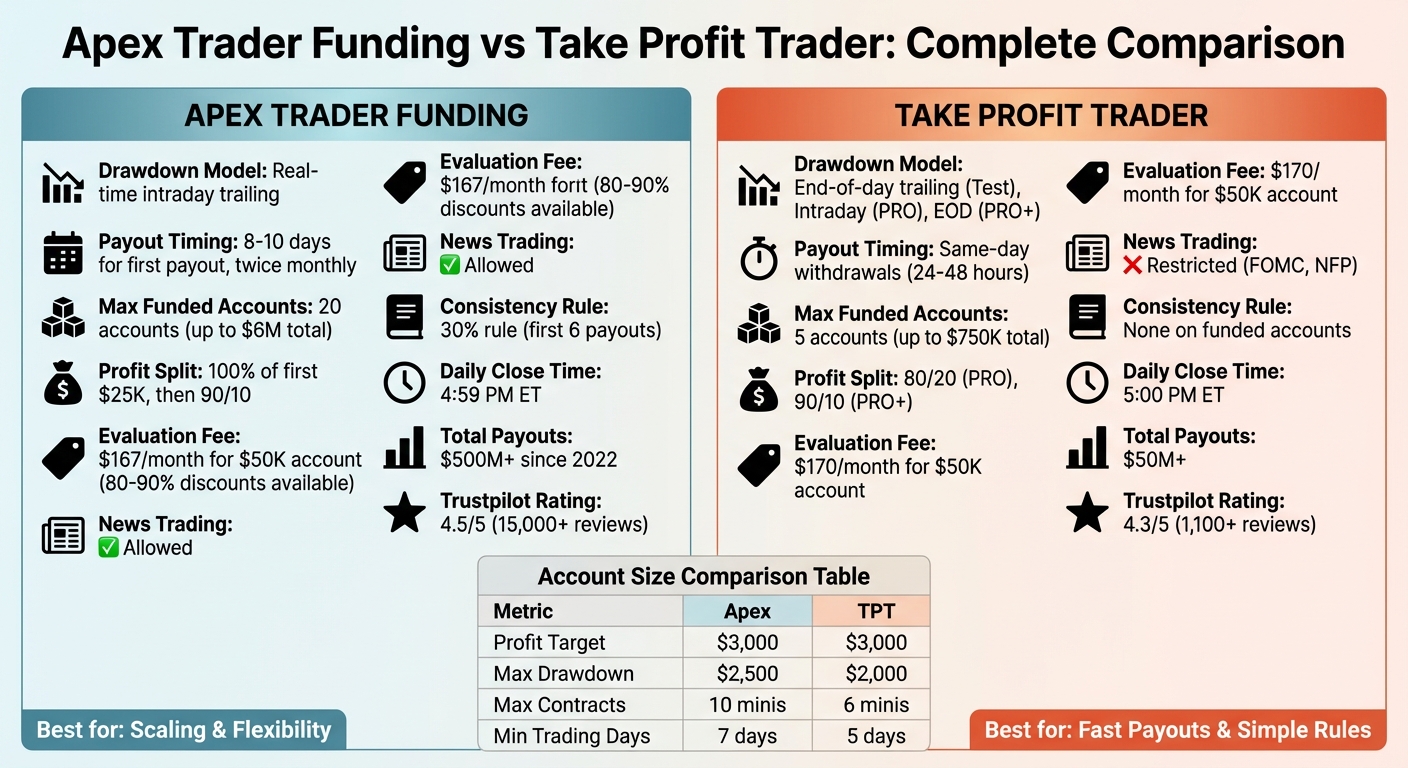
Apex Trader Funding vs Take Profit Trader: Key Features Comparison
Apex Trader Funding vs Take Profit Trader – Which is Better for Futures Trading in 2025?

sbb-itb-46ae61d
Apex Trader Funding Overview
Apex Trader Funding simplifies the evaluation process for traders with a one-step approach. To qualify, traders must achieve a profit target while adhering to a trailing drawdown, completing trades over a minimum of 7 trading days. There’s no daily loss limit, which sets it apart from many other firms. Since its launch in 2022, Apex has paid out over $500 million, with individual payouts reaching as high as $2.5 million. The firm also allows traders to scale up by using copy-trading across as many as 20 funded accounts.
"Apex stands apart as the most popular prop firm worldwide… only prop firm that lets you copy trade across 20 funded accounts simultaneously." – DamnPropFirms Review
Apex has earned a 4.5/5 star rating on Trustpilot from more than 15,000 reviews. Feedback often highlights its generous profit splits and fast payout cycles. Traders can use platforms like Rithmic, Tradovate, and WealthCharts for their trades.
Below, we’ll explore Apex’s evaluation process, account options, and risk management features in detail.
Evaluation Process and Main Features
For a $50,000 evaluation account, traders need to achieve a $3,000 profit while managing the trailing drawdown. A minimum of 7 trading days is required to qualify for a funded Performance Account.
Apex permits news trading and supports all futures contracts available on the trader’s chosen platform, offering flexibility in trading strategies [8, 12].
Account Sizes and Profit Splits
Apex offers accounts ranging from $25,000 to $300,000, with two main types: "Full" accounts, which use a trailing drawdown, and "Static" accounts, which feature a fixed drawdown. Among these, the $50,000 account is particularly popular.
Traders benefit from an attractive profit split structure. They keep 100% of the first $25,000 they earn on each account, and after that, they receive 90% of all additional profits.
| Account Size | Profit Target | Max Drawdown | Max Contracts (Minis) |
|---|---|---|---|
| $25,000 Full | $1,500 | $1,500 (Trailing) | 4 |
| $50,000 Full | $3,000 | $2,500 (Trailing) | 10 |
| $100,000 Full | $6,000 | $3,000 (Trailing) | 14 |
| $100,000 Static | $2,000 | $625 (Fixed) | 2 |
| $150,000 Full | $9,000 | $5,000 (Trailing) | 17 |
| $300,000 Full | $20,000 | $7,500 (Trailing) | 35 |
The monthly evaluation fees range from $147 for a $25,000 account to $677 for a $300,000 account. However, Apex frequently offers discounts of 80% to 90%, bringing the cost of a $50,000 account down to around $33 to $35. After passing the evaluation, traders can choose between a monthly fee of $85 to $105 or a one-time lifetime activation fee, which ranges from $85 to $145 depending on the platform.
Drawdown Rules and Risk Management
Apex’s approach to drawdowns and risk control is designed to provide flexibility while maintaining discipline.
The firm’s trailing drawdown adjusts in real time as equity grows, locking in profits during upward trends. This means that as your account hits a new high, the drawdown threshold updates to reflect the peak. However, this dynamic feature can be tricky during volatile markets, as a sudden reversal could lead to a drawdown violation [10, 12].
"Apex is a solid choice for futures traders, especially those who struggle with daily loss limits at other firms. The trailing-only drawdown is more forgiving." – QuantCrawler Review
Once traders move to a funded Performance Account, the trailing drawdown stops adjusting once it reaches the starting balance plus $100. This creates a breakeven safety net. Apex also enforces a 30% consistency rule for payouts: no single trading day can contribute more than 30% of the total profit. Payouts are available every 8 trading days, with caps on the first five withdrawals (e.g., $2,000 for a $50,000 account). These caps are lifted after the sixth successful payout.
Take Profit Trader Overview
Take Profit Trader (TPT) operates with a straightforward one-step evaluation process. Traders need to hit a 6% profit target over a minimum of 5 trading days, which is shorter than Apex’s 7-day requirement. Historically, TPT’s pass rate has hovered between 17% and 20%.
The firm has received a 4.3/5 star rating on Trustpilot, based on over 1,100 reviews. Many traders commend its fast payout processing and transparent rules. TPT offers three account tiers: Test, PRO, and PRO+. The PRO+ tier is invitation-only, reserved for traders who either demonstrate consistent performance or achieve $10,000 in a single trading day.
One standout feature of TPT’s evaluation is the End-of-Day (EOD) trailing drawdown, which updates only at market close, providing more flexibility compared to Apex’s real-time intraday model. However, after passing the evaluation, PRO accounts switch to a stricter intraday trailing drawdown, while PRO+ accounts revert to the forgiving EOD model.
"The drawdown model. TakeProfitTrader uses EOD trailing drawdown in Test (forgiving), switches to intraday trailing in PRO (brutal), then back to EOD in PRO+. Apex uses intraday trailing drawdown everywhere – it never stops chasing your balance." – Paul, Lead Writer, PropTradingVibes
TPT enforces restrictions around major news events like FOMC, NFP, and CPI, requiring traders to close positions 1 minute before and after these announcements. Additionally, traders are limited to 5 funded accounts at a time, with a combined capital cap of $750,000, which is significantly lower than Apex’s allowance of 20 accounts.
The following sections cover TPT’s evaluation process, account options, and risk management strategies, along with comparisons to Apex Trader Funding.
Evaluation Process and Main Features
To qualify for a PRO account, TPT traders must meet specific benchmarks. For example, with a $50,000 evaluation account, traders need to achieve a $3,000 profit target while managing a $2,000 drawdown over at least 5 trading days.
In January 2025, TPT removed the daily loss limit for Test accounts, allowing traders more freedom to handle intraday volatility without automatic liquidation. However, the firm still enforces a 50% consistency rule, which means no single trading day can account for more than half of the total profits. Positions must also be closed by 5:00 PM ET daily.
Account Sizes and Profit Splits
TPT provides five account sizes, ranging from $25,000 to $150,000. The $50,000 account is a popular choice, offering 6 mini contracts (or 60 micros).
| Account Size | Monthly Fee | Profit Target | Max Drawdown | Max Contracts (Minis/Micros) |
|---|---|---|---|---|
| $25,000 | $150 | $1,500 | $1,500 | 3 / 30 |
| $50,000 | $170 | $3,000 | $2,000 | 6 / 60 |
| $75,000 | $245 | $4,500 | $3,000 | 9 / 90 |
| $100,000 | $330 | $6,000 | $4,000 | 12 / 120 |
| $150,000 | $360 | $9,000 | $4,500 | 15 / 150 |
Profit splits vary by account type. PRO accounts offer an 80/20 split, while PRO+ accounts increase this to 90/10. Traders can withdraw profits as soon as they meet the buffer requirement, with payouts typically processed within 24 to 48 hours. Withdrawals over $250 are free, but smaller amounts incur a $50 fee.
A one-time $130 activation fee applies when transitioning from Test to PRO. However, this fee is often waived with promo codes like "VIBES" or "NOFEE40".
Drawdown Rules and Risk Management
TPT’s drawdown rules shift depending on the account tier. During the Test phase, the firm uses an EOD trailing drawdown, which updates only at the end of the trading day, offering traders more leeway during volatile sessions. Once funded, PRO accounts switch to a stricter intraday trailing drawdown that includes unrealized profits. For PRO+ accounts, the EOD model returns, and the buffer requirement is removed entirely.
For PRO accounts, a buffer zone equal to the maximum drawdown must be built before withdrawals are allowed. For instance, in a $50,000 account, the balance must reach $52,000 before the first payout. This requirement is waived for PRO+ accounts.
While TPT eliminated daily loss limits for Test and PRO+ accounts in January 2025, traders must still adhere to the 5:00 PM ET mandatory close and news trading restrictions across all account types. These rules make TPT a better fit for disciplined intraday traders who avoid holding positions overnight.
Payout Structures and Rules Compared
Profit Splits and Payout Timing
The payout policies and profit splits set Apex Trader Funding and Take Profit Trader apart in meaningful ways. Apex processes payouts twice a month, typically on the 15th and the last business day. However, traders must wait 8 to 10 trading days between requests. The firm also caps the first five payouts based on account size – for instance, $2,000 for a $50,000 account – and enforces a 30% consistency rule until the sixth payout.
On the other hand, Take Profit Trader offers a quicker withdrawal process, with funds available within 24–48 hours. PRO accounts start with an 80/20 profit split, while PRO+ accounts offer a more favorable 90/10 split. There are no withdrawal caps on PRO accounts, and no consistency rules block payouts. However, PRO accounts require a buffer zone equal to the maximum drawdown before the first withdrawal. This requirement does not apply to PRO+ accounts.
| Feature | Apex Trader Funding | Take Profit Trader |
|---|---|---|
| Initial Profit Split | 100% of first $25,000 | 80% (PRO) or 90% (PRO+) |
| Standard Profit Split | 90/10 | 80/20 or 90/10 |
| Payout Frequency | Twice per month | Daily withdrawals |
| Minimum Trading Days for Payout | 8–10 days | None (withdraw from day one) |
| Consistency Rule | 30% rule enforced | None |
| Withdrawal Caps | Capped for first 5 payouts (e.g., $2,000 max on a $50K account) | None |
"Apex wins on raw numbers if you’re profitable. Apex gives you 100% of your first $25K in profits per account, then 90/10." – Paul, PropTradingVibes
Apex has distributed over $500 million in payouts since 2022, while Take Profit Trader has paid out more than $50 million. These payout structures can heavily influence a trader’s choice, depending on how quickly they need access to their earnings.
Trading Styles and Restrictions
Apex offers flexibility for traders who thrive on market volatility, allowing news trading during major events like FOMC, NFP, and CPI. However, the firm enforces a 30% consistency rule for the first six payouts – no single trading day can contribute more than 30% of total profits when requesting a withdrawal. Additionally, all positions must be closed by 4:59 PM ET daily. Apex prohibits hedging and fully automated trading systems.
Take Profit Trader takes a stricter approach to news trading. For both PRO and PRO+ accounts, traders must be flat one minute before and after FOMC and NFP announcements. A 50% consistency rule applies during the evaluation phase but is removed once the account is funded. Positions must be closed by 5:00 PM ET, and overnight or weekend holds are not allowed. Apex’s trading window is more accommodating for swing traders, while Take Profit Trader enforces tighter session restrictions.
"TakeProfitTrader restricts news trading during FOMC and NFP in PRO and PRO+ accounts, requiring you to be flat with a 1-minute buffer around those events." – Paul, PropTradingVibes
Risk management also differs between the two firms. Apex uses an intraday trailing drawdown that adjusts in real time as profits rise, creating a more dynamic risk framework. In contrast, Take Profit Trader employs an end-of-day trailing drawdown during the Test phase and for PRO+ accounts. However, standard PRO accounts switch to an intraday trailing drawdown, which adds complexity. Traders who prioritize flexibility during volatile market events may lean toward Apex, while those who prefer fewer restrictions might favor Take Profit Trader.
Account Scaling and Multiple Accounts
When it comes to scalability, Apex offers traders the ability to manage up to 20 funded accounts simultaneously, with copy trading enabled across all accounts. There’s no cap on combined capital, meaning traders could theoretically control $5 million or more across multiple accounts.
Take Profit Trader, by comparison, limits traders to five funded accounts. While this may seem restrictive, the firm’s daily withdrawal flexibility and simpler rules make it appealing for those who prioritize quick access to funds. The PRO+ tier is invitation-only and reserved for traders who either show consistent performance or achieve $10,000 in profits on a single trading day.
For traders interested in aggressive scaling and leveraging multiple accounts, Apex is the clear choice. However, those who value faster payouts and a more straightforward trading experience might find Take Profit Trader better suited to their needs.
Pricing and Fees Compared
Evaluation Fees and Monthly Costs
When comparing Apex Trader Funding and Take Profit Trader, their fee structures reveal key differences, particularly in subscription costs and platform options. Both platforms operate on a monthly subscription model until traders pass the evaluation or cancel their accounts. However, the pricing varies depending on the chosen platform and available promotions.
For a $50,000 evaluation account, Apex charges $167/month for Rithmic, $187/month for Tradovate, and $167/month for WealthCharts. Take Profit Trader simplifies things with a flat $170/month fee for the same account size, regardless of the platform.
| Account Size | Apex (Rithmic) | Apex (Tradovate) | Apex (WealthCharts) | Take Profit Trader |
|---|---|---|---|---|
| $25,000 | $147 | $167 | $147 | $150 |
| $50,000 | $167 | $187 | $167 | $170 |
| $100,000 | $207 | $227 | $297 | $330 |
| $150,000 | $297 | $317 | $397 | $360 |
After completing the evaluation, both platforms charge an activation fee to start a funded account. Apex provides two options: a recurring fee of about $85/month or a one-time payment ranging from $85 to $145, depending on the account size and platform. Take Profit Trader, on the other hand, charges a flat one-time fee of $130 for PRO accounts, which is often waived using promo codes.
For market data, Apex charges $41/month for Level 2 access, while Level 1 data is free. Take Profit Trader includes market data fees in its pricing, making their fee structure more straightforward.
These pricing differences set the foundation for understanding other potential costs, such as resets and hidden charges.
Reset Fees and Other Charges
Additional charges, like reset fees and commission rates, can significantly impact overall costs. If a trader fails an evaluation, Apex charges $80 for a reset. However, accounts that fail automatically qualify for a free reset upon their monthly subscription renewal. Take Profit Trader offers a more generous policy, granting three free resets for PRO accounts.
Apex also requires traders to sign the Performance Account agreement and pay the activation fee within 48 hours of passing the evaluation. Following a funded account checklist can help ensure no critical steps are missed during this transition. Missing this deadline can void the account. Take Profit Trader does not impose such strict deadlines, offering more flexibility.
Commission rates differ as well. Apex charges approximately $3.10 per round turn on Tradovate and $3.98 per round turn on Rithmic. Take Profit Trader introduces a unique restriction with its PRO+ tier, freezing $5,000 of accumulated profit as collateral. Only 80% of this amount is recoverable when the account is closed. Apex does not have a similar restriction but does enforce a 30% consistency rule that can delay payouts and require additional trading.
Discounts and Promo Codes
Promotions and discounts play a significant role in reducing costs. Apex is known for its aggressive sales, often cutting evaluation fees by 80% to 90%. For example, during sales, a $50,000 account fee can drop from $167 to around $33/month. Promo codes like ONKAGNVZ and DGT can lower fees for smaller accounts to as little as $17.70–$30.
Take Profit Trader typically offers discounts of 40% to 50% on evaluations. Promo codes like VIBES provide 40% off, while NOFEE100 waives the $130 activation fee entirely. According to Paul from PropTradingVibes:
"Take Profit Trader with promos… activation is waived, and the first month’s fee gets refunded after your first withdrawal – making your total cost effectively $0 if you pass quickly".
FuturesPropTrading.com highlights Apex’s advantages:
"Apex combines the lowest cost, fastest payouts, and most flexible rules – an unbeatable mix for serious futures traders."
For traders aiming to minimize upfront costs, Apex’s promotional pricing offers the lowest entry point. However, Take Profit Trader’s refundable first month and waivable activation fee can make it the better choice for those who pass evaluations quickly.
Trading Platforms and Support
Supported Platforms and Brokers
Apex Trader Funding works with four main platforms: NinjaTrader, Tradovate, Rithmic, and WealthCharts. While this streamlined selection might simplify decision-making, it could feel restrictive for traders who prefer a broader range of tools. On the other hand, Take Profit Trader supports over 15 platforms, including popular names like NinjaTrader, Tradovate, TradingView, Sierra Chart, Quantower, ATAS, Jigsaw, BookMap, and MotiveWave.
For traders using Mac, platform compatibility is an important consideration. Apex’s Rithmic requires running a Windows virtual machine on macOS. In contrast, Tradovate, WealthCharts, and many of the platforms supported by Take Profit Trader offer native or cloud-based options for Mac users.
Apex also allows traders to manage up to 20 funded accounts simultaneously using its built-in trade copier. Take Profit Trader, however, limits traders to five concurrent PRO accounts. This makes Apex a better fit for high-volume scalping strategies. These platform options play a key role in supporting the dynamic trading approaches discussed earlier.
Technical Tools and Data Access
When it comes to trading data, Apex provides free Level 1 market data, while Level 2 data is available for an additional $41 per month. Take Profit Trader simplifies things by bundling data fees into its subscription, offering a more predictable cost structure.
For Apex users, WealthCharts stands out with tools like AI scanners, backtesting capabilities, and the WealthTracker dashboard. However, once you choose WealthCharts, switching to another platform isn’t an option. Meanwhile, Take Profit Trader prioritizes compatibility with advanced order flow tools such as Jigsaw Daytradr, BookMap, and ATAS – platforms not natively supported by Apex.
Both companies rely on Rithmic for low-latency execution, enabling seamless access to platforms like NinjaTrader, Quantower, and Sierra Chart.
Customer Support and Community Resources
Beyond technical features, both Apex and Take Profit Trader focus heavily on customer support and fostering active trading communities. Both use ticket-based systems for customer inquiries. Apex handles a high volume of support requests and supplements this with extensive community resources, while Take Profit Trader is known for its quick and responsive ticket resolution.
Apex boasts a Discord community of over 59,000 members, making it one of the largest in the prop trading world. Benzinga highlights Apex’s community-driven approach:
"Apex offers access to community channels, webinars, and training materials. Much of the education is community-driven, with strategy talk, trade reviews, and Q&A support."
Take Profit Trader, in contrast, offers more structured educational resources. Benzinga notes:
"TakeProfit Trader offers structured education, guides, and community access. Some accounts include mentorship-style progress feedback or evaluation guidance, giving new traders more direction than Apex."
Both platforms receive high marks from users. Apex has a 4.5/5 rating on Trustpilot from over 11,112 reviews, with traders frequently praising its fast payouts and scalability. Take Profit Trader holds an even higher rating of 4.8/5, with users highlighting its same-day payouts and straightforward rules.
Which Prop Firm Fits Your Trading Style?
Apex is a solid choice for traders looking for aggressive scaling and the ability to trade during major news events. It allows up to 20 accounts at once and permits trading during high-impact events like FOMC or NFP. Apex also offers a 100% profit split on the first $25,000 per account. However, its 30% consistency rule can slow down payouts, which might not work for everyone.
If quick payouts and liquidity are your priorities, Take Profit Trader might be a better fit. It uses an end-of-day (EOD) drawdown, which helps manage intraday volatility, and lets you withdraw profits daily from the first day if you’re using a PRO account. In contrast, Apex requires at least eight trading days before processing payouts, which are done twice a month. This makes Take Profit Trader especially appealing for those who need immediate access to their earnings.
For news traders, Apex stands out because it places no restrictions on trading during major economic releases. Take Profit Trader, on the other hand, requires traders to close their positions one minute before and after events like FOMC or NFP. Additionally, it prohibits holding positions overnight or over the weekend. These policies reflect the differing approaches to risk management between the two firms.
Cost is another key consideration. Apex charges about $147 per month for a $50K evaluation, often with significant discounts. Take Profit Trader’s monthly fee is around $170, though discounts of up to 40% are frequently available. Activation fees for Apex range between $125 and $160, while Take Profit Trader charges a $130 activation fee, which can sometimes be waived with promo codes.
FAQs
Which drawdown model is safer for my strategy?
The way you manage drawdowns often depends on your personal risk tolerance and trading approach. Apex Trader Funding uses a trailing drawdown model that adjusts as your account grows. This approach offers dynamic risk control, helping to cushion against sudden losses. On the other hand, Take Profit Trader calculates drawdowns at the end of the trading day. While this method simplifies risk management, it could leave traders more vulnerable to intraday risks. Apex’s model stands out by offering greater adaptability to shifting market conditions.
How soon can I withdraw profits, and what blocks payouts?
You can request a withdrawal once you’ve completed at least 8 trading days, with a minimum of 5 days showing profits of $50 or more. Payouts are processed efficiently, and you can keep trading without interruption, even after submitting a withdrawal request.
To withdraw, you’ll need to meet specific payout criteria, including profit thresholds and safety net requirements. After your sixth withdrawal, there are no limits on payouts, giving you unrestricted access to all your available profits.
Can I scale with multiple accounts and copy trade?
Apex Trader Funding offers the option to scale up to 20 funded accounts, giving experienced traders the flexibility to handle multiple positions and manage risks across various accounts. While the platform doesn’t explicitly mention copy trading, having the ability to oversee multiple accounts suggests that traders could potentially apply similar strategies across them. For more details about available features, it’s best to explore Apex’s platform tools or check their official resources.