
Choosing the right prop firm depends on your trading style and priorities. Apex Trader Funding offers flexibility with no daily loss limits, higher account sizes (up to $300,000), and a single-step evaluation process. Topstep emphasizes structured risk management, with strict daily loss caps and end-of-day drawdown rules. Here’s a quick overview:
- Apex: Best for aggressive traders who value freedom in trading strategies, including swing and high-frequency trading.
- Topstep: Ideal for traders seeking a disciplined environment with clear rules and educational support.
Key Differences:
- Drawdown Type: Apex uses intraday trailing drawdown, while Topstep calculates at the end of the day.
- Daily Loss Limits: None for Apex; mandatory for Topstep.
- Profit Split: Apex offers 100% of the first $25,000; Topstep used to provide 100% of the first $10,000 but now is default at a 90% profit split.
- Account Sizes: Apex ranges from $25,000 to $300,000; Topstep offers $50,000 to $150,000.
Quick Comparison
| Metric | Apex Trader Funding | Topstep Trading Combine |
|---|---|---|
| Evaluation Steps | 1-Step | 1-Step |
| Drawdown Type | Intraday Trailing or static | End-of-Day |
| Daily Loss Limit | None | None |
| Profit Split | 100% of first $25k, then 90/10 | 100% of first $10k (pre 2026), now new accounts are all 90/10 split |
| Account Sizes | $25,000–$300,000 | $50,000–$150,000 |
| Min. Days to Pass | 1-7 days | 2 |
| Max Funded Accounts | 20 | 5 |
Apex suits traders seeking larger capital and fewer restrictions, while Topstep is better for those who prefer a structured, rule-based approach. Both have strengths, so your choice should align with your trading goals.
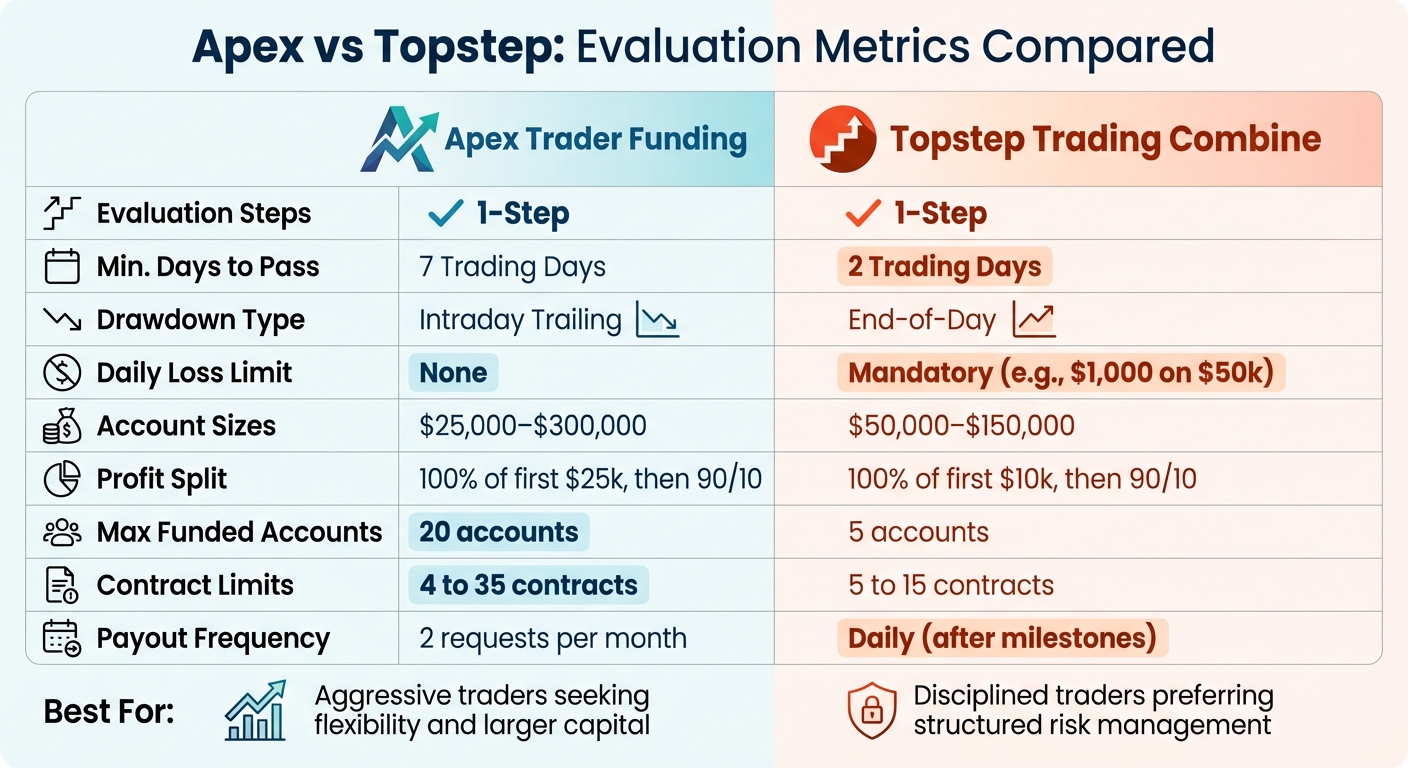
Apex vs Topstep Trading: Complete Evaluation Metrics Comparison
Apex Trader Funding Evaluation Metrics
Profit Targets and Account Sizes
Apex Trader Funding provides account options ranging from $25,000 to $300,000. The profit targets increase proportionally with the account size:
- $25,000 account: $1,500 profit target
- $50,000 account: $3,000 profit target
- $100,000 account: $6,000 profit target
- $150,000 account: $9,000 profit target
- $300,000 account: $20,000 profit target
Apex also features a unique $100,000 Static account, which has a lower profit target of $2,000, a fixed $625 drawdown, and a limit of 2 mini contracts. This option caters to traders seeking a more conservative evaluation process.
These account tiers form the foundation for Apex’s risk management strategy.
Drawdown Rules and Safety Nets
Apex uses a trailing drawdown system that adjusts based on the highest intraday profit. For example, in a $50,000 account, the trailing drawdown starts at $2,500 and increases as profits grow. Unlike many other platforms, Apex does not enforce daily loss limits. Traders can experience larger single-day losses as long as they stay above the overall drawdown threshold.
For funded Performance Accounts, the trailing drawdown locks in once it reaches the account’s starting balance plus $100. Additionally, for the first three payouts, traders must maintain a buffer equivalent to the starting balance, the drawdown amount, and $100 combined.
Evaluation Timeframe and Trading Days
There’s no set deadline to complete the evaluation, giving traders flexibility. However, they are required to trade on at least seven separate days before the account becomes active.
Contract Limits and Scaling Rules
Position limits are tied to the account size. For example:
- $25,000 account: 4 mini contracts (40 micros)
- $50,000 account: 10 mini contracts (100 micros)
- $300,000 account: 35 mini contracts (350 micros)
Once funded, traders can manage up to 20 Performance Accounts simultaneously using copy-trading software. However, each account must independently meet the 30% consistency rule to qualify for payouts.
For an in-depth review of Apex Trader Funding’s features, visit DamnPropFirms:
https://damnpropfirms.com/futures-prop-firms/apex-trader-funding/
Topstep Trading Combine Metrics
Profit Targets and Account Sizes
Topstep provides three straightforward account options: $50,000, $100,000, and $150,000. Each account comes with a 6% profit target, translating to goals of $3,000, $6,000, or $9,000, respectively. Unlike Apex, which offers a wider variety of account sizes, Topstep sticks to this consistent three-tier structure. To encourage steady trading habits, a Consistency Target requires that no single day exceeds 50% of the total profit goal. This approach discourages traders from relying on one-time large gains and instead promotes sustainable performance.
"The ticket to consistent profitability is when you can put up a repeatable performance." – Topstep Help Center
The monthly fees for the Standard Path accounts are $49, $99, and $149 for the $50,000, $100,000, and $150,000 accounts, respectively. Additionally, there’s a $149 one-time activation fee.
These structured targets and fees align with Topstep’s focus on disciplined risk management.
Daily and Overall Drawdown Limits
Topstep enforces strict drawdown rules to complement its profit targets. The firm uses an end-of-day (EOD) maximum loss limit (MLL), calculated based on the account’s closing balance rather than intraday unrealized profits. For example, the $50,000 account has an MLL of $2,000.
"Topstep’s MLL is based on your end of day balance, unlike other prop firms, who calculate it on unrealized profits intraday (high water mark). We have the best drawdown in the business and give you more room to trade." – Topstep
As of August 25, 2024, TopstepX accounts no longer include a Daily Loss Limit. However, platforms like NinjaTrader or Tradovate may still apply their own limits if you have old accounts on these platforms. Since 2026 ProjectX is the exclusive platform if you want to trade with Topstep.
Evaluation Timeframe and Trading Days
Traders have no set time limit to hit their profit targets, which provides flexibility. Once you transition to the Express Funded stage, you’ll need to complete at least five Benchmark Trading Days (each earning $150+ in profits) to qualify for your first payout. Additionally, Topstep enforces a day trading rule, requiring all positions to be closed by 3:10 PM CT.
For a deeper dive into Topstep’s evaluation process, check out the review on DamnPropFirms:
https://damnpropfirms.com/futures-prop-firms/topstep/
Apex vs. Topstep: Side-by-Side Comparison
Comparison Table of Key Metrics
Both Apex and Topstep use a one-step evaluation process, but their criteria differ in ways that can significantly influence a trader’s experience. Apex leans toward flexibility and scalability, while Topstep prioritizes structured risk management with built-in safeguards. Here’s how they measure up:
| Metric | Apex Trader Funding | Topstep Trading Combine |
|---|---|---|
| Evaluation Steps | 1‑Step | 1‑Step (Trading Combine) |
| Min. Days to Pass | Pass in 1 day or 7 Trading Days depending on promo | 2 Trading Days |
| Days for First Payout | 8 Winning Days (5 days $50+ profit and 3 days flipping possible) | 5 Winning Days ($150+ each) |
| Drawdown Type | Intraday Trailing | End‑of‑Day |
| Daily Loss Limit | None | None |
| Consistency Rule | 30% Cap on Best Day | None |
| Payout Buffer | Required (Drawdown + $100) | None |
| Profit Split | 100% of first $25,000, then 90/10 | 100% of first $10,000, then 90/10 |
| Max Account Size | $300,000 | $150,000 |
| Contract Limits | 4 to 35 contracts | 5 to 15 contracts |
| Max Funded Accounts | 20 accounts | 5 accounts |
| Payout Frequency | Every 8 days | Daily (after milestones) |
Apex stands out by letting traders keep 100% of their first $25,000 in profits, compared to Topstep’s $10,000 threshold. For traders focused on aggressive early gains, this difference could be a game-changer.
The following analysis dives into how these differences shape trading strategies.
How These Differences Affect Traders
The differences in risk management between Apex and Topstep heavily influence trading strategies. One of the clearest distinctions lies in their drawdown methods. Apex uses an intraday trailing drawdown, which adjusts in real-time as unrealized profits grow. For instance, if your trade swings from a $500 profit to a $200 loss, the higher drawdown threshold locks in, potentially leading to account termination. This approach requires traders to be highly mindful of intraday swings.
Topstep, on the other hand, calculates drawdowns at the end of the trading day. This gives traders more flexibility to manage their positions during volatile intraday movements without immediate penalties. However, Topstep enforces a strict daily loss limit (e.g., $1,000 for a $50,000 account), which can prevent major losses but might also limit recovery from early setbacks.
Another key difference is in scaling potential. Apex allows up to 35 contracts, while Topstep caps this at 15. Additionally, Apex enforces a consistency rule, capping any single day’s contribution to total profits at 30% during the funded stage. In contrast, Topstep drops this requirement once you’re funded, rewarding traders for big winning days without restrictions.
For more details on the complete rules and benefits of the best futures prop firms, check out the reviews at Apex Trader Funding and Topstep.
sbb-itb-46ae61d
Choosing the Right Firm for Your Trading Style
Apex: Better for Flexible Trading Approaches
Apex is ideal for traders who value freedom in their strategies. Its structure, which includes no daily loss limits, offers flexibility for handling larger positions during periods of high market volatility. Unlike many other futures prop firms, Apex allows trading during major news events, such as Federal Reserve announcements and non-farm payroll releases – key opportunities for skilled traders. Additionally, Apex supports swing trading, enabling positions to be held overnight or through weekends, and accommodates algorithmic strategies without imposing "day trading only" restrictions.
With account sizes reaching up to $300,000 and the option to manage up to 20 funded accounts simultaneously, Apex attracts experienced scalpers and news traders. However, this flexibility requires disciplined risk management, especially during market pullbacks. For traders seeking stricter boundaries and a more regimented framework, Topstep might be a better fit.
Topstep: Better for Structured, Risk-Controlled Trading
Topstep caters to traders who thrive under clear rules and strict risk management. For instance, the firm enforces daily loss limits, such as a $1,000 cap on a $50,000 account, encouraging careful position sizing and reducing the risk of significant single-day losses. Its "day trading only" policy ensures all positions are closed before the market close, eliminating overnight risks altogether.
"Topstep is where traders come to build skill, confidence, and a real path to live trading." – Team Topstep
The platform also emphasizes education and skill-building through its resources and coaching tools. According to Topstep, its TopstepX platform increased trader pass rates by 86% compared to older systems. This structured approach is especially beneficial for traders refining their strategies or looking to avoid emotional decision-making. If you’re aiming to build consistency within a supportive framework, Topstep could be the right choice.
Account Size Considerations
Apex offers account sizes ranging from $25,000 to $300,000, with monthly fees between $150 and $597. In contrast, Topstep’s accounts range from $50,000 to $150,000, with monthly fees from $49 to $165, plus a one-time activation fee of $149. Apex’s broader account options suit traders looking for aggressive scaling and access to larger capital pools. On the other hand, Topstep’s mid-sized accounts and tighter risk controls appeal to those who prefer a more measured approach.
To dive deeper into the specifics of each firm’s rules and account features, check out the detailed reviews on Apex Trader Funding and Topstep on DamnPropFirms.
👐 Topstep vs Apex Trader Funding 🎯 Which Prop Firm Is Best for You?
Conclusion
Understanding the differences in evaluation models can help you match your trading style with the right funding partner. Apex Trader Funding employs an intraday trailing drawdown that adjusts with unrealized profits, allows for swing trading overnight and over weekends, and lets traders manage up to 20 accounts at once. However, traders need to stay disciplined to avoid liquidation during market pullbacks.
Topstep, on the other hand, uses an end-of-day drawdown approach with strict daily loss limits (e.g., around $1,000 for a $50,000 account) and requires all positions to be closed by the market’s end. Its two-phase Trading Combine, combined with educational tools, helps traders build consistency and develop professional habits – making it a great fit for beginners or those who prefer a structured environment. Notably, Topstep earned the "Best Rules" award among futures firms at the 2025 Prop Firm Match Awards.
The key difference lies in their flexibility and risk controls. Apex allows traders to keep 100% of the first $25,000 in profits, while Topstep offers 100% retention on the first $10,000 unless you bought accounts after February in 2026. Deciding between the two depends on your trading approach and risk tolerance.
For a deeper dive into each firm’s evaluation criteria, check out their review pages: Apex Trader Funding and Topstep on DamnPropFirms. You can also explore tools like the Consistency Rule Calculator to understand how consistency rules might influence your payout eligibility.
FAQs
How do Apex Trader Funding and Topstep handle drawdowns differently?
The way Apex Trader Funding and Topstep handle drawdowns plays a big role in shaping traders’ risk strategies. Here’s how they differ:
- Apex Trader Funding uses a trailing drawdown based on the highest equity your account reaches during trading. This means the maximum allowable loss adjusts dynamically as your account grows, giving you more room to maneuver throughout the trading day.
- Topstep applies an end-of-day trailing drawdown. In this case, the maximum loss is calculated at the end of each trading session. This approach sets a fixed daily limit, encouraging traders to stay within their risk boundaries by the day’s close.
These approaches cater to different trading styles. Apex might appeal to those who value flexibility during the day, while Topstep is better suited for traders who thrive on maintaining strict daily discipline.
What are the profit split structures for Apex Trader Funding and Topstep?
Apex Trader Funding and Topstep both have attractive profit-sharing models, but they approach it differently. Apex usually offers traders a 90% profit share, though certain plans might adjust to a 75/25 split. On the other hand, Topstep lets traders keep 100% of their first $10,000 in profits before 2026, now Topstep has permanently shifted to a 90/10 split.
These differences give traders options based on their personal goals and trading approach, so it’s worth diving into each firm’s plans to see which aligns best with your needs.
Which prop firm is better for traders focused on disciplined risk management?
For traders focused on disciplined risk management, Topstep is a solid option. Its Trading Combine includes clear guidelines, such as strict maximum loss limits tied to end-of-day balances. These rules are designed to promote consistent and organized trading practices, making it a great choice for those who prefer firm, well-defined risk controls.
On the other hand, Apex Trader Funding provides more flexibility with its trailing drawdown, which adjusts based on the equity high. While this approach offers traders more freedom, it also demands active, real-time risk monitoring. If you prioritize a structured and disciplined framework, Topstep may align better with your trading style.