
Choosing between Apex Trader Funding and Topstep boils down to your trading style and priorities. Here’s a quick breakdown:
- Apex offers flexibility with no daily loss limits, a 100% profit split on the first $25,000, and the ability to manage up to 20 accounts. However, it enforces a 30% Consistency Rule and uses a trailing drawdown system that adjusts in real-time, which can be challenging for swing traders.
- Topstep, on the other hand, emphasizes structure with daily loss limits, a two-step evaluation process, and a 100% profit split on the first $10,000. It also allows for daily payouts and does not impose a consistency rule on funded accounts, making it more appealing to traders who value discipline and quicker earnings access.
Quick Comparison
| Feature | Apex Trader Funding | Topstep |
|---|---|---|
| Profit Split | 100% on first $25,000; 90/10 after | 100% on first $10,000; 90/10 after |
| Consistency Rule | 30% max for single-day profits | None |
| Daily Loss Limits | None | Strict |
| Payout Frequency | Twice monthly | Daily |
| Evaluation Process | One-step | Two-step |
| Account Management | Up to 20 accounts | Up to 5 accounts |
If you’re an experienced trader seeking flexibility, Apex may align better with your goals. For beginners or those who prefer a structured environment, Topstep’s focus on discipline and compliance might be the better choice.
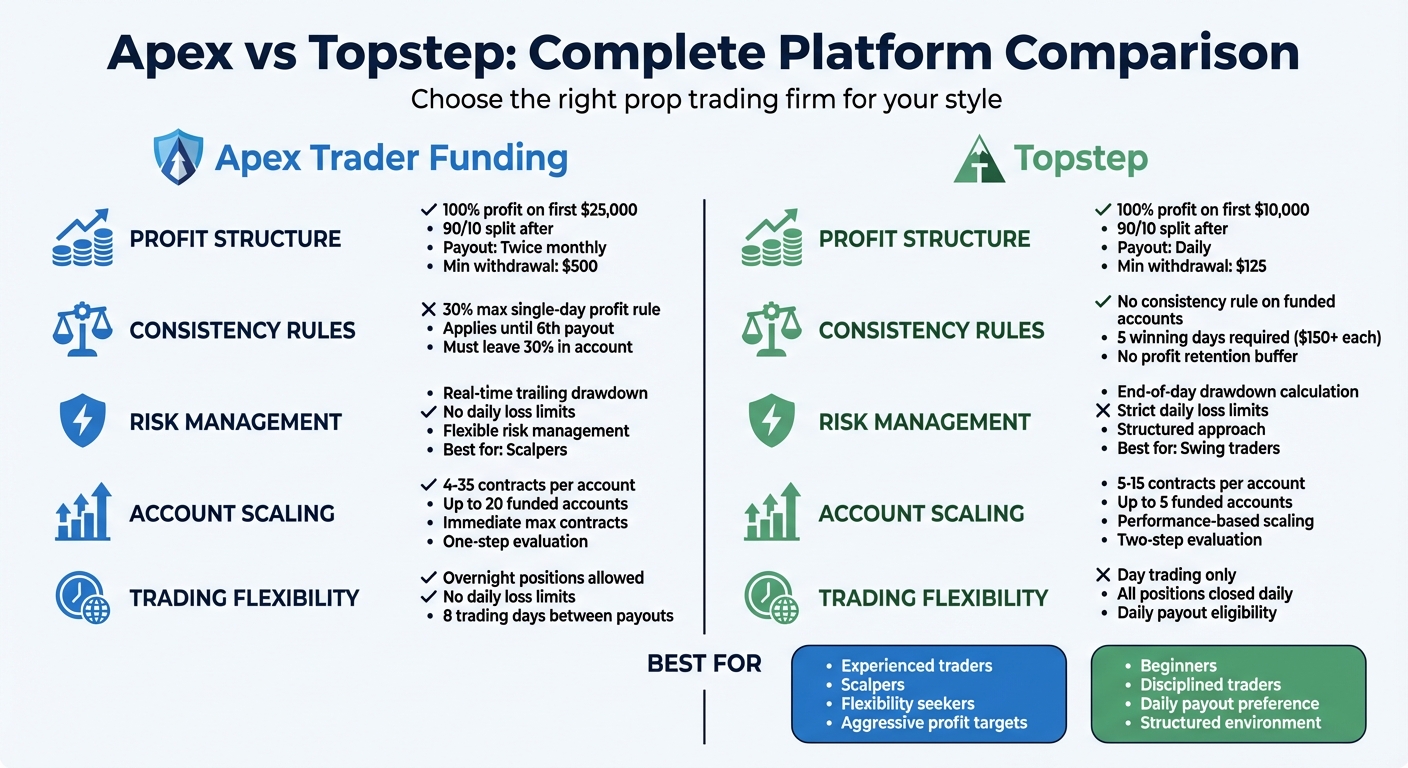
Apex vs Topstep Trading Platform Comparison Chart
Topstep Trader vs Apex Trader Funding In Under 5 Minutes!

sbb-itb-46ae61d
Profit Splits and Payout Structures
This section breaks down the profit splits and payout structures of Apex Trader Funding and Topstep, highlighting their unique approaches to rewarding traders.
Apex Trader Funding Profit Splits
Apex offers traders 100% of their first $25,000 in profits per account. After reaching that amount, the profit split shifts to 90/10, where traders keep 90% of the profits, and Apex retains 10%. Payouts are processed twice a month, with withdrawals taking 8–10 trading days to complete.
Apex also applies a 30% consistency rule, meaning no single trading day can account for more than 30% of the total profits when requesting a withdrawal. For example, if your best trading day nets $1,000 and your total profit is $1,350, you’ll need to grow your total profit to about $3,333 to meet the consistency requirement.
In comparison, Topstep offers a more frequent payout schedule and a simpler withdrawal process, which may appeal to traders who prioritize flexibility.
Topstep Profit Splits
Topstep allows traders to keep 100% of their first $10,000 in profits, after which the split changes to 90/10. Unlike Apex, Topstep processes payouts daily, giving traders quicker access to their earnings. However, before making the first withdrawal, traders must achieve five winning days, with each day generating at least $150 in profit.
Another key difference is that Topstep doesn’t impose a consistency rule on funded accounts, making it a better fit for traders who prefer daily profit benchmarks over long-term consistency.
Profit Splits Comparison Table
| Feature | Apex Trader Funding | Topstep |
|---|---|---|
| 100% Profit Threshold | First $25,000 | First $10,000 |
| Standard Profit Split | 90% Trader / 10% Firm | 90% Trader / 10% Firm |
| Payout Frequency | Twice per month | Daily |
| Days to First Payout | 8–10 trading days | 5 winning days (min. $150/day) |
| Consistency Rule | 30% maximum for a single day | None |
| Payout Buffer Required | Drawdown + $100 | None |
These payout structures cater to different trading styles. Apex is ideal for traders focused on building larger profits with scheduled withdrawals, while Topstep appeals to those seeking faster access to their earnings and fewer restrictions. Each approach offers distinct advantages depending on your trading strategy and financial goals.
Daily Consistency Rules and Profit Limits
When it comes to shaping your trading and earnings strategy, daily consistency rules and profit limits play a key role. Here’s how two major firms, Apex Trader Funding and Topstep, approach these rules.
Apex Trader Funding Consistency Rule
Apex uses a 30% consistency rule that directly impacts when you can withdraw profits. Essentially, no single day’s earnings can exceed 30% of your total profits if you want to make a withdrawal. This rule ensures traders don’t rely solely on one highly profitable day to meet evaluation requirements.
For instance, if you earn $1,500 in one trading session but your total profits stand at $2,000, that single day would account for 75% of your earnings. You can use a futures trading profit calculator to track these daily fluctuations accurately. In this case, you’d need to continue trading until your overall profits grow enough to meet the 30% threshold.
"The 30% Rule in Apex Trader Funding applies to withdrawals from funded accounts. It means you must leave at least 30% of total profits in your account when withdrawing."
- Sarah Edwards, Contributor, Benzinga
While Apex doesn’t impose a strict daily profit cap, this rule requires you to monitor your largest single-day earnings closely. This way, you can ensure eligibility for withdrawals without hitting a roadblock.
Topstep Consistency Requirements
Topstep takes a different route with its Trading Combine evaluation phase, enforcing strict consistency targets. This approach is designed to discourage traders from relying on one big win and then halting trading altogether.
"Topstep’s consistency rules are strict. You can’t just scalp your way to $3,000 in one day and ghost the account."
- TechNests
Topstep also enforces daily loss limits, creating tighter risk controls for traders. While there’s no hard ceiling on daily profits, the consistency requirement during evaluation ensures that success isn’t built on a single standout day. After passing the evaluation, these rules are no longer applied to withdrawals. However, Topstep’s "day trading only" policy requires all positions to be closed before the market closes, which can limit certain trading strategies.
Daily Consistency Rules Comparison Table
| Feature | Apex Trader Funding | Topstep |
|---|---|---|
| Single-Day Profit Cap | No hard cap; 30% rule applies to withdrawals | No specified hard profit cap |
| Consistency Rule | Best day cannot exceed 30% of total profit | Strict during evaluation; not applied after funding |
| Daily Loss Limit | Flexible; based on trader’s own risk management | Set limits imposed by the firm |
| Withdrawal Buffer | Must leave at least 30% of profits in the account | Not specified |
| Trading Hours | Flexible; positions can be held overnight | Day trading only; all positions must be closed daily |
Both firms prioritize disciplined trading over risky, high-stakes wins. Apex’s rules may delay withdrawals but offer more flexibility for traders who hold positions overnight. On the other hand, Topstep’s stricter loss limits and day-trading policy create a more structured environment for risk management.
Drawdown and Risk Management Rules
Understanding drawdown rules is crucial for maintaining your trading account. Apex Trader Funding and Topstep approach risk management in very different ways, and these differences can significantly impact how you trade. Let’s break down how their drawdown policies influence trading strategies.
Apex Trader Funding Drawdown Policies
Apex employs an intraday trailing drawdown, which tracks your unrealized profit and loss in real-time. As your profits grow, the drawdown limit adjusts upward permanently, but it won’t loosen if the market pulls back against you.
"At Apex, this is where accounts die… because of their intraday trailing drawdown rule. Every uptick permanently tightens the space between your position and your liquidation point." – Team Topstep
This setup can be risky for traders who hold positions through market fluctuations. A trade that’s profitable overall could still hit the drawdown limit if it retraces. While this system can work well for scalpers with quick exits, it poses challenges for swing traders who need to weather market volatility.
On the positive side, Apex allows traders to customize their risk parameters, giving them more control over their strategies. Automated safeguards also help prevent exceeding position sizes, reducing errors that could lead to account termination.
Topstep Drawdown Rules
Topstep, on the other hand, calculates its Maximum Loss Limit at the end of the trading day, not during active trades. This means the drawdown doesn’t tighten with every tick as your position moves in your favor.
"Topstep’s Maximum Loss Limit does not trail intraday. It does not tighten behind every tick. It is calculated at the end of the trading day, not during it." – Team Topstep
This method allows for normal market retracements without triggering a violation, making it more forgiving for traders who hold positions longer. However, Topstep imposes strict daily loss limits and enforces maximum position sizes based on your account tier. These rules can help traders who need external discipline but may feel restrictive for those who prefer more flexibility.
Topstep has been recognized for its trader-friendly approach, earning the title of "Best Rules" among futures firms in the 2025 Prop Firm Match Awards.
Drawdown and Risk Management Comparison Table
Here’s a side-by-side look at how the two firms handle drawdowns and risk management:
| Feature | Apex Trader Funding | Topstep |
|---|---|---|
| Drawdown Calculation | Real-time intraday trailing | End-of-day (post-market close) |
| Unrealized Profit Impact | Pulls drawdown limit up permanently | No effect until day close |
| Pullback Tolerance | Very low; retracement can fail account | High; limited only by daily/max loss |
| Daily Loss Limit | User-defined; flexible | Strictly enforced hard limits |
| Position Limits | System-capped | Prescribed by account tier |
| Best For | Scalpers with quick exits | Swing/trend traders needing wider stops |
| Risk Flexibility | High autonomy; self-managed | Low flexibility; structured |
Payout Eligibility and Withdrawal Criteria
With risk management practices covered, it’s time to break down how firms handle payout eligibility. Knowing when and how you can access your earnings is a key factor, especially as it ties into evaluation metrics and risk controls. Let’s dive into the specific payout and withdrawal rules for Apex Trader Funding and Topstep.
Apex Trader Funding Payout Requirements
Apex has a structured approach to payouts. Traders must wait 8 trading days between payout requests and ensure at least 5 of those days show profits of $50 or more. Payouts are processed twice a month. However, until your sixth payout, the 30% Consistency Rule applies.
"The 30% Rule in Apex Trader Funding applies to withdrawals from funded accounts. It means you must leave at least 30% of total profits in your account when withdrawing." – Benzinga
For the first three payouts, Apex also requires a "Safety Net" balance. This is your drawdown limit plus $100, which must remain in the account. Additionally, withdrawal caps apply for the first five payouts, depending on account size (e.g., $2,000 for a $50,000 account). The minimum withdrawal amount is $500.
Payments are handled through Deel, which supports over 150 countries and offers options like bank transfers, PayPal, Wise, and cryptocurrency. The table below provides a quick comparison of these requirements.
Topstep Payout Criteria
Topstep’s rules are a bit different. Traders need 5 winning trading days to make a payout request. A winning day is defined as achieving a net profit of at least $150 (or $200 for legacy dashboard users).
Unlike Apex, Topstep doesn’t enforce a consistency rule for funded accounts. Once you hit the 5-day requirement, you’re good to withdraw – no need to calculate percentages or leave a specific amount behind.
For Express Funded Accounts, traders can withdraw up to $5,000 or 50% of the account balance, whichever is lower. The minimum payout is $125, which is lower than Apex’s $500 threshold. Topstep also processes payouts daily for Live Funded Accounts, providing quicker access compared to Apex’s twice-monthly schedule.
There’s no mandatory profit retention buffer for Express Funded Accounts. However, you must show at least $0.01 in profit since your last withdrawal to qualify for another. Once you log 30 non-consecutive winning days in a Live Funded Account, you unlock daily payouts and full profit access. Check out the table below for a side-by-side comparison of payout criteria.
Payout Eligibility Comparison Table
| Feature | Apex Trader Funding | Topstep |
|---|---|---|
| Min. Trading Days | 8 days (5 days ≥ $50 profit) | 5 winning days (≥ $150 profit) |
| Consistency Rule | 30% rule until 6th payout | None |
| Profit Retention | Safety Net (Drawdown + $100) | Must be $0.01+ profitable |
| Min. Payout Amount | $500 | $125 |
| Max. Payout Amount | Capped by account size | $5,000 or 50% of balance |
| Payout Frequency | Twice monthly | Daily (Live) or per 5 winning days (Express) |
| Payment Methods | Deel (Bank, PayPal, Wise, Crypto) | Not specified |
Account Scaling and Contract Progression
After meeting evaluation and payout criteria, the next step is scaling your trading capacity. Both Apex Trader Funding and Topstep offer ways to grow, but their methods differ quite a bit.
Apex Trader Funding Scaling Rules
Apex gives traders immediate access to the maximum contract limits once the account is funded. With Apex, you can manage between 4 and 35 contracts per account, and an automated system ensures you don’t exceed these limits.
"Apex rewards consistent profits with immediate scaling options. As long as traders stick to Apex evaluation rules, there’s no maximum to what they can earn." – Benzinga
Rather than increasing limits within a single account, Apex allows scaling by managing up to 20 funded accounts.
Topstep Scaling Rules
Topstep takes a performance-based approach, increasing your limits as your account balance grows. Their Dynamic Live Risk Expansion feature automatically raises your Daily Loss Limit as your account grows. Once your account reaches a $100,000 balance, you can contact the Topstep Trade Desk to request higher contract limits.
Topstep also has a "Path to Reduction" system for managing drawdowns. If your account takes a hit, a Risk Manager may issue a "Shoulder Tap", reducing your contract sizes or Daily Loss Limits. Unlike Apex, Topstep caps the number of Express Funded Accounts at five, which is much lower than Apex’s 20-account limit.
Scaling and Progression Comparison Table
Here’s a side-by-side look at how Apex and Topstep compare in terms of scaling and progression:
| Feature | Apex Trader Funding | Topstep |
|---|---|---|
| Contract Limits | 4 to 35 contracts | 5 to 15 contracts |
| Immediate Max Contracts | Yes | No, performance-based |
| Scaling Mechanism | Automated plans based on profit consistency (verified via consistency calculator) | Dynamic Live Risk Expansion |
| Contract Limit Increases | Automated system prevents exceeding limits | Request from Trade Desk at $100,000 balance |
| Max Funded Accounts | Up to 20 accounts | Up to 5 Express Funded Accounts |
| Drawdown Management | automated trailing drawdown enforcement | "Shoulder Tap" by Risk Managers |
| Evaluation Minimum | 7 trading days | 2 trading days |
Conclusion: Choosing Between Apex and Topstep
Deciding between Apex Trader Funding and Topstep ultimately comes down to your trading style, level of experience, and how you approach risk management.
Apex is better suited for experienced scalpers and swing traders who thrive on flexibility. It offers no daily loss limits, allows traders to manage up to 20 funded accounts at once, and features a one-step evaluation process. With 100% profit retention on the first $25,000, Apex appeals to aggressive traders who can navigate its trailing drawdown system. On the other hand, Topstep is ideal for beginners and disciplined day traders. Its structured approach, daily loss limits, and extensive educational resources provide a supportive environment to develop skills. The TopstepX platform has improved evaluation pass rates by 86% compared to older systems, and daily payouts after five winning days ensure consistent cash flow. However, its two-phase evaluation and stricter rules may not appeal to more seasoned traders.
"Apex for ‘freedom,’ TopstepX for ‘discipline’." – PickMyTrade Analysis
Cost is another factor to weigh. Apex’s evaluation fees and monthly costs differ from Topstep’s activation and subscription structure, so it’s important to consider how these align with your budget. Both firms frequently run promotions, allowing traders to save significantly if they time their signups well. These pricing models, combined with each firm’s unique approach to risk and profit management, underline the importance of choosing based on your trading goals.
If you’re looking for rapid scaling and fewer restrictions, Apex – with its higher initial profit thresholds and multiple account options – might be the better fit. However, if daily access to earnings and educational support are priorities, Topstep’s structured environment and quicker payout schedule could be worth the trade-offs. For more detailed reviews and comparisons with other futures prop firms like Take Profit Trader, FundedNext Futures, Alpha Futures, Tradeify, and Lucid Trading, check out DamnPropFirms.
FAQs
How does Apex’s trailing drawdown affect swing trades?
Apex’s trailing drawdown is tied to the account’s highest equity point. This setup lets traders navigate normal market ups and downs without facing instant penalties. It’s particularly helpful for managing risk when holding longer-term swing trades.
Which firm pays out faster in real-world use?
Apex Trader Funding is known for offering quicker payouts compared to Topstep. With Apex, traders can request withdrawals as soon as they meet the payout criteria – there’s no waiting period before they can resume trading. On the other hand, while Topstep is dependable, its payout process may include additional review steps, which can cause delays. For those who value speed, Apex tends to deliver a faster withdrawal experience.
What’s the easiest way to avoid Apex’s 30% consistency rule issues?
To steer clear of Apex’s 30% consistency rule complications, make sure the profit from your single best trading day doesn’t exceed 30% of your total accumulated profit at payout. This means setting realistic daily profit targets and keeping a close eye on your performance. Regularly tracking and reviewing your trading results will help you stay within this threshold and meet the requirement smoothly.