
Discipline is the key to passing prop firm challenges. Most traders fail not due to poor strategies, but because they can’t stick to rules or manage emotions under pressure. Prop firms have strict limits on drawdowns, daily losses, and profit targets, making discipline non-negotiable.
Here’s what you need to focus on:
- Risk Management: Limit risk per trade to 0.25%-0.5% of your account. Keep daily losses below 1.5%-2%, even if the firm allows up to 5%.
- Structured Routines: Prepare before trading, follow a checklist during the session, and review your performance after.
- Trading Plan: Align your plan with the firm’s rules, use realistic goals, and avoid overtrading or revenge trading.
- Emotional Control: Identify triggers like fear or greed, take breaks after losses, and avoid rushing to meet profit targets.
- Accountability: Use a journal to track trades, emotions, and rule adherence. Regularly review your performance for patterns.
Success comes from consistent execution, not quick profits. Stick to your plan, manage emotions, and focus on process-driven goals to increase your chances of securing funding.
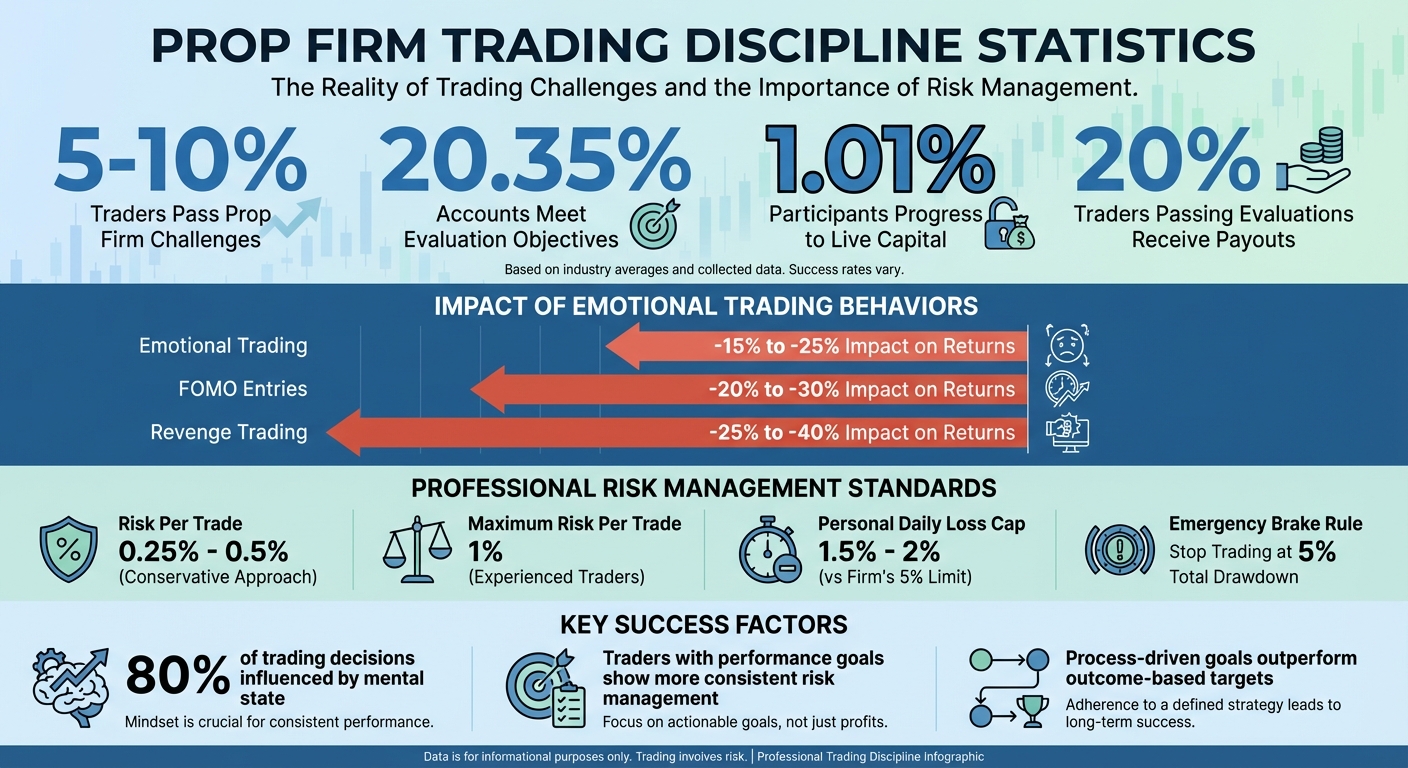
Prop Firm Trading Challenge Success Rates and Discipline Impact Statistics
The Top 7 Reasons Prop Traders Blow Their Accounts (Do This Instead!) | The Trader’s Edge
The Psychological Challenges of Prop Firm Evaluations
Navigating prop firm evaluations isn’t just about mastering technical skills – it’s a test of emotional resilience. The intense pressure of these evaluations often magnifies emotions like fear, greed, impatience, and frustration, making it even harder to stay disciplined.
Here’s a sobering statistic: only 5% to 10% of traders manage to pass these challenges. As FunderPro aptly puts it:
The difference between passing and breaching is rarely the strategy. It is the trader’s ability to stay calm enough to follow it
Let’s dive into the most common discipline challenges and how they can derail even the most skilled traders.
Common Discipline Failures and Their Impact
One of the most destructive behaviors is revenge trading. After a loss, the urge to recover quickly can lead to impulsive decisions – oversized positions, rushed entries, and a total disregard for the trading plan. This behavior often spirals into deeper losses, pushing traders toward breaching their drawdown limits.
Another frequent pitfall is overtrading. Whether driven by boredom or the fear of missing out (FOMO), forcing trades on low-quality setups often eats away at the daily drawdown buffer. Since many prop firms cap daily drawdowns at around 4% to 5%, there’s little room for error when trades are taken out of impatience rather than strategy.
Inconsistent risk levels also wreak havoc. After a winning streak, greed may tempt traders to take on larger positions, while losses can trigger panic, leading to reckless doubling down or complete inaction. Both responses disrupt the mathematical edge that a trading system relies on.
Here’s a quick look at how these behaviors typically impact returns:
| Behavior Pattern | Impact on Returns |
|---|---|
| Emotional Trading | -15% to -25% |
| Revenge Trading | -25% to -40% |
Ego and overconfidence are equally dangerous. A few wins can create a false sense of mastery, leading traders to deviate from their plans or hold positions longer than they should. But in evaluations, consistency in following the rules is far more critical than a short streak of success.
Lastly, the pressure to hit profit targets often results in poor decisions, such as reckless position sizing or poorly timed entries.
Recognizing these behavioral traps underscores why discipline is the cornerstone of successful trading.
Why Discipline Matters for Long-Term Trading Success
For professional traders, success is defined not by daily profits but by their ability to consistently follow their rules. Kyle Janas from Power Trading Group sums it up perfectly:
If you followed your trading rules, it was a good day regardless of profit/loss
This mindset is what separates those who build sustainable trading careers from those who rely on luck. Prop firms enforce rules like "Minimum Trading Days" and consistency requirements to weed out traders who chase profits through high-risk bets instead of disciplined, repeatable processes.
Discipline ensures you stick to your strategy’s statistical edge. For instance, many professional prop traders risk only 0.25% to 0.5% of their account per trade. While this cautious approach may feel slow, it’s vital for surviving losing streaks that can devastate undisciplined accounts.
The evaluation phase isn’t just about proving you can make money – it’s about showing you can protect capital under pressure. Prop firms prioritize traders who focus on capital preservation over aggressive profit-seeking. As FunderPro wisely advises:
Stop trading before you stop thinking
This simple rule captures the essence of discipline. The ability to pause, reset, and stick to your plan when emotions threaten to take over can be the deciding factor between securing funding or joining the majority who fail.
How to Create a Trading Plan for Prop Firm Challenges
Having a trading plan is non-negotiable when tackling a prop firm evaluation. It keeps impulsive decisions at bay and ensures your actions align with the firm’s rules while addressing your personal trading tendencies. Here’s how to craft one that works.
Matching Your Plan to Prop Firm Rules
Start by understanding the specific rules of your chosen prop firm. Most firms impose a daily loss limit of about 5% and a maximum drawdown ranging from 6% to 12%. Some firms use a static drawdown, which stays fixed at your starting balance, while others use a trailing drawdown, which adjusts as your unrealized profits grow. Familiarize yourself with these rules and build your plan around them.
Consistency rules are another critical factor. For example, Tradeify caps single-day profits at 20% to 35% of your total earnings. If your biggest winning day is $1,000 and the rule is 20%, you’ll need at least $5,000 in total profits to qualify for a payout.
Operational restrictions also play a role. Many firms limit trading during high-impact news events, such as CPI or FOMC announcements, often restricting activity for 2 to 5 minutes before and after the release. Additionally, accounts can be terminated after 21 to 30 days of inactivity. These rules should serve as strict boundaries in your plan.
As MyFundedFutures advises:
If you can’t summarize your plan on one page, it’s too complicated
Keep your plan concise. Use a single-page summary for daily reference, with detailed strategy rules stored separately. This keeps you focused and avoids overthinking during live trades.
Once you’ve defined the firm’s limits, adjust your risk management practices to align with them.
Setting Risk Management and Position Size Rules
One of the biggest mistakes traders make is pushing their risk to the firm’s maximum limits. Instead, aim to stay well below these thresholds. Professional prop traders typically risk between 0.25% and 0.5% per trade. Seasoned traders might go up to 1%, but during an evaluation, it’s best to stay conservative. Set a personal daily loss cap of 1.5% to 2% – this helps protect you from emotional trading and the temptation of "revenge trading" after losses.
Use a position size calculator for every trade. This ensures your position size adjusts dynamically based on your stop-loss, keeping your risk percentage consistent.
Implement an "emergency brake" rule: if your total account drawdown hits 5%, stop trading for a week. Use that time to review your strategy and reset mentally.
| Risk Metric | Firm’s Typical Limit | Your Plan Recommendation |
|---|---|---|
| Max Daily Loss | 5% (Static) | 1.5%–2% personal cap |
| Risk Per Trade | – | 0.25%–0.5% for steady progress |
| Max Total Drawdown | 6%–12% | Stop trading at ~50% of the limit |
Creating Realistic and Measurable Goals
Success in trading isn’t just about hitting profit targets – it’s about setting achievable, process-driven goals. Instead of obsessing over an 8%–10% profit target, focus on executing 2 to 3 high-quality trades per day. Define what makes an “A+” setup in your plan, such as trend alignment, clear support/resistance levels, and a risk-to-reward ratio of at least 1.5:1.
Track your expectancy rather than fixating on your win rate. For instance, a trader with a 50% win rate and a 2:1 risk-to-reward ratio can expect a positive outcome of $50 per trade. Break your goals into weekly milestones instead of daily targets. If you need $4,000 to pass the challenge, aim for $1,000 per week over four weeks. This approach reduces daily pressure and keeps your focus on consistent execution, even on days with small losses or break-even results.
Stick to the firm’s profit consistency rules by spreading your targets across weekly checkpoints. This method reinforces the steady discipline required during evaluations.
As ATFunded puts it:
In trading, luck doesn’t last. Structure does
Your plan should feel straightforward – if it feels thrilling, you’re probably taking on too much risk. Commit to following your checklist for 30 days. Over time, this repetition will solidify discipline into a natural habit.
Developing Daily Routines for Consistent Discipline
Creating structured daily routines is a game-changer when it comes to sticking to prop firm rules and avoiding emotional decision-making. A solid routine takes the guesswork out of your day and helps you stay composed, especially when dealing with the strict requirements of prop firm challenges. Divide your day into three main phases: preparation before the market opens, execution during live trading hours, and review after the session ends.
Pre-Market Preparation Routines
Dedicate the 30 minutes before the market opens to get mentally prepared and organize your trading environment. Start by rating your sleep, stress, and readiness on a 1–5 scale. If your score falls below 3, consider skipping trading for the day. This simple step can help you avoid costly decisions driven by fatigue or anxiety – factors that influence an estimated 80% of trading decisions.
Next, review the overnight price action and mark key levels on your charts, such as the previous day’s highs and lows, support/resistance zones, and moving averages. Check the economic calendar for major events like FOMC or CPI announcements. Many prop firms, including Apex Trader Funding and Topstep, enforce strict rules around trading during these high-impact events, often restricting activity 2–5 minutes before and after announcements.
Review your one-page trading plan to solidify your entry and exit criteria. As Team Topstep aptly puts it:
If you can’t explain your strategy in a sentence, you don’t own it
Double-check your internet connection and platform settings. A simple technical issue, like a Wi-Fi dropout during a volatile market, could lead to a breach of prop firm drawdown limits.
Here’s a quick breakdown of your pre-market routine:
| Phase | Activity | Duration |
|---|---|---|
| Mindset | Deep breathing, rating mental state | 5–10 mins |
| Analysis | Reviewing overnight action, marking key levels | 15–20 mins |
| News Check | Checking economic calendar and firm restrictions | 5 mins |
| Strategy | Reviewing entry/exit rules | 5 mins |
| Technical | Verifying Wi-Fi, platform settings, organizing workspace | 5 mins |
Once you’ve completed these steps, you’ll be ready to focus on disciplined execution during live trading.
Staying Focused During Live Trading
When the market opens, your primary task is to stick to your predefined trading criteria. Only take trades that meet your checklist requirements. To avoid getting caught up in minor price movements, set price alerts for key levels. Staring at every tick can lead to emotional reactions and FOMO-driven trades, which studies show can reduce returns by 20% to 30%.
Implement a circuit breaker: if you take two emotional trades or one significant loss, step away for an hour. This cooling-off period is crucial to avoiding revenge trading, which can wipe out 25% to 40% of your capital. Keep your focus narrow by trading just 2–3 instruments. Spreading your attention too thin makes it harder to stay within the strict drawdown limits of prop firm challenges.
Above all, prioritize following your rules over immediate profit or loss. As Kyle Janas from Power Trading Group puts it:
If you followed your trading rules, it was a good day regardless of profit/loss
Stick to fixed trading hours. Overtrading due to fatigue is a common pitfall that often leads to avoidable losses.
After your trading session, shift your attention to reviewing and refining your approach for the next day.
End-of-Day Reviews and Adjustments
Set aside 30 minutes after the market closes to review your performance. This step is essential for reinforcing discipline and staying aligned with your trading plan and prop firm requirements. Start by scoring your discipline adherence on a 1–10 scale. Remember, a "good day" is defined by following your plan, even if you end up with a small loss.
Check whether your trades were executed at the planned levels and aligned with your strategy. Take screenshots of your setups and annotate your charts to objectively compare your execution with your ideal plan. Reflect on your emotional state during trades – were you feeling fear, greed, or impatience? Note any physical signs like tension or restlessness. Calculate key daily stats, such as win rate, average win/loss, drawdown, and profit factor. These metrics will serve as the foundation for your weekly and monthly reviews.
Identify the root cause of any rule violations and outline one actionable step to address it. For example, if you entered a trade without fully reviewing your checklist, your next-day action could be: "Rate setup confidence on a 1–5 scale before clicking the buy button." As MyFundedFutures wisely states:
A lucky win outside the plan is a red flag, not a success
If your review shows a pattern of emotional trades, consider switching to a simulator for the next session or taking a day off. Wrap up your review by updating your watchlists and marking key price levels for the following day. This ensures you’re ready to start the cycle again with a clear and focused mindset.
sbb-itb-46ae61d
Using a Trading Journal to Track Accountability
A trading journal is one of the most effective tools for staying accountable during prop firm challenges. It transforms discipline into measurable data, giving you a clear picture of your trading behavior. Without it, you’re left relying on memory and emotions – two things that can easily lead you astray. Rayner Teo, Founder of Trading with Rayner, emphasizes this point:
A trading journal is a deciding factor of whether you’ll be a consistently profitable trader – or loser
The gap between the 5% of traders who succeed and the 95% who don’t often comes down to whether they track their actions systematically. By recording key details – like entry points, position sizes, stop losses, emotional states, and market conditions – you can uncover not just what happened but why it happened. More importantly, you’ll see whether you followed your plan.
What to Record in Your Trading Journal
Your trading journal should go beyond daily reviews to provide deeper insights for long-term growth.
Start with the basics: date, time, trading session (London, NY, Asia), instrument, timeframe, position size, and entry/exit prices . Don’t forget to include your initial stop loss, profit target, and the final result, measured in R-multiples (risk units) instead of dollar amounts. This approach helps you stay objective and reduces emotional bias toward specific monetary figures.
Add a "Followed Plan (Y/N)" column to track how well you stick to your strategy. As Team Topstep explains:
The worst trades aren’t losers. They’re trades you didn’t plan
You should also log your setup type (e.g., Trendline Retest or VWAP Reclaim) and the current market environment (trending or ranging). Be aware of major news events and their timing, as these can heavily influence your trades.
Another key aspect to record is your emotional state before and during each trade – whether you felt calm, anxious, or impulsive. Tracking these emotions can reveal patterns, like revenge trading after losses or FOMO-driven decisions during volatile markets . Including screenshots of your charts adds valuable context, making it easier to spot recurring setups or mistakes .
For funded accounts, take it a step further by tracking advanced metrics like Maximum Adverse Excursion (MAE) and Maximum Favorable Excursion (MFE). These metrics show how far a trade moved against or in your favor before closing, helping you refine your stop-loss placements and profit targets. Log your trades within 24 hours to ensure the details are fresh and accurate .
Conducting Weekly and Monthly Self-Reviews
While daily entries are crucial, weekly and monthly reviews help you identify bigger performance trends. A well-maintained journal makes these evaluations much easier.
For weekly reviews, assess whether you followed your plan, sized positions correctly, and traded in harmony with the market conditions. Sort your entries by setup type or trading session to uncover patterns. For instance, you might find that your breakout strategy struggles during the Asia session or that range-bound trades fail when the market is trending. As Funding Rock puts it:
Expectancy shows whether your system works; adherence shows whether you work. A good system with bad adherence still fails
Calculate your system’s expectancy each week to determine whether losses stem from execution errors or just bad luck. You can also color-code your entries – green for disciplined trades that followed your plan, red for impulsive or rule-breaking ones. This visual cue makes it easier to spot trends at a glance .
Monthly reviews should focus on your overall stats and risk management. Track key metrics like your win rate, average R-multiple, and maximum drawdown. Use this data to adjust your position sizing based on facts, not emotions. If you notice a habit of overtrading after losses, implement strict rules – like taking a mandatory one-hour break after your first stop-out.
A 2020 study in the Journal of Behavioral Finance found that traders with clear performance goals showed more consistent risk management and achieved better long-term results. Review winning trades as thoroughly as losing ones; a profitable trade that ignored your plan is a warning sign, not a success. The ultimate goal is to build a repeatable system, not rely on luck. Use time-based stats to identify when you’re prone to "boredom trading" during low-volume periods – these trades often lead to unnecessary losses.
Managing Emotions During Prop Firm Evaluations
Mastering your emotions in real time is just as crucial as tracking your trades. When it comes to prop firm evaluations, emotional control often outweighs technical skills. While many traders dedicate 90% of their time refining strategies, success in these evaluations often hinges on managing fear, greed, and frustration under pressure. The gap between the 5%–10% who pass and those who don’t is often a matter of emotional discipline.
Letting emotions dictate your trades can seriously hurt your performance. Emotional trading alone can slash returns by 15%–25%, and behaviors like revenge trading can cut gains by as much as 40%. These aren’t minor setbacks – they can mean the difference between passing an evaluation or starting over from scratch.
Identifying Your Emotional Triggers
The first step in managing emotions is identifying what triggers them. Four key emotions tend to derail traders during evaluations:
- Fear: Leads to hesitation or prematurely closing trades.
- Greed: Results in overtrading or ignoring risk rules.
- Frustration: Sparks revenge trading after losses.
- Euphoria: Fuels overconfidence and reckless decisions.
Your brain processes market data in two ways. System 1 is fast and emotional, reacting instinctively to price movements and encouraging impulsive behavior. System 2, on the other hand, is slow and logical, helping you analyze data and stick to your plan. Discipline means training yourself to operate in System 2 mode.
Two cognitive biases can amplify these emotional triggers. Loss aversion makes losses feel twice as painful as equivalent gains are satisfying. Meanwhile, recency bias causes you to overemphasize your most recent trades – winning streaks can lead to overconfidence, while losing streaks may trigger panic.
To combat this, log your emotional state alongside trade details. Track your stress levels, feelings, and conditions. Over time, patterns may emerge – like overtrading in the afternoon or chasing setups when you’re behind on your profit target. Recognizing these patterns is the first step toward addressing them.
Practical Techniques for Emotional Control
Once you’ve pinpointed your triggers, it’s time to take action. Here are some strategies to help you stay in control:
- Set strict rules: For example, if you experience two consecutive losses, step away for 30 minutes. Pre-planned responses like this prevent impulsive decisions when emotions run high.
- Pre-trade preparation: Spend 3 minutes on deep breathing or visualization before trading. Picture yourself calmly executing trades and accepting potential losses. A quick workout before trading – about 30 minutes – can also help reduce stress.
- Take regular breaks: Step away from your screen for 5 minutes every hour to avoid fatigue and overanalysis.
- Use a checklist: Print out a checklist to ensure every trade meets your objective criteria. This helps you rely on data rather than gut feelings.
- Normalize risk: Limit your risk per trade to 0.25%–0.5% of your account. This keeps individual trades manageable and reduces the emotional impact of losses.
Here’s a quick summary of how certain behaviors impact returns and the fixes to address them:
| Behavior Pattern | Impact on Returns | Recommended Fix |
|---|---|---|
| Emotional Trading | -15% to -25% | Stick to objective, rule-based strategies |
| FOMO Entries | -20% to -30% | Remind yourself there’s always another setup |
| Revenge Trading | -25% to -40% | Take mandatory breaks after losses |
These techniques help you stay disciplined and avoid the rush that can sabotage your evaluation.
Avoiding the Rush to Pass Evaluations
Rushing to pass an evaluation is one of the biggest emotional pitfalls. When traders try to meet profit targets quickly, they often abandon their edge and start gambling. Setting outcome-based goals like “pass in 5 days” creates unnecessary pressure. Instead, focus on process-based goals such as “stick to my plan with 100% discipline for 10 days.” This shift reduces stress and supports consistency.
“Amateurs trade the charts. Pros trade their mindset.” – The Forex Online School
Rushing often leads to over-leveraging or taking poor setups in desperation, which increases the risk of breaching daily or maximum drawdown limits. A single emotional mistake can derail your evaluation. The best traders prioritize protecting their capital over chasing quick profits – that’s the mindset for long-term success.
Reframe how you view the evaluation. Instead of fixating on the profit target, commit to executing your plan flawlessly for a set number of days. Treat losses as “business costs” rather than personal failures. As The Forex Online School wisely puts it:
“Losses = data, not failure.” – The Forex Online School
To build confidence, backtest at least 100 trades before starting your evaluation. This gives you a clear understanding of your system’s long-term performance, which can help you stay calm during losing streaks. Knowing your system’s expectancy allows you to trade with confidence, even when the market isn’t going your way.
End your trading session when your decision-making is sharp, rather than squeezing in “one more trade” when you’re tired. Limit your exposure to financial news and social media by scheduling specific times for updates. This helps you avoid emotional reactions to market noise. Creating a dedicated trading space and setting fixed hours can also help you maintain focus and avoid burnout.
Finally, after each session, rate your discipline on a scale of 1 to 10 and write down one sentence about what went well. This simple practice builds self-awareness and reinforces good habits. Remember, only about 20% of traders who pass evaluations actually receive payouts. Emotional control and unwavering commitment to your process are what truly set successful traders apart.
Conclusion
Achieving success in a prop firm evaluation goes beyond just having a great strategy or impeccable timing. It’s about sticking to a structured plan, maintaining consistent routines, and mastering emotional discipline. Your trading plan lays out the rules, daily habits reinforce those rules, and emotional control ensures you don’t stray from them.
The statistics are sobering: only 20.35% of accounts meet evaluation objectives, and a mere 1.01% of participants progress to trading live capital. Clearly, technical skills alone aren’t enough – discipline is what separates those who succeed from those who fall short.
"Trading discipline isn’t a destination – it’s a daily practice"
To build this discipline, start with the basics. Create a one-page trading plan that includes clear entry and exit rules, a minimum 1:2 risk-to-reward ratio, and a risk limit of 0.5%–1% per trade. Use simple if-then rules to guide your actions – for example, stepping away for 30 minutes after two consecutive losses – and aim for 100% adherence to these rules over a 10-day period.
Incorporate daily journaling into your routine. Record not just your trade data but also your emotions, and rate your discipline on a scale of 1 to 10 after each session. This habit fosters accountability and helps you spot recurring patterns, like revenge trading after losses or overconfidence during winning streaks. By sticking to a validated plan and measured routine, you’ll align with prop firm rules and cultivate the discipline necessary for long-term success.
FAQs
How can I stay emotionally disciplined during prop firm challenges?
Staying in control of your emotions during prop firm challenges is no small feat. It takes self-awareness and practical strategies to keep emotions like fear, greed, frustration, and overconfidence from clouding your judgment. The starting point? Recognize how these feelings influence your decisions and commit to staying calm and focused.
One way to stay grounded is by setting clear daily goals. These could include sticking to your trading plan or steering clear of impulsive decisions. Pair this with professional risk management: use stop-loss orders and keep your position sizes in check to prevent emotional reactions from spiraling out of control. On top of that, stress-management techniques – like deep breathing exercises or maintaining a structured routine – can help you stay mentally sharp when the pressure is on.
When you combine self-awareness, careful planning, and strong risk management, you create the emotional discipline needed to navigate prop firm challenges successfully.
What are the main discipline challenges in prop trading, and how can traders overcome them?
Discipline issues in prop trading often stem from behaviors like overtrading, chasing losses, ignoring risk management rules, or falling prey to emotional triggers such as FOMO (fear of missing out) or revenge trading. These habits can result in impulsive decisions, taking on unnecessary risks, and ultimately failing to achieve challenge objectives.
To tackle these hurdles, traders should prioritize developing consistent habits. One effective approach is setting process-oriented goals – like adhering to specific trade setups and maintaining strict risk limits – rather than fixating solely on profit targets. Establishing a structured daily routine that includes pre-trade planning, regular performance reviews, and strategies for managing emotions can also reinforce discipline. Learning to identify and handle emotions like fear or frustration is critical to staying in control and avoiding rash decisions.
By committing to consistency, emotional regulation, and a well-thought-out trading plan, traders can sidestep common mistakes and enhance their chances of succeeding in prop firm challenges.
How can I create a trading plan that meets prop firm requirements?
To build a trading plan that works within the framework of a prop firm’s rules, start by outlining your trading goals. These goals should cover both short-term and long-term ambitions, while also detailing your approach to entries, exits, and position sizing. A well-structured plan is key to staying disciplined and consistent.
Focus on a small selection of markets or instruments – ideally two or three – that align with your trading style and the firm’s specific requirements. For example, consider factors like drawdown limits or minimum trading days. Clearly document your strategies and setups, making sure they are simple and repeatable.
Lastly, incorporate the prop firm’s rules directly into your plan. This includes adhering to daily loss limits, any restrictions on trading during news events, and platform-specific guidelines. A straightforward, rule-compliant plan not only boosts your chances of success but also helps you steer clear of any violations.