Prop trading in Germany offers traders access to firm-funded accounts, reducing personal financial risk. However, understanding local regulations, taxes, and account structures is critical. Here’s a quick breakdown:
- BaFin Regulation: Germany’s financial authority, BaFin, does not regulate firms offering simulated prop trading accounts since they don’t handle real funds or brokerage services.
- Taxation: Prop trading income is taxed as "other income" at progressive rates (14%-45%) instead of the flat 25% capital gains tax. Expenses like evaluation fees and software are deductible.
- Germany-U.S. Tax Treaty: U.S.-based traders can avoid double taxation by claiming a Foreign Tax Credit for German taxes paid.
- Live Accounts: Most prop firms provide simulated accounts, with payouts based on performance rather than real-market trades. SEPA transfers are a preferred payout method for German residents.
BaFin Regulations for Prop Trading
What BaFin Does
BaFin, Germany’s financial regulatory authority, oversees banks, brokers, insurers, and investment firms. Since its establishment in 2002 through a merger, BaFin has operated under the Banking Act (KWG) and the Securities Trading Act (WpHG). Its responsibilities include monitoring market activity, licensing financial institutions, and enforcing anti-money laundering (AML) standards across the financial sector.
For example, in 2021, BaFin fined Deutsche Bank AG €8.66 million for failing to maintain adequate systems to ensure the integrity of input data. This case highlights BaFin’s readiness to hold even major financial institutions accountable when they fail to meet compliance requirements.
Compliance Rules for Prop Firms
Currently, BaFin does not regulate proprietary trading firms that solely offer simulated-account evaluation programs. As of March 2026, no major proprietary trading firm holds a BaFin license. These firms are outside BaFin’s purview because their evaluation accounts do not involve real brokerage services, regulated financial products, or the custody of client funds.
However, firms engaged in proprietary trading as a service for third parties or those involved in high-frequency trading must comply with BaFin regulations. These firms would need a BaFin license and must adhere to strict compliance standards, including risk-based AML and counter-terrorism financing (CFT) measures, Know Your Customer (KYC) and Customer Due Diligence (CDD) processes (such as screening for politically exposed persons), and BAIT IT security requirements.
For traders, the relationship with a proprietary trading firm is governed by contract law rather than financial market regulation. As of March 2026, proprietary trading remains fully legal in Germany, and residents can participate in international funded trader programs without restrictions.
How U.S. Traders Can Verify Compliance
U.S. traders should take proactive steps to verify a firm’s legitimacy, especially since most proprietary trading firms do not require BaFin licenses. A key indicator of compliance is whether the firm accepts standard German IDs, such as a Personalausweis or Reisepass, for KYC verification, ensuring alignment with EU AML standards. If a firm skips identity verification, it may signal non-compliance with AML regulations.
If a firm claims to be "BaFin Regulated", traders can verify this by checking BaFin’s public database of licensed banks, financial services providers, and investment firms. This database provides transparency about which entities hold regulatory licenses. Additionally, firms with clear terms and conditions, profit-sharing models across prop firms, and detailed risk management disclosures often demonstrate higher compliance standards.
Before signing up, U.S. traders should confirm that the firm accepts U.S. residents and supports local KYC documentation. It’s also important to verify whether the firm supports SEPA transfers, which can help avoid costly currency conversion fees. A lack of these operational features might indicate a less reliable or potentially problematic firm. By following this verification process, traders can better understand the operations and reliability of live trading accounts.
sbb-itb-46ae61d
Prop Trading in Deutschland: Alles Wichtige auf einen Blick | Steuerberater Roland Elias
Tax Rules for Prop Trading in Germany
Prop Trading vs Capital Gains Tax Comparison in Germany
German Tax Rules for Trading Profits
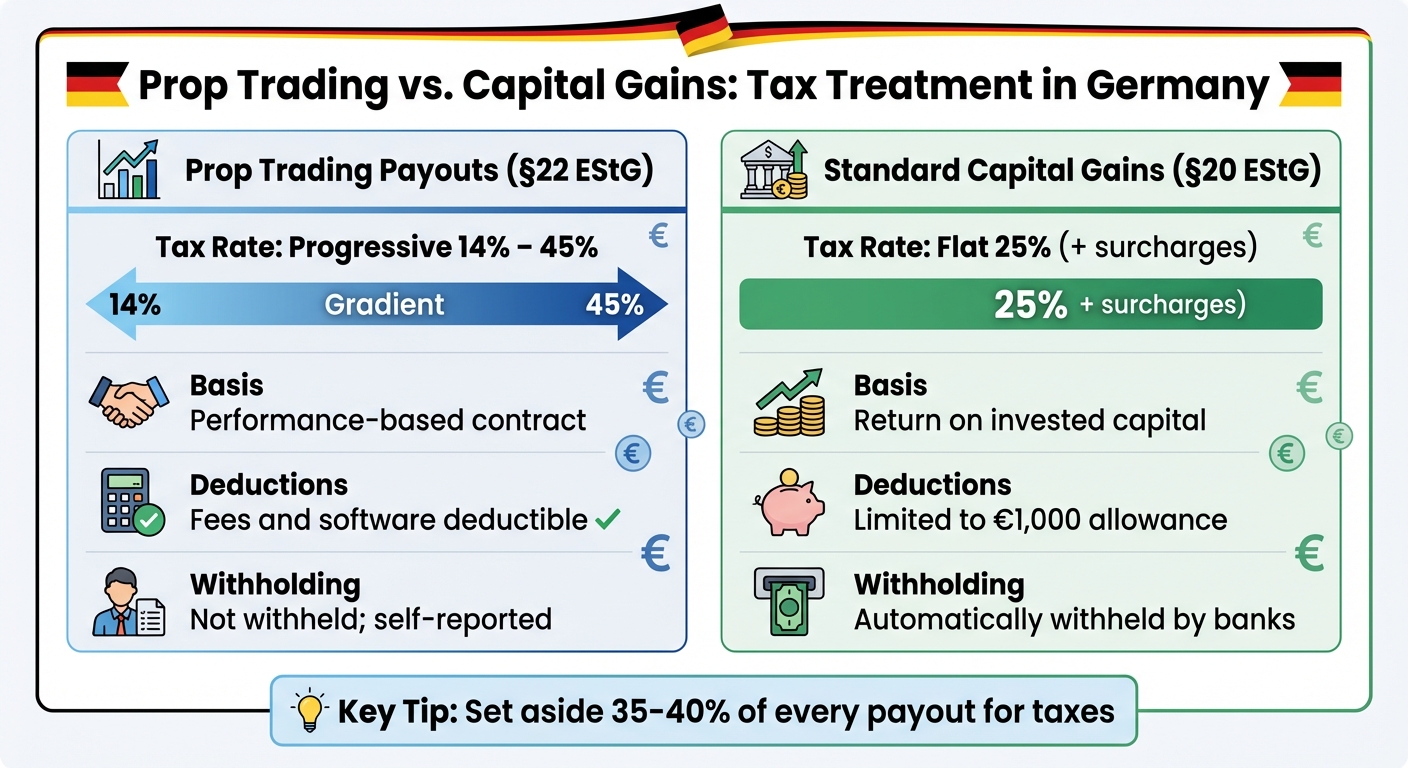
In Germany, prop trading payouts fall under the category of "other income" (sonstige Einkünfte) as defined in §22 EStG, rather than being treated as capital gains. This classification significantly impacts how taxes are calculated. Instead of the flat 25% capital gains tax (Abgeltungsteuer) applied to regular investments, prop trading income is taxed progressively, with rates ranging from 14% to 45%, depending on your total income. This distinction stems from the nature of prop trading, where payouts are tied to performance rather than returns on personal invested capital.
Certain expenses, such as evaluation fees (whether you pass or fail), trading software subscriptions, and data feed costs, can be deducted as income-related expenses (Werbungskosten), which helps lower your taxable income. For most traders, registering as a business (Gewerbeanmeldung) isn’t necessary unless prop trading becomes your primary income source, typically exceeding €2,000 per month.
| Feature | Prop Trading Payouts (§22 EStG) | Standard Capital Gains (§20 EStG) |
|---|---|---|
| Tax Rate | Progressive (14% – 45%) | Flat 25% (+ surcharges) |
| Basis | Performance-based contract | Return on invested capital |
| Deductions | Fees and software deductible | Limited to €1,000 allowance |
| Withholding | Not withheld; self-reported | Automatically withheld by banks |
To avoid surprises, prop traders in Germany should set aside 35% to 40% of every payout for taxes. Since most prop firms are based outside Germany (e.g., in the U.S., UK, or UAE), they don’t report your earnings to the German Finanzamt. This places the responsibility for proper declaration entirely on you. Up next, let’s look at how the Germany-U.S. tax treaty helps prevent double taxation.
Germany-U.S. Tax Treaty
Germany’s domestic tax rules are further shaped by the Germany-U.S. tax treaty, which governs how cross-border income is taxed. Both countries tax worldwide income. For U.S. citizens and green card holders, this means reporting global earnings to the IRS no matter where they reside. This overlap can lead to double taxation on prop trading income if not handled properly.
The treaty addresses this issue with the Foreign Tax Credit (FTC). Using IRS Form 1116, you can claim a credit for taxes paid to Germany, directly reducing your U.S. tax liability. However, the treaty includes a "Saving Clause", allowing the U.S. to tax its citizens as if the treaty didn’t exist. Thankfully, the FTC ensures you won’t pay taxes twice on the same income.
"The U.S.-Germany income tax treaty steps in as the grown-up at the table: it decides which country taxes which slice of your income, tells the other one to ease off (via a credit or an exemption), and often cuts withholding tax on dividends and interest." – Katelynn Minott, CPA & CEO, Bright!Tax
If you’re a U.S.-based trader without a physical presence in Germany, Article 5 of the treaty may mean Germany doesn’t have the primary right to tax your business income. Tie-breaker rules – based on factors like permanent home, center of vital interests, habitual abode, and nationality – determine which country has taxing rights if you qualify as a resident in both.
Filing Taxes as a Prop Trader
Navigating both domestic tax laws and treaty provisions is key to filing your taxes correctly. U.S.-based traders must report all worldwide income. If you earn over $600 through a U.S. prop firm, you’ll likely receive a 1099-NEC form, though overseas firms aren’t required to issue one. The self-employment tax rate for U.S. traders in 2026 is 15.3% on the first $168,600 of net earnings.
Keep detailed records of payout statements, fee receipts, and bank transfers, similar to how you would track funded accounts. Use the European Central Bank (ECB) reference rates for USD-to-EUR conversions. A dedicated bank account for your prop trading activity can simplify tracking and create a clear paper trail for the Finanzamt.
If you’re claiming treaty-based tax relief, file Form 8833 (Treaty-Based Return Position Disclosure). Additionally, U.S. traders with foreign account balances exceeding $10,000 at any time must file an FBAR (FinCEN Form 114).
Given the complexities of international tax law, consulting a tax advisor with experience in cross-border income is highly recommended. Initial consultations typically cost between €200 and €500. To avoid hefty year-end tax bills, consider making quarterly advance tax payments (Vorauszahlungen) in Germany. U.S.-based traders should also make estimated tax payments quarterly, due mid-April, mid-June, mid-September, and mid-January.
How Live Accounts Work in Germany
Live Account Structure and Features
In Germany, most proprietary trading firms provide simulated accounts rather than traditional live accounts. This means trades are executed in a demo environment instead of directly on real exchanges. The payouts you receive are based on your performance within this simulated setup, not on profits generated from actual invested capital.
Because these accounts don’t involve real brokerage services or the handling of customer funds, they operate outside the jurisdiction of BaFin (Germany’s financial regulatory authority). Essentially, they function as performance contracts. Once you pass an evaluation and secure funding, you trade on the firm’s simulated trading platform, and your earnings are determined by the profit-sharing terms outlined in your agreement.
For German residents, identity verification is mandatory and typically requires either your Personalausweis (German ID card) or Reisepass (passport). Most firms accept these documents without complications. When comparing the best futures prop firms, it’s wise to prioritize those that support SEPA bank transfers. This allows you to receive payments in EUR directly into your Girokonto (German bank account), avoiding currency conversion fees. Notable examples include Lucid Trading and FundedSeat, both of which cater to European traders with direct EUR transfer options.
Benefits of Live Accounts for Futures Traders
Simulated accounts come with several advantages for futures traders. Perhaps the most appealing is access to significant trading capital without risking your own money. Account sizes often range from $25,000 to $250,000 or more, allowing traders to scale their operations far beyond what they might manage independently.
Another perk is the tax treatment. Evaluation fees, along with costs for trading software, data feeds, and platforms, are typically deductible on your German tax return. This can be a major advantage compared to traditional brokerage accounts, where profits are subject to the flat 25% Abgeltungssteuer (capital gains tax) with limited opportunities for deductions.
Common Problems with Live Accounts
Despite the benefits, live accounts come with their own set of challenges. One frequent issue is meeting consistency requirements. Many firms impose rules that limit the percentage of profits you can earn in a single day, encouraging steady performance across multiple trading sessions.
Taxation is another area where traders often stumble. Since many overseas firms don’t report earnings to the German Finanzamt (tax office), you’re responsible for declaring this income yourself. To avoid surprises, it’s recommended to set aside 35%-40% of each payout for taxes. For instance, if you earn €50,000 from your regular job and an additional €20,000 from prop trading, your marginal tax rate on the trading income could climb to around 42%.
Lastly, finding a tax advisor familiar with the nuances of prop trading can be tricky. It’s a good idea to budget between €200 and €500 for an initial consultation with someone experienced in international income and digital entrepreneurship. Addressing these challenges – consistency requirements, tax obligations, and professional advice – can help ensure a smoother trading experience.
Choosing Futures Prop Firms for Germany
What to Look for in a Prop Firm
When selecting a futures prop firm in Germany, it’s essential to consider operational and technological aspects to ensure smooth trading and compliance. Start by reviewing the payout methods. Opt for firms that support SEPA transfers and accept German IDs like the Personalausweis or Reisepass. SEPA transfers are not only reliable but also help avoid currency conversion headaches, making it easier to manage documentation for your Finanzamt.
Another crucial factor is the drawdown rules. Firms may use either End-of-Day (EOD) or trailing drawdown. EOD drawdown, calculated after market close, is more forgiving during volatile sessions. Interestingly, traders using EOD drawdown reportedly have an 83% higher pass rate compared to those dealing with real-time trailing drawdown adjustments. Additionally, check for consistency rules, which might limit daily profits. Some firms, like Tradeify and Apex Trader Funding, have eliminated these restrictions, giving traders more flexibility.
Lastly, ensure platform compatibility. Leading firms often support professional platforms like NinjaTrader 8, Tradovate, and TradingView, paired with Rithmic data feeds for ultra-low latency (sub-1 millisecond).
Top Futures Prop Firms
Once you’ve identified the features you need, compare firms based on their reliability and support. For example, TakeProfitTrader and Lucid Trading both boast a 4.9/5 rating. Lucid Trading stands out for offering direct SEPA payouts, making it a strong choice for European traders. Similarly, Tradeify offers 50K account evaluations starting at $139, with profit splits ranging from 80% to 90%.
FundedNext Futures holds a 4.8/5 rating and is known for its attractive cost-to-funding ratio. On the other hand, Apex Trader Funding scores 3.9/5, offering specialized tools for German traders but with stricter rules. Evaluation periods for most firms last 7-14 days, and profit splits can reach up to 80% once you pass. For budget-conscious traders, Leeloo Trading offers entry points as low as $26.
Trading Tools and Discounts
Maximizing your trading efficiency often involves using advanced tools and taking advantage of discounts. Platforms like DamnPropFirms provide resources to help traders optimize performance while reducing costs. For instance, their Consistency Rule Calculator helps you understand daily profit limits if your firm enforces consistency requirements. Active promo codes can also significantly reduce evaluation fees. A 50K account that typically costs $150 might drop to $100-$120 with a valid discount.
For those managing multiple accounts, tools like TradeSyncer simplify the process by copying trades across accounts, allowing for easier scaling without manual effort. Additionally, a dedicated Discord community offers ongoing support, sharing insights and callouts on firm benefits to help traders stay ahead in their journey.
Conclusion
Key Takeaways
In Germany, prop trading operates outside BaFin regulations because simulated evaluations don’t involve regulated financial products or the custody of funds. This provides more trading flexibility but also means it’s on you to verify the legitimacy of the firms you work with.
Prop trading payouts fall under sonstige Einkünfte (other income) per §22 EStG and are taxed at progressive rates between 14% and 45%, instead of the flat 25% rate. To stay prepared, set aside 35–40% of your payouts for taxes. The good news? Expenses like evaluation fees and software subscriptions are deductible, which can lower your taxable income. Be sure to keep thorough records and use ECB reference rates for USD-to-EUR conversions when reporting to the Finanzamt.
Once you pass evaluations, live accounts provide access to real trading capital, with typical profit splits ranging from 80% to 90%. If your monthly trading income consistently exceeds about $2,200 (€2,000), you may need to register a business (Gewerbeanmeldung), though most casual traders are likely to stay under this threshold.
These points are essential for staying on top of your regulatory and tax obligations.
Practical Steps for U.S. Traders
By understanding Germany’s regulatory and tax requirements, you can trade with greater confidence. Here’s how to get started:
- Consult a Steuerberater: Find a tax advisor experienced in international income. Initial consultations typically cost $220–$550. They can guide you through the Germany-U.S. Tax Treaty and help you avoid double taxation.
- Open a Dedicated Bank Account: Use a separate account for your trading income and expenses to keep your financial records clean and audit-ready.
- Leverage Resources: Use DamnPropFirms to compare firms that comply with German regulations. Tools like the Consistency Rule Calculator can help you manage daily profit limits, and promo codes can reduce evaluation fees.
- Join the Community: Engage with DamnPropFirms’ Discord group of over 3,000 traders. It’s a great place to get insights on firm policies and payout experiences.
- Focus on Trusted Firms: Look for firms with strong reputations, such as TakeProfitTrader and Lucid Trading, which are praised for their transparent terms and reliable SEPA payouts.
FAQs
When does a prop firm need a BaFin license?
In Germany, a proprietary trading firm must obtain a BaFin license if it conducts regulated financial activities. This includes offering financial instruments for trading on an organized market or platform. Additionally, authorization is required for certain other activities specified under German law. It’s essential to review local regulations carefully to ensure compliance with BaFin’s requirements.
How do I report prop trading payouts on my German tax return?
Prop trading payouts in Germany are typically classified as income from self-employment or a trade. To stay compliant and report these earnings accurately, it’s a good idea to consult a local tax advisor. They can help ensure you’re declaring everything correctly on your tax return.
What should I check before trusting a “live” prop account?
Before putting your trust in a "live" prop account, it’s crucial to check whether the trading firm is regulated and adheres to the rules set by authorities like BaFin in Germany. Look into their licensing credentials, transparency practices, and compliance standards.
It’s also important to examine their payout terms, risk management policies, and the conditions tied to their accounts. Taking these steps helps ensure the firm operates within legal boundaries and offers a reliable environment for your investments.