Looking for the best Top One Futures account? Here’s a quick breakdown of their 5 account types, each tailored to different trading styles and goals:
- Elite Challenge: One-step evaluation, 6% profit target, no minimum trading days. Monthly fees start at $27.60.
- Elite Daily: Daily payouts, no consistency rules after funding. Monthly fees range from $71.20 to $159.20.
- Instant Sim Funded (ISF): No evaluation, instant access to capital for a one-time fee starting at $167.60.
- S2F Sim PRO: Tick-by-tick intraday drawdown, stricter risk management. One-time fees from $102.80.
- Ignite: On-demand payouts, strict 15% consistency rule. Entry costs start at $87.20.
Key Features Across All Accounts:
- 90% profit split
- Payouts processed in under 4 hours
- Options for end-of-day or intraday drawdown
- Pricing varies: monthly subscriptions or one-time fees
Quick Comparison:
| Account Type | Evaluation | Profit Target | Consistency Rule | Payout Schedule | Fees |
|---|---|---|---|---|---|
| Elite Challenge | Single-step | 6% | 25% after funding | Every 4 days | $27.60–$123.60/month |
| Elite Daily | Single-step | 6% | None after funding | Daily | $71.20–$159.20/month |
| Instant Sim Funded | None | 6% (first payout) | 20% | Every 5 days | $167.60–$375.60 (once) |
| S2F Sim PRO | None | 6% (first payout) | ESS-based | Every 10 days | $102.80–$290.80 (once) |
| Ignite | None | 5% flat | 15% | On-demand | $87.20–$319.60 (once) |
Whether you’re a beginner or a seasoned trader, Top One Futures offers flexible options tailored to your trading strategy. Let’s dive deeper into what each plan offers.
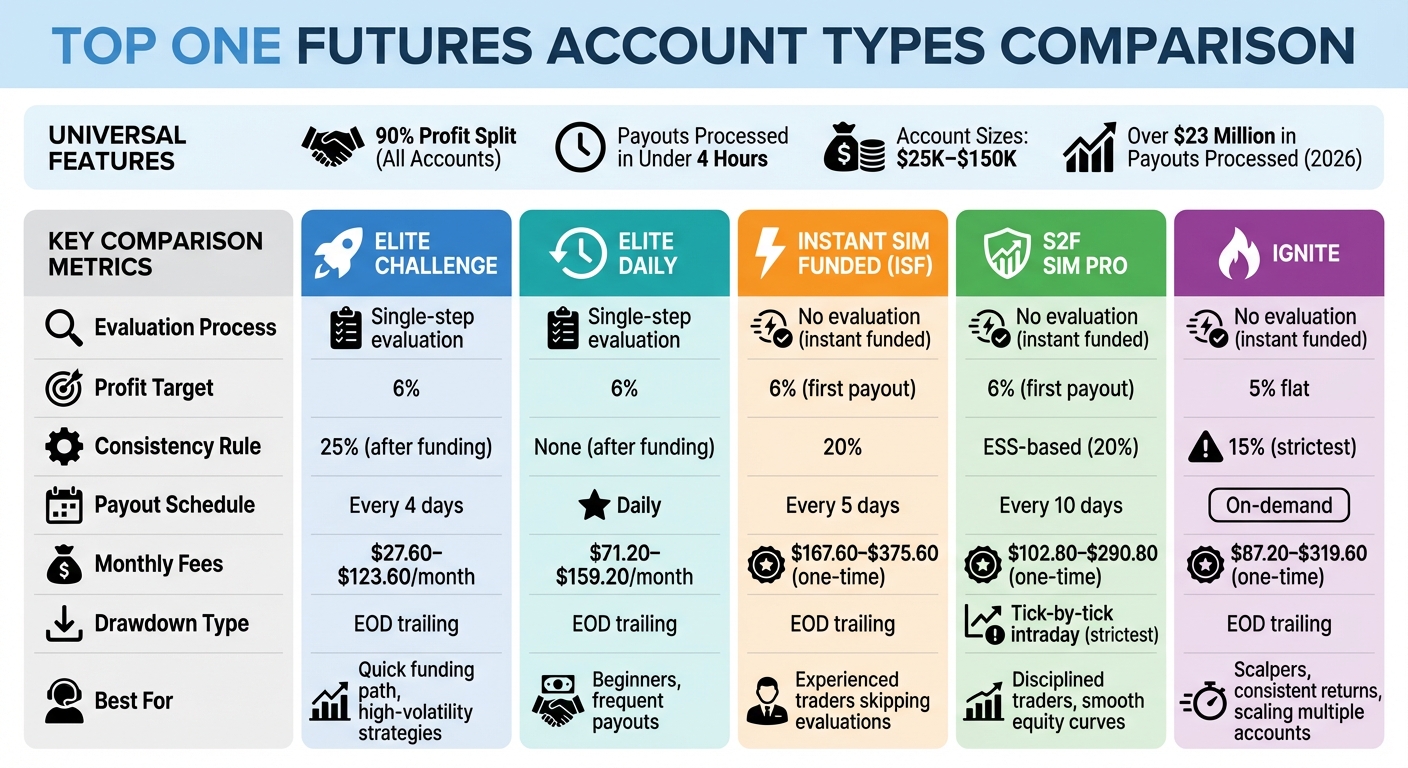
Top One Futures 5 Account Types Comparison Chart 2026
Don’t Buy a Top One Futures Account Until You Watch This! (Rules EXPLAINED for Dummies)

sbb-itb-46ae61d
Top One Futures Account Types: Quick Overview
Top One Futures offers five distinct account types, each designed to cater to different trading preferences and payout structures. Here’s a snapshot of what they provide:
- Elite Challenge: A single-step evaluation with a 6% profit target and no minimum trading days.
- Elite Daily: Daily withdrawals with no consistency restrictions after funding.
- Instant Sim Funded (ISF): Skip evaluations entirely and start trading simulated capital immediately for a one-time fee.
- S2F Sim PRO: Features a tick-by-tick intraday trailing drawdown, making it more restrictive for risk management.
- Ignite: Allows on-demand withdrawals after reaching a 5% profit buffer, with a 15% consistency requirement.
All accounts share a 90% profit split and processing times of under 4 hours. Pricing varies – some accounts require monthly subscriptions starting at $27.60, while others charge one-time fees ranging from $87.20 to $375.60. Traders can also choose between End-of-Day (EOD) and intraday drawdown methods, impacting their overall trading experience.
Main Features of Each Account
- Elite Challenge: Monthly subscription fees range from $27.60 to $123.60, with a one-time $149 activation fee after evaluation. No consistency rules apply during evaluation, but a 25% rule kicks in after funding. Payouts are cycle-based, occurring every 4 days.
- Elite Daily: Costs between $71.20 and $159.20 per month, with no activation fee. Offers daily payouts and removes all consistency rules once funded. During evaluation, traders must maintain a 45% consistency score.
- Instant Sim Funded (ISF): Eliminates the evaluation phase entirely. One-time fees range from $167.60 to $375.60. Features a 20% consistency rule and an EOD trailing drawdown. Payouts occur every 5 days, and the drawdown floor locks once the starting balance plus $100 is reached.
- S2F Sim PRO: Available for a one-time fee of $102.80 to $290.80. It uses an Equity Stability Score (ESS) for risk management instead of percentage-based rules. Includes a tick-by-tick intraday trailing drawdown, with payouts every 10 days.
- Ignite: Entry costs range from $87.20 to $319.60. Offers on-demand payouts after hitting a 5% profit buffer. Requires a strict 15% consistency rule and uses an EOD trailing drawdown.
Which Traders Each Account Suits Best
- Elite Challenge: Perfect for traders who want a quick path to funding without minimum trading day requirements. Its flexibility suits those aiming to hit the 6% profit target through high-volatility strategies.
- Elite Daily: Aimed at beginners and active traders seeking frequent payouts. With no activation fees and a starting price of around $79 for a 25K account, it’s a great option for those still refining their trading approach.
- Instant Sim Funded (ISF): Appeals to seasoned traders who prefer skipping evaluations. The one-time fee and 20% consistency rule strike a balance between immediate access and manageable risk.
- S2F Sim PRO: Geared toward disciplined traders with smooth, predictable equity curves. The tick-by-tick trailing drawdown is ideal for those comfortable with tight, real-time risk adjustments.
- Ignite: Best for traders with steady daily returns. The 15% consistency rule makes it the most stringent option, aligning with those who prioritize tight risk management. Its on-demand payout feature adds flexibility, though the lower contract limits favor specialized strategies.
Top One Futures Account Types Compared
Let’s break down the details of Top One Futures’ five account types and how they cater to different trading styles. Each account has unique features, especially regarding drawdown methods, consistency rules, and payout structures.
The five accounts – Elite Challenge, Elite Daily, ISF (Instant Sim Funded), S2F Sim PRO, and Ignite – are tailored for different trader needs. Some, like Elite Challenge and Elite Daily, require a single-step evaluation. Others, such as ISF, S2F Sim PRO, and Ignite, skip the evaluation phase entirely, offering instant access to trading capital.
Where these accounts really stand apart is in their drawdown methods and consistency requirements. Four accounts – Elite Challenge, Elite Daily, ISF, and Ignite – use an end-of-day (EOD) trailing drawdown, which evaluates account balance at market close. On the other hand, S2F Sim PRO employs a real-time, tick-by-tick intraday trailing drawdown, making it the strictest option for managing intraday volatility.
Prop firm consistency rules also vary widely. Elite Daily drops all consistency requirements once funded, providing maximum freedom. Meanwhile, Elite Challenge enforces a 25% consistency rule after funding. ISF and S2F Sim PRO require a 20% consistency rule, with the latter also applying an Equity Stability Score (ESS) to promote steady trading patterns. Ignite is the most stringent, capping daily profits at 15% of total earnings.
Payout schedules differ, too. Elite Challenge offers payouts every four days, while Elite Daily allows daily withdrawals. ISF processes payouts every five days, while S2F Sim PRO requires traders to complete 10 trading days (with at least seven profitable days) before their first payout. Ignite uses a cycle-based payout system. Across all accounts, traders keep 90% of their profits, and Top One Futures has processed over $23 million in payouts as of early 2026, often within 12 hours.
Below, we’ll take a closer look at what makes each account unique.
Elite Challenge
This account is built around a single-step evaluation, requiring traders to hit a 6% profit target without any minimum trading days. Its EOD trailing drawdown allows traders to hold positions overnight without constant monitoring. During the evaluation phase, there’s no consistency rule, meaning traders can meet their target in a single day. However, once funded, a 25% consistency rule applies.
Traders can manage up to three accounts at a time, with payouts processed every four days. This account suits trend and swing traders who value EOD drawdown flexibility and don’t need daily liquidity.
Elite Daily
Elite Daily operates on a monthly subscription model and eliminates activation fees. To pass evaluation, traders must achieve a 45% consistency score, typically requiring at least three profitable days. Once funded, this account removes all consistency rules, offering unmatched flexibility in profit distribution.
A standout feature is its daily payout option, making it perfect for traders who prioritize frequent access to their earnings. With support for up to five accounts and an EOD trailing drawdown, this account is ideal for traders refining their strategies without steep entry costs.
Instant Sim Funded (ISF)
ISF skips the evaluation phase entirely, offering instant funding for a one-time fee. It uses an EOD trailing drawdown that locks permanently once the account balance reaches the starting amount plus $100. This creates a fixed risk floor, giving traders more room to manage overnight or multi-day trades.
The account enforces a 20% consistency rule and processes payouts every five days. Depending on their performance, traders can manage between three and five accounts. ISF is great for experienced traders who want to skip evaluations and focus on earning payouts without recurring fees.
S2F Sim PRO
S2F Sim PRO also offers instant funding with a one-time fee. It stands out with its strict, real-time intraday trailing drawdown, which monitors equity tick by tick. Instead of a standard consistency rule, it uses an Equity Stability Score (ESS) to discourage erratic trading patterns.
To qualify for payouts, traders must complete 10 trading days, with at least seven of those days being profitable (defined as earning 0.1% of the starting balance). This account is ideal for professional traders who prefer smoother equity curves and stricter risk management. Traders can manage between five and ten accounts, with payouts processed once the drawdown locks in place.
Ignite
Ignite is designed for traders managing six to ten accounts, making it a great choice for those scaling their trading volume. It enforces the strictest consistency rule – 15% – to ensure no single trading day dominates the overall profit.
With a cycle-based payout system, Ignite encourages traders to build a profit buffer, preparing them for live account transitions. This account is well-suited for those who aim to generate steady returns and scale their trading aggressively across multiple accounts.
Account Comparison: Key Metrics
Here’s a breakdown of the critical metrics that differentiate these accounts, providing a clear side-by-side comparison of their features.
Account Sizes and Profit Splits
All Top One Futures accounts offer a 90% profit split. Account sizes generally range from $25,000 to $150,000, though the Elite Daily plan is capped at $100,000.
Payout targets depend on the account type. For most plans, payouts follow a tiered system: 6% for the first payout, 5% for the second, and 4% for all subsequent payouts. However, the Ignite plan simplifies things with a flat 5% target for every withdrawal request.
Pricing and Fees
Top One Futures accounts use either monthly subscriptions or one-time fees. Here’s how the costs stack up:
- Elite Challenge Plan: Monthly fees range from $69 to $309, plus a $149 activation fee after passing the evaluation.
- Elite Daily Plan: Monthly costs run between $178 and $398, but there’s no activation fee. This plan can be more economical for traders who pass evaluations quickly. For instance, a $50,000 Elite Daily account costs just $95 in the first month.
For instant funding futures prop firms, only a one-time fee is required:
- S2F Sim PRO: Costs between $257 and $727 and includes stricter intraday drawdown rules.
- Instant Sim Funded: Fees range from $419 to $939.
- Ignite Plan: Priced between $218 and $799.
Drawdown and Consistency Rules
The drawdown methods and consistency rules vary across plans, impacting trading flexibility:
- Drawdown Rules: Most accounts – Elite Challenge, Elite Daily, Instant Sim Funded, and Ignite – use an end-of-day (EOD) trailing drawdown, which updates at market close and allows overnight positions. The S2F Sim PRO account, however, applies a real-time intraday trailing drawdown, making it the most restrictive option.
- Consistency Rules: Once funded, the Elite Daily plan eliminates consistency requirements. The Elite Challenge plan, however, enforces a 25% consistency rule after funding. Both Instant Sim Funded and S2F Sim PRO accounts require traders to maintain a 20% consistency threshold, with S2F Sim PRO adding an Equity Stability Score (ESS) to curb erratic trading. The Ignite plan takes a stricter approach with a 15% consistency cap, ensuring daily profits remain balanced. Traders can use a consistency calculator to ensure they stay within these limits. Additionally, all accounts enforce a 14-day inactivity rule, meaning accounts may be flagged if no trades are made within this period.
Trading Platforms and Execution
Top One Futures offers five main trading platforms: Tradovate, NinjaTrader, Project X, Quantower, and TradingView. Each platform caters to different needs, with Tradovate standing out for its browser-based integration that works seamlessly with all account types. On the other hand, platforms like NinjaTrader and Quantower connect using Rithmic data feeds, which require separate credentials accessible through your Top One Futures dashboard.
When it comes to execution speed, the choice of platform matters. Rithmic-powered platforms – NinjaTrader, Quantower, and Project X – are known for their low-latency execution, making them ideal for high-frequency scalping and traders relying on the depth-of-market (DOM) feature. Tradovate, while slightly slower in execution, shines in its simplicity and reliability. This makes it a great option for beginners who might not want to deal with the complexities of setting up Rithmic credentials or managing additional data subscriptions.
"Tradovate is the best platform for beginners at Top One Futures. It has direct integration with TOF, runs in a browser without any software installation, and has the simplest setup process." – Paul, Author
For those using TradingView, execution is routed through Tradovate. To trade, you must first link your Top One Futures account to Tradovate and then connect TradingView to that Tradovate account. While TradingView offers exceptional charting tools, its limited DOM functionality makes it less suitable for depth-of-market strategies. If you’re interested in automated trading, Top One Futures supports TradersPost, which integrates with both Project X and Tradovate.
However, there are some technical considerations to keep in mind. Rithmic connections can experience session conflicts if you try to run multiple platforms simultaneously with the same credentials – this often results in one platform disconnecting. Additionally, all trades must remain open for at least 10 seconds to meet profit requirements, and positions must be closed by 4:10 PM EST, as overnight holding is generally not allowed for most account types.
Selecting the right platform can make a big difference in execution quality and how well it aligns with your trading approach.
How to Choose the Right Top One Futures Account
If you’re new to trading or want the most freedom, the Elite Daily account is a great starting point. It’s competitively priced for beginners, has no activation fee, and removes all consistency rules once funded. Plus, it allows daily payouts, making it perfect for traders who are still fine-tuning their strategies. On the other hand, if you’re after fast funding with clear fees, you might want to explore other plans.
For those focused on quick funding, the Elite Challenge is worth considering. It features a one-step evaluation process that can be completed in just one day. There are no minimum trading days or consistency rules during the evaluation phase. However, once funded, you’ll need to follow a 25% consistency rule. If you’re looking for instant-funded options, there are alternatives as well.
For traders confident in their strategies and looking to skip evaluations altogether, the Instant Sim Funded account offers immediate access to trading capital for a one-time fee. This option is ideal for experienced traders ready to start trading and earning right away.
If you’re disciplined and comfortable managing intraday drawdowns, the S2F Sim PRO account might be a good fit. Its drawdown updates tick-by-tick, which requires a steady hand, and it’s available for a one-time fee. For those who prefer scaling their accounts gradually and focusing on consistent returns, another option may align better with their goals.
Finally, the Ignite account is tailored for scalpers and traders who prioritize consistency. It offers on-demand payouts and supports up to six simultaneous accounts. However, it has the strictest consistency rule, requiring traders to maintain a 15% consistency level.
"The Elite Daily 25K is the best starting point for beginners… the low monthly cost means a failed attempt doesn’t sting financially." – Paul, PropTradingVibes
Each of these accounts comes with unique fee structures and risk management rules, so the best choice depends on your trading style and priorities.
FAQs
Which Top One Futures account is best for beginners?
The standard evaluation account is a great starting point for beginners. It offers a simple assessment process, easy-to-follow rules, and achievable targets. With lower funding requirements and less complex guidelines than advanced plans, this account provides an approachable way for newcomers to futures prop trading to develop their skills in a more forgiving setup.
How do EOD and intraday drawdowns differ in real trading?
End-of-Day (EOD) drawdowns are recalculated daily based on the highest closing balance. This approach helps secure profits by ensuring the limit doesn’t decrease during the trading day. On the other hand, intraday drawdowns are tracked in real-time, applying either a fixed or dynamic loss limit during active trading hours. This requires constant attention to risk management. The main distinction lies in their timing: EOD drawdowns are updated at the end of the day, while intraday drawdowns react immediately during trading.
What do the consistency rules actually limit day to day?
The consistency rules are designed to manage daily trading activities by prohibiting overnight positions and enforcing end-of-day (EOD) trailing drawdown limits. These measures help traders stay within predefined loss thresholds throughout the trading day.