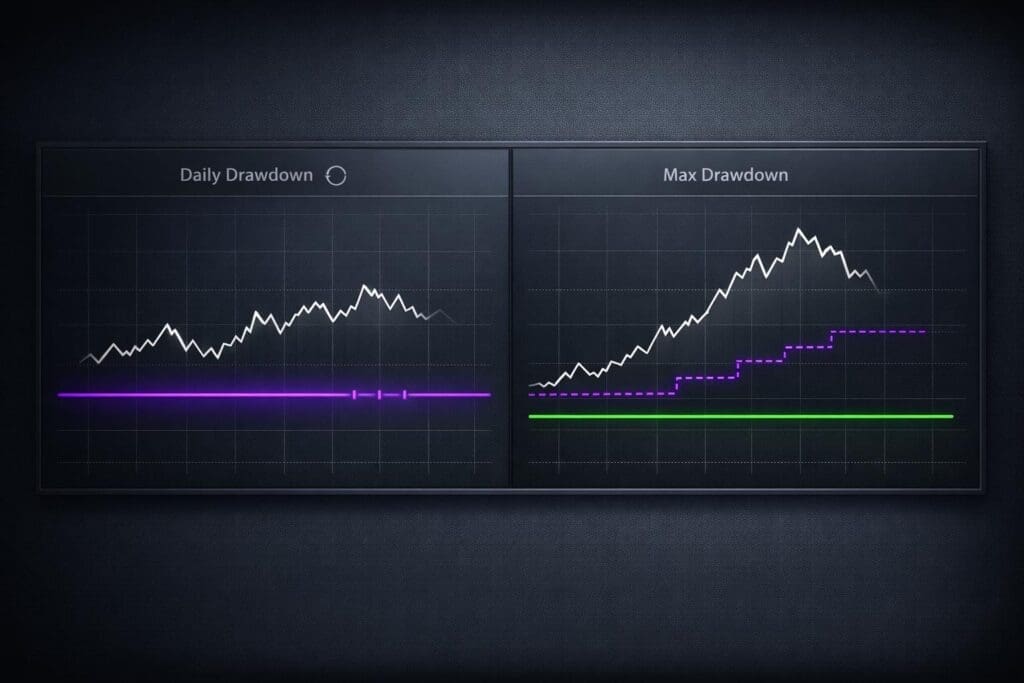
Daily drawdown rules reset every day and are meant to stop you from blowing up your account in a single trading session. Max drawdown, on the other hand, is a fixed threshold that doesn’t reset – once you hit it, you’re out. Both are designed to protect the prop firm’s capital, but they impact your trading strategy in very different ways.
If you’re trading with a firm like Apex, their trailing drawdown rules are tied to your unrealized equity, which means even open trades can push you closer to the limit. Topstep has a stricter daily loss limit but uses a static max drawdown, making it more predictable for swing traders. Take Profit Trader ditches daily limits altogether but still has trailing drawdowns to manage.
Here’s the deal: understanding how these rules are calculated – daily reset vs. fixed, equity-based vs. balance-based – can make or break your prop firm evaluation. Let’s break it all down.
STOP Blowing Prop Firm Accounts
sbb-itb-46ae61d
What Is Daily Drawdown?
Daily drawdown, or the Daily Loss Limit (DLL), is a safeguard to cap how much you can lose in a single trading day [1]. Think of it as a built-in circuit breaker to protect your account from a disastrous session. For most futures prop firms, the limit refreshes daily at 5:00 PM ET [1][3].
Firms usually calculate this limit based on your floating equity, which includes both realized and unrealized losses [1][3]. So, if you’ve got an open trade that’s down $800 and your daily limit is $1,000, you’re already skating close to the edge – even if the trade isn’t closed yet.
Daily drawdown limits typically fall between 3% and 5% of your account balance [3]. For example, on a $50,000 account, that’s roughly $1,500–$2,500 per day. However, some firms take a stricter approach. Topstep, for instance, enforces a $1,000 daily limit (about 2%) on its accounts [1]. On the flip side, firms like Apex Trader Funding and Take Profit Trader skip daily loss limits entirely. Instead, they rely on trailing drawdowns or end-of-day rules to manage risk [1][2].
If you do breach the daily limit, consequences can vary. Some firms might just lock you out for the rest of the trading day, while others will outright terminate your account [1][3]. The key difference between daily drawdown and maximum drawdown is that the daily limit resets at 5:00 PM ET. Losses from the previous day don’t roll over. This means you could hit the daily limit but still stay well above your overall account’s drawdown threshold.
The purpose of the daily loss limit is simple: it’s there to stop you from revenge trading or wiping out weeks of progress in a single bad day. Knowing how these limits work is crucial for tweaking your strategy, which we’ll dive into in later sections.
What Is Maximum Drawdown?
Maximum (fixed) drawdown sets a hard loss limit that stays constant throughout your evaluation. Unlike a daily loss limit that resets every day, this one doesn’t budge – it’s locked in from day one.
Here’s the deal: Say you start with a $50,000 account, and the prop firm sets a $2,500 (5%) maximum drawdown. Your loss threshold is fixed at $47,500[1]. If your equity drops to that level, whether from realized or unrealized losses, you’re done – the evaluation ends right there. But as you grow your account, your buffer grows too. For example, if you push the account up to $53,000, your buffer increases to $5,500 compared to the initial $2,500. Even if you then take a $3,000 hit, your equity would still sit at $50,000 – well above the $47,500 limit[3]. Knowing how this static rule works is key to setting up a solid risk management plan during prop firm challenges.
This drawdown limit is set at the start and doesn’t move, unlike a trailing drawdown, which adjusts upward as your account grows.
Most firms calculate this using floating equity, meaning they include unrealized P&L from open trades. So, if you’re down $1,800 on an open position with a $2,000 buffer, you’re teetering on the edge of a breach. Some firms might calculate based on your closed balance instead, but equity-based methods are far more common – and stricter.
The goal of maximum drawdown is simple: to protect the firm’s capital from massive losses. As Funded.now puts it:
You don’t fail prop firm challenges because you can’t make money – you fail because you give it back.[1]
To navigate this fixed limit, you’ll need tight position sizing and disciplined stop-loss strategies, which we’ll cover in the next section.
Daily vs Max Drawdown: Key Differences
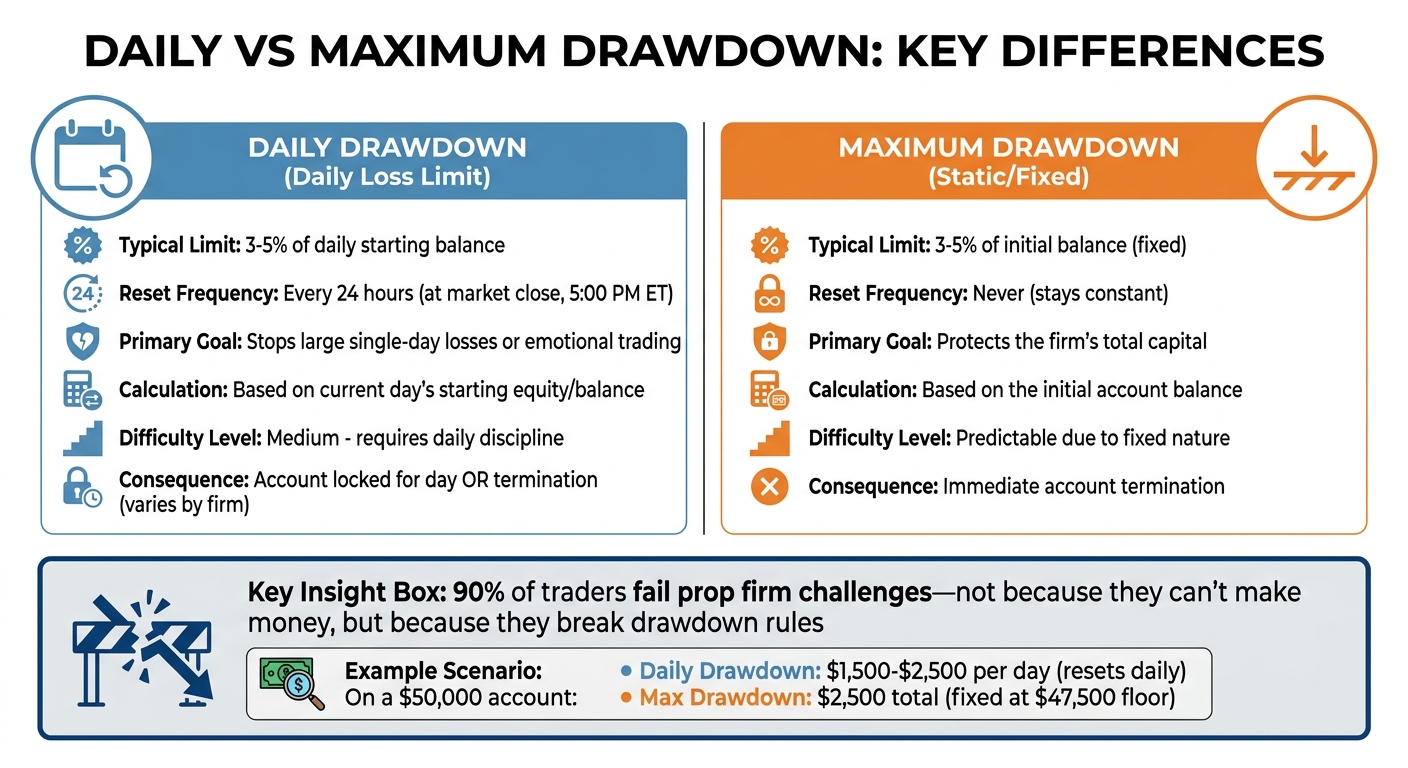
Daily vs Maximum Drawdown Rules Comparison for Prop Traders
Let’s break down how daily and maximum drawdowns differ in how they work and why they exist.
Maximum drawdown is tied to a fixed threshold based on your starting balance. For example, if you’re trading a $50,000 account with a -$2,500 max drawdown, that limit stays the same throughout. Daily drawdown, on the other hand, resets each day at 5:00 PM ET and is based on that day’s starting equity[1][3].
Here’s where it gets tricky: you can violate the daily loss limit and lose your account – even if your overall balance is still in profit. Why? The daily rule is like a circuit breaker, designed to stop massive single-day losses or emotional trading spirals[1].
The maximum drawdown rule has a different purpose. It protects the firm’s overall capital from being drained by cumulative losses over time.
Most firms calculate both limits using your floating equity, which includes unrealized profits and losses from open trades. A few firms base it on your closed balance instead, but equity-based calculations are more common – and stricter[1][3].
The consequences of breaking these rules depend on which one you violate. Breaching the maximum drawdown almost always results in your account being terminated immediately. With the daily drawdown, some firms might just lock you out for the rest of the day, while others will terminate your account altogether[1].
Comparison Table: Daily vs Max Drawdown
| Feature | Daily Drawdown (Daily Loss Limit) | Maximum Drawdown (Static/Fixed) |
|---|---|---|
| Typical Limit | 3–5% of daily starting balance[3] | Around 3–5% of the initial balance (fixed)[1][3] |
| Reset Frequency | Every 24 hours (at market close)[1] | Never (stays constant)[1] |
| Primary Goal | Stops large single-day losses or emotional trading | Protects the firm’s total capital |
| Calculation | Based on current day’s starting equity/balance | Based on the initial account balance |
| Difficulty | Medium; requires daily discipline | Predictable due to its fixed nature |
Why does this matter? Because about 90% of traders fail prop firm challenges – not because they can’t make money, but because they break these drawdown rules[1][3]. Understanding how these limits work can be the difference between passing and blowing your account.
How Prop Firms Calculate Drawdown Rules
Let’s break down how prop firms handle drawdown limits and what it means for your trading. The math itself isn’t complicated, but the method they use can make or break your strategy. Firms typically rely on one of two approaches: balance-based (only closed trades count) or equity-based (open trades are factored in). Equity-based rules are stricter since they track your account’s real-time peaks, meaning even unrealized profits can push you closer to the limit[2].
Here are the three main ways firms calculate drawdowns:
- Static (Fixed) Drawdown
This method sets a hard floor that never moves. The formula is simple: Starting Balance – Max Drawdown Amount = Fixed Floor.
For instance, if you’re trading a $50,000 account with a $2,500 drawdown, your floor is locked at $47,500 for the duration of the account[1]. - Intraday Trailing Drawdown
This one adjusts in real time based on your highest unrealized equity during the day. The formula: Highest Unrealized Equity – Drawdown Amount = New Floor.
Say your account hits $50,875 during a trade; the floor immediately updates to $48,375 ($50,875 minus $2,500)[2]. - End-of-Day (EOD) Trailing Drawdown
Unlike intraday, this updates only once daily, after the market closes. The formula: Highest EOD Balance – Drawdown Amount = New Floor for the Next Day. This gives you a little more flexibility during the trading day[2].
Daily Loss Limits
Daily loss limits are calculated separately and reset on a set schedule, often at the end of the trading day. The formula is: Daily Starting Balance – Daily Limit = Daily Floor.
For example, a $50,000 account with a $1,000 daily limit resets every day at 5:00 PM ET[1].
Extra Costs and Monitoring Tools
Most firms include commissions and fees when calculating drawdowns. So even a break-even trade might nudge you closer to your limit. To stay on top of this, platforms like RTrader Pro show your "Auto-Liquidation Threshold", while Tradovate displays the trailing drawdown in the account dropdown menu[2].
Hybrid Models
Some firms mix trailing and static rules. For example, Apex Trader Funding uses a hybrid approach in their Performance Accounts. The trailing drawdown stops moving once it reaches the starting balance plus a $100 buffer. This gives traders more room to work with once they’ve proven themselves[2].
Understanding these rules isn’t just about avoiding violations – it’s about tailoring your risk management to fit the firm’s structure. Each method has its quirks, so knowing how they work can save your account.
How Drawdown Rules Affect Your Trading Strategy
Drawdown rules don’t just set limits – they shape how you approach every trade. Take a daily loss limit for example. If you’re trading a $50,000 account with a $2,500 daily cap, two trades risking 1% each can eat up 40% of your daily allowance. That’s why many traders swear by the 2-Loss Rule: stop trading for the day after two back-to-back losses. It’s not just about protecting your account – it’s about keeping your emotions in check too[1]. This rule naturally forces you to rethink both your short-term moves and your bigger-picture strategy.
Daily limits focus on keeping you disciplined within a single session, but maximum drawdown rules control your risk over the long haul. Static max drawdown gives you a fixed cushion, and if you build up profits, you effectively gain more room before hitting the limit. On the flip side, trailing drawdown constantly adjusts as your account grows, moving the floor higher with each new peak. The catch? Even a small pullback from a fresh high can violate the rule faster than the same drop from your starting balance.
Your position sizing has to match whichever rule is stricter. The Dynamic Risk Reduction Framework suggests scaling back risk as you approach your limits. For instance, if you’ve burned through 30% of your daily cap, cut your risk to 0.25%. If you’re down 60%, drop it further to 0.1%[4]. This isn’t about playing it too safe – it’s about surviving long enough for your strategy to work.
Here’s the harsh reality: around 90% of traders fail prop firm challenges. Not because they can’t trade, but because they break the drawdown rules[1][3]. Daily loss limits protect you from massive one-day hits, but they can also trip you up during normal market swings. Static drawdown is more predictable, which is great for swing traders. Trailing rules, though, force you to take profits aggressively and tighten your stops.
Some firms, like Apex Trader Funding, tweak these rules to give traders a better shot. Their Performance Accounts use a hybrid trailing drawdown that stops moving once it hits your starting balance plus a $100 buffer[2]. This setup rewards traders who can lock in early gains. To make these rules work for you, you’ve got to understand how each firm calculates drawdown. Are they using equity-based or balance-based rules? Does the trailing drawdown update intraday or only at market close? These details can make or break your strategy.
Want specifics? Check out our reviews of Apex Trader Funding, Topstep, and Take Profit Trader for the latest on each firm’s rules and policies.
Drawdown Rules from Top Futures Prop Firms
Each futures prop firm sets up its drawdown rules differently. Knowing these details can help you choose the evaluation that matches your trading style.
Apex Trader Funding Drawdown Rules

Apex Trader Funding uses an intraday trailing drawdown tied to your highest equity peak, including unrealized gains [2]. For example, if you’re up $500 on an open trade, the drawdown floor adjusts upward by that exact amount and stays there, even if the trade reverses. On a $50,000 account, the trailing drawdown is $2,500, and there’s no daily loss limit [1].
Once you transition to a funded Performance Account, the trailing drawdown continues to rise until it locks at your starting balance plus $100. At that point, it becomes a fixed floor. Apex also offers Static Accounts, like the $100k Static, where the drawdown is fixed at a specific level – $99,375 in this case – and doesn’t trail. As of 2026, Apex introduced a choice between EOD (End-of-Day) and intraday drawdown for evaluation accounts, providing more options for traders [2].
"The unrealized trailing drawdown at Apex Trader Funding is the single biggest rule that trips up traders. Unlike a static drawdown, it moves up with your account’s highest unrealized gains and never moves back down."
This setup means you need to keep a buffer above your threshold to avoid liquidation from small intraday pullbacks. A $100–$300 cushion is usually a safe range [2]. For a deeper dive into Apex’s rules, check out our full Apex Trader Funding review.
Now let’s see how Topstep handles drawdown limits.
Topstep Drawdown Rules

Topstep uses a Daily Loss Limit paired with a Maximum Drawdown. On a $50,000 account, the daily loss limit is $1,000, while the maximum drawdown is $2,000 [1]. The max drawdown is static, meaning it stays at $48,000 no matter how much profit you make, and the daily loss limit resets every day at 5:00 PM ET [1].
If you hit the daily limit, Topstep locks you out for the rest of the day, but your account isn’t terminated. You can resume trading the next morning. The static max drawdown is great for swing traders because it doesn’t punish normal pullbacks after profitable runs [3]. For a full breakdown of Topstep’s rules and account options, visit our Topstep review.
Next up, Take Profit Trader takes a different approach.
Take Profit Trader Drawdown Rules
Take Profit Trader (TPT) has done away with the daily loss limit for both Test and PRO accounts [6]. This gives traders more room to maneuver intraday, but the trailing drawdown still requires careful management. TPT offers two main account types with distinct drawdown mechanics.
- PRO Accounts: These come with an intraday trailing drawdown based on the peak balance, including unrealized gains. For a $50,000 PRO account, the trailing drawdown is $2,000. Once your minimum account balance reaches the starting balance, the trailing stops [5].
- PRO+ Accounts: These use an End-of-Day (EOD) trailing drawdown, which only updates based on your account balance at the end of the trading day. Intraday swings don’t affect the drawdown level – only the closing balance matters. PRO+ accounts also feature a 90/10 profit split (compared to 80/20 on PRO accounts) and eliminate the "Buffer Zone" for withdrawals. You can upgrade to PRO+ by invitation or by hitting a $10,000 single-day profit.
"TPT recently made a crucial change that transformed them from just another prop firm to a serious contender in the space. They completely removed their daily loss limit – and if you’re an experienced trader, you know just how significant this is."
For a detailed comparison of PRO vs. PRO+ accounts and current pricing, check out our Take Profit Trader review.
As you can see, drawdown rules vary widely across firms, so tailoring your risk management strategy to fit each firm’s structure is essential.
Choosing a Prop Firm Based on Drawdown Rules
When picking a prop firm, aligning their drawdown rules with your trading style and risk tolerance is key. If you’re the type to hold positions overnight, a static drawdown account – like what Topstep offers – might be your best bet. The fixed limit protects you from overnight pullbacks, so normal multi-day swings won’t push you into trouble. But if you’re more of an intraday scalper, firms like Apex Trader Funding with intraday trailing drawdown rules might suit you better. Closing trades quickly helps you avoid the trailing floor creeping too far against you.
Once you’ve matched the drawdown style to your trading approach, it’s all about managing risk. There’s always a trade-off between cost and risk flexibility. Intraday trailing accounts tend to have lower fees but come with higher failure rates. On the flip side, static or end-of-day (EOD) accounts might cost more upfront, but they give you a bigger safety net. If you’re newer to trading, paying a bit more for a static or EOD account could save you from constantly resetting your account.
Risk management is non-negotiable. Keep your risk per trade to 0.5% or less – on a $50,000 account, that’s $250 per trade. This gives you room for about 10 losses before hitting a $2,500 drawdown limit. During your first week, aim to maintain a buffer of $500–$1,000 and stop trading after two back-to-back losses. This helps you avoid emotional revenge trades that could push you dangerously close to your drawdown threshold.
For a detailed look at drawdown rules, check out the reviews for Apex Trader Funding, Topstep, and Take Profit Trader. Since firms tweak their rules from time to time, always double-check the latest parameters before diving in.
FAQs
Does unrealized P&L count toward drawdown limits?
Yes, unrealized P&L often impacts drawdown limits, depending on the prop firm’s specific rules. Take Apex Trader Funding, for example – they use a trailing drawdown model that includes unrealized gains. This setup adjusts your max loss threshold during the day. Unrealized profits can push your account’s high-water mark higher, but unrealized losses can also edge you closer to hitting the drawdown limit if you’re not paying attention.
How do trailing drawdowns differ from static max drawdown?
Trailing drawdowns move up as your account hits new highs, locking in gains but exposing you to more risk if your balance drops after growing. On the other hand, static max drawdowns stay fixed at a specific amount or percentage from your starting balance, giving you a steady level of protection. The main distinction here is that trailing drawdowns adjust dynamically, while static drawdowns offer a more predictable and consistent safety net.
Which drawdown rules are best for swing trading vs scalping?
Static or max drawdown rules are a solid fit for swing trading because they lock in a fixed loss limit. This gives you consistency and makes it easier to manage risk over longer timeframes. For scalping, daily or trailing drawdown rules tend to work better since they allow more flexibility for frequent trades. Just keep in mind that trailing drawdowns can be tricky – they move with your account’s high point, so you’ll need to watch them closely to avoid breaking the rules.