Futures prop firms enforce consistency rules to ensure traders demonstrate steady, repeatable performance rather than relying on a few big wins. These rules require profits to be distributed evenly across trading days and limit single-day contributions to total profits, often between 20%-50%. Trade frequency plays a key role in meeting these rules, but balancing it can be tricky:
- High trade frequency risks breaking transaction limits or consistency rules if one day dominates profits.
- Low trade frequency risks failing minimum trading day requirements (typically 5–10 days).
Key Takeaways:
- Spread profits across multiple days to meet consistency thresholds.
- Avoid overtrading or undertrading to stay compliant.
- Use tools like consistency calculators and trackers to monitor performance.
Example: If a firm enforces a 30% rule and your best day earns $2,000, your total profits must reach $6,667 ($2,000 ÷ 0.30) to comply. Adjust position sizes, stagger trades, and set daily profit caps to maintain compliance.
Understanding firm-specific rules is essential. Some firms, like FundedNext, remove consistency rules at the funded stage, while others, like Apex Trader Funding, retain them. Use strategies like ATR-based position sizing and structured breaks to balance trade frequency and risk.
Futures Prop Firm CONSISTENCY RULE (FREE CALCULATOR)
sbb-itb-46ae61d
The Problem: How Trade Frequency Conflicts with Consistency Rules
Getting the balance right with trade frequency is a big deal when it comes to evaluations or maintaining a funded trading account. Trade too much, and you risk breaking rules tied to profit consistency or transaction limits. Trade too little, and you might fail to meet minimum trading day requirements. Striking the right balance is essential for staying compliant and achieving long-term success. Let’s break down how these issues arise.
High Trade Frequency and Rule Violations
Trading too often can lead to problems, especially when a single session accounts for an outsized portion of your profits. For instance, imagine you earn $1,500 in one day but only $500 across the rest of your trading period. That one day would represent 75% of your total profits, which is well above the 20%-50% limits many firms impose on single-day contributions [1].
"One huge winner doesn’t prove you can trade, repeatability does." – Take Profit Trader [6]
High-frequency traders, particularly scalpers, also face transaction limits. For example, Take Profit Trader enforces a cap of 50 trades per day on funded accounts. Exceeding this cap can lead to penalties or even account termination [6]. Moreover, frequent trading often results in inconsistent position sizing. Firms like Seacrest Funded and FTMO may flag trades that are double your average size as reckless, which could jeopardize your account [2]. Even if high-frequency trading helps you hit profit targets faster, you’re still required to meet minimum trading day requirements, which are usually 5–10 days across the best futures prop firms [6].
On the flip side, trading too little can also create compliance issues.
Low Trade Frequency and Minimum Day Requirements
Trading infrequently comes with its own challenges. If you hit your profit target in just one or two days, you might fail to meet the minimum trading day requirement, which could disqualify you from funding or payouts – even if your strategy is otherwise sound [8]. Low trade frequency also concentrates profits into a small number of sessions, which can violate consistency rules. For example, Apex Trader Funding doesn’t allow any single trading day to account for more than 30% of total profits in a funded account. If you earn $3,000 in one day but only $1,000 across the remaining days, that day’s concentration would exceed the allowable limit [9].
To avoid this, traders may feel pressured to keep trading just to dilute concentrated profits, which increases the risk of unnecessary losses. These rules are designed to ensure that performance is consistent and repeatable across different market conditions, rather than relying on a single lucky day [1].
Solutions: How to Balance Trade Frequency for Compliance
When it comes to compliance, most consistency violations don’t disqualify you outright but instead raise the bar for your profit requirements before payout. The trick is to adjust your trading habits to meet compliance standards while staying profitable. Below are strategies to tackle common compliance challenges: spreading profits to avoid single-day concentration issues, meeting the required trading days without overtrading, and using tools to simplify the process.
Distributing Profits Evenly Across Trading Days
A dilution strategy can help you manage consistency rules. For example, if you have a single standout day with profits that exceed your firm’s threshold, you won’t lose your account. Instead, you’ll need to keep trading until that day represents a smaller slice of your overall profits. Here’s the math: if your best day brought in $1,000 and your firm enforces a 20% rule, you’ll need to grow your total profits to $5,000 ($1,000 ÷ 0.20 = $5,000) to comply [10][1].
To make this happen, cut your position sizes by 50% and double the number of setups. This spreads your profits across more days without increasing market exposure [1]. Setting daily profit caps is another way to keep your equity curve steady, ensuring no single day disproportionately affects your account [7].
Different firms handle consistency thresholds differently, depending on your payout stage. For instance, Tradeify Lightning accounts use a tiered system: 20% for the first payout, 25% for the second, and 30% for subsequent payouts [10]. Meanwhile, MyFundedFutures Starter Plans enforce a 40% rule during the funded stage, while their Core, Scale, and Pro plans apply a 50% rule during evaluations [1]. Knowing your firm’s specific rules is crucial to planning your trades effectively. This strategy not only helps spread risk but also aligns well with methods for meeting minimum trading day requirements.
Meeting Minimum Days Without Overtrading
Hitting profit targets quickly can backfire if you don’t meet the minimum trading days required – usually 5 to 10 days [1]. The solution? Plan low-volume trading sessions to fulfill the day count without taking on unnecessary risk. Instead of forcing trades just to meet the requirement, stick to a consistent fraction of your capital for each position. This way, your gains come from a repeatable system rather than a single high-risk trade [7].
If you hit your profit goal early, switch to reduced position sizes. This allows you to add qualifying days without risking significant losses. By taking this approach, you keep your equity curve steady and show that your strategy works across different market conditions.
Tools for Managing Trade Frequency
Specialized tools can make it easier to stay compliant. For example, DamnPropFirms provides a free Consistency Rule Calculator. Just input your largest end-of-day profit and account size, and it calculates how much total profit you’ll need to bring that outlier day into compliance. The formula is simple:
Biggest End of Day PnL ÷ Consistency % = Total Balance Needed [11][10][4].
Platforms like Tradeify also offer built-in trackers that monitor your daily progress. These trackers flag potential consistency issues early, so you can address them before they impact your payout eligibility [11]. For traders juggling multiple accounts, tools like TradeSyncer let you manage trade frequency across all accounts simultaneously, removing the hassle of manual tracking [11]. These tools take the guesswork out of compliance, helping you execute your strategy with confidence.
Trade Frequency Rules Across Top Futures Prop Firms
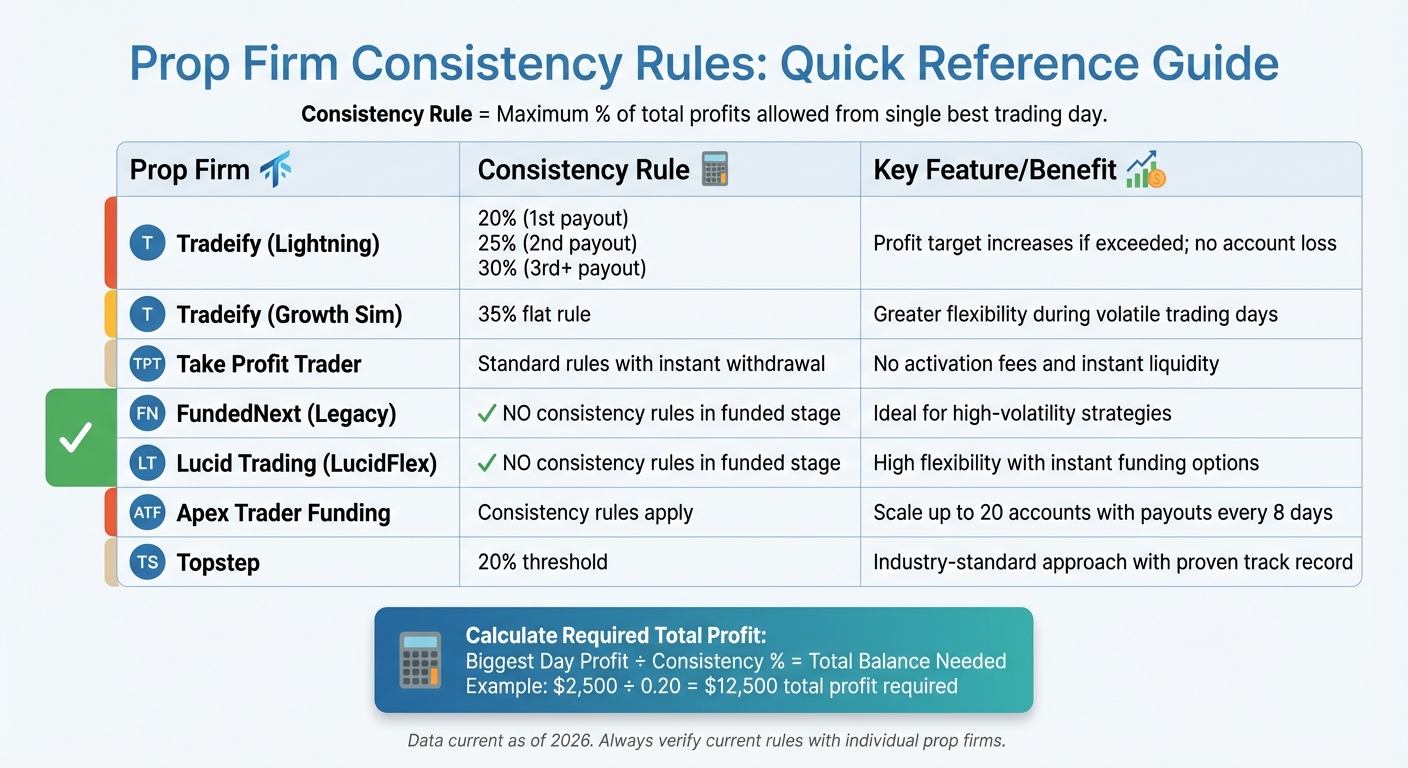
Futures Prop Firm Consistency Rules and Trade Frequency Requirements Comparison
Understanding the trade frequency rules of different futures prop firms is essential if you want to align your trading approach with their compliance requirements.
Differences in Trade Frequency Requirements
Prop firms have varying rules when it comes to trade frequency and profit allocation. For instance, Tradeify‘s Lightning accounts use a tiered system: 20% profit allocation for the first payout, 25% for the second, and 30% for subsequent payouts [10][11]. On the other hand, their Growth Sim accounts follow a flat 35% rule, which offers traders more leeway for larger single-day gains [10]. Meanwhile, Take Profit Trader stands out by allowing withdrawals from day one without activation fees, making it a great choice for traders seeking instant access to their profits [10].
Some firms remove consistency rules altogether once traders are funded. FundedNext, for example, offers a "Legacy Challenge" account that eliminates consistency rules at the funded stage. Similarly, Lucid Trading‘s LucidFlex accounts follow the same approach, making them appealing to traders who rely on high-volatility or news-driven strategies [10].
On the other hand, Apex Trader Funding retains consistency rules but compensates by allowing traders to scale up significantly. Traders can manage up to 20 accounts and withdraw up to $70,000 every 8 days [10].
To make these differences clearer, here’s a quick comparison:
Comparison Table: Prop Firm Rules and Trade Frequency
| Prop Firm | Consistency Rule | Key Feature |
|---|---|---|
| Tradeify (Lightning) | 20% for 1st payout, 25% for 2nd, 30% for 3rd+ [10][11] | Profit target increases if exceeded; no account loss |
| Tradeify (Growth Sim) | 35% flat rule [10] | Greater flexibility during volatile trading days |
| Take Profit Trader | Standard rules with instant withdrawal capability [10] | No activation fees and instant liquidity |
| FundedNext (Legacy) | No consistency rules in the funded stage [10] | Ideal for high-volatility strategies |
| Lucid Trading (LucidFlex) | No consistency rules in the funded stage [10] | High flexibility with instant funding options |
| Apex Trader Funding | Consistency rules apply [10] | Scale up to 20 accounts with payouts every 8 days |
| Topstep | 20% threshold | Industry-standard approach with a proven track record |
How to Calculate Consistency Rule Requirements
DamnPropFirms offers a free Consistency Rule Calculator to help you figure out your eligibility for payouts. The process is simple: divide your largest profit day by your firm’s consistency percentage to determine the required total profit. For example, if your best trading day nets $2,500 and your firm enforces a 20% consistency rule, you’ll need to accumulate $12,500 in total profits ($2,500 ÷ 0.20) before you can request a payout [10].
Advanced Methods for Managing Trade Frequency and Risk
This section builds on earlier techniques, refining risk management and entry timing to align trading performance with consistency rules.
Adjusting Position Sizes Based on Volatility
Adjusting position sizes using the Average True Range (ATR) helps traders maintain consistent risk across different market conditions. When volatility increases, this method reduces the number of contracts and widens stop losses, ensuring that the dollar risk per trade remains steady – typically between 0.5% and 1%. This approach is critical, as poor risk management accounts for 95% of failures in top futures prop firm evaluations, rather than flawed strategies[12].
To calculate position size, use this formula:
(Account Balance × Risk Percentage) ÷ ATR-based stop loss distance.
For instance, if you’re risking 1% of a $100,000 account ($1,000) and using a 2× ATR stop on EUR/USD with an ATR of 50 pips, the position size would be:
$1,000 ÷ (2 × 50 pips) = $10 per pip.
This method smooths the equity curve and supports compliance with consistency rules, which often penalize large single-day profit spikes[12][7].
In February 2026, Sarah Chen successfully passed her FTMO $100,000 evaluation in just 30 days by using ATR-based position sizing. She risked 0.75% ($750) per trade on EUR/USD, adjusting her lot sizes according to market volatility. Her disciplined approach led to a 58% win rate and $10,847 in Phase 1 profits, with her largest single-day gain capped at 2.1%[12].
In addition to position sizing, taking structured breaks is crucial for managing daily volatility.
Cool-Down Periods After High-Frequency Days
After high-profit or high-frequency trading days, taking a break can prevent "consistency debt." This happens when a significant single-day profit forces you to meet disproportionate future profit targets. For example, under a 20% consistency rule, earning $2,000 on your best day would require $10,000 in total profits before that $2,000 could be withdrawn[13].
To avoid this, set a daily profit cap using this formula:
Minimum Payout Target × (Consistency Limit – 5%).
Once you hit the cap, stop trading for the day.
As Tradeify puts it: "By stopping early you are essentially paying yourself for future stress relief"[13].
Cool-down periods not only help regulate trading performance but also mitigate the psychological effects of big wins. They reduce the risk of impulsive revenge trades or over-leveraging, which can lead to rule violations.
Beyond taking breaks, optimizing the timing of trade entries can further balance profit distribution.
Staggering Trade Entries Throughout the Day
Spreading out trade entries throughout the day helps distribute daily gains more evenly. Focus on high-volatility periods, such as the first hour after the market opens (9:30–10:30 AM EST) and the last 30 minutes before it closes (3:30–4:00 PM EST), to maximize opportunities.
Use limit orders to enter at predetermined price levels, ensuring consistent risk-reward ratios and avoiding the temptation to chase the market. Combine analysis of higher timeframes, like daily charts, with execution on lower timeframes, such as 5-minute charts. Only enter trades after identifying technical confirmations, such as a VWAP reclaim or RSI divergence, to increase the likelihood of success[14][15].
Conclusion: Managing Trade Frequency for Compliance
Summary of Trade Frequency Challenges
High-frequency trading can lead to single-day profits dominating cumulative gains, while low-frequency trading risks failing to meet minimum active day requirements. Each firm has its own thresholds, typically ranging between 20% and 40%.
For low-frequency traders, the challenge lies in meeting the minimum number of active trading days – usually between 5 and 10. These active days are crucial for proving that trading strategies can adapt to varying market conditions[3]. Without enough active sessions, even profitable traders may face disqualification.
Final Recommendations for Compliance
To address these challenges, adopt strategies that balance trade frequency and risk management. One way to achieve this is by reducing position sizes and increasing the number of trades. For instance, instead of risking 2% on five trades, risk 1% on ten trades to ensure profits are spread more evenly. Use established formulas to calculate the required balance before initiating trades[5].
Maintain a detailed trading journal to track performance and adjust risk as needed. If a single day’s profit approaches the threshold – say, 45% for a 40% limit – reduce risk on subsequent trades to prevent one day from skewing your overall results[1]. Tools like the DamnPropFirms Consistency Rule Calculator can simplify this process, ensuring calculations are accurate and efficient.
"Consistency signals control, discipline, and risk management. Prop firms view it as a measure of long-term potential, not just short-term performance."
– Fred Harrington, Founder of Vetted Prop Firms[2]
Prop firms such as Apex Trader Funding enforce a 30% consistency rule for funded accounts, making compliance essential for retaining payout privileges[4]. Strategies like disciplined position sizing, scheduled breaks, and staggered trade entries can help maintain a smooth equity curve. This approach not only aligns with firm requirements but also leads to better profit splits and quicker withdrawals. By implementing these adjustments, you can safeguard your funded account while optimizing performance to meet the expectations of prop firms.
FAQs
How do I pick a trade frequency that won’t break consistency rules?
To maintain consistency in trading, it’s essential to focus on steady, controlled strategies. Many firms set limits on how much of their total profits can come from a single day – often between 20% and 50%. The goal is to spread profits over several days rather than relying on one big win.
Key practices include monitoring daily gains closely and employing risk management techniques such as position sizing and setting daily targets. Additionally, adjusting your trade frequency can help. Prioritize smaller, consistent trades instead of aiming for large, concentrated gains in a single day. This approach can lead to more sustainable results over time.
What should I do if one big day puts me over the consistency limit?
To avoid penalties, it’s important to adjust your daily profits if a large trading day surpasses the firm’s consistency limit. Typically, this means keeping your daily profits within about 20% of your profit target, ensuring you stay compliant with the firm’s rules.
How can I meet minimum trading days after I hit my profit target?
To satisfy the minimum trading day requirement, aim to distribute your profits over several days rather than depending on one big profit day. Be mindful of the daily profit limit imposed by your prop firm’s consistency rule, which usually restricts single-day earnings to a specific percentage of your overall profit target. This approach not only keeps you compliant but also highlights steady trading habits, making it easier to meet the required trading days.