
The consistency rule in prop trading ensures traders achieve steady, repeatable profits instead of relying on one-off, high-risk trades. Many futures prop firms use this rule during evaluations or even after funding. Here’s how it works:
- Profit Limits: No single trading day should account for more than 20%-50% of your total profits.
- Why It Matters: It promotes disciplined trading, identifies reliable traders, and filters out high-risk behavior.
- Impact: Exceeding the limit doesn’t disqualify you but delays payouts until profits are balanced.
To comply, spread profits across multiple days, avoid oversized trades, and monitor your performance using tools like the DamnPropFirms Consistency Rule Calculator. Firms like Topstep, Apex Trader Funding, and Tradeify apply this rule differently, so understanding each firm’s policy is key to avoiding delays and reaching payout eligibility.
Futures Prop Firm CONSISTENCY RULE (FREE CALCULATOR)
What Is the Consistency Rule?
The consistency rule is a risk management guideline aimed at ensuring traders achieve profits through steady and repeatable performance over multiple trading days. Prop firms implement this rule by capping the percentage of total profit that can come from a single trading day.
"The consistency rule is a guideline that limits how much of your total profits can come from a single trading day. It ensures traders show steady performance rather than relying on one lucky trade." – Phidias Prop Firm
Typically, firms set this cap between 30% and 50% of your total earnings. For instance, if your best trading day brings in $1,200 out of a $3,000 total profit, that’s 40%. If the firm’s rule caps it at 30%, you’ll need to keep trading to reduce that percentage.
However, this isn’t a strict violation that disqualifies your account. Instead, it delays funding or payout eligibility until you balance out the outlier with consistent daily profits. The calculation is straightforward:
Biggest End-of-Day Profit ÷ Consistency Percentage = Total Balance Needed.
Understanding this rule is key to navigating its role in trader evaluations.
Main Goals of the Consistency Rule
The consistency rule has three main objectives when it comes to evaluating traders’ performance.
First, it promotes disciplined trading. By discouraging reliance on a single high-profit day, firms encourage you to develop a steady and reliable trading strategy that works across various market conditions.
Second, it evaluates reliability. A trader who earns $500 daily over 10 days shows far more control and consistency than someone who makes $5,000 on day one but loses money the rest of the week. Prop firms view consistent performance as a sign of long-term success.
"Consistency signals control, discipline, and risk management. Prop firms view it as a measure of long-term potential, not just short-term performance." – Fred Harrington, Founder, Vetted Prop Firms
Third, it helps identify high-risk behavior. Traders who overleverage to achieve quick wins often lack the strategies needed for sustainable success. The rule filters out those who might score one lucky win but struggle to maintain steady results when managing real capital.
Common Misconceptions
Many traders mistakenly believe the consistency rule limits their payouts. In reality, it’s more of a training tool than a restriction. Prop firms aren’t trying to cap your earnings – they want to ensure you can replicate your success over time. A trader who earns $10,000 in a single day but can’t sustain that performance poses a bigger risk than someone who consistently makes $2,000 each week.
Another misconception is that the rule applies universally across all firms and account stages. Some firms, like Topstep, Take Profit Trader, and TradeDay, enforce the rule only during the evaluation phase, removing it once you’re funded. Others, such as Apex Trader Funding, apply it even to funded accounts, which can affect payout eligibility.
Understanding these nuances can help traders see the consistency rule as a tool for growth rather than a limitation on their potential. It’s designed to encourage sustainable trading habits that lead to long-term success.
Why Prop Firms Use the Consistency Rule
Prop firms rely on the consistency rule to safeguard their capital while identifying traders capable of delivering steady, long-term results. This rule acts as a critical filter, distinguishing disciplined professionals from high-risk gamblers. By enforcing this standard, firms ensure that their evaluations focus on traders who can handle real capital responsibly. Let’s dive into the two main reasons prop firms enforce this rule.
Risk Management and Capital Protection
The consistency rule is like what JoinProp describes as "guardrails on a highway" – it doesn’t stop you from reaching your goals, but it keeps you from taking unnecessary risks. Prop firms face significant exposure when traders pass evaluations using a single high-risk trade but lack the discipline to manage risk consistently.
"A trader who scores big in one trade could easily blow an account the next day. The consistency rule provides a measurable method to filter out unstable traders." – Fred Harrington, Founder, Vetted Prop Firms
The financial stakes are high. In 2026, futures prop firms paid out more than $325 million globally, yet fewer than 1% of traders typically advance to managing live capital. Prop firms need traders who can deliver predictable, stable returns – not those who rely on risky tactics that could lead to massive losses. As MyFundedFutures puts it: "The habits that gave them one big win will eventually give them one catastrophic loser".
Building Long-Term Trading Habits
The consistency rule does more than protect firm capital – it pushes traders to develop the disciplined habits required for long-term success in leveraged markets. By enforcing this rule, firms can identify and correct dangerous behaviors, such as overleveraging after a win or chasing losses.
Traders who succeed under the consistency rule demonstrate stable position sizing, stick to disciplined trading plans, and generate returns across various market conditions. The rule ensures that success isn’t just luck or market randomness but a repeatable approach that can scale predictably. It separates traders with consistent daily performance from those who rely on occasional, high-risk wins.
Developing these habits is essential before traders can effectively use advanced tools and strategies to meet the consistency requirements.
How the Consistency Rule Works in Futures Prop Trading
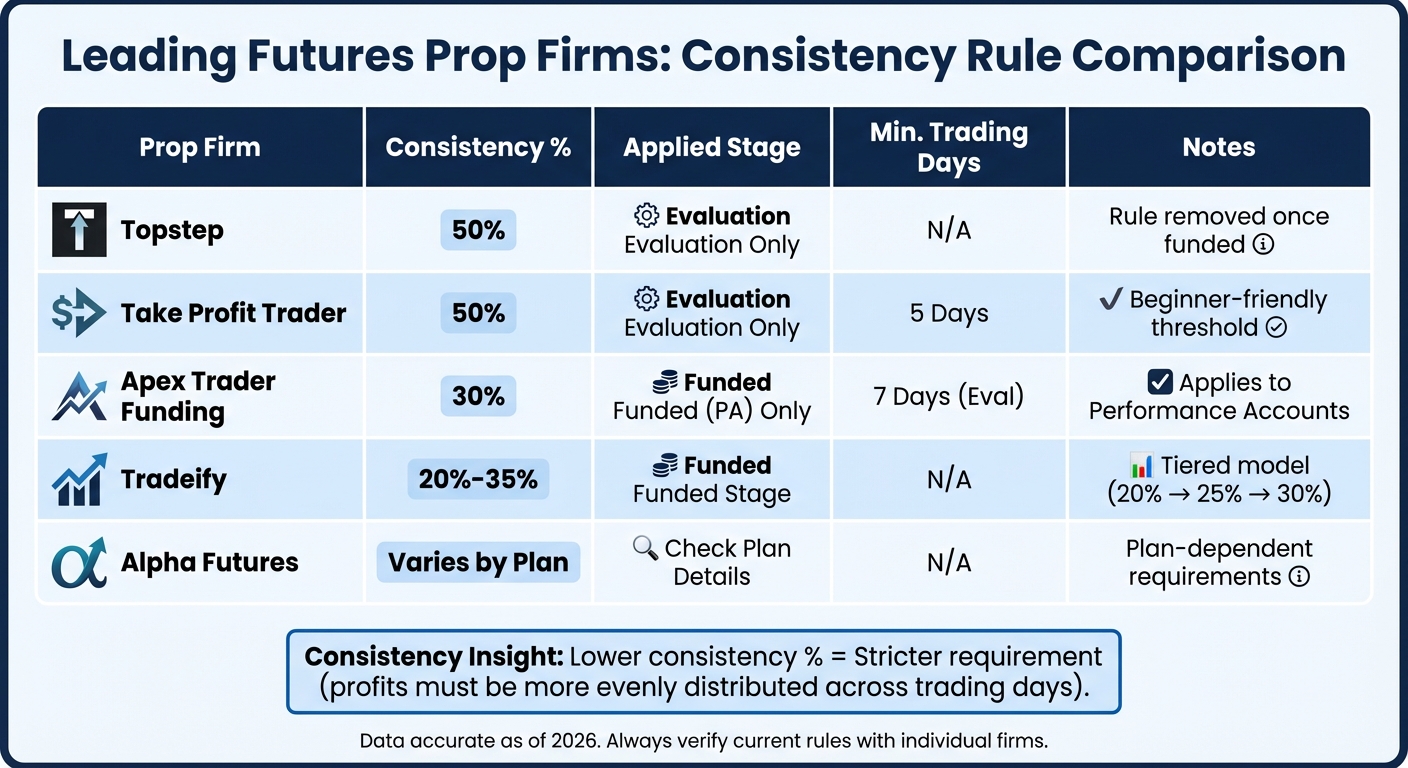
Futures Prop Firms Consistency Rule Comparison Chart
The consistency rule ensures that your best trading day contributes between 20% and 50% of your total profit. This guideline is rooted in risk management principles and is a key factor in futures prop trading.
The math behind this is simple: divide your best day’s profit by your total profit. If the result exceeds the firm’s threshold, you’ll need to keep trading and increase your overall profit until the ratio falls within the acceptable range. The formula looks like this: Biggest Day Profit ÷ Consistency % = Total Balance Needed. This calculation is essential for fine-tuning your trading approach, especially if you’re aiming to secure funding for your account.
Most firms also require traders to trade for at least 5 to 10 days to prevent hitting profit targets from a single lucky day. While some firms enforce the consistency rule only during the evaluation phase, others apply it in the funded stage – or both. For instance, Topstep eliminates the rule entirely once you’re funded, whereas Apex Trader Funding enforces it during the Performance Account (PA) stage.
Standard Rule Parameters
Firms often cap the percentage of your total profit that can come from your best trading day. Instead of penalizing accounts immediately for exceeding this cap, firms typically raise the profit target until your results meet the required consistency. For example, if you’re trading a $150,000 account with a 20% consistency rule and your best day nets $2,500 while your total profit is $9,000, you’ll need to reach $12,500 in total profits (calculated as $2,500 ÷ 0.20) before you can request a payout.
In addition, firms keep an eye on lot size variance to identify traders who might suddenly increase leverage to hit targets quickly. This ensures that traders maintain steady and disciplined trading habits, which are essential for long-term success.
Examples from Leading Futures Prop Firms
Here’s a breakdown of how some leading futures prop firms apply the consistency rule:
| Prop Firm | Consistency % | Applied Stage | Min. Trading Days |
|---|---|---|---|
| Topstep | 50% | Evaluation Only | N/A |
| Take Profit Trader | 50% | Evaluation Only | 5 Days |
| Apex Trader Funding | 30% | Funded (PA) Only | 7 Days (Eval) |
| Tradeify | 20%–35% | Funded Stage | N/A |
| Alpha Futures | Varies by Plan | Check Plan Details | N/A |
Tradeify, for instance, uses a tiered model where the consistency threshold increases with each payout: 20% for the first, 25% for the second, and 30% for subsequent withdrawals. Apex Trader Funding applies a 30% rule specifically to their Performance Accounts. Darrell Martin, the company’s founder, explains:
"The consistency rule is aimed at weeding out gamblers, scammers, and schemers who might trade a large contract one time while trading micros the rest of the time".
sbb-itb-46ae61d
How to Meet the Consistency Rule Requirements
The consistency rule is all about spreading your profits over multiple trading sessions instead of banking on one massive win. To meet this requirement, focus on distributing your gains evenly. For instance, you can lower the risk per trade and increase the number of setups you take, ensuring no single day overshadows the rest of your trading performance.
Creating a Structured Trading Plan
Start with a solid risk management strategy. Risking a consistent fraction of your capital on each trade helps keep your daily results balanced. Avoid drastic changes in position sizes – aim for a variation of no more than 10–20%. Sudden increases in lot sizes can be seen as risky behavior. Instead of chasing a big payday, set achievable daily profit goals, like $500–$1,000, to maintain steady progress.
"Consistency signals control, discipline, and risk management. Prop firms view it as a measure of long-term potential, not just short-term performance".
Your trading plan should also include clear entry and exit rules that adapt to different market conditions. Many firms require traders to actively trade for 5 to 10 days to demonstrate a repeatable, skill-based strategy rather than relying on luck. A good benchmark for consistency is keeping your best day’s profit within 2–3 times your average daily earnings.
Once your plan is ready, tracking your daily execution becomes essential.
Monitoring Daily Performance
To ensure you’re staying consistent, calculate the percentage of your best day’s profit relative to your total profits using this formula:
(Best Day Profit ÷ Total Profits) × 100.
If this percentage exceeds the allowed limit, you can use the "fix" formula to determine how much more profit you need to stay compliant:
(Best Day Profit ÷ Consistency Threshold %) = New Profit Target.
For example, if your best day brought in $2,000 and the consistency rule allows 30%, you’ll need at least $6,667 in total profits before you can request a payout.
Keeping a detailed trading journal is a must. Record every trade, including profit or loss, position sizes, and market reactions. This helps you identify and correct inconsistent patterns early. If you exceed the threshold, reduce your position sizes and continue trading until you’re back within compliance.
Using Compliance Tools
To stay on track, make use of tools designed to help with consistency requirements. The DamnPropFirms Consistency Rule Calculator is a great example – it allows you to input your daily profit numbers and instantly check if you’re meeting the rule. It also calculates how much more profit you need to qualify for a payout. While many proprietary firms provide internal dashboards for monitoring, using an independent calculator offers an extra layer of assurance.
Pair these calculators with risk management tools like stop-loss settings and position sizing calculators. These tools help you maintain steady trade sizes and avoid oversized wins that could breach consistency rules. Always double-check your numbers with the calculator before submitting a withdrawal request to prevent delays or denials.
Using DamnPropFirms Resources for the Consistency Rule

DamnPropFirms provides a range of tools and insights to help traders navigate the consistency rule requirements. From calculators to detailed firm comparisons, the platform simplifies the process of staying compliant.
Consistency Rule Calculator
The DamnPropFirms Consistency Rule Calculator is designed to assist with futures prop firm evaluations and instant funding accounts. It uses a straightforward formula: Biggest End-of-Day Profit ÷ Consistency % = Total Balance Needed. By entering your daily profits, the calculator determines if your largest winning day falls within the firm’s allowable threshold – whether that’s 20%, 30%, or 35%.
For instance, let’s say you’re trading on a Tradeify $150,000 Lightning account with a $9,000 profit goal and a 20% consistency rule. In this case, the maximum profit you can make in a single day is $1,800. If you exceed that and record a $2,500 profit in one day, your profit target increases to $12,500 ($2,500 ÷ 0.20) before you can request a payout.
"Going over the Consistency Rule does not mean you lose your account. Instead, your profit target increases until your results satisfy the rule." – DamnPropFirms
The calculator accommodates various thresholds, including Tradeify’s gradual consistency model and Phidias’s 30% rule. To avoid payout delays, it’s a good idea to use this tool to verify your numbers before submitting a withdrawal request. Once your figures are confirmed, you can dive into the platform’s reviews and guides for deeper insights.
Reviews and Educational Resources
Beyond the calculator, DamnPropFirms offers detailed reviews and guides that cover consistency rules, payout structures, and account options. These resources include evaluations of firms like Apex Trader Funding, Take Profit Trader, FundedNext Futures, and Alpha Futures.
For example, the "Tradeify Consistency Rule – Full Guide" explains how the gradual consistency model works for Lightning accounts – starting at 20% for the first payout, increasing to 25% for the second, and 30% for all subsequent payouts. These guides not only clarify the rules but also help you develop strategies to work within them. Additionally, the Damn Good Traders Discord community, with over 3,000 members, offers a space to share setups, profit and loss results, and other trading insights.
Links to Top Prop Firm Reviews
To help you find a firm that aligns with your trading preferences, DamnPropFirms provides direct links to its reviews. If you’re looking for accounts without consistency rules, consider Phidias Prop Firm (25K Static account with 0% consistency requirements) or Lucid Trading (LucidFlex account with no consistency rule).
For more lenient consistency thresholds, beginner-friendly options like Tradeify (Growth Sim accounts with a 35% rule) or FundingTicks are worth exploring. If instant funding is your priority, firms like Lucid Trading and Tradeify provide immediate access to capital without requiring evaluation phases.
Additional reviews include options like TickTickTrader, The Futures Desk, and Topstep. These reviews break down each firm’s consistency rules, pricing, and payout terms, helping you make an informed decision before committing to an account.
Conclusion
The consistency rule acts as a safety net, ensuring traders don’t rely on occasional, oversized wins. Instead, it focuses on identifying those who can deliver steady returns through repeatable strategies. This approach filters out traders dependent on one-off high-profit days and emphasizes the disciplined execution essential for managing real capital over time.
"The consistency rule is a training tool that builds the discipline required to survive in leveraged markets." – MyFundedFutures
This disciplined mindset forms the backbone of lasting success in prop trading. Adhering to these rules fosters habits that help maintain funded accounts. Across firms, the message is clear: steady, controlled performance always surpasses erratic, high-risk gains.
Before requesting payouts, double-check your numbers with the DamnPropFirms Consistency Rule Calculator. Their in-depth reviews of firms like Apex Trader Funding, Take Profit Trader, and FundedNext Futures break down each firm’s policies, helping you align with an account that suits your trading style. With the right tools and insights, you can turn consistency into a competitive advantage, reinforcing the sustainable trading practices needed for long-term success.
FAQs
What is the consistency rule in prop trading, and how does it affect my strategy?
The consistency rule in prop trading exists to promote steady, disciplined trading instead of relying on a few big, high-risk wins. This rule often limits any single day’s profit to a percentage of your total profits – typically between 20% and 40%. The goal? To encourage traders to aim for consistent results over time.
For your trading strategy, this means placing a strong emphasis on risk management and avoiding putting too much on the line in a single trade or day. Sticking to this rule not only helps you build sustainable trading habits but also increases your chances of meeting the firm’s funding and payout criteria. While breaking the rule doesn’t usually result in losing your account, it can delay payouts until your profits show a more balanced distribution. In the end, mastering this rule lays the groundwork for long-term success in the world of prop trading.
What happens if I go over the consistency percentage in one trading day?
If your trading activity exceeds the allowed consistency percentage in a single day, your account won’t be disqualified. However, you’ll need to keep trading until your consistency ratio aligns with the acceptable range before you can request a payout. This approach helps ensure fair performance evaluation over time and promotes disciplined trading practices.
What is the consistency rule in futures prop trading, and how does it affect evaluations and funding?
The consistency rule in futures prop trading is all about proving a trader’s ability to generate steady, controlled profits over time. It’s designed to ensure that success isn’t based on a single lucky day but instead reflects disciplined and consistent performance across multiple trading sessions. For instance, some firms might cap a single day’s profit at a specific percentage of the overall profit target – often around 20%. This ensures that traders are using repeatable strategies rather than relying on one-off gains.
During the evaluation phase, traders must follow these rules to qualify for funding. Falling short of the consistency criteria could mean failing the evaluation or losing eligibility for funding. Even after traders secure funding, many firms continue monitoring their performance to ensure they maintain steady, reliable results. This system not only protects the firm’s capital but also encourages traders to develop sustainable habits for long-term success.