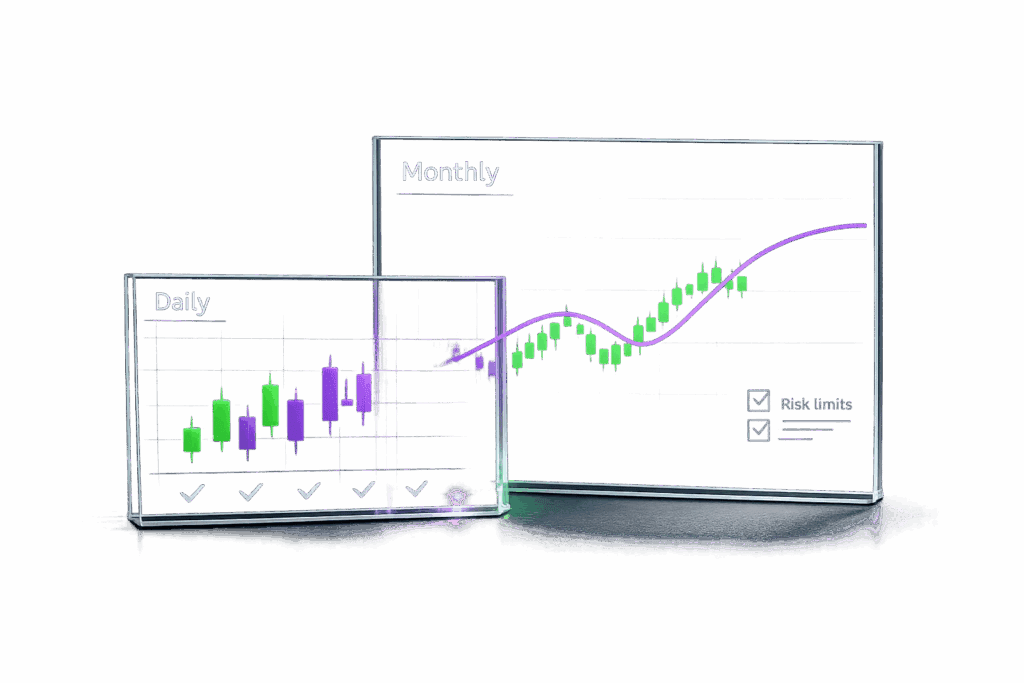
Tracking your trade performance is essential, but how often should you do it – daily or monthly? Both methods offer distinct benefits and drawbacks, depending on your trading style and goals. Here’s a quick breakdown:
- Daily Tracking: Provides immediate feedback, helps identify intraday patterns, and ensures compliance with strict rules like drawdown limits. However, it can be stressful, prone to overreacting to market noise, and overwhelming for high-frequency traders.
- Monthly Tracking: Focuses on long-term trends, simplifies performance reviews, and aligns with most prop firm payout cycles. On the downside, it delays feedback on issues, misses short-term opportunities, and makes it harder to pinpoint specific mistakes.
Key Takeaway: Day traders and scalpers benefit from daily tracking for quick adjustments. Swing and position traders may prefer monthly tracking to filter out noise and focus on broader trends. Combining both methods can strike a balance – daily logs for detailed data and monthly summaries for strategic insights.
Benefits of Daily Performance Tracking
Real-Time Feedback and Quick Strategy Changes
Tracking your performance daily creates a feedback loop that highlights what’s working and what’s not. It helps you spot profitable habits and catch costly mistakes within just 24 hours [5]. In fast-paced markets, yesterday’s winning strategy might backfire today, so quick adjustments are crucial.
For instance, if your win rate drops from 64% during the market open to 38% in the midday session [13], you can adapt by avoiding trades between 12 pm and 2 pm. Daily reviews also shine a light on execution issues like slippage or premature exits, which can quietly drain 15–30% of your potential profits [13]. Interestingly, research shows that 80% of traders feel more confident in their decisions after adopting a daily tracking routine [12].
This practice also helps separate emotional impulses from data-driven decisions [11]. For example, your journal might reveal that excitement after three wins leads to over-leveraging on the next trade, or that fear after consecutive losses keeps you from taking valid setups. These avoidable mistakes – like revenge trading or missed stop-losses – often go unnoticed in the heat of the moment [5]. With daily tracking, you gain clarity on these patterns and can act on them immediately.
Better Understanding of Intraday Patterns
Markets behave differently throughout the day, and daily tracking helps you identify these shifts. For example, the open (9:30 am), midday lull (12 pm–2 pm), and power hour (3 pm–4 pm) each have unique characteristics [13]. By breaking down your trades by session, you can pinpoint where your strengths lie.
Take the "time-to-first-trade" metric: traders who wait at least 15 minutes after the market opens tend to have higher win rates compared to those who dive in during the first 5 minutes [13]. Keeping a log of this metric helps you measure your patience and refine your approach. If you’re making 10 to 50+ trades daily, even one bad habit repeated hundreds of times a month can lead to significant losses [13]. Daily tracking helps prevent these small errors from snowballing.
Daily Monitoring of Consistency Rules
For traders working with prop firms like Apex Trader Funding or Tradeify, daily tracking is non-negotiable. Many firms enforce a Consistency Rule, which limits a single day’s profit to 30–40% of your total profit target [8][9]. Without daily monitoring, you could accidentally exceed this limit, forcing you to continue trading just to restore balance.
Daily tracking also helps you avoid drawdown violations. Prop firms often have intraday trailing drawdowns that can result in account failures, even if you recover by the market close [8][14]. Some firms, like Tradeify, offer "Select Daily" accounts with soft-breach daily loss limits [8], making precise real-time monitoring critical. Tools like the Consistency Rule Calculator can help you stay compliant with these rules before any issues arise.
Drawbacks of Daily Performance Tracking
Higher Stress and Over-Monitoring
Tracking daily performance can feel like a double-edged sword. Real-time profit and loss (P&L) updates might seem helpful, but they often stir up strong emotions, leading to impulsive decisions like revenge trading. As Optimus Futures puts it:
"The excitement you associate with ‘real trading’ is actually the psychological addiction that destroys accounts" [15].
Short-term trading on 1- to 15-minute charts is another layer of stress. It demands constant focus and split-second decision-making, which can quickly drain you mentally and physically [16][17]. Add to that the endless scrolling through market data, and it’s no surprise that burnout becomes a real risk. For high-frequency traders, even the administrative side – like manually logging trades – can pile on unnecessary stress. A backlog of unlogged trades only adds to the chaos of an already intense trading day [3].
Overreacting to Market Noise
Daily tracking also has a habit of amplifying the small stuff. Every minor market fluctuation – whether it’s a holiday, a global headline, or just random noise – gets magnified. This can tempt traders to ditch a solid strategy after just a couple of rough days. PropFirmPress highlights this risk:
"Focusing solely on daily data can sometimes lead to overreacting to normal variability" [4].
For those working under strict intraday drawdown limits (like in prop firm trading), this noise becomes even more hazardous. A sudden market spike could breach your drawdown limits before you even have time to adjust, especially if you’re overleveraged [6]. Constantly reacting to these fluctuations can lead to rushed decisions instead of thoughtful, strategic adjustments [4].
Difficulty Analyzing Many Transactions
If you’re executing a high volume of trades daily, the sheer amount of data can feel overwhelming. Trying to review every single trade in detail often leads to what’s called analysis paralysis – where the flood of information makes it harder to pinpoint what really matters [4][7]. Instead of uncovering useful insights, you might find yourself stuck in a cycle of manually updating spreadsheets with figures like P&L, win rates, and contract sizes, without actually learning anything from the data. TradeFundrr sums it up well:
"Too much information can be paralyzing. Focus on actionable insights, not endless spreadsheets" [5].
This constant need to process daily data can quickly lead to fatigue, making it harder to stay sharp and focused [4][5].
| Challenge | Impact | Solution |
|---|---|---|
| Higher Stress | Burnout, emotional decisions, and declining mental health [17] | Turn off real-time P&L displays; rely on alerts to minimize screen time [15][17] |
| Market Noise | Overreacting to minor fluctuations, abandoning solid strategies [4] | Focus on longer-term trends (weekly or monthly) before making adjustments [4] |
| Analysis Overload | Information paralysis, unlogged trades, and missed insights [3][7] | Use automation for trade syncing and prioritize actionable data over manual, excessive tracking [5] |
Benefits of Monthly Performance Tracking
Focus on Long-Term Trends
Looking at performance on a monthly basis helps you spot meaningful trends while filtering out the noise of daily fluctuations. Instead of stressing over a bad day or celebrating a single lucky win, you can focus on patterns that genuinely reflect your trading skills. As Prop Firm Press puts it:
"Monthly data minimizes the noise present in daily and weekly reports, focusing attention on meaningful trends rather than transient fluctuations" [4].
This approach makes it easier to distinguish between skill and luck. A profitable month is far more likely to reflect consistent effort and strategy than a single standout trade. Trade With the Pros emphasizes this idea:
"Monthly trading performance reviews turn trading into a systematic process, fostering consistency and self-awareness" [7].
It also helps you uncover emotional patterns that might be affecting your trades. By stepping back and looking at the bigger picture, you can better understand how emotions play into your decisions [7].
Easier Overall Performance Review
Monthly tracking simplifies performance evaluations by consolidating key metrics like net profit, win rate, average trade size, and maximum drawdown into a single snapshot. This makes it much easier to measure your progress against quarterly goals or other key benchmarks [4].
It also provides an opportunity to evaluate your trading strategy more objectively. When you’re not caught up in reviewing every single trade, you can assess whether you followed your plan or let impulsive decisions take over [7].
Matches Prop Firm Payout Schedules
Most prop firms operate on monthly or multi-week payout cycles, so aligning your tracking with these schedules is a practical move. It also helps you stay within their consistency rules, which often require that no single day accounts for more than 30% to 50% of your total profit during a payout cycle [18][9].
For instance, MyFundedFutures imposes a 40% consistency rule on its Starter Funded accounts. If any single day’s profit exceeds 40% of your total gains for the cycle, payouts are paused until further trading balances it out [18].
Similarly, Phidias requires traders to achieve three successful payouts – or $75,000 in cumulative withdrawals – before advancing to a live funded account [9]. Monthly tracking ensures you stay on top of these rules, making it easier to plan your finances and meet firm requirements [4][8].
Here’s a breakdown of some key prop firm rules and payout structures:
| Prop Firm | Consistency Rule | Payout Speed | Scaling Path |
|---|---|---|---|
| Phidias | 30% | 1–4 hours | Live account after 3 payouts [9] |
| MyFundedFutures | 40% (Starter Funded) | ~1 minute | Payout caps for first 60 days [18][9] |
| Tradeify | 40% (Select) | 1 business day | Elite tier after 5 payouts [8] |
| Apex Trader Funding | 30% Negative P&L | 5–7 business days | 100% of first $25,000 profit [9] |
| TakeProfitTrader | Buffer Zone system | 3–5 business days | PRO+ live account upgrade [9] |
Drawbacks of Monthly Performance Tracking
Delayed Feedback on Problems
Reviewing trades only at the end of the month can significantly delay the discovery of failing strategies or bad habits. By the time an issue is identified, the damage – such as substantial losses – may already be done. As Prop Firm Press puts it:
"Monthly metrics risk obscuring critical signals occurring within a shorter timeframe, delaying corrective actions or innovation." [4]
This lag in feedback can lead to serious consequences in a prop firm setting. For instance, exceeding daily drawdown limits or violating consistency rules may go unnoticed until your account is restricted or your payouts are impacted [10]. In contrast, daily monitoring provides immediate insights into short-term fluctuations, enabling quicker corrective actions.
Missing Short-Term Opportunities
While monthly tracking offers a broader perspective, it tends to smooth out fluctuations, making it harder to spot short-term opportunities. These transient events often hold the key to rapid adjustments. As Jasper Osita from ACY Securities explains:
"A daily review shows you how you behaved. But a monthly review reveals something deeper – the true direction your trading is heading." [19]
Although monthly reviews provide strategic insights, they might miss fleeting patterns that are crucial for short-term gains. For traders who rely on swift decision-making, this lack of granularity can be a significant disadvantage.
Harder to Identify Specific Trade Mistakes
Another challenge with monthly tracking is its inability to pinpoint individual mistakes. When an entire month’s trades are grouped into one report, identifying the specific trades responsible for losses becomes a lot harder. This aggregation can obscure the psychological triggers behind poor decisions, such as fear of missing out (FOMO) or overconfidence [4][19].
Some traders find that 70–90% of their profits come from just a handful of setups – valuable insights that are easily lost in a high-level monthly summary [19]. Without daily or weekly breakdowns, it’s tough to isolate and address specific errors, and the emotional context of each trade may fade over time [7][19].
These limitations highlight the trade-offs between granular daily data and broader monthly summaries:
| Metric Frequency | Primary Focus | Main Drawback |
|---|---|---|
| Daily | Detailed visibility, intraday patterns, behavioral insights | Can lead to overreacting to market noise [4] |
| Weekly | Micro-trends and tactical adjustments | May overlook day-to-day volatility in fast-moving markets [4] |
| Monthly | Big-picture strategy and long-term direction | Masks critical short-term signals and delays feedback [4] |
5 Trading Metrics Your Need to Track + Free Trade Analytics Template
sbb-itb-46ae61d
Daily vs. Monthly: Comparison Table
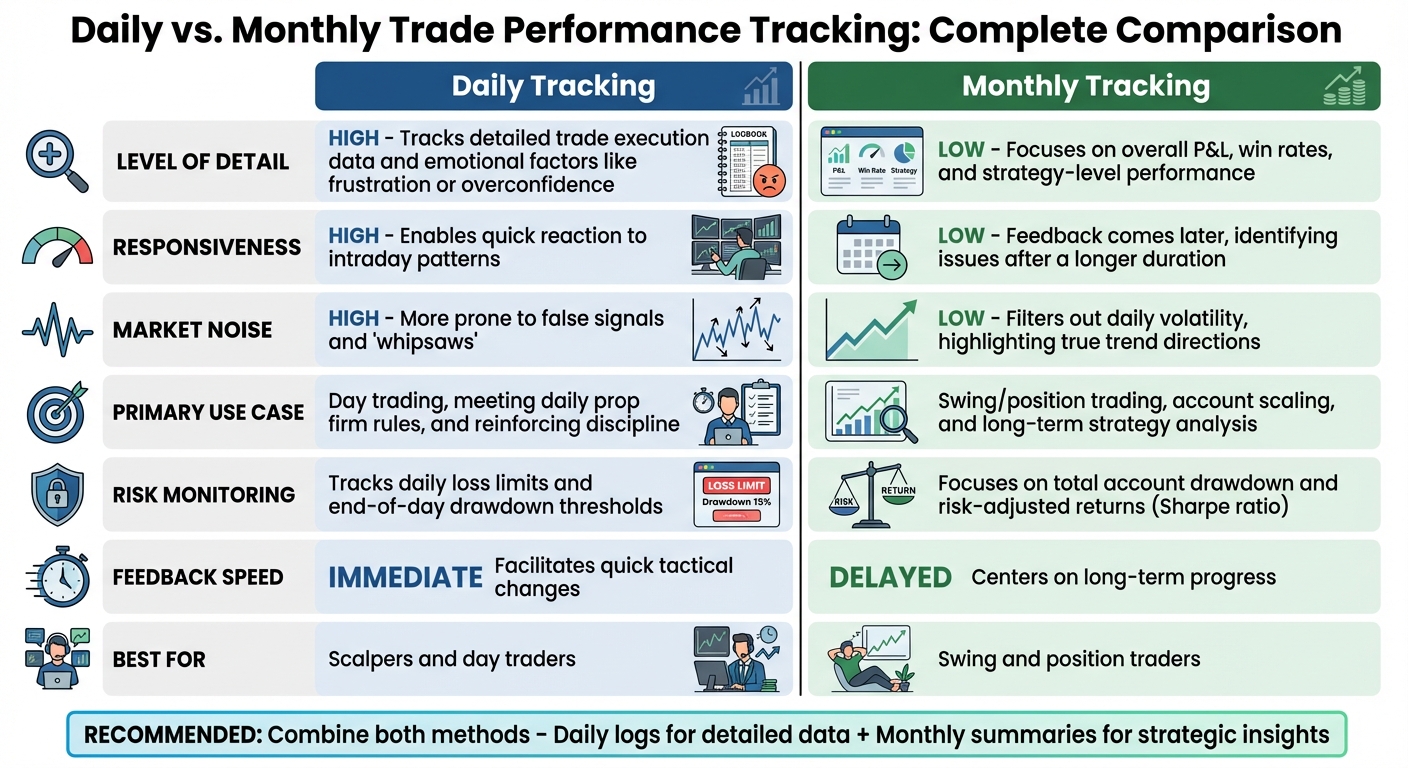
Daily vs Monthly Trade Performance Tracking Comparison Chart
Your trading approach, comfort with risk, and the guidelines of your prop firm will influence whether daily or monthly tracking works better for you. The table below outlines the key differences between the two methods.
| Feature | Daily Tracking | Monthly Tracking |
|---|---|---|
| Level of Detail | High: Tracks detailed trade execution data and emotional factors like frustration or overconfidence [5] | Low: Focuses on overall P&L, win rates, and strategy-level performance [1][3] |
| Responsiveness | High: Enables quick reaction to intraday patterns [1] | Low: Feedback comes later, identifying issues after a longer duration [1] |
| Market Noise | High: More prone to false signals and "whipsaws" [1] | Low: Filters out daily volatility, highlighting true trend directions [1] |
| Primary Use Case | Day trading, meeting daily prop firm rules, and reinforcing discipline [5][10] | Swing/position trading, account scaling, and long-term strategy analysis [3][20] |
| Risk Monitoring | Tracks daily loss limits and end-of-day drawdown thresholds [10] | Focuses on total account drawdown and risk-adjusted returns, such as the Sharpe ratio [3] |
| Feedback Speed | Immediate: Facilitates quick tactical changes [4] | Delayed: Centers on long-term progress [7] |
| Best For | Scalpers and day traders [21] | Swing and position traders [21] |
Daily tracking is a must for high-frequency traders who rely on immediate feedback to refine their tactics. However, it comes with a caveat. As Professor Valeriy Zakamulin notes:
"Using daily data may allow the trader to be more ‘responsive’ to market action, however… this responsiveness may be drowned in false signals via so-called ‘whipsaws.’" [1]
On the other hand, monthly tracking smooths out daily volatility, offering a clearer picture of your strategy’s long-term direction. This approach aligns well with evaluating broader trends and syncing with prop firm payout schedules, though it might delay the recognition of potential issues.
Ultimately, the choice between daily and monthly tracking depends on your trading style and how you prioritize risk management. This comparison provides a starting point to help you decide which method best suits your needs, with more details explored in the following sections.
When to Use Daily Tracking
Daily tracking is a must for traders who need real-time insights and the ability to make quick adjustments. While monthly tracking can provide a broader overview, daily tracking is critical in certain trading scenarios. If you’re placing multiple trades throughout the day or striving to meet funded account requirements, keeping tabs on your performance daily lays the groundwork for long-term success.
High-Frequency or Day Trading
For scalpers and day traders executing 10, 20, or even 50+ trades per day, remembering the reasoning behind every trade can be nearly impossible. By the afternoon, the logic behind your early-morning trades might be a blur [13]. Without a daily log, valuable lessons slip away, increasing the risk of repeating mistakes.
Breaking down each session in detail helps identify patterns – both good and bad. For instance, one Tradervue user discovered that losses often piled up during low-volume lunch hours [24]. Research also shows that starting your day with a losing trade can significantly lower your win rate for the rest of the session [13]. On the flip side, traders who wait at least 15 minutes after the market opens before placing their first trade tend to perform better than those who dive in during the chaotic first 5 minutes [13]. These kinds of insights are only possible with daily tracking; monthly summaries would obscure them entirely.
By capturing these intraday patterns, you can refine your strategy and meet the strict requirements often set by proprietary trading firms.
Meeting Prop Firm Rules Daily
If you’re working with firms like Tradeify, Apex Trader Funding, or Take Profit Trader, daily tracking becomes non-negotiable. These firms often enforce a 20% consistency rule, meaning no single trading day can contribute more than 20% of your total profit target [22].
Here’s how it works: if you earn $1,000 on your best trading day under a 20% rule, you’ll need at least $5,000 in total profits to qualify for a payout [22]. Surpassing the daily threshold means building additional profits over time to stay compliant.
Daily reviews help ensure your end-of-day (EOD) balance aligns with these requirements. As MyFundedFutures puts it:
"Traders who pass evaluations relying on one huge win often struggle once funded. The habits that gave them one big win will eventually give them one catastrophic loser" [18].
When to Use Monthly Tracking
If your trading approach leans toward capturing longer-term trends, monthly tracking can be a game-changer. This method is particularly effective for strategies that rely on filtering out the daily ups and downs of the market, focusing instead on broader movements over time [4]. For traders who hold positions for several days or weeks, this approach aligns perfectly with their needs.
Swing or Position Trading
For swing and position traders – those who hold trades over multiple sessions and wait for trends to unfold – monthly tracking offers a clear advantage. These traders thrive on sustained market patterns rather than fleeting intraday fluctuations. By analyzing monthly data, you can pinpoint the setups that drive the bulk of your profits [19]. For instance, you might notice that trades executed during the New York session or liquidity sweeps play a significant role in your overall success. As Japer Osita from ACY Securities explains:
"A monthly review reveals something deeper – the true direction your trading is heading" [19].
This broader perspective helps reduce the urge to abandon a well-thought-out strategy after a tough week. It also highlights emotional patterns, like greed during sudden spikes or impulsiveness during sharp declines, allowing you to fine-tune your approach [4][19]. Monthly tracking naturally complements scaling strategies, especially when you’re working within prop firm guidelines.
Planning Account Scaling with Prop Firms
Monthly reviews are also well-suited for the payout cycles of prop firms, which typically range from 5 to 10 trading days and cover about 20-22 sessions per month [26][4].
For example, at Tradeify, traders qualify for the "Elite" live-funded tier after achieving five payouts from simulated funded accounts [8]. Tracking progress on a monthly basis can help you stay on course without getting bogged down by daily fluctuations. As of early 2026, Tradeify has processed over $125 million in trader payouts and holds a 4.7/5 rating on Trustpilot from more than 2,100 reviews [8].
Monthly tracking is also invaluable for navigating prop firm consistency rules. By planning trades over a longer period, you can meet the required thresholds while maintaining discipline. Tools like DamnPropFirms‘ Consistency Rule Calculator can help ensure your largest profit day stays within the firm’s limits before you request a withdrawal [22].
For traders scaling with Apex Trader Funding, which offers up to $6 million in funding across 20 accounts, monthly reviews are critical for staying organized [22][10]. Tracking safety-net thresholds and contract limits across multiple accounts is far more manageable with monthly summaries than with daily records [25].
Combining Both Tracking Methods
Futures traders often find success by blending daily logs with monthly reviews. Daily logs capture the detailed data needed to adhere to prop firm rules, while monthly reviews provide insights into whether a trading strategy consistently delivers results over time [22][23]. This combination allows for precise day-to-day execution while maintaining a broader, strategic perspective.
Daily for Trades, Monthly for Trends
Daily tracking is all about discipline. By recording each trade’s profit or loss and keeping a close eye on end-of-day (EOD) drawdowns, traders can ensure they’re staying within daily loss limits [10][22]. This immediate feedback loop helps tackle common pitfalls like overtrading and revenge trading.
On the other hand, monthly tracking takes the daily data and zooms out to evaluate sustainability. Over a typical payout cycle of 20–22 trading days, traders can identify which strategies produce steady equity growth and which bring unpredictable spikes [23]. This long-term view is essential for managing Consistency Rules, which often require that no single trading day accounts for more than 20% to 40% of total profits [22][23]. While daily logs flag outlier days as they happen, monthly reviews provide a roadmap for smoothing out these spikes by calculating how much additional profit is needed to meet consistency thresholds and maintain payout eligibility [22][18].
Using Prop Firm Tools for Combined Tracking
Many traders rely on specialized tools to simplify this dual tracking approach. For example, DamnPropFirms offers a Consistency Rule Calculator. By inputting the largest profit day and the firm’s consistency percentage, the tool calculates the total profit required to meet consistency standards (using the formula: Biggest Profit Day ÷ Consistency %).
Some prop firms also integrate tracking features directly into their platforms. Take Tradeify, for instance – it uses a "Sage Score" to compile weeks of trading data, giving traders a broader view of their behavioral patterns [8].
At Apex Trader Funding, where traders can scale up to $6 million across 20 accounts, combining daily and monthly tracking becomes even more critical. Daily logs allow traders to manage EOD drawdowns across multiple accounts, while monthly reviews help ensure consistency thresholds are met, making payout planning smoother and more efficient [10][22].
Conclusion: Choosing the Right Tracking Method
When you compare these tracking methods, it’s clear that each serves a distinct purpose in managing risk and refining trading strategies. The choice between daily and monthly tracking ultimately depends on your trading style, the rules of your prop firm, and your own mindset. For day traders and high-frequency traders, daily tracking is essential to manage immediate risks and comply with strict drawdown limits. On the other hand, swing and position traders gain more from monthly reviews, as these help cut through short-term noise and focus on long-term trends [4][6][9].
Combining daily logs with monthly reviews can create a well-rounded tracking system. Daily logs are ideal for monitoring end-of-day drawdowns, keeping track of trade counts to avoid overtrading, and ensuring adherence to firm-specific rules [2][10]. Meanwhile, monthly reviews are better suited for analyzing win rates, checking compliance with consistency rules, and planning for account scaling or payout requests [4].
If you’re working with a prop firm, your tracking approach should align with their specific policies. Firms with intraday trailing drawdown requirements, like Apex Trader Funding, demand constant monitoring. In contrast, firms with end-of-day drawdown policies allow for more flexibility during the trading day [6][10]. Additionally, consistency rules – where no single day’s profit can exceed 30% to 40% of total profits – highlight the need for both daily oversight and a broader monthly perspective [8][9].
This underscores the importance of disciplined tracking, as summed up by FunderPro Futures:
"Mastering drawdown discipline is what separates consistent traders from frequent resetters." – FunderPro Futures [6]
FAQs
What should I track daily vs. monthly?
Daily tracking zeroes in on short-term performance metrics such as profit, win rate, trade duration, and trade count. This helps traders monitor their execution closely and tackle issues like emotional decision-making or impulsive trading.
On the other hand, monthly tracking takes a step back to assess the bigger picture. It focuses on overall profit, risk-reward ratio, and consistency to identify patterns, refine strategies, and evaluate long-term progress.
Both daily and monthly tracking play a crucial role in maintaining and improving trading performance, each offering unique insights to help traders stay on track and grow.
How do I avoid overreacting to daily P&L swings?
To keep emotions in check and avoid overreacting to daily profit and loss (P&L) swings, it’s better to focus on longer-term performance metrics like weekly or monthly results. This broader view offers a clearer sense of your overall consistency and helps you sidestep the emotional rollercoaster that comes with daily fluctuations.
Another helpful strategy is applying the consistency rule – prioritizing steady, repeatable outcomes over time. This mindset encourages discipline and helps you stay grounded, even when short-term volatility tries to pull you off course.
How can I track prop firm consistency and drawdown limits?
Tracking consistency and managing drawdown limits are crucial for successful trading with prop firms. Tools like DamnPropFirms’ Futures Prop Firm Consistency Calculator can help you stay on track by ensuring your trading aligns with firm rules, such as adhering to the standard 20% daily profit target threshold. Additionally, understanding the difference between fixed and trailing drawdowns, as well as intraday versus end-of-day limits, is key to managing risk effectively while staying compliant with firm requirements.