Choosing between Lucid Trading and Apex Trader Funding depends on your trading style, goals, and preferences. Here’s a quick breakdown of the differences:
- Drawdown Models: Lucid uses End-of-Day (EOD) drawdowns, while Apex offers both EOD and Intraday options. Intraday tracking can stop you out early if unrealized profits reverse.
- Fees: Lucid charges a one-time fee (e.g., $65 for a 50K account), while Apex has lower entry fees (as low as $19.70 during promotions) but includes monthly charges ($85/month after funding).
- Payouts: Lucid processes payouts in about 15 minutes, offering withdrawals every three days. Apex pays twice monthly, taking 3–10 business days.
- Profit Split: Both firms offer a 90% split, but Apex allows traders to keep 100% of their first $25,000.
- Account Limits: Apex supports up to 20 accounts per trader, while Lucid allows 5.
Quick Comparison
| Feature | Lucid Trading | Apex Trader Funding |
|---|---|---|
| Drawdown Type | End-of-Day (EOD) | EOD or Intraday |
| Fees | One-time fee ($65 for 50K) | Monthly fees ($85/month) |
| Payout Speed | ~15 minutes | 3–10 business days |
| Profit Split | 90% | 100% (first $25K), then 90% |
| Max Accounts | 5 | 20 |
| Trustpilot Rating | 4.8/5 (689 reviews) | 4.5/5 (15,938 reviews) |
Lucid is ideal for traders seeking fast payouts and no recurring fees, while Apex suits those managing multiple accounts or looking for low entry costs. Both firms cater to different needs, so pick the one that aligns with your trading strategy.
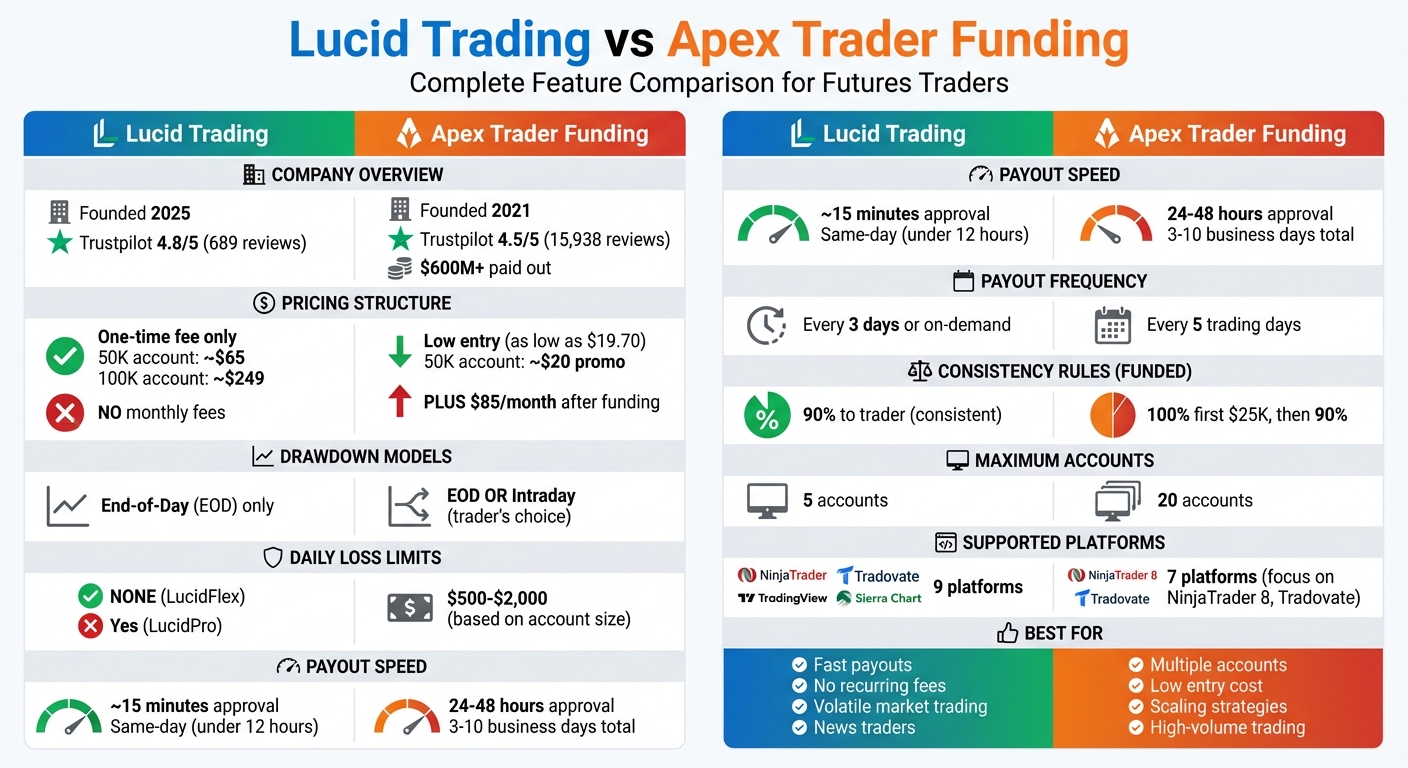
Lucid Trading vs Apex Trader Funding: Complete Feature Comparison
Apex Still King in 2026? 50K Prop Firm Data Breakdown – Apex vs TPT vs Trade Day vs Lucid + MFF & E8
Lucid Trading and Apex Trader Funding: Company Profiles
Below are profiles of Lucid Trading and Apex Trader Funding, outlining their origins, missions, and how they operate.
Lucid Trading Profile
Founded in 2025 by AJ Campanella, Lucid Trading quickly gained traction in the trading community. Campanella, a U.S.-based entrepreneur, remains actively engaged with the firm’s community [3][9]. Lucid Trading’s mission has been clear from the start: reduce restrictive rules and eliminate delays in execution [6].
The company stands out for its trader-friendly features like end-of-day (EOD) drawdown calculations and fast payouts, which appeal to those who value efficiency. It also supports strategies like news trading, scalping, and short-term trades, even during volatile market conditions [1][2].
In February 2026, Lucid Trading introduced a major update by phasing out its LucidBlack account and launching LucidMaxx, an invite-only tier designed for high-performing traders. This tier offers daily payouts, further enhancing its appeal [1][9]. The firm has earned a Trustpilot rating of 4.8/5 from 689 reviews, reflecting its growing reputation among traders.
Lucid Trading limits traders to five accounts and operates with a one-time fee model, eliminating recurring monthly fees. Costs range from $75 for a 25K account to $345 for a 150K account [3][9].
Apex Trader Funding Profile
Founded in 2021 by Darrell Martin, Apex Trader Funding targets traders looking for maximum scaling opportunities [3][5]. The firm supports up to 20 accounts per trader, allowing for significant capital management [2][3]. Since its inception, Apex has paid out over $600 million to traders, making it a prominent name in the futures prop trading space [5].
Apex caters to traders managing capital up to $3,000,000 across multiple accounts and offers flexibility with its drawdown models. After updates rolled out in March 2026, traders can now choose between EOD and Intraday drawdown models. Additionally, Apex introduced a faster payout system, enabling withdrawals of up to $100,000 within 5 days [2].
The firm is also known for its affordability during promotional periods, with entry costs as low as $17.70 to $28.05. However, once funded, traders pay an $85/month Performance Account fee [5]. Apex Trader Funding holds a Trustpilot rating of 4.5/5 from 15,938 reviews, reflecting its established presence and reliability [5].
Account Options and Pricing
Here’s a breakdown of the updated account options and fee structures for both Lucid Trading and Apex Trader Funding as of March 2026.
Lucid Trading Accounts and Fees
Lucid Trading sticks with its one-time fee model, offering four main account types: LucidPro, LucidFlex, LucidDirect, and the exclusive LucidMaxx.
- LucidPro: Includes a structured evaluation process with specific profit targets and consistency requirements.
- LucidFlex: Removes daily loss limits and consistency rules after funding, making it ideal for traders navigating volatile markets.
- LucidDirect: Provides instant funding for a higher upfront fee, with no activation charges.
- LucidMaxx: An invite-only option for top-performing traders, offering daily payouts.
Pricing depends on account size:
- A 25K account costs approximately $100.
- A 50K account is priced around $65 during promotions.
- A 100K account runs about $249.
Lucid Trading frequently offers discounts of up to 50%, and there are no activation fees. If a trader fails the evaluation, a reset fee of around $85 applies.
Apex Trader Funding Accounts and Fees
Apex Trader Funding uses a one-step evaluation process that leads directly to a funded Performance Account. Traders can choose between End-of-Day (EOD) or Intraday drawdown models, depending on their trading style.
- A 50K account evaluation fee is around $20 during promotional periods.
- A 100K account evaluation fee is approximately $207.
After passing the evaluation, traders pay an activation fee ranging from $79 to $160, plus a monthly fee of $85 for maintaining their Performance Account. Reset fees average about $50, with some accounts exempt.
To compare costs:
- For a 50K account, the total funding cost at Apex is roughly $210.33, while Lucid Trading’s equivalent costs around $130.
- Profit targets also differ: Apex sets a $6,000 target for 100K accounts, compared to Lucid Trading’s $8,000 target.
Trading Rules and Requirements
Drawdown Limits and Risk Controls
Lucid Trading and Apex Trader Funding approach drawdown limits differently. Lucid Trading strictly uses end-of-day (EOD) drawdown for its programs – LucidPro, LucidFlex, and LucidDirect – while Apex Trader Funding provides the flexibility of choosing between EOD and intraday drawdown models. Both firms update their maximum loss limits at the end of the trading day.
When it comes to daily loss limits, Apex enforces limits that range from $500 for 25K accounts to $2,000 for 150K accounts [7]. On the other hand, LucidFlex accounts from Lucid Trading do not impose any daily loss limits, which can be particularly advantageous during volatile markets or major events like NFP (Non-Farm Payroll) and FOMC (Federal Open Market Committee) announcements.
Apex also applies a 30% Maximum Adverse Excursion (MAE) rule on its legacy accounts. This rule caps live, unrealized negative P&L at 30% of the account’s start-of-day profit balance [11]. In contrast, LucidPro accounts at Lucid Trading use a Buffer Balance system. This system requires traders to maintain a balance that includes the Initial Max Loss Limit plus $100, which locks funds until profits exceed this threshold [2]. Additionally, Apex locks the drawdown to the starting balance once sufficient profit is earned [7].
These differences in drawdown and risk controls highlight the unique approaches each firm takes to manage trader risk.
Consistency Rules and Trading Restrictions
Consistency rules are another way these firms ensure fair profit reporting. These rules prevent payouts from being based solely on a single highly profitable day. Apex enforces a 50% consistency rule on its Performance Accounts, meaning that no single winning day can contribute more than half of the total profit during a payout cycle. Lucid Trading, however, tailors its consistency rules based on account type:
- LucidDirect: Enforces a 20% rule.
- LucidPro: Enforces a 40% rule (applicable to accounts purchased or reset on or after November 28, 2025).
- LucidFlex: No consistency rule once the account is funded.
"The absence of a consistency rule at Lucid means big winning days don’t delay your payout cycle the way they can at Apex." – Paul, ProTradingVibes [7]
Position management is another area where these firms differ. Both require positions to be closed before the market closes. Lucid sets a deadline of 4:45 PM EST, while Apex allows positions to remain open until 4:59 PM ET. Overnight or weekend holds are not permitted on standard accounts at either firm. However, both firms allow traders to engage in news trading and scalping during major events like FOMC and NFP, offering flexibility for different trading strategies.
Account management also varies: Apex permits traders to manage up to 20 funded accounts simultaneously, while Lucid Trading typically limits traders to 5 accounts.
These varying rules and restrictions significantly influence how traders can operate and realize profits. The table below provides a clear comparison of the key differences.
Comparison Table: Rules and Requirements
| Feature | Apex Trader Funding | Lucid Trading (LucidFlex) | Lucid Trading (LucidPro) |
|---|---|---|---|
| Drawdown Type | EOD or Intraday | End-of-Day (EOD) | End-of-Day (EOD) |
| Daily Loss Limit | $500 – $2,000 | None | Yes (20% of target) |
| Funded Consistency | 50% Rule | None | 40% Rule |
| Max Accounts | 20 | 5 | 5 |
| Position Close Time | 4:59 PM ET | 4:45 PM EST | 4:45 PM EST |
| News Trading | Allowed | Allowed | Allowed |
| Open Trade Risk Control | 30% MAE Rule (Legacy) | None | Buffer Balance System |
sbb-itb-46ae61d
Payouts and Profit Sharing
Payout Speed and Reliability
Lucid Trading stands out for its quick payout process, typically completing transactions in about 15 minutes on average, with funds often reaching traders within 12 hours[4][12]. This fast turnaround ensures traders can access their earnings without delay.
On the other hand, Apex Trader Funding operates on a longer timeline. While payout requests are approved within 24–48 hours, the actual transfer of funds – using platforms like Deel – can take an additional 1–3 business days, resulting in a total processing time of 3–10 business days[4][7].
To illustrate the difference, in March 2026, trader Paul shared his experience of withdrawing over $84,800 from various prop firms, including $24,000 from Lucid Trading. He noted Lucid’s approval process frequently took under 15 minutes, compared to the multi-day wait times at other firms[8].
Profit Split Structures
Both firms offer attractive profit-sharing models, but their approaches differ. Lucid Trading provides a straightforward 90% profit split across all account types – LucidPro, LucidFlex, and LucidDirect. This consistency ensures traders retain 90 cents of every dollar earned[2].
Apex Trader Funding, however, employs a tiered system. Traders keep 100% of their first $25,000 in profits, with a 90% split applying to earnings beyond that amount[4]. This setup can be advantageous for those still working toward their initial profit goals.
Payout frequency also varies. Lucid Trading offers on-demand payouts once eligibility criteria are met, with some accounts (like LucidPro) allowing withdrawals as often as every three days[1]. In contrast, Apex Trader Funding processes payouts on a five-trading-day cycle[3].
"Lucid wins on pricing structure (one-time fees vs monthly), payout speed (same-day vs 8+ days), and rule flexibility." – Paul, Professional Trader and Reviewer, PropTradingVibes[8]
Comparison Table: Payouts and Profit Splits
| Feature | Lucid Trading | Apex Trader Funding |
|---|---|---|
| Profit Split | 90% to trader | 100% (first $25,000), then 90% |
| Payout Approval Speed | 1–15 minutes | 24–48 hours |
| Total Payout Timeline | Same-day (under 12 hours) | 3–10 business days |
| Payout Frequency | Every 3 days or on-demand | Every 5 trading days |
| Minimum Withdrawal | $500 | Varies by account |
| Withdrawal Methods | Rise, Bank Transfer, Crypto, Plaid ACH | ACH, Wire, Plane, Deel |
| Safety Buffer Required | None (Flex/Direct); Max Loss + $100 (Pro) | Starting Balance + Drawdown + $100 (first 3 payouts) |
Trading Platforms and Resources
Supported Platforms and Features
Lucid Trading offers access to nine trading platforms, giving traders plenty of options to tailor their trading experience [2][13]. These platforms include NinjaTrader, Tradovate, TradingView (via Tradovate), Sierra Chart, MotiveWave, Quantower, Bookmap, and Tradesea.
Apex Trader Funding, on the other hand, supports seven platforms, with a strong focus on NinjaTrader 8 (via Rithmic) and Tradovate [3][7]. Apex stands out by enabling high-volume traders to manage up to 20 accounts at once using an integrated trade copier – a feature designed for efficiency [3][5]. Both firms provide mobile and web trading through Tradovate, ensuring accessibility for traders on the go. For market data, both rely on Rithmic and Tradovate/CQG, delivering consistent and reliable feeds across their platforms [2][13].
Lucid Trading also supports DLL integrations on its LucidPro and LucidFlex accounts for NinjaTrader and Sierra Chart [13]. This allows traders to use custom indicators and automate their strategies, making trade execution more efficient. These features highlight Lucid’s focus on providing robust tools for its users.
Trader Tools and Support Resources
Both firms go beyond platform access by equipping traders with tools and resources designed to improve performance.
Apex Trader Funding offers WealthCharts Apex, a proprietary platform tailored for its evaluation and performance accounts [10]. This platform includes the "Champion Trend Pack" by Rob Hoffman, tools to analyze trading performance, and an integrated trade copier for mirroring trades across multiple accounts. Additionally, Apex evaluations come with a free NinjaTrader license key and real-time data, adding value for traders [10].
Lucid Trading takes a different route, leveraging standard third-party integrations while introducing unique account features. After completing six payouts, traders unlock access to LucidLive, a program that offers swing trading capabilities, bonus opportunities, and the LucidEscrow model [2]. In February 2026, Lucid introduced LucidMaxx, an exclusive, invite-only program focused on daily payouts and a faster path to live funding [1][13].
When it comes to community support, the two firms take distinct approaches. Lucid’s Damn Good Traders (DGT) Discord community includes over 4,500 traders, fostering a collaborative environment [1][2]. Meanwhile, Apex leans on its extensive history, offering detailed documentation, strategy guides, and a proven track record of over $600 million in payouts [5][7]. Lucid emphasizes community-driven support, while Apex caters to traders looking for institutional-level resources.
"Lucid supports 9 platforms, which is more than most competitors. Topstep is locked to Tradovate and NinjaTrader." – Paul, PropTradingVibes [13]
Choosing the Right Firm for Your Trading
When selecting a trading firm, it’s essential to align their rules and offerings with your trading style, risk tolerance, and financial goals. For traders who thrive on high-volatility and aggressive strategies, LucidFlex could be a strong contender. It stands out with no daily loss limit and no consistency rules, offering significant flexibility. On the other hand, those who prefer a more structured approach might lean toward LucidPro, which includes a one-day pass evaluation and a 40% consistency rule [1][2].
"LucidFlex has zero daily loss limit AND zero funded consistency rule, the most forgiving combination in futures prop trading." – Paul, PropTradingVibes [13]
Payout speed is another critical factor. Lucid Trading provides near-instant payouts, making it an attractive choice for traders who want quick access to their earnings. Comparatively, Apex processes payouts on a bi-weekly schedule. However, Apex’s reputation for reliability is noteworthy – it has distributed over $600 million to traders since 2021, showcasing its established presence in the market [5].
For traders managing multiple accounts, Apex is particularly advantageous. Its high-volume capabilities and integrated trade copier make it ideal for scaling strategies. Additionally, Apex frequently offers promotions, with evaluations for a $50K account sometimes priced as low as $18 to $20 [3].
When considering trading restrictions, it’s important to note the nuances of each firm’s rules. For example, LucidDirect may not suit traders aiming for large single-session wins, as its 20% consistency rule could limit such strategies [1]. Meanwhile, Apex’s intraday trailing drawdown can challenge scalpers who don’t secure profits quickly. In contrast, Lucid’s end-of-day drawdown provides more flexibility during volatile market conditions [4].
Lastly, don’t overlook each firm’s reputation. Lucid boasts a Trustpilot rating of 4.8/5 from 689 reviews, reflecting strong user satisfaction. Apex, with a larger customer base, holds a 4.5/5 rating from 15,938 reviews [5]. For an in-depth look at each firm, visit the Lucid Trading and Apex Trader Funding review pages.
Considering a Third Option? FundedNext Futures
If neither Lucid’s end-of-day model nor Apex’s scaling-focused lineup quite fits, FundedNext Futures is worth a serious look as a third alternative. It takes a different approach from both firms by offering three distinct challenge paths under one roof — letting you pick the evaluation style that matches your trading rhythm instead of forcing you into one structure.
What makes FundedNext different:
- Rapid Challenge — one-phase evaluation with recurring payouts as fast as every 3 days once funded. If Lucid’s payout speed appeals to you but you want a traditional challenge format, this is the path.
- Legacy Challenge — two-phase evaluation with no consistency rule in funded accounts, similar to Lucid’s LucidFlex but without the instant-funding price tag. For traders who want full freedom on funded days.
- Bolt $50K Challenge — a single one-phase $50K account with day-1 withdrawals once funded. The simplest entry point if you want to start small and scale.
All three paths use end-of-day trailing drawdown (like Lucid, unlike Apex’s intraday), allow up to 5 accounts per trader, and process payouts in roughly 24 hours. Account sizes range from $25K to $100K.
For the full breakdown of rules, pricing per challenge, and the 10% discount with code DGT, see our complete FundedNext Futures review.
Conclusion
Choosing between these two options depends on your trading preferences and priorities. Lucid Trading stands out with its one-time fee structure and quick payouts – sometimes in as little as 15 minutes [5]. Its LucidFlex account is particularly appealing for news traders or those focusing on high-volatility strategies, as it removes daily loss limits and consistency rules once the account is funded [1][13].
On the other hand, Apex Trader Funding shines in scalability, allowing up to 20 accounts with a funding cap of $3,000,000. Since 2021, Apex has distributed over $600 million to traders, showcasing its extensive reach [3][5].
The cost structures of these firms also highlight key differences. Lucid Trading charges a one-time evaluation fee and avoids additional activation or monthly costs [13]. Meanwhile, Apex offers promotional entry prices as low as $18–$20 but includes a recurring monthly Performance Account fee of about $85 once funded [3][5][13]. This makes Apex an attractive option for traders looking for low initial costs, while Lucid Trading appeals to those who prefer to avoid ongoing fees.
Ultimately, the best choice will depend on your trading strategy and performance. For more in-depth information on account options, rules, and trader reviews, check out the Lucid Trading and Apex Trader Funding pages on DamnPropFirms.
FAQs
Which drawdown model is safer for my strategy – EOD or intraday?
The drawdown model you choose should align with your trading style and risk tolerance. End-of-day (EOD) models, such as those used by LucidFlex, evaluate accounts at the close of the market. This approach minimizes interruptions during the trading day and allows for greater flexibility. On the other hand, intraday models, like those offered by Apex Trader Funding, track accounts in real time throughout the day. This means trading can be halted earlier if losses occur during market hours. The right choice depends on what works best for your trading strategy.
What will I pay in total after I get funded (fees, activation, monthly)?
The total cost after funding depends on the firm and the type of account you choose. Lucid Trading charges a one-time evaluation fee, typically ranging from $60 to $130 (discounts are often available), and there are no recurring fees once funding is secured. On the other hand, Apex Trader Funding has a $160 lifetime activation fee along with a $19.70 monthly fee.
Costs can vary depending on the evaluation fees and any discounts applied. Lucid Trading also stands out for its fast payouts and a generous 90/10 profit split.
How soon can I withdraw profits, and what can delay a payout?
You can start withdrawing your profits from Lucid Trading immediately after being funded – there’s no waiting period. Most payout requests get approved within minutes, and funds are often transferred within 2 business days. In some cases, you might even see the money in as little as 15 minutes.
However, delays could happen if certain eligibility rules, like meeting profit targets or consistency requirements, aren’t fulfilled. Transfer methods and internal reviews might also impact the timing.