Markets change fast, and if you’re not adjusting your trading, you’re toast – especially with prop firm rules breathing down your neck. One day, your trend strategy prints cash; the next, it’s bleeding your account dry in a range-bound market. This guide breaks down how to spot market shifts, tweak your strategy, and stay compliant with prop firms like Apex, Topstep, and FundedNext. Whether it’s managing volatility, using tools like the Consistency Rule Calculator, or knowing when to sit out, we’ve got you covered. Let’s keep your funded account alive and thriving.
Trade Alignment: Conditions Change, You Change – Plan, Trades, Logic with Tom B at the Traders Lab
sbb-itb-46ae61d
How to Spot Market Condition Changes
The first step in staying ahead is recognizing when the market shifts gears. Markets don’t send out memos – they leave subtle clues instead. If you’re trading with a prop firm account, missing these signs can mean blowing your account instead of cashing out. Here’s a breakdown of three key transitions every trader needs to track.
When Markets Shift from Trending to Range-Bound
Trending markets are all about momentum – higher highs and higher lows (or the reverse). Range-bound markets, on the other hand, bounce between support and resistance. The shift happens when directional volume fades and price starts gravitating toward VWAP (Volume Weighted Average Price).
Keep an eye on your ADX (Average Directional Index) and ATR (Average True Range). If ADX dips below 20 and ATR flattens, you’re likely looking at a range. Multiple failed breakouts – where price keeps rejecting key levels – are another red flag. Trading platforms like TradingView and TradeLocker have these tools built in, so there’s no excuse to trade blind[5].
Here’s the deal: trending strategies fail in ranges. If you’re still chasing breakouts in a consolidating market, you’re setting yourself up for losses. And on a prop account with a trailing drawdown – like Apex Trader Funding or Topstep – those losses hit your high-water mark hard. Next up, let’s talk about how to handle shifts between high and low volatility.
High-Volatility vs. Low-Volatility Periods
Volatility isn’t just about big moves – it’s about how fast and erratic those moves are. High volatility means wide ranges, strong directional volume, and price action that can blow past your stop in seconds. Low volatility, on the other hand, brings tighter ranges, clustered volume near VWAP, and more predictable price action.
Here’s a quick breakdown:
| Market Regime | Characteristics | Key Indicators | Suggested Strategies |
|---|---|---|---|
| High Volatility / Trending | Expanding ranges, strong momentum, higher highs/lower lows. | ADX > 25, Rising ATR, VWAP expansion. | Trend following, scale into winners, use wider stops. |
| Low Volatility / Ranging | Tight ranges, price hugging VWAP, failed breakouts. | ADX < 20, Flat ATR, Volume clustering. | Mean reversion, range trading, or sit out. |
Order flow tools like the DOM (Depth of Market), footprint charts, and volume profiles can give you a real-time edge. For example, aggressive buying on the bid without price movement signals liquidity absorption, which you’ll often see in low-volatility markets. On the flip side, thin liquidity in the DOM paired with price ripping through levels is a warning to tread carefully.
For prop traders, high volatility is a double-edged sword. Firms like FundedNext Futures and Take Profit Trader use intraday trailing drawdowns that update in real time. For example, if you’re up $500 but let it pull back $300 before closing, that $300 still counts against your drawdown. In low-volatility markets, you might want to tighten stops and focus on mean reversion strategies to avoid unnecessary whipsaws. These volatility changes become even more critical when economic events come into play.
How Economic Events and News Releases Affect Futures
Big reports like FOMC meetings, CPI data, and Non-Farm Payroll (NFP) numbers don’t just move markets – they can shake things up for hours or even days. These "Tier 1" events can shift markets from trending to range-bound (or vice versa)[2][3]. During these moments, you’ll see rapid price swings, liquidity gaps, and sudden sentiment changes that can blow through stops faster than you can react[1].
Prop firm rules can make these events even trickier. Some firms enforce a “flat 2 minutes before and after” rule, meaning you can’t hold positions during the release[3]. Others, like Apex Trader Funding and Topstep, allow news trading but warn about the risks of extreme volatility. If you’re with a firm requiring mandatory bracket orders – like Tradeify or Alpha Futures – a sudden spike can trigger your stop before the market stabilizes.
Stay on top of an economic calendar. Mark FOMC, CPI, and NFP dates in advance, and decide whether you’ll trade or sit out[2][3]. Use order flow tools like DOM and footprint charts to monitor real-time pressure during these events[2]. And if you’re unsure, paper trade the event first. It’s better to skip a potential winner than to blow your account on a CPI surprise.
How to Adjust Your Trading Strategy
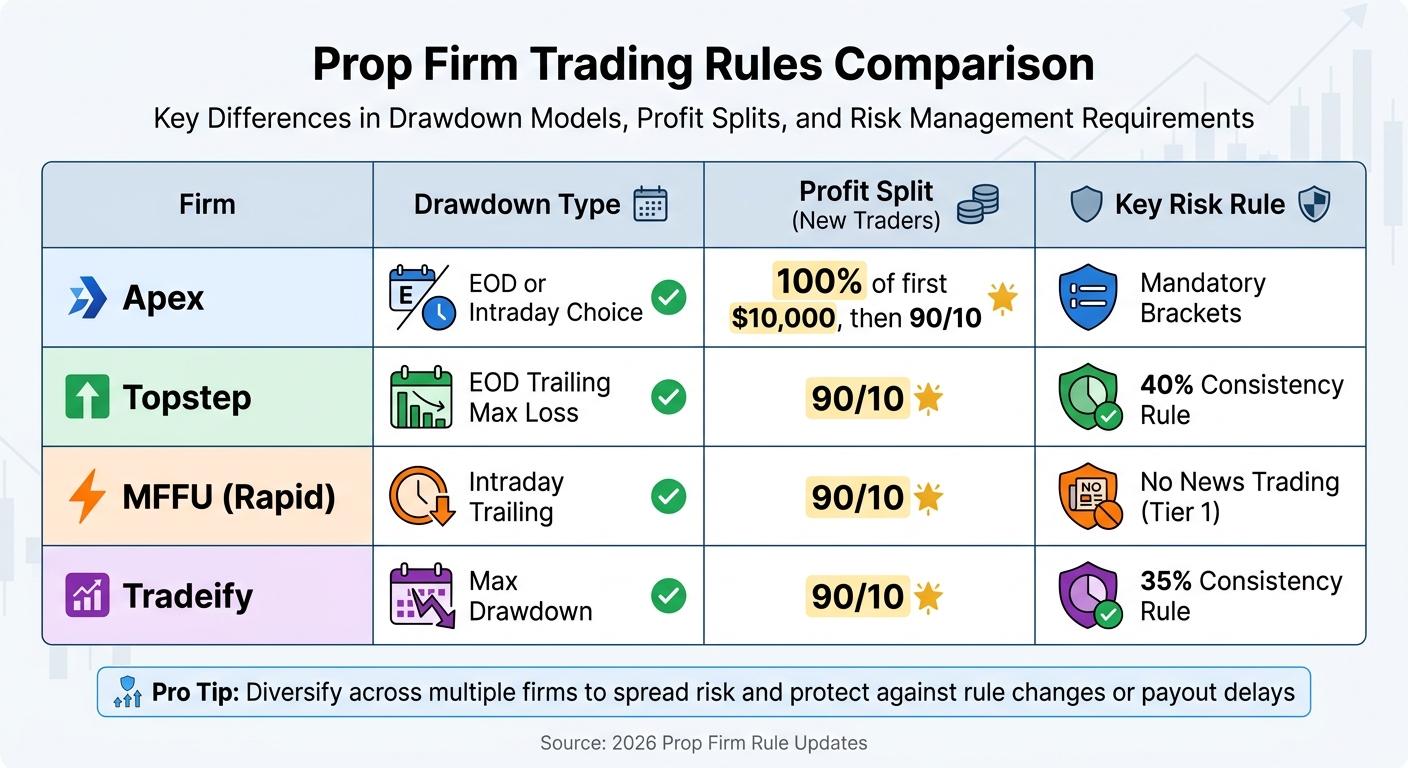
Prop Firm Trading Rules Comparison: Drawdown Types, Profit Splits, and Risk Requirements
Spotting shifts in the market is one thing – actually adjusting your trading strategy is where the real challenge lies. What works in a trending market can quickly drain your account when conditions turn range-bound. For prop traders, the stakes are even higher. Losses don’t just hurt your balance – they can trigger drawdown limits and end your funded account. Let’s talk about how to tweak your strategy without blowing up.
Changing Position Size and Managing Risk
When volatility spikes or liquidity dries up, scaling down your position size is a smart move. For example, if the ATR doubles for ES futures, you should reduce the number of contracts you’re trading to keep your risk per tick consistent. This is crucial for avoiding max drawdown, especially with firms that enforce intraday trailing rules like FundedNext Futures or Take Profit Trader.
Apex Trader Funding now requires mandatory bracket orders, meaning you have to set both stop-loss and take-profit levels before entering a trade[3]. This rule prevents you from holding onto losing trades too long or scrambling to exit during sudden market moves. While Apex enforces these brackets, other firms have different risk rules, so it’s critical to know the specifics for each firm.
Here’s a quick look at how some firms handle risk:
| Firm | Drawdown Type | Profit Split (New Traders) | Key Risk Rule |
|---|---|---|---|
| Apex | EOD or Intraday Choice | 100% of first $10,000, then 90/10 | Mandatory Brackets [3] |
| Topstep | EOD Trailing Max Loss | 90/10 | 40% Consistency Rule [3] |
| MFFU (Rapid) | Intraday Trailing | 90/10 | No News Trading (Tier 1) [3] |
| Tradeify | Max Drawdown | 90/10 | 35% Consistency Rule [4] |
Another tip: diversify across multiple firms. Running accounts at Apex, Topstep, and Lucid Trading is a good way to spread risk. Using one of the best trade copying platforms, you can mirror your strategy across platforms, so if one firm changes its rules or faces technical issues, your income isn’t entirely at risk[3].
Once your risk is under control, it’s time to adjust your trading style to match the market’s rhythm.
Moving Between Scalping and Swing Trading
After dialing in your risk management, focus on picking the right trading style for the current market. Scalping and swing trading aren’t just about timeframes – they’re entirely different approaches. Scalping is fast-paced, requiring split-second decisions and tools like DOM and footprint charts[1][2]. Swing trading, on the other hand, is more laid-back, with wider stops and lower risk per trade, aiming to capture trends over days or weeks[4].
Scalp when markets are choppy and volatile. This is often the case after major news events when short-term moves dominate, but no clear trend emerges[1]. Switch to swing trading when the market settles into a trend or when scalping starts to wear you out mentally. If you’re holding positions overnight or longer, make sure your account has enough drawdown room. For instance, Tradeify offers a $2,000 drawdown buffer on $50,000 accounts – 33% more than the typical $1,500 buffer at other firms[4].
Before trying a new style on a live funded account, test it in a demo or simulated environment first. This lets you see how changes in timeframe affect your win rate, trade duration, and emotional control without risking real money[1]. Also, watch out for consistency rules. At Topstep, no single day can make up more than 40% of your total profits[3]. At Tradeify, the limit is 35%[4]. These rules mean you can’t rely on one big win – you need steady, repeatable results.
By adapting your trading style, you’ll not only meet your prop firm’s requirements but also stay aligned with shifting market conditions.
Testing New Strategies with Historical Data
Before putting a new strategy into action, validate it with historical data. Backtesting lets you see how your setup performs in different market scenarios – trending, range-bound, high volatility, or low volatility – without risking capital[1]. Platforms like TradingView or TradeLocker provide access to historical price data and technical indicators, making it easy to test your ideas.
Keep in mind, though, that backtesting isn’t perfect. Simulated fills don’t account for slippage or liquidity gaps during high-volatility events[2]. So don’t assume your backtest results will translate 1:1 into live trading. If you’re trading in a prop firm environment, factor in their specific rules. For instance, at Apex Trader Funding, you’ll need to incorporate the 50% consistency rule into your backtest. For Topstep, stick to their 40% rule[3]. Make sure your strategy doesn’t accidentally trip any rules that could disqualify you from getting payouts.
Some firms, like FundedNext, require strategy consistency between your evaluation and funded phases[6]. If you backtest and refine a swing trading strategy, stick with it when you go live – don’t suddenly switch to scalping. This highlights why thorough testing is so important. Lock in your approach, test it rigorously, and stay consistent. If you’re just starting out, go for higher timeframes. Swing trading is easier to backtest and less impacted by short-term market noise than scalping[6].
Managing Risk During Volatile Markets
Volatile markets can put your funded account at serious risk. Drawdown limits and consistency rules don’t care if the market jumps 3% in an hour – they only care if you stay within the firm’s rules. The difference between keeping your account and losing it often comes down to knowing those rules and adjusting your risk before the chaos hits. If you don’t, you’re gambling with your account. Smart risk management is what keeps you in the game when the market gets wild.
Prop Firm Drawdown and Consistency Rules
Not all drawdown models are created equal, and knowing the difference can save your account during volatile periods. Take End-of-Day (EOD) trailing drawdown, for example. It only adjusts your drawdown floor at the session close, giving you more breathing room for intraday swings. Compare that to a tick-by-tick trailing drawdown, which updates the floor at every profit peak. Here’s how it plays out: if a trade hits $3,000 in profit but pulls back to $1,500, a tick-by-tick model calculates the drawdown from that $3,000 high. An EOD model, on the other hand, locks in the $1,500 gain instead. This flexibility is why firms like Apex Trader Funding now offer an EOD option alongside their traditional trailing model.
Consistency rules are another layer of protection. Some firms cap daily profits to prevent traders from relying on one big win. BluSky, for example, enforces a 21% consistency rule on large accounts, while Velotrade has no such restrictions, letting traders take full advantage of high-volatility opportunities. At Velotrade, the daily loss limit is 5% of your starting balance, so on a $100,000 account, you’re limited to a $5,000 loss. Dominion Funding, on the other hand, enforces a 6% maximum drawdown and a 4% daily loss limit.
Vittorio De Angelis, Executive Chairman of Velotrade, puts it bluntly:
Rule compliance is non-negotiable. A strategy that generates 15% average monthly returns will still end in account termination if it requires drawdowns that exceed the daily loss limit.[7]
Setting your own loss cap below the firm’s limit is one way to avoid revenge trading and keep your account intact. Knowing these limits and sticking to them can make all the difference.
How to Avoid Account Violations During Market Spikes
Once you’ve nailed down the drawdown rules, it’s time to adjust your tactics for market spikes. Start by adjusting your position sizing. If the Average True Range (ATR) on ES futures doubles, reduce your contracts by half to keep your dollar-risk per tick steady. This is especially important at firms like Apex Trader Funding where managing exposure is key.
Traders like Zeeshan Ali and Selcuk Ozgen have proven that disciplined risk control and position-sizing can turn around consecutive losses and drawdowns, eventually leading to solid payouts.
If you’re restricted from trading during high-impact news events, avoid them entirely. If you do trade news, use ATR-based stops, lock in partial profits early with trailing stops, and stick to high-liquidity instruments like ES, NQ, or CL to minimize slippage. These small adjustments can help you stay within the rules while navigating volatile markets.
Using Prop Firm Resources to Your Advantage
Understanding drawdown rules is important, but picking the right prop firm is just as critical. The firm you choose should match your trading style, as this can be the difference between consistent payouts and constantly breaking rules. Platforms like DamnPropFirms make it easier to compare key metrics and rules, so you can find the best fit for your strategy. Once you’ve got the right firm, you can use their tools to refine and improve your trading approach.
Choosing a Prop Firm That Matches Your Trading Style
Your trading style plays a big role in which firm will work best for you. For scalpers who make tons of trades in a day, firms with intraday trailing drawdowns and flexible consistency rules – like the 50% rule from Apex Trader Funding or MyFundedFutures – are ideal. These setups allow for frequent smaller wins without penalizing you. Swing traders, on the other hand, should look for firms offering End-of-Day (EOD) trailing drawdowns. This way, your unrealized intraday swings won’t put your account at risk.
For example, Apex Trader Funding gives you the option of both EOD and intraday trailing drawdowns, offering flexibility no matter your style [3]. Firms like Topstep enforce a 40% consistency rule, while Apex and MyFundedFutures push it to 50%, letting you have one big winning day without breaking the rules [3][4]. And if you’re looking for a cushion during tough trading days, Tradeify offers a $2,000 drawdown buffer on $50,000 accounts, which is more generous than the $1,500 offered by MyFundedFutures [4]. Picking a firm that aligns with your approach is step one; after that, it’s all about tracking your performance.
Tracking Performance with the Consistency Rule Calculator
Staying on top of your consistency is essential for meeting firm requirements and avoiding payout headaches. The Consistency Rule Calculator on DamnPropFirms is a handy tool to help you track whether your biggest trading day stays within the firm’s limits – usually 40% to 50% of your total profits [3][4]. This rule is one of the most common reasons traders face payout delays or denials.
Here’s an example: if you’ve made $5,000 in total profits but $2,600 of that came from a single day, you’ve gone over the 50% consistency threshold. The calculator helps you avoid this by automatically checking your daily profit percentages, so you can stay in compliance and get your payouts on time.
Conclusion: Staying Flexible in Changing Markets
Futures markets are always shifting. One day you’re riding a strong trend, the next you’re stuck in a choppy range. Add in high-volatility spikes or slow, dead zones, and it’s clear – you’ve got to adjust or risk blowing your drawdown. A momentum play that crushes it during a breakout can just as easily wreck your account when the market stalls. Flexibility isn’t just a nice-to-have; it’s what separates traders who thrive from those stuck resetting evaluations.
On top of market dynamics, prop firms keep you on your toes with rule changes. Firms like Apex Trader Funding and Topstep have adjusted their structures as recently as 2026. If you’re married to one firm or one strategy, you’re setting yourself up for a single point of failure. Smart traders are spreading risk by running accounts with multiple firms and using trade copying to hedge against sudden rule changes or payout delays.
Your strategy toolkit should include 3–4 setups tailored for different conditions: one for trends, one for ranges, one for news-driven volatility. Start your day by reading the market – overnight range tight? Big news on the calendar? Trendy open? Then, pick the right strategy for the job. And don’t forget to align your approach with your drawdown type. Scalping and mean reversion are better for tight intraday trailing drawdowns, while momentum and breakout trades shine in static or end-of-day drawdown accounts.
FAQs
How do I know when to stop trading and sit out?
Knowing when to call it quits in trading is all about spotting bad market conditions and respecting your risk limits. Step back when you see extreme volatility, sudden price spikes, or when the market shifts in ways you didn’t expect. Build a trading system with clear rules for hitting pause, and keep an eye out for early warning signs of chaos. Stick to your risk management plan – don’t let unpredictable markets drain your account.
How can I adjust position size when volatility spikes?
When the market gets choppy and volatility ramps up, it’s time to dial back your position size. Scaling down your trade size in proportion to the increased volatility is a smart way to protect your account from bigger-than-expected losses. You’ll also want to tighten up your daily loss limits – don’t give yourself too much room to bleed, especially when prop firm rules like drawdown or daily-loss limits are on the line. Stick to your risk management plan like glue; it’s the best way to stay compliant and keep trading another day when the market’s wild.
How do I avoid breaking drawdown or consistency rules?
To stay within drawdown or consistency rules, tweak your risk management to fit the market’s mood. Adjust your position sizes, set your own loss limits, and stick to the firm’s rules like trailing drawdowns. When markets get volatile, scale back on leverage and keep a close eye on your trades. Discipline is everything – stick to your profit targets and manage your risk per trade to stay compliant and steer clear of violations.