If you’ve ever had a payout denied or your funded account shut down over some confusing rule, you’re not alone. Most disputes with prop firms boil down to misunderstood agreements, like trailing drawdowns or consistency rules. Here’s the deal: knowing the rules inside out and handling disputes strategically can save your account and your money. We’ll break down the steps to resolve issues, from reviewing your agreement to escalating complaints, and even filing with regulators if needed. Let’s dive into how to protect yourself and your trading career.
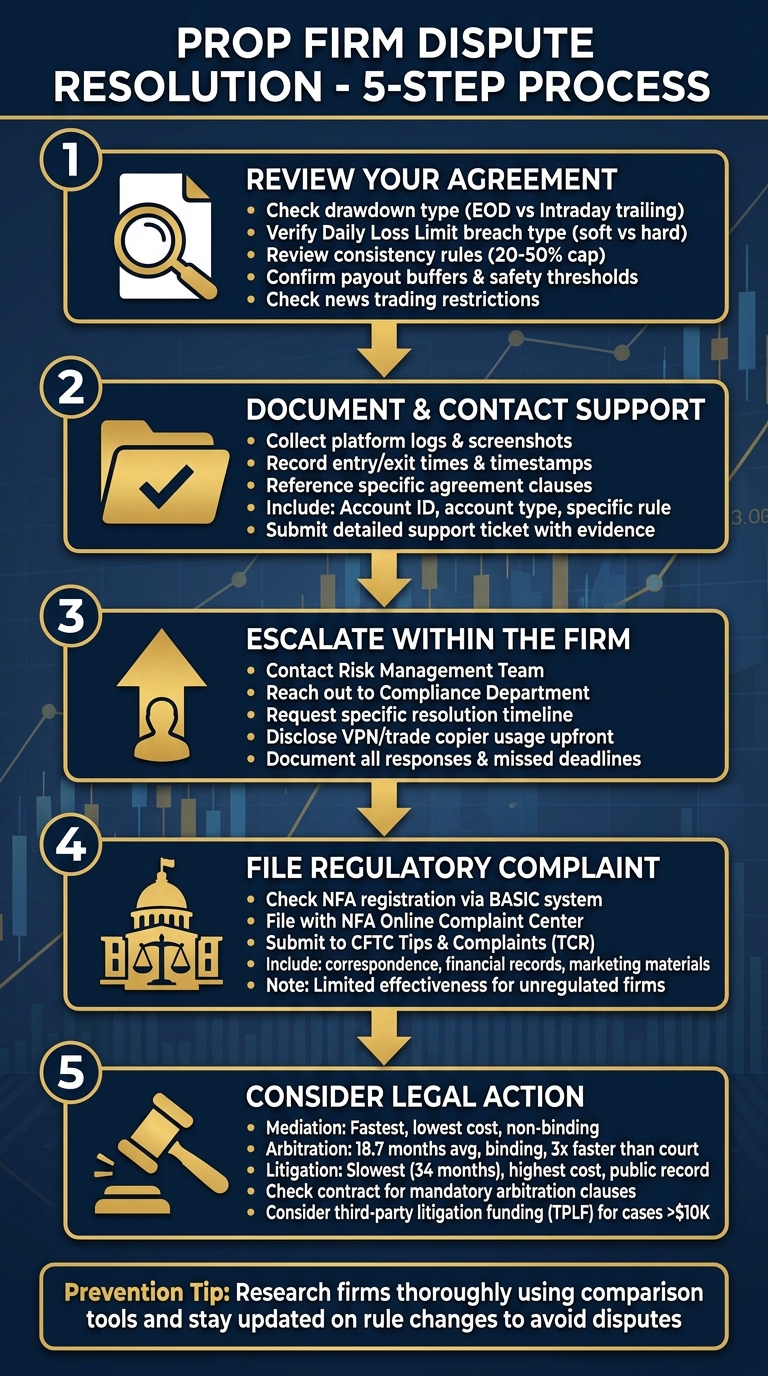
5-Step Prop Firm Dispute Resolution Process
Step 1: Review Your Prop Firm Agreement
Before jumping into a dispute, take a moment to carefully go through your prop firm agreement. Many disputes stem from misunderstandings of the rules rather than actual violations by the firm. Often, one overlooked clause in the terms you agreed to can make all the difference.
Key Sections to Review
Prop firm agreements can be long and dense, but a few sections are absolutely critical to understand:
- Drawdown Type and Lock Behavior: Figure out if your firm uses End-of-Day (EOD) trailing drawdown, which updates at the session close, or Intraday trailing drawdown, which updates in real-time with every tick. Some firms also "lock" the drawdown floor once it hits the starting balance plus a small buffer (often around $100). This lock can significantly tighten your breathing room, especially with intraday trailing models during volatile trades.
- Daily Loss Limit (DLL) Breach Type: Check how the firm handles DLL breaches. Some treat them as "soft breaches", temporarily pausing your account, while others enforce "hard breaches", which permanently close your account. For example, one firm might give you a warning, while another might shut you down immediately for the same violation.
- Consistency Rules: These rules limit how much of your total profit can come from one trading day, usually capping it at 20% to 50%. Before requesting a payout, make sure your largest single-day profit doesn’t exceed the firm’s threshold. For instance, Apex Trader Funding enforces a 50% consistency rule as of 2026.
- Payout Buffers and Safety Thresholds: Always keep your balance above your starting capital by at least your maximum drawdown plus some extra margin.
- News Trading Restrictions and Account Lifecycle Limits: Many agreements require you to be "flat" (no open positions) during major news events like FOMC, NFP, or CPI releases. Some firms even require a 1-2 minute buffer before and after these events. Additionally, firms like Apex Trader Funding may limit the number of payouts an account can receive (e.g., six payouts) before the account is considered "finished" and must be replaced.
Once you’ve reviewed these sections, compare them against your trading records to identify any potential mismatches or misunderstandings.
How to Identify Rule Violations
To figure out if there’s been a rule violation, compare your trading activity against the firm’s policies. A common source of confusion is the difference between "trailing" and "static" drawdown. Trailing drawdown moves up with your equity gains, which can lead to breaches even if your overall balance is still positive. It’s also important to know whether the drawdown is "balance-based" or "equity-based."
Here’s a real-world example: In December 2024, a PaidPex trader (linked to Pax Market Funds) disputed an account suspension. The trader had made $19,011 in total daily profits across 28 trades and stayed under the 4% daily loss limit of $4,000. However, the firm’s FAQ clarified that their trailing drawdown was equity-based and followed the highest floating profit. One trade peaked and then dropped $4,265, which triggered a trailing drawdown breach despite the trader’s positive balance. According to Pax Market Funds’ FAQ:
"The 4% daily drawdown is not a static metric, but one that trails forward with the highest floating profit of the day" [3].
If a firm uses a calculation method (like trailing drawdown) that isn’t clearly defined in its Terms of Service or FAQ, or if it fails to reset the daily loss limit after profits are realized, it could be in breach. To protect yourself, verify the drawdown type, check the FAQ for precise definitions, and keep detailed records of all your trades, including open/close times and maximum floating profit/loss. Use this data to match your trade records with the firm’s automated triggers and determine if a violation occurred.
sbb-itb-46ae61d
Step 2: Document the Issue and Contact Support
Once you’ve reviewed your agreement, it’s time to gather everything you need to back up your claim. A well-documented case can help you settle disputes quickly before things spiral out of control.
How to Document Your Dispute
Start by collecting objective evidence from platform logs and screenshots. FINRA advises, "To be eligible for investigation, the dispute must pertain to factual information and not subjective or interpretive information" [4]. In other words, your personal opinion won’t cut it – you need concrete proof.
Pull together logs, screenshots, and detailed trade records. This includes entry and exit times, timestamps, balance changes, and any floating profit or loss that might have triggered a drawdown breach. PropFirmRetiree suggests, "Keep a detailed trade journal with screenshots for every session – if a day is disputed, you need to show the entry, exit, and reasoning" [7]. If you’re challenging a consistency rule violation, grab your daily profit and loss records to clearly show what happened on each trading day.
Next, reference the specific sections of your agreement tied to the issue. For instance, if you’re disputing a trailing drawdown breach, point to the clause explaining how the firm calculates drawdown – whether it’s based on equity or balance. Include your account ID, account type (e.g., EOD Trail vs. Intraday Trail), and the specific rule in question, like a daily loss limit, consistency rule, or news trading restriction [6].
Make sure to keep every email and support ticket in a safe place [5]. Creating a timeline – showing when the trade happened, when the rule was supposedly broken, and when you contacted support – will give you a solid foundation if you need to escalate the issue beyond the firm’s internal process.
Once you’ve got your evidence in order, it’s time to contact support.
Submitting a Support Ticket
Reach out to support with a clear, evidence-backed message. Reference your documented proof and the relevant agreement clauses to make it easy for them to understand your case. Be specific: explain the issue, name the rule or agreement section involved, attach your evidence (like screenshots, CSV trade logs, or video recordings), and state exactly what resolution you’re looking for [4].
If you’re requesting a payout after a big trading day, consider contacting support before submitting the request. PropFirmRetiree advises, "When requesting a large payout, proactively contact support and explain the trade context before submitting" [7]. This can help avoid any delays or blocks caused by windfall clauses.
Be upfront about your trading setup. If you’re using tools like a VPN, trade copying platforms, or managing multiple accounts, disclose this right away. This can help you avoid being flagged by automated fraud systems. And if you’re dealing with a technical issue, like rejected orders, double-check whether the problem stems from position limits, API rate limits, or platform connectivity issues. The more specific you are, the faster support can investigate.
As a precaution, test their responsiveness before a dispute arises. Send a basic query to see how quickly and thoroughly they reply [5]. If they’re slow or vague, it might be a warning sign for how they’ll handle bigger issues.
Step 3: Escalate Within the Firm
If your support ticket and evidence don’t resolve the issue, it’s time to escalate. A generic or unhelpful response from support means you’ll need to take it up with higher-level teams like Risk Management, Compliance, or your account manager.
Contacting Higher-Level Support
Ask to escalate your case directly to the Risk Management Team, Compliance Department, or your account manager. These teams have the authority to review trade data, override automated flags, and make final decisions. Be clear and direct in your request. For example, say, “I need to speak with the Risk Management Team about my account closure,” or “Please forward my case to Compliance for further review.”
Keep using the same detailed documentation you included in your original support ticket. Reference specific clauses in your agreement that back up your claim. For instance, if you’re contesting a drawdown breach, point out whether the agreement uses equity-based or balance-based calculations and provide your account equity at the time of the alleged violation. Some experts suggest involving your firm’s compliance or legal team if the issue remains unresolved.
If you’ve used tools like VPNs, trade copiers, or managed multiple accounts, disclose this upfront. It’s better to address potential fraud flags directly than have them derail your case later. Keep in mind that some firms use cumulative warning systems, which could influence how your case is handled [8].
When to Request a Resolution Timeline
Once you’ve escalated your case, ask for a specific resolution timeline. This creates a clear expectation and gives you something to reference if the firm misses the deadline. For example, if the issue drags on, you might need to take it to regulators like the NFA or CFTC. Make sure to document any missed deadlines as evidence for further action.
Check the firm’s stated resolution timelines. Some top futures prop firms handle payouts within one to three business days [1][6], while others have fixed schedules, like processing payouts weekly (often on Wednesdays) [1]. Before assuming a delay is a breach, confirm whether you’re within their normal processing window. Knowing these timelines helps you decide if further escalation is necessary or if you simply need to wait.
If internal escalation still doesn’t resolve your issue, your next step may be filing a complaint with regulatory authorities.
Step 4: File a Complaint with Regulatory Bodies
If you’ve tried everything internally and still can’t resolve your issue, it’s time to escalate to U.S. regulators. This should be your last resort after exhausting all internal options with your prop firm. Be aware, though, that many futures prop firms operate in a regulatory gray area, which can limit what regulators can do.
Filing with the NFA or CFTC
Start by checking if the firm is registered with the National Futures Association (NFA). Use their BASIC system to verify the firm’s status. If they’re a registered member, you can file a complaint through the NFA Online Complaint Center. This is where you can report potential violations of NFA rules, like unethical behavior or misconduct.
If your issue involves fraud, market manipulation, or similar concerns, you can also file a complaint with the Commodity Futures Trading Commission (CFTC) through their Tips, Complaints, and Referrals (TCR) system. However, keep in mind that regulators may not be able to help if the firm operates as a "simulated funding" service rather than a fully regulated broker.
When submitting your complaint, include as much documentation as possible:
- Copies of all correspondence (support tickets, emails, letters to compliance)
- Financial records (evaluation fees, payout requests)
- Marketing materials, especially if they made misleading claims
- Evidence showing you tried to resolve the issue internally
As FINRA advises:
"If you lost money or there was an unauthorized trade made in your account, you should complain in writing. Retain copies of your letter and of all other related correspondence with the brokerage firm" [9].
Pros and Cons of Regulatory Escalation
Filing a regulatory complaint has its pros and cons. On the plus side, it creates an official record of your dispute, which might pressure the firm to take your case more seriously. Regulated brokers have to follow strict rules set by the SEC, CFTC, and NFA, including safeguarding client funds with protections like SIPC coverage (up to $500,000 per account).
However, most retail prop firms don’t fall under these regulations. They often operate with minimal oversight, don’t segregate client funds, and lack the same level of client protection. Regulators in this space tend to act only after a large number of traders have been affected [5].
Before you file, double-check the firm’s registration status and set realistic expectations about what regulators can actually do in your case.
Step 5: Consider Mediation, Arbitration, or Legal Action
When internal complaints and regulatory channels hit a dead end, your next steps boil down to mediation, arbitration, or litigation. Each route comes with its own costs, timeline, and level of complexity, so it’s crucial to weigh your options carefully.
Mediation and Arbitration Options
Mediation is the most informal and cost-effective of the three. A neutral mediator helps both parties communicate and work toward a voluntary agreement. You maintain control of the outcome, and nothing is finalized unless both sides agree to and sign a settlement. It’s private, quick, and typically the least expensive. As Harvard Law School’s Program on Negotiation explains:
"In a mediation process, a neutral, trained mediator works to help disputants come to a consensus on their own" [11].
But here’s the catch: if the prop firm refuses to participate or negotiate in good faith, mediation won’t get you anywhere.
Arbitration, on the other hand, is more formal and legally binding. An arbitrator – often a lawyer or former judge – reviews the evidence and issues a decision that’s enforceable in court. According to the American Arbitration Association (AAA):
"Arbitration is usually a faster, more cost-effective, and more private process than court proceedings" [10].
Arbitration is, on average, three times faster than litigation in U.S. District Courts. The median time to an award is about 18.7 months compared to 34 months for court cases [10]. In 2025, the AAA handled $29 billion in B2B claims, and over half of consumer cases settled before reaching a final award [10].
Check your contract for mandatory arbitration clauses. Most prop firms like Topstep include these, requiring disputes to go through specific providers like the AAA or National Arbitration and Mediation (NAM). If your contract has one, you’re likely barred from filing a traditional lawsuit [12]. Some traders opt for med-arb, a hybrid approach where you start with mediation and transition to arbitration if no agreement is reached [11].
| Feature | Mediation | Arbitration | Legal Action (Litigation) |
|---|---|---|---|
| Binding? | No (unless settlement signed) | Yes (Legally binding) | Yes (Legally binding) |
| Decision Maker | The parties (with mediator’s help) | Arbitrator (acts as judge) | Judge or Jury |
| Privacy | Private and Confidential | Private and Confidential | Public Record |
| Speed | Fastest | Faster than court (3x faster) | Slowest (Median 34 months) |
| Cost | Lowest | Moderate (includes admin fees) | Highest (legal fees/court costs) |
Deciding on Legal Recourse
If mediation and arbitration don’t cut it, litigation is the final option. This is the slowest, priciest, and most public route. Civil cases can rack up thousands to tens of thousands of dollars in legal fees [13]. Under the "American Rule", each side usually covers their own legal costs unless a contract or statute says otherwise [12]. Even if you win, you might not recover your legal expenses.
For traders with limited funds, third-party litigation funding (TPLF) can help. These agreements cover legal fees in exchange for 20–40% of any settlement or judgment [14]. If you lose, you owe nothing [13][14]. That said, TPLF providers are highly selective, approving only 4% to 5% of cases after rigorous due diligence on the case’s strength and the defendant’s ability to pay [13]. Commercial funders usually target cases with damages exceeding $10 million, while consumer-focused TPLF typically funds 7–10% of the case’s estimated value [13].
Before committing to litigation, consider whether the potential recovery is worth the cost. Many prop firms operate in murky legal territories and may not have enough assets to make a lawsuit worthwhile.
Takeaway: For disputes under $10,000, mediation or arbitration usually offers the best balance of speed and cost. Litigation should be a last resort, especially for smaller claims.
Preventing Future Disputes with Research and Reviews
Avoiding disputes with prop firms starts with doing your homework. Most issues traders face boil down to misunderstanding the rules or picking a firm that doesn’t fit their trading style. By staying informed about a firm’s policies and updates, you can save yourself frustration, time, and money. Think of it like risk management – just as you protect your account during trades, staying on top of firm rules protects you from unnecessary conflicts.
Using DamnPropFirms to Compare Firms

DamnPropFirms is a go-to resource for comparing key details that matter to traders. The site offers verified reviews, in-depth guides, and tools tailored to match your trading style with the right firm. For example, their Futures Prop Firm Payout Estimator and Apex Payout & Scaling Calculator help you break down profit splits, buffer requirements, and payout caps. This way, you know exactly what to expect before shelling out for an evaluation fee [2].
Want proof of reliable payouts? DamnPropFirms publishes payout proof articles, like one from March 2026 detailing a trader’s experience with Lucid Trading. The trader used a "LucidDirect" instant funded account to withdraw $3,000, which resulted in a $2,700 deposit (after a 90/10 split) hitting their bank account in under 30 seconds [2]. Transparency like this helps you spot firms that pay out promptly instead of dragging their feet.
The site also sends real-time alerts about firm closures and regulatory issues. For instance, in April 2026, they flagged the shutdowns of TickTickTrader and FundingTicks, warning traders to avoid these insolvent firms. Tools like the "Checklist for Evaluating Prop Firm Legitimacy" can help you verify registration, licensing, and payout data before committing to a firm [2]. Staying informed about these details lets you dodge disputes and adapt to rule changes with ease.
Checking for Recent Rule Changes
Prop firm rules aren’t set in stone – they change often. Take Apex Trader Funding, for example. On April 2, 2026, they rolled out big updates, including a 6% profit target and a new six-step weekly payout ladder for funded accounts. Traders with legacy accounts from before March 2026 still follow the old 30% consistency rule, while new accounts now face a stricter 50% consistency rule [2].
DamnPropFirms keeps traders up to speed on these changes with detailed guides. They break down policies like trade copying limits, anti-hedging rules, and restrictions on news trading. For instance, Take Profit Trader enforces a 1-minute buffer rule around high-impact news events like FOMC or NFP on PRO accounts. Missing that rule could wipe out your funded account in one trade.
Before activating a funded account, double-check the rules for that phase. As PropFirmRetiree, the site’s founder, points out:
"The consistency rule change between eval and funded phase has tripped up more traders in our community than any other single rule" [7].
Firms like Tradeify and Alpha Futures often tweak rules like drawdown types, consistency caps, or daily loss limits after funding. DamnPropFirms’ side-by-side comparison tool can help you spot these changes before they catch you off guard. By staying proactive with rule updates, you can avoid unnecessary conflicts and keep your trading on track.
FAQs
How can I prove a trailing drawdown or daily loss limit breach was calculated incorrectly?
If you think there’s been a miscalculation, start by gathering all your trading records. You’ll need detailed info like timestamps, profit/loss data, and any rules that apply to your trades. Compare your records with the firm’s numbers. If something doesn’t add up, take it to the firm’s internal dispute process or arbitration (if they allow it). Check their policies to understand the exact steps, and make sure your evidence is clear, organized, and ready to present.
What should I include in a prop firm support ticket to get a faster reversal?
To speed up a resolution, make sure your support ticket includes clear and specific details. Here’s what to provide:
- A brief issue description: Examples include payout errors, account restrictions, or platform glitches.
- Your account ID or username: This helps them locate your account quickly.
- Key dates or timestamps: Pinpoint when the problem occurred.
- Supporting evidence: Attach screenshots, documents, or anything that backs up your claim.
- Relevant references: Mention specific rules or prior communications that relate to the issue.
The more precise and thorough you are, the quicker they can address your problem.
When should I escalate to the NFA/CFTC or arbitration instead of waiting on support?
If you’re dealing with regulatory violations, legal non-compliance, or persistent issues that support can’t fix after multiple tries, it’s time to escalate. You can take your dispute to the NFA/CFTC or pursue arbitration. These options are your go-to when all internal resolution efforts have hit a dead end, and the problem still hasn’t been resolved.