EOD (End-of-Day) and Intraday Drawdown are two risk management systems used by Apex Trader Funding to determine when a trading account gets disqualified. Here’s what you need to know:
- EOD Drawdown: Calculated once daily at market close (4:59:59 PM ET) based on your realized closing balance. It doesn’t change intraday, offering more flexibility during trading hours. The threshold increases only if a new daily closing high is achieved.
- Intraday Drawdown: Adjusts in real-time based on your highest unrealized equity peak. This means every tick of profit immediately raises the threshold, even if the trade later pulls back or closes at breakeven.
Key Differences:
- Update Frequency:
- EOD: Once daily at market close.
- Intraday: Continuous, real-time updates.
- Basis:
- EOD: Realized closing balance.
- Intraday: Peak unrealized equity.
- Trading Style:
- EOD suits traders who hold positions longer or tolerate pullbacks.
- Intraday favors scalpers or short-term strategies with tight risk control.
- Cost:
- EOD accounts are pricier due to their leniency.
- Intraday accounts are cheaper but require stricter discipline.
Quick Comparison:
| Feature | EOD Drawdown | Intraday Drawdown |
|---|---|---|
| Calculation Basis | Closing balance | Peak unrealized equity |
| Update Frequency | Once daily | Real-time |
| Risk Tolerance | Handles pullbacks better | Strict, requires constant attention |
| Account Cost | Higher | Lower |
Summary:
Choose EOD Drawdown if you prefer flexibility and less stress during trading. For more details on account management, see our answers to common Apex questions. Opt for Intraday Drawdown if you’re focused on quick trades and can manage tight risk limits. Both systems enforce immediate liquidation if thresholds are breached, so always maintain a buffer to avoid disqualification.
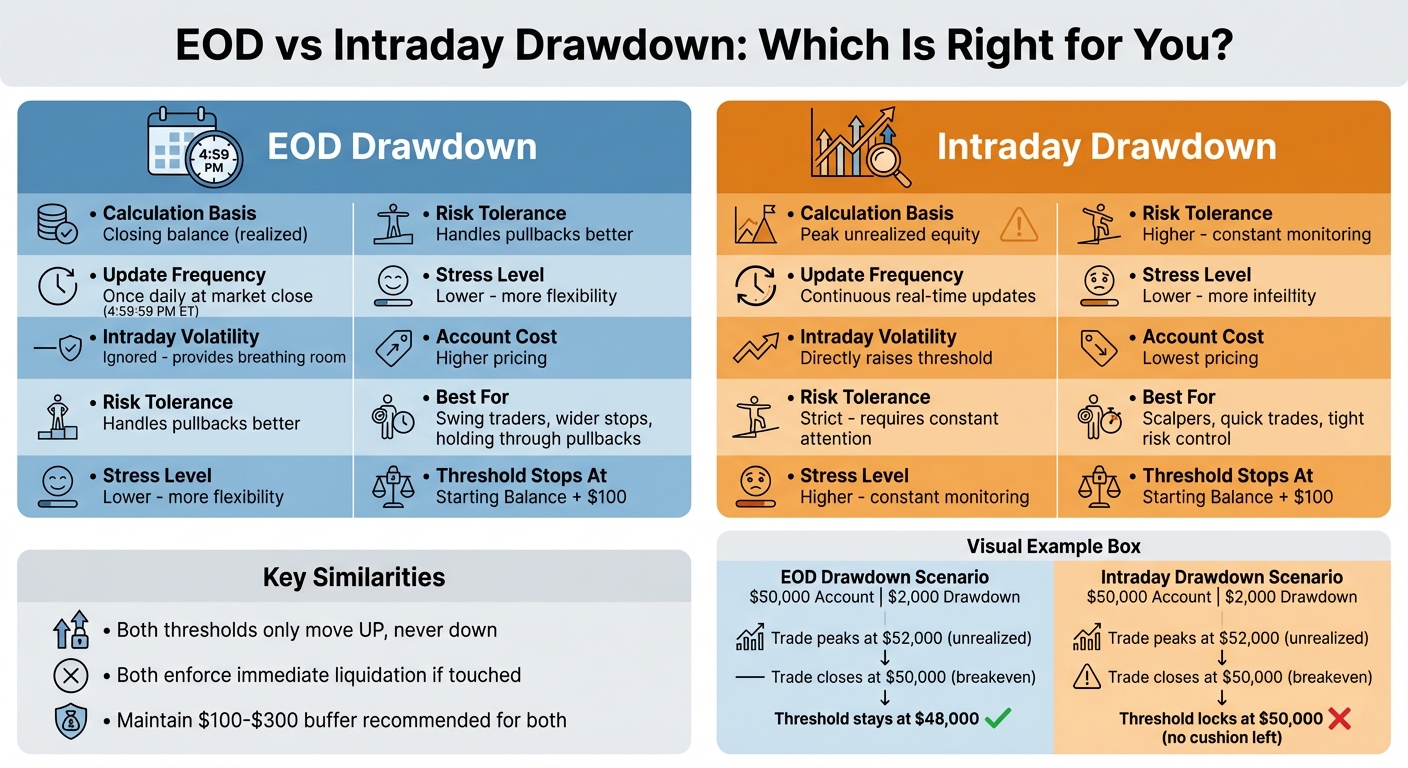
EOD vs Intraday Drawdown Comparison Chart for Apex Trader Funding
Intraday vs End-of-Day Trailing Drawdown (Which Apex Account Should You Choose?)
sbb-itb-46ae61d
What is End-of-Day (EOD) Drawdown?
End-of-Day (EOD) drawdown is a risk management rule that sets your maximum loss limit based on your account balance at the close of the trading day (4:59:59 PM ET). This threshold, calculated at market close, remains active during the following trading session and is enforced in real time.
Here’s the formula:
New EOD Threshold = Highest EOD Closing Balance − Maximum Drawdown Amount
For example, if your account starts at $50,000 with a $2,000 drawdown limit, your initial threshold is $48,000. If you close Day 1 with a balance of $50,800, your threshold rises to $48,800. The key is that the threshold only increases with new closing highs – it never lowers after a loss.
"The EOD Threshold… is calculated only once per day at market close based on the closing account balance; it remains fixed throughout the next trading session but is still enforced in real time if touched." – Apex Trader Funding
A common misconception is that EOD drawdown applies only at the end of the day. In reality, the threshold acts as a hard stop throughout the next session. If your account balance touches or drops below it, your positions are liquidated, and the account is disqualified.
How EOD Drawdown is Calculated
EOD thresholds are recalculated daily at 4:59:59 PM ET, using your realized closing balance – not your highest intraday unrealized equity. This means intraday profits don’t impact the threshold unless they are locked in by the close.
Let’s break it down for a $50,000 account with a $2,000 drawdown:
| Trading Phase | EOD Closing Balance | Drawdown Amount | EOD Threshold (Minimum Balance) |
|---|---|---|---|
| Start | $50,000 | $2,000 | $48,000 |
| Day 1 (Profit) | $50,800 | $2,000 | $48,800 |
| Day 2 (Profit) | $51,600 | $2,000 | $49,600 |
| Day 3 (Loss) | $50,900 | $2,000 | $49,600 (No change) |
| Day 4 (New High) | $52,000 | $2,000 | $50,000 |
Notice that on Day 3, even though the balance dropped from $51,600 to $50,900, the threshold stayed at $49,600. It only adjusts upward when there’s a new closing high.
For Apex Performance Accounts (PA), the EOD threshold stops trailing once your starting balance increases by $100. For Rithmic and Wealthcharts evaluations, it stops when you hit the Target Profit balance. However, Tradovate evaluation accounts continue trailing indefinitely with your peak closing balance.
It’s worth noting that realized profits within the drawdown range can temporarily increase your Maximum Loss Limit (MLL) until the next close.
Benefits of EOD Drawdown
One of the biggest advantages of EOD drawdown is the flexibility it offers during the trading day. The threshold is tied to your closing balance, not intraday unrealized profits, so you’re free to ride out significant price swings without worrying about tighter risk limits. For instance, if you’re up $1,500 on an open position but it pulls back before you close it, your drawdown threshold doesn’t change – it’s still based on the prior day’s closing balance.
"End-of-day drawdown = pro-trader" – Isaac, Author, ImanTrading
This approach provides a stable safety net throughout the trading session. Your failure point is fixed, making it easier to plan trades without the stress of sudden adjustments due to temporary profit spikes. For traders who rely on strategies that involve holding positions through volatile moves or letting winners run, this predictability is a game-changer.
EOD drawdown is often preferred because it reduces the pressure of monitoring intraday profits. Unlike intraday trailing models, it won’t penalize you for brief profit spikes that could raise your threshold. As a result, traders can focus more on executing their strategies and less on micromanaging risk.
"Want the best middle ground? EOD drawdown is the most trader-friendly choice." – DamnPropFirms
However, this flexibility comes at a price. EOD accounts are typically more expensive than those with intraday trailing drawdowns, reflecting the reduced risk constraints. You can often offset these costs by using an Apex Trader Funding 80% OFF Code during sales events. To avoid unexpected liquidations due to minor intraday dips, traders are advised to maintain a buffer of $100–$300 above their EOD threshold. For Rithmic users, the "Auto Liquidate Threshold" in RTrader Pro provides a real-time view of your enforceable drawdown level.
Next, we’ll explore how the Intraday Trailing drawdown works and how it differs from EOD drawdown.
What is Intraday Trailing Drawdown?
Intraday trailing drawdown tracks your real-time high-water mark, including unrealized profits. Unlike End-of-Day (EOD) drawdown, which only updates at market close, this threshold adjusts continuously throughout the trading session. The key difference? The drawdown floor moves in just one direction – up. Once your open trade reaches a profit peak, the threshold immediately locks in that new high-water mark. Even if your trade reverses and closes at a lower profit, the floor doesn’t budge.
"It punishes you for having an open profit that you didn’t lock in fast enough." – Copilink
This creates what traders call the "breakeven trap." For example, if your trade peaks at $52,000 on a $50,000 account with a $2,000 drawdown, the drawdown floor rises to $50,000. If you close the trade at breakeven, you’re already at the liquidation threshold, meaning a small $300 loss could trigger failure.
Intraday trailing accounts are the least expensive evaluation option at Apex, reflecting the stricter risk controls they impose.
How Intraday Drawdown is Calculated
The intraday drawdown threshold recalculates in real time, based on your highest unrealized equity – not just your realized closing balance. Every tick of profit in an open position raises the risk floor immediately.
Here’s an example for a $50,000 account with a $2,000 drawdown:
| Event | Account Equity | Drawdown Floor | Remaining Cushion |
|---|---|---|---|
| Start of Trade | $50,000 | $48,000 | $2,000 |
| Trade Peaks (Unrealized) | $52,000 | $50,000 | $2,000 |
| Trade Retraces/Closes | $50,000 | $50,000 | $0 |
Even though the trade closed at breakeven, the floor locked at $50,000 – the peak unrealized equity – leaving no safety cushion.
For Rithmic users, the "Auto Liquidate Threshold" in RTrader Pro shows this moving floor in real time. Tradovate users can view it directly in their account dropdown. If your balance or open equity touches this threshold, liquidation happens immediately – there’s no waiting until market close.
In Apex Performance Accounts, the trailing drawdown stops moving once it reaches your starting balance plus $100. For instance, on a $50,000 account, the floor locks at $50,100 once your balance reaches $52,500.
"The trailing nature means you can be a net profitable trader and still fail a prop evaluation if a drawdown follows a strong run." – Copilink
To avoid accidental liquidation, traders are encouraged to risk only 7–15% of their total drawdown per trade and keep a buffer of $100–$300 above the threshold for protection during normal market fluctuations.
Understanding this calculation method highlights why intraday drawdown demands tighter risk discipline.
Benefits of Intraday Drawdown
Compared to EOD drawdown, the intraday method requires constant attention and quick profit-taking. While challenging to manage, it offers advantages for certain trading styles. One major upside is cost – these accounts are the most affordable way to enter Apex evaluations, making them appealing for budget-conscious traders.
The real-time adjustments enforce strict discipline around profit-taking and risk control. Since open profits immediately raise your floor, you’re encouraged to lock in gains through partial exits rather than holding through large pullbacks. This strategy suits scalpers and high-frequency traders who focus on quick profits.
"The Trailing Drawdown ensures vigilant risk management, thus avoiding potentially costly mistakes." – Apex Trader
Traders who succeed with intraday drawdown often use aggressive profit management techniques. These include scaling out of positions when in profit, moving stops to breakeven early, and reducing position sizes during high volatility to prevent large equity spikes from raising the threshold too much. This model works best for scalpers who enter and exit trades quickly, but it can be tough for swing traders or those who prefer to let winners run.
The psychological challenge is real – many traders fail evaluations because they underestimate how intraday peaks impact their safety buffer, even if trades close at lower profit levels. However, for disciplined scalpers willing to take partial profits aggressively, the lower account cost can make the stricter rules worth the effort.
EOD vs Intraday Drawdown: Direct Comparison
Both EOD and Intraday drawdown systems share a key similarity: their thresholds only move upward and never decrease once set. They also enforce liquidation immediately if your account balance touches the threshold. However, the difference lies in how and when these thresholds adjust. EOD thresholds are recalculated once daily at 4:59:59 PM ET based on your closing balance, while Intraday thresholds update in real time with each new peak in unrealized equity.
"The Live Trailing Threshold moves with intraday performance, while the EOD Threshold sets at market close and enforces during the following day." – Apex Trader Funding
This timing difference has a direct impact on trading behavior and risk management. With EOD, you can ride out intraday market swings without penalty. The threshold remains fixed throughout the session, allowing for pullbacks or retracements, as long as your closing balance stays above the threshold. On the other hand, Intraday drawdown doesn’t offer this flexibility. Every uptick in unrealized profit raises your threshold immediately, and that new, higher floor remains – even if the trade later pulls back or closes lower. This creates two very distinct trading experiences and risk profiles.
"Even if your balance closes lower, the trailing drawdown ‘remembers’ your highest unrealized peak." – DamnPropFirms
The psychological effects of these systems are worth noting. Intraday trailing drawdown often pushes traders to be overly cautious, prompting them to cut winning trades too soon or avoid valid setups altogether, fearing that any pullback could tighten their safety margin. EOD, by contrast, eliminates this pressure by ignoring intraday peaks entirely. That said, Intraday accounts are the most affordable evaluation option offered by Apex, while EOD accounts come with a slightly higher price tag.
Comparison Table
Here’s a breakdown of the main differences between EOD and Intraday drawdown systems:
| Feature | End-of-Day (EOD) Drawdown | Intraday (Unrealized) Drawdown |
|---|---|---|
| Calculation Basis | Closing account balance (settled) | Highest unrealized equity (peak) |
| Update Frequency | Once daily at market close | Continuous real-time updates |
| Intraday Volatility | Ignored (unless threshold is touched) | Directly impacts/raises the threshold |
| Stress Level | Lower; provides "breathing room" | Higher; requires constant monitoring |
| Risk Control | Focuses on daily consistency | Enforces strict intraday discipline |
| Account Cost | Moderate | Lowest |
| Trailing Stop Point | Often stops at Starting Balance + $100 | Often stops at Starting Balance + $100 |
These differences are critical to consider, as they not only affect how you perform during the evaluation phase but also shape your overall trading strategy.
How Each Drawdown Type Affects Your Trading
Both systems enforce immediate liquidation when your balance hits the drawdown threshold, but they influence position sizing, risk management, and trader psychology in very different ways.
Effects During Evaluation Phase
In the evaluation phase, Intraday drawdown encourages traders to start with smaller positions. Here’s why: every tick of unrealized profit raises the threshold, creating a higher bar to maintain. To avoid situations where a quick profit peak reverses and permanently shrinks their safety cushion, traders often stick to reduced contract sizes. For example, keeping a $100–$300 buffer becomes standard practice to handle the risk of threshold increases caused by temporary gains.
"The unrealized trailing drawdown at Apex Trader Funding is the single biggest rule that trips up traders. Unlike a static drawdown, it moves up with your account’s highest unrealized gains and never moves back down." – DamnPropFirms
On the other hand, EOD drawdown allows for a more patient and calculated approach. Since the threshold only updates at market close (4:59:59 PM ET), traders can use normal position sizes and ride through intraday volatility without worrying about a rising floor. This is especially helpful for swing traders who prefer to hold positions through pullbacks. The trade-off? EOD accounts often come with slightly higher costs, but many traders find the reduced stress and added flexibility worth it. These differences during evaluation lay the groundwork for how traders approach their funded accounts.
Effects on Funded Accounts
Once the evaluation phase is complete, the rules for managing funded accounts change. The drawdown threshold becomes fixed at the starting balance plus $100. For instance, in a $50,000 Performance Account, the threshold locks at $50,100. From this point, your main task is to keep your balance above that level to stay active.
For Intraday-funded traders, the period before the threshold locks requires extra caution. Significant unrealized profits can push the floor higher, forcing traders to either close positions early or risk getting stopped out by minor market dips. This creates pressure to monitor every tick closely.
EOD-funded traders, however, have more breathing room. Realized profits during the day temporarily increase the Maximum Loss Limit (MLL) for that session, offering additional flexibility before the threshold resets at the end of the day. This daily buffer makes trade management feel more natural and reduces the emotional strain that comes with constant monitoring.
Choosing the Right Drawdown for Your Trading Style
What to Consider When Choosing
When selecting a drawdown style, you’ll need to think about two big factors: how long you hold trades and how much volatility you can handle. If your strategy involves enduring intraday pullbacks or holding positions throughout the day, End-of-Day (EOD) drawdown gives you the flexibility to let trades play out without obsessively watching every market move. With EOD, the threshold only matters at market close (4:59:59 PM ET), so temporary price swings won’t trigger liquidation. This ties back to the calculation differences mentioned earlier.
On the other hand, Intraday drawdown requires constant vigilance. A single momentary dip below the threshold – even for just a second – can lead to account failure. This makes it ideal for scalpers or short-term traders who thrive on precision and can consistently close trades at their peaks. EOD drawdown, by contrast, is more forgiving, reducing the stress of minute-by-minute monitoring.
Cost is another key consideration. Intraday trailing drawdown accounts are the most affordable option, while EOD accounts come with slightly higher pricing. If you’re disciplined and can manage real-time risk, Intraday might save you some money. But if you prefer a bit more mental clarity and flexibility, the extra cost of EOD could be well worth it.
Finally, market conditions play a role. During high-volatility events like Federal Reserve announcements, Intraday rules can be risky, as sudden price spikes might breach limits in seconds. EOD accounts, however, are only concerned with the final balance at market close. Regardless of your choice, it’s always a good idea to maintain a small buffer above the threshold to avoid unnecessary stress.
Let’s explore how these considerations apply in real trading scenarios.
Example Trading Scenarios
Scalper Scenario
Imagine a scalper who takes 10–15 trades daily, aiming for tight 4–6 tick targets. For this trader, Intraday drawdown can be challenging. Small profit peaks cumulatively push the threshold higher, making it harder to recover if a $200 unrealized gain vanishes. However, if the scalper has the discipline to close trades quickly and avoid letting profits slip, the lower cost of Intraday accounts might make sense. The key is staying sharp and avoiding situations where unrealized gains inflate the threshold while the actual balance drops.
Day Trader Scenario
Now, consider a day trader who holds 2–3 positions for 30–90 minutes. This type of trader benefits greatly from EOD drawdown. Their trades often experience $100–$200 pullbacks before reaching take-profit targets. With EOD rules, these temporary swings are ignored, offering the freedom to manage normal position sizes without worrying about unrealized profits shrinking the safety cushion.
Wider Stop-Loss Scenario
For traders using wider stop-losses, EOD drawdown is a better fit during volatile periods. Picture a trader holding a position through a morning news release. Their account might swing $300–$500 intraday before closing with a modest $150 profit. Under Intraday rules, a $500 peak could raise the threshold enough to trigger liquidation during a minor pullback. EOD rules, however, only evaluate the final balance at market close, making intraday volatility irrelevant.
These examples highlight how the right drawdown choice depends on your trading style, risk tolerance, and market conditions.
Conclusion
Grasping the distinction between End-of-Day (EOD) and Intraday drawdown at Apex Trader Funding can make all the difference when selecting the evaluation path that suits your trading approach. With EOD drawdown, your threshold is recalculated daily at market close (4:59:59 PM ET), allowing you to ride out intraday fluctuations without penalty. In contrast, Intraday drawdown adjusts in real-time based on your highest unrealized equity peak, meaning even temporary gains can reduce your safety margin permanently.
"The unrealized trailing drawdown at Apex Trader Funding is the single biggest rule that trips up traders." – Kyle Kozlowski, Editor, DamnPropFirms
Your trading style should guide your choice. If you’re a scalper focused on precision and can handle tight trade management, Intraday accounts might be a fit. However, if your strategy involves holding trades longer, using wider stops, or navigating volatile market events, EOD accounts provide the flexibility to let your trades play out without added pressure.
No matter which type of drawdown you select, keeping a $100–$300 buffer above your threshold is crucial to avoid liquidation from small price movements or commission costs. Tools like RTrader Pro or the Tradovate and NinjaTrader platforms can help you monitor your "Auto Liquidate Threshold" in real-time. Additionally, sizing trades conservatively during volatile sessions can prevent unnecessary setbacks.
"Mastering drawdown discipline is what separates consistent traders from frequent resetters." – FunderPro Futures
Ultimately, the best drawdown option isn’t about which is inherently "better" – it’s about what aligns with your trading habits, risk tolerance, and how much stress you’re prepared to manage. Choose based on how you actually trade, not just the cost of entry.
FAQs
Does EOD drawdown still liquidate me intraday?
An EOD (End-of-Day) drawdown won’t trigger intraday liquidation of your positions unless your account balance hits or drops below the EOD threshold during trading hours. This type of drawdown is calculated using your account’s closing balance at the end of the trading day. It only comes into play if the threshold is breached during the day – it’s not a live, real-time limit applied intraday.
Why can I fail intraday drawdown after a breakeven trade?
When trading, you might hit the intraday drawdown limit even after a breakeven trade. Why? The drawdown limit adjusts in real-time. If you lose unrealized profits before closing a trade, the intraday trailing drawdown recalculates dynamically, potentially triggering liquidation. This works differently from the End-of-Day (EOD) drawdown, which only updates after the trading day ends.
How do commissions and slippage affect my drawdown buffer?
Commissions and slippage chip away at your drawdown buffer by directly affecting your account balance and overall risk. Commissions eat into your net profit, pushing your balance closer to the drawdown threshold. Meanwhile, slippage – the gap between the price you expect and the price you actually get – can result in bigger losses or smaller gains than anticipated. Combined, these factors shrink your buffer, making it more likely to hit the drawdown limit and potentially forcing the liquidation of your positions.