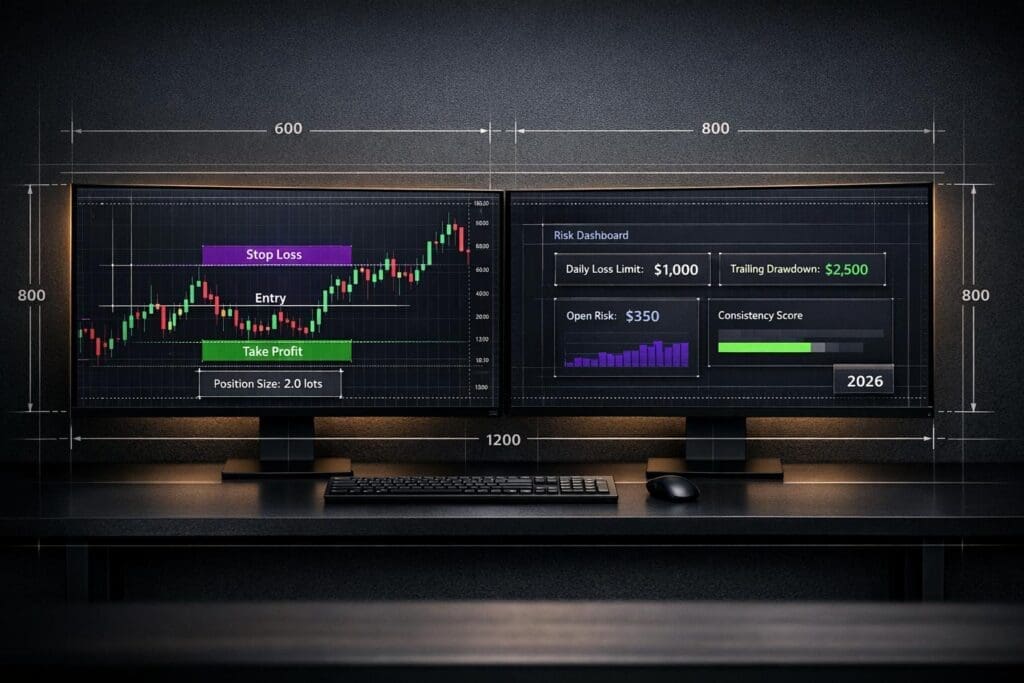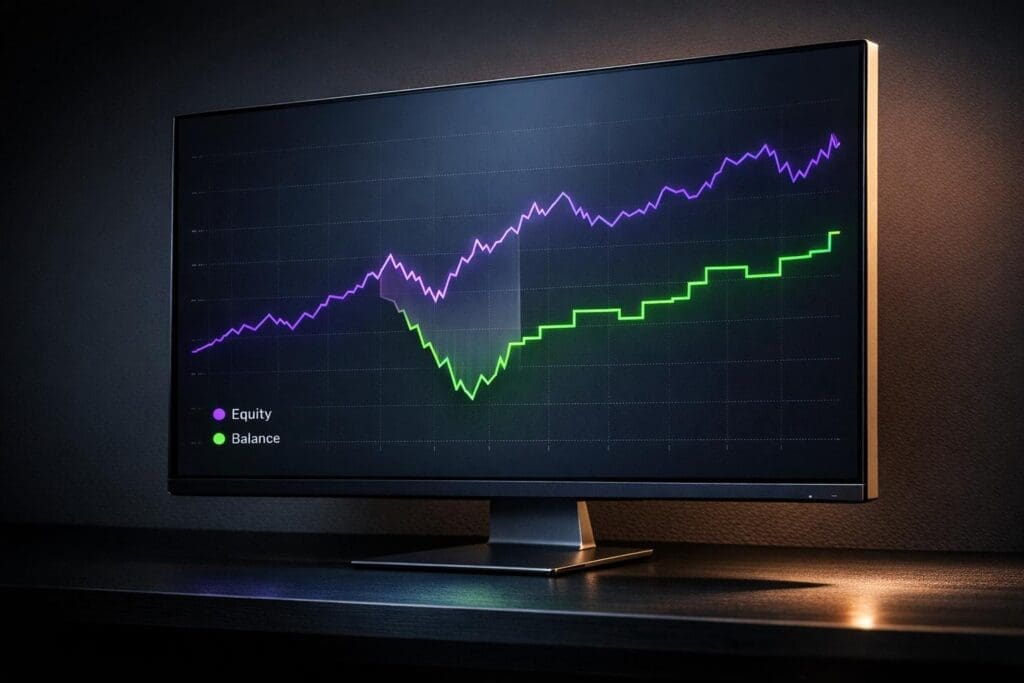
When trading with prop firms, understanding drawdown is crucial as it directly impacts your account’s survival. Drawdown measures how much your account value drops before recovering. There are two main types:
- Balance Drawdown: Tracks losses based on closed trades only. It’s stable and doesn’t account for unrealized losses or gains, making it predictable for traders.
- Equity Drawdown: Updates in real-time, including open trade fluctuations. It’s dynamic but more sensitive to market volatility, often requiring strict risk management.
Key Differences:
- Balance Drawdown: Updates only after trades are closed. Suitable for swing traders who need flexibility during market fluctuations.
- Equity Drawdown: Tracks live account value, including open trades. Ideal for disciplined day traders or scalpers who monitor positions closely.
Quick Comparison:
| Aspect | Balance-Based Drawdown | Equity-Based Drawdown |
|---|---|---|
| Calculation Basis | Closed trades only | Includes unrealized gains/losses |
| Update Timing | Static (updates after trades close) | Dynamic (real-time updates) |
| Flexibility | Allows holding through volatility | Sensitive to market swings |
| Risk Sensitivity | Lower | Higher |
| Best For | Swing traders, low-risk strategies | Day traders, scalpers |
Prop firms often enforce these rules to manage risk. For example, Apex Trader Funding uses equity-based trailing drawdown, while firms like Topstep rely on balance-based systems. Choosing the right drawdown model is essential for aligning with your trading strategy and avoiding account termination.
Understanding the nuances of these rules helps traders manage risk effectively and maintain compliance with firm requirements.
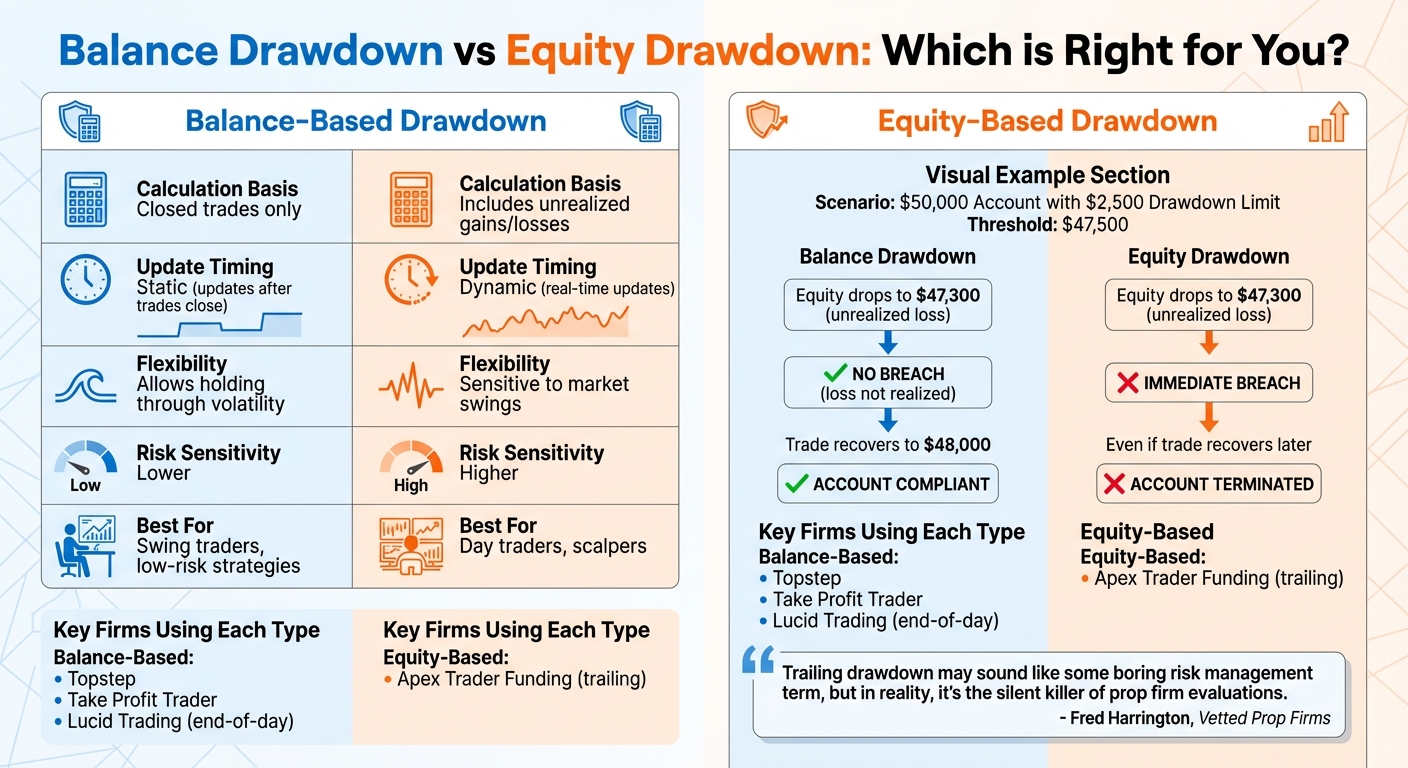
Balance vs Equity Drawdown Comparison Chart for Prop Traders
Balance-based Drawdown VS Equity-based Drawdown: Which One Is Better?
sbb-itb-46ae61d
What is Balance Drawdown?
Balance drawdown tracks the drop in your account’s balance – from its highest point to its lowest – using only the profits and losses from closed trades. It doesn’t factor in unrealized gains or losses from open positions, which makes it different from equity drawdown, where real-time market changes are included.
"Balance reflects your account’s static value from closed trades only." – Prop Firm Reviews
One of the key advantages of focusing on balance is its predictability. The drawdown limit is fixed and tied to your starting balance – or the balance at the beginning of the trading day – until a trade is officially closed. For instance, if you have a $50,000 account with a 5% drawdown limit (a maximum loss of $2,500), your threshold is set at $47,500. This setup allows temporary market fluctuations without triggering a breach.
How Balance Drawdown Works
Balance drawdown is usually updated at the close of each trading day (commonly at 00:00 UTC) or when a trade is closed. This means that intraday drops in equity don’t count as breaches unless a position is closed at a loss.
"Balance-based drawdown focuses solely on the change in your account’s balance due to closed trades, providing a static and stable figure." – Edris Derakhshi, Founder, TradingRage
This feature gives traders the chance to recover from temporary, unrealized losses without immediate consequences.
Balance Drawdown Example
Let’s say you have a $50,000 account with a 5% drawdown limit, which sets your maximum allowable loss at $2,500 and your threshold at $47,500. Now imagine you open a trade that causes your equity to dip to $47,300 due to an unrealized loss. With balance drawdown rules, this doesn’t count as a breach since the loss isn’t realized. If the trade later recovers and closes at $48,000, your account remains compliant. However, in an equity-based system, the moment your equity dropped to $47,300, it would have flagged a breach – even if the trade eventually recovered. This flexibility is why many traders prefer the balance-based approach found at the best prop firms with instant funding.
This comparison helps set the stage for a deeper look at how equity drawdown differs from balance drawdown.
What is Equity Drawdown?
Equity drawdown gives you a real-time view of your account’s performance by factoring in open trade fluctuations. Unlike balance drawdown, which only updates after trades are closed, equity drawdown reflects the ongoing changes in your account value, including both your balance and any unrealized profits or losses from open positions. This makes it a more dynamic and immediate measure of your trading account’s health.
"Equity is your trading account’s ‘live score.’ It’s the real-time value of your account, factoring in your balance plus or minus the profit or loss from any open trades." – Prop Firm Reviews
To calculate equity, use this formula: Equity = Balance + Unrealized Gains/Losses. For example, if your account balance is $50,000 and you have an unrealized profit of $500, your equity totals $50,500. If that trade shifts to a $300 loss, your equity drops to $49,700.
How Equity Drawdown Works
Equity drawdown updates continuously throughout the trading day, using a trailing mechanism to adjust the drawdown threshold as your equity reaches new highs. This "ratchet effect" ensures that while the threshold rises with gains, it doesn’t decrease when equity falls, tightening the margin for error.
"Monitoring drawdown against equity allows prop firms to manage risk dynamically, adapting to market conditions as they unfold." – PropFirmReviews.net
For instance, if your equity peaks at $51,000 during a trade, the trailing drawdown threshold will increase accordingly. But if the market reverses and equity declines, the threshold stays fixed, reducing your buffer. This setup emphasizes the importance of managing risk with strategies like futures risk management planning, tight stop-losses, and vigilant position monitoring to avoid sudden breaches.
Equity Drawdown Example
Let’s break this down with an example. Suppose you have a $50,000 account with a $2,500 drawdown limit, setting the initial threshold at $47,500. If your equity temporarily drops to $47,300 during a trade, the account breaches the limit immediately.
In a September 2025 case at Apex Trader Funding, a trader started with a $50,000 account and the same $2,500 drawdown limit. During trading, the account’s equity peaked at $50,875, raising the trailing liquidation threshold to $48,375 (calculated by subtracting $2,500 from $50,875). When the trader later closed the position with a balance of $50,100, the buffer shrank to $1,725. This example highlights how strict equity drawdown rules can be, especially when markets are volatile.
This real-time approach to risk management makes equity drawdown a tough metric to navigate, requiring careful planning and discipline to handle unpredictable market swings effectively.
Equity vs Balance Drawdown: Main Differences
The key difference between equity and balance drawdown lies in timing and sensitivity. Balance drawdown only updates when trades are closed, making it stable and predictable throughout the trading session. Equity drawdown, on the other hand, tracks every market movement in real time, which increases risk during volatile conditions [2,8]. These differences have a direct impact on trading strategies and risk management.
"Balance based drawdown offers static and predictable loss limits, making it ideal for low-risk strategies and traders seeking consistency."
– Edris Derakhshi, Founder, TradingRage
This timing distinction has practical implications for trading. Balance drawdown allows traders to hold positions through temporary volatility without breaching account limits. In contrast, equity drawdown demands constant attention, as even brief price spikes can raise the drawdown threshold permanently, regardless of whether the market later recovers [4,5].
Side-by-Side Comparison
| Aspect | Balance-Based Drawdown | Equity-Based Drawdown |
|---|---|---|
| Calculation Basis | Starting balance; closed trades only | Account balance plus floating profit & loss |
| Update Timing | Static (updates only when positions close) | Dynamic (fluctuates in real-time) |
| Flexibility | Allows for temporary volatility | Highly sensitive to market fluctuations |
| Risk Sensitivity | Ignores unrealized gains/losses | Tracks every movement in open positions |
| Trader Suitability | Ideal for swing traders and low-risk strategies | Suited for disciplined day traders and scalpers |
This table highlights why each drawdown type requires a tailored approach to trading.
How Each Type Affects Your Trading
The timing of drawdown updates shapes how you trade. Your preferred style will determine which type of drawdown aligns with your strategy. Swing traders often favor balance-based or end-of-day drawdown rules because these offer the flexibility to hold positions overnight or through intraday volatility without prematurely hitting drawdown limits. Equity drawdown, however, poses challenges during volatile periods – like Federal Reserve announcements or earnings reports – where sudden price spikes might breach limits before the market has a chance to recover.
Day traders and scalpers, who typically operate with brief positions, need to adopt stricter stop-loss rules and conservative position sizing to navigate equity-based drawdown effectively. Even a short trade can face risks during high-impact news events, as sudden market moves can quickly widen trailing drawdown limits.
"Intraday trailing drawdown = anti-trader; End-of-day drawdown = pro-trader"
– Isaac, Founder, Iman Trading
To better manage these risks, consider reducing your risk per trade from 1% to 0.5% or even 0.25%. This approach slows the rate of losses and helps protect your account. You can also use a consistency calculator to ensure your trading remains within firm limits.
How Futures Prop Firms Use Drawdown Rules
Futures prop firms rely on drawdown rules to manage risk and ensure steady profits. These rules help traders avoid holding onto losing positions for too long or chasing losses through revenge trading. The type of drawdown rule – whether unrealized trailing, end-of-day, or static – plays a key role in shaping how traders handle their positions and manage risks.
The type of drawdown also impacts account pricing. For instance, accounts with unrealized trailing drawdown are typically less expensive because they are harder to manage, while end-of-day drawdown accounts cost more but offer greater flexibility. Knowing these differences can help traders choose accounts that fit their trading strategies and risk tolerance.
Drawdown Rules at Top Prop Firms
Leading futures prop firms use different drawdown strategies. For example, Apex Trader Funding employs an unrealized trailing drawdown. This system tracks the highest equity peak during a trade and raises the drawdown threshold with each new peak, creating a strict risk control framework.
"The unrealized trailing drawdown at Apex Trader Funding is the single biggest rule that trips up traders. Unlike a static drawdown, it moves up with your account’s highest unrealized gains and never moves back down."
– Kyle Kozlowski, Editor & Reviewer, DamnPropFirms
On the other hand, firms like Take Profit Trader and Topstep use balance-based or end-of-day drawdown rules. With these rules, the drawdown threshold updates only at the end of the trading day based on the closed balance. Intraday price swings don’t affect the limit unless the equity actually hits the threshold during the trading session. This setup is ideal for swing traders who need room for their positions to move throughout the day.
Some firms also introduce a drawdown lock feature. Once your account reaches the starting balance (or starting balance plus $100), the trailing drawdown stops moving. This creates a permanent safety net once your account has achieved a certain profit level.
These different drawdown approaches also play a large role in how instant funding accounts are structured.
Instant Funding Accounts and Drawdown
Building on these drawdown principles, some firms offer instant funding accounts with more flexible drawdown structures. For example, Lucid Trading provides "Direct-to-Funded" accounts that use an end-of-day drawdown system. Lucid Trading, which supports over 24,000 traders and has paid out $20 million, processes payouts in as little as 15 minutes. Their accounts range from $10,000 (with a one-time fee of $75) to $100,000 (with a one-time fee of $225), and activation takes just 5–15 minutes after purchase.
Similarly, Tradeify offers instant funding accounts, often combined with top trade copying platforms for managing multiple accounts. These accounts come with higher upfront costs but allow traders to start earning payouts immediately.
Instant funding accounts generally feature more forgiving drawdown rules than evaluation accounts. Since these firms take on immediate risk, they often use end-of-day or balance-based drawdowns instead of stricter unrealized trailing models. This setup gives traders more flexibility to navigate intraday market swings without constantly worrying about hitting their "Auto Liquidate Threshold".
Conclusion
Balance drawdown sets your loss limit based on realized trades, offering a fixed threshold, while equity drawdown factors in real-time, unrealized changes, making the limit more fluid. This distinction plays a critical role in shaping your approach to risk management, position sizing, and overall strategy.
Your choice of drawdown model can directly impact trading results. For instance, swing traders often prefer balance-based or end-of-day rules, as these can accommodate intraday fluctuations. On the other hand, scalpers tend to lean toward equity-based or trailing models, which provide tighter risk control. Picking the right drawdown structure can be the difference between passing an evaluation or facing an auto-liquidation during a sudden market spike.
As Fred Harrington, Founder of Vetted Prop Firms, explains:
"Trailing drawdown may sound like some boring risk management term, but in reality, it’s the silent killer of prop firm evaluations."
– Fred Harrington, Founder, Vetted Prop Firms
When evaluating futures prop firms, it’s essential to understand their drawdown rules – whether they use intraday trailing, end-of-day, or static models. For example, firms like Apex Trader Funding and Topstep rely on balance-based systems, while instant funding providers such as Lucid Trading and Tradeify implement end-of-day rules. Platforms like DamnPropFirms are great for comparing these structures, reading verified reviews, and finding a firm that aligns with your trading goals.
FAQs
Which drawdown type is safer for my trading style?
Balance-based drawdown offers a sense of security by setting fixed, predictable loss limits. This predictability simplifies risk management and reduces the emotional strain, which is particularly helpful for traders using low-risk strategies. Since it doesn’t rely on fluctuating equity values, its static nature allows for better planning and decision-making.
How does trailing equity drawdown tighten my buffer?
Trailing equity drawdown works by monitoring your account’s peak equity level and adjusting your margin buffer accordingly. If your equity falls below this peak, your available margin is reduced, which in turn decreases your safety cushion. This system is designed to enforce stricter risk controls as your account balance increases.
How can I avoid breaching drawdown during volatile news?
During volatile news events, the risk of breaching your drawdown limits can spike. To safeguard your account, it’s essential to stick to strict risk management strategies. These can include:
- Reducing position sizes: Smaller positions mean smaller potential losses if the market moves against you.
- Using tighter stop-losses: This helps cap your losses quickly during sudden price shifts.
- Monitoring open positions closely: Keep a watchful eye on trades to respond swiftly to unexpected market changes.
By staying disciplined and following these practices, you can better protect your account from the unpredictability of volatile markets.