Trade copiers let you replicate trades across multiple accounts, making them a useful tool for managing larger capital. However, improper use can lead to account bans, forfeited payouts, and other penalties from prop firms. Here’s what you need to know:
- Key Risks: Prop firms monitor IP addresses, device data, and trade metadata to detect copying. Violations include exceeding IP limits, mismatched drawdowns, and high trade correlations.
- Common Issues: Slippage, platform incompatibility, and improper trade copying platform settings can breach firm rules. For example, failing to adjust lot sizes for smaller accounts often leads to drawdown violations.
- Compliance Tips:
- Use a dedicated IP or VPS to avoid triggering red flags.
- Configure risk settings like equity limits and trade multipliers to match account rules.
- Randomize execution times and remove metadata tags to reduce detection risks.
- Test copier settings in demo mode before using them with funded accounts.
- Prop Firm Policies: Some firms allow internal trade copying (e.g., Apex Trader Funding supports up to 20 accounts), while others strictly limit it. External copying (e.g., from signal services) is generally prohibited.
Understanding and following these guidelines can help you use trade copiers effectively without risking your accounts.
Common Problems with Trade Copiers
IP Address and Multi-Account Detection
Prop firms keep a close eye on IP addresses, device fingerprints, and session data to identify linked accounts. Typically, firms allow up to three unique IP addresses per day before triggering a manual review. Exceeding this limit often prompts risk teams to investigate whether someone is operating multiple accounts from different locations or sharing login credentials.
While Virtual Private Servers (VPS) are allowed, they can raise red flags if multiple funded accounts connect through the same server or shared IP address. Firms also track device hashes – unique identifiers tied to hardware setups – so accessing multiple accounts from the same computer or shared VPS can set off alerts.
Liquidity providers add another layer of scrutiny by flagging duplicate order details in real time, reinforcing these detection measures. These systems not only identify suspicious activity but also pave the way for additional risks, such as drawdown breaches.
Drawdown Limit Breaches
Improperly configured trade copiers can easily push accounts past daily loss limits or maximum drawdown thresholds. A staggering 82% of traders fail prop firm challenges due to breaches in these limits, with over 60% of violations happening within the first two trading days.
Latency and slippage often make things worse. Delays in trade replication during volatile markets can cause follower accounts to enter trades at unfavorable prices compared to the master account. For instance, while a master account might respect a $1,000 daily loss limit, slippage could lead a smaller follower account with a $500 limit to breach it.
Another common issue arises when using fixed lot sizes instead of scaling risk based on equity. Imagine a master account with $100,000 copying 1.0 lots to a follower account with only $50,000 – this effectively doubles the risk exposure for the follower. Trade copiers that replicate risky strategies, such as averaging down or Martingale techniques, can also temporarily mask drawdown issues, only to cause catastrophic breaches when market conditions shift.
"Drawdown is not a small detail. It is the price of the strategy." – SmartT Research Team
Ensuring compatibility between platforms is equally critical, as mismatches can lead to violations.
Platform Incompatibility and Tool Detection
Many trade copiers leave behind identifiable "tags" in MT4/MT5 order logs. Prop firms inspect fields like "Magic Numbers" and "Order Comments" for traces of third-party tools, such as "FX Blue Copier" or "LTC". This metadata can serve as direct evidence of unauthorized software usage.
Platform mismatches also create execution errors that could unintentionally violate firm rules. For example, a copier designed for MT4 might fail to properly translate orders to platforms like NinjaTrader or cTrader, leading to incorrect position sizes or missing stop losses.
High Trade Correlation Across Accounts
Matching trade entry and exit times across multiple accounts is a quick way to catch the attention of prop firms. Detection algorithms monitor timestamp deltas, where orders placed within 50–200 milliseconds of each other across accounts are flagged as high-risk copying. Behavioral analytics further examine patterns by constructing correlation matrices, and a Z-score above 3.0 often triggers a manual review.
"If 500 traders copy the same signal service, the firm suddenly has 500 accounts making identical directional bets. A single bad trade from the signal provider creates correlated losses across the entire portfolio." – Finimize
This clustering of positions increases the firm’s overall market exposure, defeating the purpose of diversifying strategies. While some firms allow internal copying (between your own accounts), external copying – like following a signal service – remains prohibited because it introduces systemic risk.
sbb-itb-46ae61d
How Prop Firms Handle Trade Copying
Permitted Usage of Trade Copiers
Prop firms have clear rules about using trade copiers, especially when it comes to managing risk. Most top futures prop firms allow internal trade copying, which means you can replicate your own manual trades across multiple accounts that you personally own. The key here is that you are making the trading decisions, while the copier simply executes your trades across those accounts at the same time.
For instance:
- Apex Trader Funding: Allows trade copying across up to 20 accounts under a single configuration.
- Topstep: Permits multiple accounts but emphasizes disciplined trading behaviors.
- Tradeify: Limits funded accounts to 5 per household and prohibits cross-account hedging. Holding opposite positions for more than 10 seconds can result in penalties.
- MyFundedFutures: Supports copying across up to 3 accounts.
- BluSky Trading: Restricts copying to only 2 funded accounts.
"A trade copier replicates trades from one account (your leader) to others (your followers). You – the human – are still making every trading decision." – Copilink
FundedNext Futures allows internal trade copying but imposes a limit on the total copied capital, capping it at $300,000. Additionally, all accounts must be registered under the same name, and the use of fully automated bots that make independent trading decisions is strictly prohibited.
Restricted and Prohibited Use Cases
While internal trade copying is often permitted, external copying is a different story. This practice – mirroring trades from signal providers or social trading platforms – is banned across the industry. Prop firms fund traders based on their individual skills, and copying someone else’s strategy undermines this model.
"The moment you use such tools to mirror trades from another person’s account – even with their permission – you’re breaching the rules." – Fred Harrington, Founder, Vetted Prop Firms
Some firms take particularly strict positions:
- Take Profit Trader: Reportedly enforces a 3-account limit and advises against using trade copiers altogether.
- TradeDay and Earn2Trade: Both firms do not allow trade copying in any form.
Violating these rules can have severe consequences, such as immediate termination of accounts, forfeiture of profits, and permanent bans. To avoid issues, always check with a firm’s support team and get written approval before connecting any trade copier. Policies can vary, and it’s better to confirm than risk losing access to your funded accounts.
How I Use Trade Copiers to Trade Multiple Prop Accounts
How to Stay Compliant with Prop Firm Rules
Building on the common pitfalls outlined earlier, here are some practical strategies to ensure you stay within prop firm rules.
Using Dedicated IPs and Cloud-Based Copiers
Prop firms monitor IP addresses as "digital fingerprints" to confirm that you’re the one managing your accounts. Frequent changes in IP addresses or logging in from different locations within short periods can trigger security alerts. For instance, most firms will flag accounts if they detect more than three unique IP addresses in a single day.
To avoid such issues, stick to a dedicated IP address or your consistent home IP. If you’re using a VPS, make sure to disable the fallback option to ensure only your dedicated IP is used. Cloud-based copiers like SyncFutures offer a reliable alternative, running continuously on dedicated infrastructure. This eliminates the hassle of VPS maintenance and minimizes execution delays.
To avoid detection at the millisecond level, set randomized execution delays (e.g., 300–1,000 ms) to prevent identical trade patterns. Additionally, turning off the "trade comment" feature can help remove metadata tags like "FX Blue" or "LTC" that could reveal the use of third-party software.
Beyond connectivity, having strong risk controls in place is equally important.
Setting Up Risk Management Features
Implementing strict equity limits in your copier before linking funded accounts is crucial. Most prop firms enforce daily loss limits of 3% to 5% of your account’s opening balance. To comply, configure your copier to automatically stop trading as you approach these thresholds.
Position size multipliers can help you manage risk proportionately across accounts. For instance, if your master account is $150,000 and a follower account is $50,000, using a 0.33x multiplier ensures the same risk percentage is applied consistently. These adjustments address concerns about excessive exposure and potential rule violations. You can also enable TP/SL randomization, adding slight variations (e.g., 1–2 pips or points) to exit levels, which helps avoid the appearance of perfectly mirrored trades.
Before applying these settings to funded accounts, test them in demo mode for several days. This allows you to confirm that stop losses, partial exits, and multipliers work as intended. It’s also a good idea to familiarize yourself with a "Panic Button" or "Flatten All" feature in your copier, which can instantly close all positions during periods of high volatility or technical issues.
Manual Trade Inputs and Platform Compatibility
In addition to automated features, ensuring your trading platform is compatible and using manual trade inputs when necessary can further protect your setup.
Many futures prop firms operate on platforms like Tradovate, Rithmic, or NinjaTrader. Make sure your copier software supports these platforms, as some firms require accounts to operate in "demo/simulation" mode even when funded. Cloud-based copiers often allow cross-platform replication, enabling you to copy trades from a Tradovate master account to Rithmic follower accounts seamlessly.
If copier automation isn’t an option or you’re experimenting with a new strategy, manually entering trades across accounts can help avoid detection, though it’s more time-intensive. Additionally, configure your copier for instrument mapping if you’re trading between different contract sizes, such as E-mini S&P 500 (ES) and Micro E-mini (MES).
Finally, if you’re traveling internationally, notify your prop firm in advance to maintain a consistent IP profile.
Top Prop Firms and Tools for Trade Copying
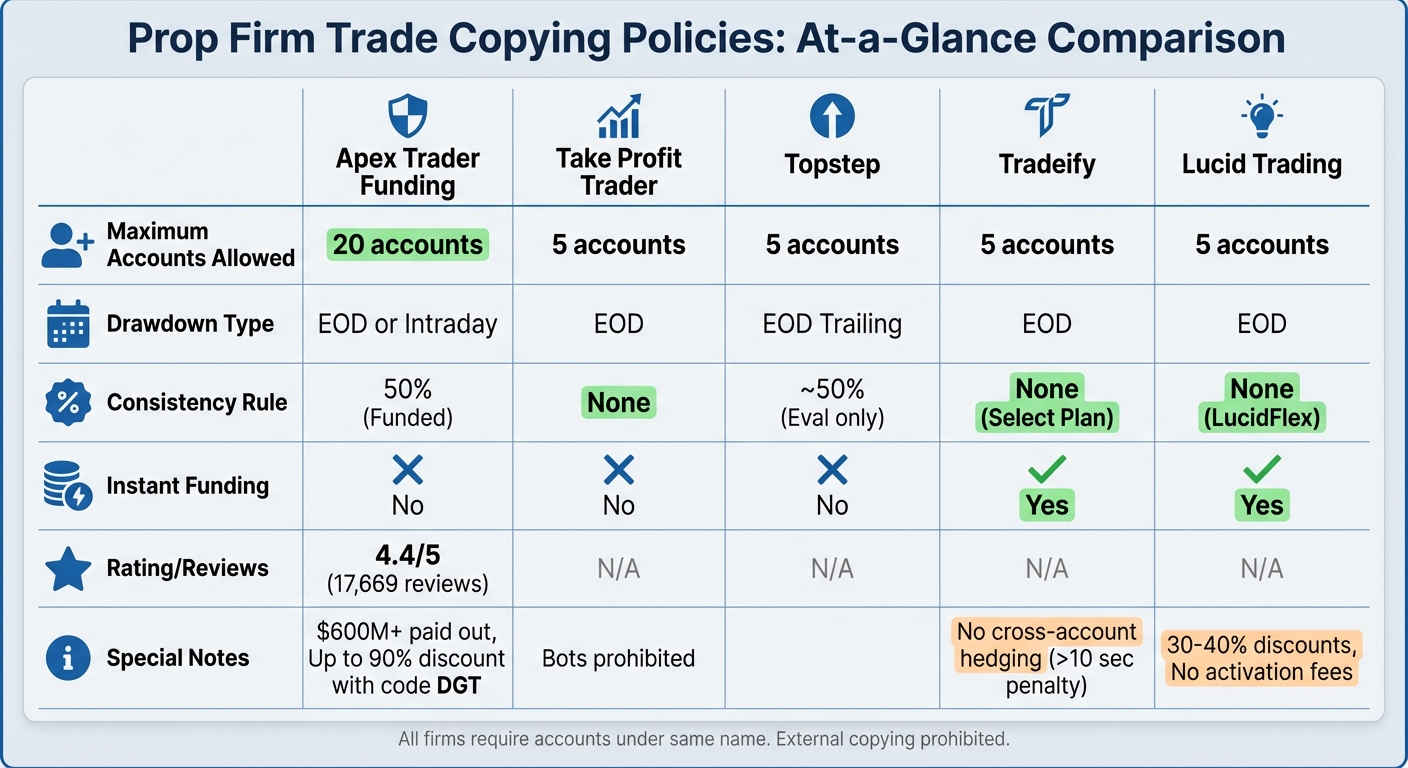
Prop Firm Trade Copying Policies and Account Limits Comparison
Knowing your options for prop firms and the best trade copying tools can help you stay compliant with firm policies and avoid costly mistakes.
Recommended Prop Firms
Futures prop firms vary widely in their trade copying policies. Some allow up to 20 accounts, while others limit you to five or impose stricter monitoring.
- Apex Trader Funding: Apex is a standout choice, allowing up to 20 Performance Accounts to be copy-traded under the same personal or business name. With over 17,669 reviews and a 4.4/5 rating, Apex has paid more than $600,000,000 to traders. They also offer discounts of up to 90% using the code DGT, though they enforce a 50% consistency rule in funded accounts.
- Take Profit Trader: This firm allows trade copying across up to five accounts with its Pro+ plan. However, trading bots are strictly prohibited during both evaluation and funded stages.
- Topstep: Topstep supports up to five accounts for trade copying and uses an end-of-day trailing drawdown model.
- Tradeify: Known for instant funding, Tradeify allows copying across five accounts but has a strict no cross-account hedging rule. Holding opposite positions on the same instrument across different accounts for more than 10 seconds can result in penalties.
- Lucid Trading: Lucid offers LucidFlex accounts that eliminate consistency rules during the funded stage. They frequently provide discounts of 30–40% with no activation fees.
Now, let’s look at the tools that make trade copying easier and more efficient.
Trade Copying Tools and Resources
The right trade copying tools can save time and reduce the risk of errors. Here are some top options:
- TradeSyncer: A cloud-based trade copier supporting platforms like Rithmic, Tradovate, NinjaTrader, DXFeed, and ProjectX. It doesn’t require a VPS and executes trades in under 100 milliseconds, processing over 1,000,000 trades for futures traders. TradeSyncer offers a 7-day free trial and 10% off with code DGT. Its cloud engine ensures trades sync even if your local computer is offline.
- Replikanto: Designed for NinjaTrader users, Replikanto includes features like ATM Copy and "Follower Guard" to help avoid risk limit breaches. It costs about $250 for a two-machine license, with a 20% discount available using code DGT.
- Apex Trade Copier: A budget-friendly option for traders who work exclusively with Apex. It’s priced at around $150 for a two-machine license.
- DamnPropFirms Consistency Rule Calculator: This tool helps you plan trade sizes and profit distributions to comply with firm-specific rules, including Apex’s 50% consistency requirement.
Comparison Table of Key Prop Firms
Here’s a quick overview of the key metrics for each prop firm:
| Prop Firm | Max Accounts | Drawdown Type | Consistency Rule | Instant Funding | Review Link |
|---|---|---|---|---|---|
| Apex Trader Funding | 20 | EOD or Intraday | 50% (Funded) | No | Review |
| Take Profit Trader | 5 | EOD | None | No | Review |
| Topstep | 5 | EOD Trailing | ~50% (Eval only) | No | Review |
| Tradeify | 5 | EOD | None (Select Plan) | Yes | Review |
| Lucid Trading | 5 | EOD | None (LucidFlex) | Yes | Review |
When working with multiple firms, adjust your trade copier settings to align with each firm’s rules. For example, set daily loss thresholds to 85–90% of each firm’s limit to avoid accidental breaches. You can also use custom copy ratios, like mirroring one ES contract in the leader account to 10 Micros in a follower account, to balance risk across accounts with varying funding levels.
Conclusion
After exploring common pitfalls and strategies for compliance, it’s clear that implementing proper measures is key to safeguarding your trading accounts. Trade copiers can effectively manage multiple prop firm accounts, but only when used within the boundaries of each firm’s rules. Success depends on thoroughly understanding those policies before copying trades.
Statistics show that around 85% of prop firm challenges fail due to avoidable rule violations. Many of these failures stem from incorrect copier settings or misunderstandings about internal copying rules.
"If a prop firm figures out you are using copy trading, they will almost certainly ban you from trading with them and not refund your challenge fee." – David Kimberley, Analyst, TradeInformer
This quote highlights the importance of using systems that are both reliable and compliant with firm regulations. To minimize risks, rely on specialized trading tools that ensure account rule isolation, offer robust risk management features, and are compatible with the platforms you use. Simple steps like setting individual risk limits, randomizing execution times, and adjusting lot sizes can go a long way in avoiding detection.
For example, what’s acceptable at Apex Trader Funding with up to 20 accounts might not fly at firms with stricter policies. By carefully reviewing firm guidelines, properly configuring your tools, and treating each account as if it could face manual scrutiny, you can protect yourself from unexpected bans and keep your trading journey on track.
FAQs
How can I tell if my prop firm allows trade copying?
Take a close look at your prop firm’s terms and conditions, official rules, or FAQ section. These documents often outline whether trade copying is permitted. Some firms openly allow it, while others strictly forbid the practice. Checking these details will help you understand their specific policies and avoid any potential issues.
What copier settings best prevent drawdown rule breaches?
To prevent breaching drawdown rules, set up your trade copier with the following precautions:
- Stick to static or trailing drawdown limits: Configure the copier to respect the specific drawdown thresholds set by your prop firm.
- Set daily loss caps: Align these caps with the firm’s rules, typically around 4-5%, to avoid exceeding allowable losses.
- Adjust lot sizes: Factor in slippage and commissions when determining lot sizes to ensure accurate risk management.
Additionally, program the copier to either halt trading or reduce position sizes as you approach these limits. This helps you stay compliant with the rules and safeguards your account from unnecessary losses.
How do I reduce copy-trade detection without breaking rules?
To reduce the chances of detection while adhering to prop firm rules, steer clear of placing identical trades, entering positions at the same time, using shared IP addresses, or creating repetitive patterns across multiple accounts. Instead, opt for trade copiers that allow for customization – features like execution delays, adjusted lot sizes, or varied stop-loss settings can help diversify your trading activity. Always review the specific rules of each prop firm to ensure your approach complies with their guidelines and avoids risks like disqualification or account bans.