Static drawdown is a fixed risk limit set by proprietary trading firms, determining the maximum loss an account can sustain before termination. Unlike trailing drawdowns, static drawdowns remain constant, tied to the starting balance. For example, a $100,000 account with a 10% static drawdown is terminated if the balance drops below $90,000. Managing this risk requires strict discipline, including daily equity monitoring, setting personal alerts, and limiting risk per trade.
Key strategies to avoid termination include:
- Daily Monitoring: Track your equity against the static threshold to maintain a buffer.
- Personal Alerts: Set alerts $100–$300 above the drawdown limit to avoid breaching it.
- Position Sizing: Risk only 0.5%–1% per trade to preserve your account.
- Avoid Overleveraging: Reduce risk during volatile market conditions.
- Use Simulators: Test strategies under static drawdown rules before trading live.
- Request Resets: Reset your account proactively if equity nears the drawdown threshold.
Static drawdown accounts offer predictability but demand disciplined risk management. Choosing the right prop firm with favorable policies, like Apex Trader Funding, can further protect your trading account. Keep your focus on consistent strategies, clear risk limits, and long-term account sustainability.
How does Max Drawdown (Static) work?
sbb-itb-46ae61d
What Is Static Drawdown in Futures Prop Trading
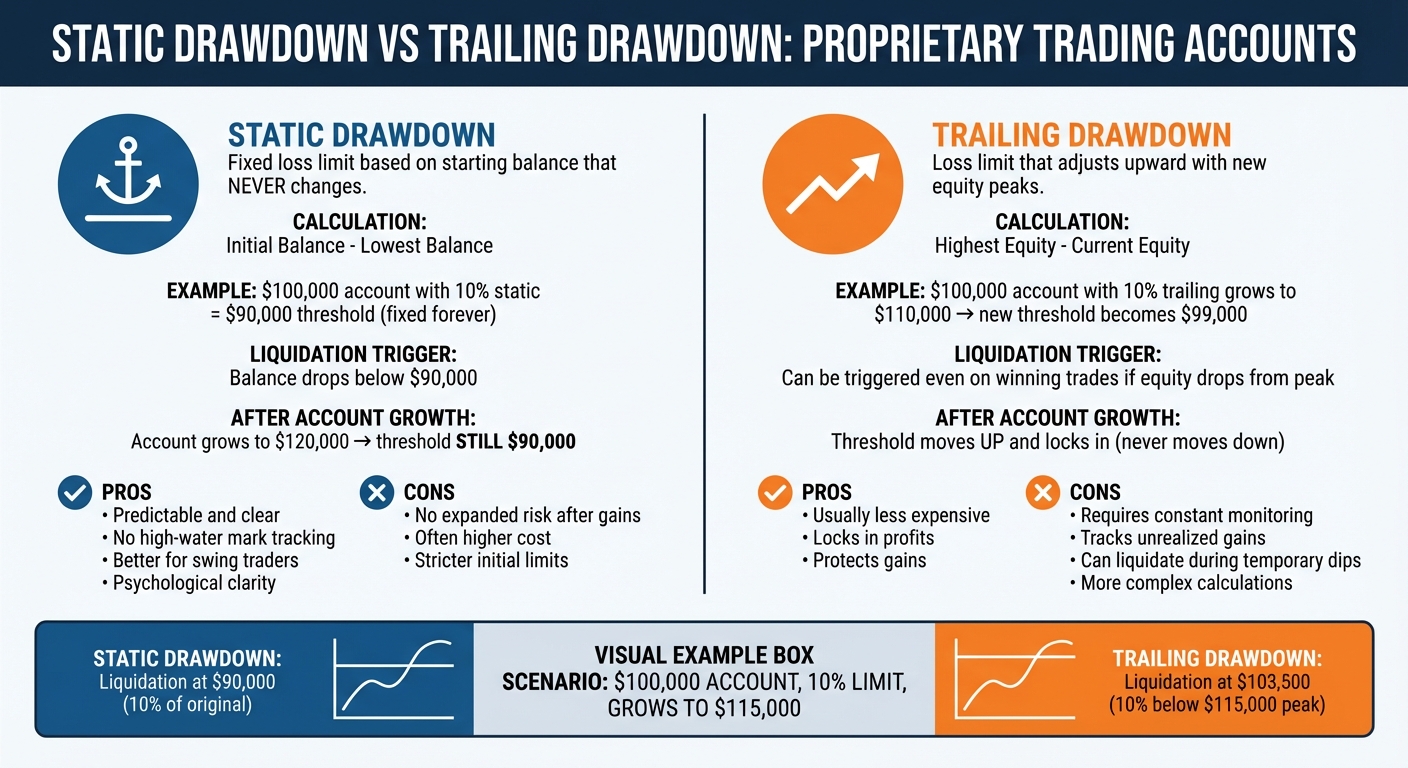
Static drawdown, also known as absolute drawdown or fixed drawdown, is a loss limit based on your starting account balance that remains constant. It’s calculated as Initial Balance – Lowest Balance. For instance, if you start with a $100,000 account and the firm sets an 8% static drawdown, your breach threshold is fixed at $92,000. This figure does not change, even if your account grows. This fixed boundary helps establish a clear and disciplined trading framework.
Unlike trailing drawdown, which increases as your account hits new equity highs, static drawdown never adjusts. For example, in a trailing system, if your $100,000 account grows to $110,000 and the firm applies a 10% trailing rule, your drawdown threshold could rise to $99,000. This reduces your safety margin as profits grow. Static drawdown avoids such recalculations, keeping your liquidation point tied to the original balance.
One key advantage of static drawdown is the psychological clarity it provides. You don’t need to monitor high-water marks or worry about intraday profit spikes tightening your risk limits. Many traders fail evaluations because they focus on closed profits, while firms track unrealized peaks in trailing systems. With static drawdown, your breach point is set from the start, making it easier to plan your trades and manage risk without constant adjustments.
Most futures prop firms combine static drawdown limits – typically 6%, 8%, or 10% – with daily loss limits, often around 5%. For example, TopOneTrader’s 2-Step "Pro" Account enforces an 8% static drawdown. Even if your account grows to $115,000, dropping below the original $92,000 threshold would result in losing funding. Daily loss limits act as an additional safeguard against significant losses before reaching the static drawdown.
Static drawdown also influences trading strategies. It’s particularly helpful for swing traders who hold positions over several days, as it eliminates the need to adjust thresholds after each profitable period. However, it doesn’t allow for expanded risk-taking after early gains – your loss limit remains fixed, whether your account is at $100,000 or $120,000. This setup challenges both your discipline and strategic approach, regardless of your account’s growth.
Key Differences: Static vs. Trailing Drawdown
Static vs Trailing Drawdown: Key Differences for Prop Traders
Understanding the difference between static and trailing drawdown is essential for managing risk effectively in trading. The main distinction lies in how the liquidation threshold is set. With static drawdown, the liquidation threshold is fixed at your starting balance minus the allowed loss, no matter how much your account grows. On the other hand, trailing drawdown adjusts upward as your account reaches new equity peaks, locking in profits along the way. This difference significantly impacts how firms like Apex Trader Funding design their risk guidelines.
At Apex Trader Funding, the trailing drawdown is tied to unrealized equity. This means that as your intraday balance reaches a new high, the liquidation threshold moves up accordingly. Once a trade is closed, the threshold remains at its highest point, reflecting the top equity level achieved.
"The unrealized trailing drawdown at Apex Trader Funding is the single biggest rule that trips up traders. Unlike a static drawdown, it moves up with your account’s highest unrealized gains and never moves back down." – DamnPropFirms
These two approaches create very different scenarios for liquidation risk. With trailing drawdown, a trader can be liquidated even on a winning trade if their equity drops sharply from its peak. In contrast, static drawdown only comes into play if the account balance dips below the set floor. For instance, on a $100,000 account with a static drawdown, liquidation would occur if the balance falls below $99,375.
Trailing drawdown accounts are typically less expensive but demand close attention to equity peaks. Static drawdown accounts, while offering more predictability, often come with higher costs or stricter loss limits. Knowing these differences can help you align your trading strategy with your risk tolerance and maintain control over your losses.
1. Monitor Account Equity Daily Against Static Threshold
Effectiveness in Mitigating Static Drawdown Risks
Keeping a close eye on your account equity every day is crucial for avoiding termination under static drawdown rules. This practice ties directly to the fixed threshold system. Unlike trailing drawdown, which adjusts as your profits grow, static drawdown stays fixed at your starting account balance. For instance, with a $100,000 account and a 10% static limit, your liquidation level remains at $90,000, no matter how much profit you generate. Monitoring your equity daily helps ensure you maintain this profit cushion.
Most firms base their calculations on equity, not just the closed balance. Equity includes unrealized gains or losses from open trades, as well as any associated fees or swaps. For example, OANDA Prop Trader triggers the Maximum Static Drawdown when equity falls to 90% of the initial balance. This means even one unfavorable trade could push your equity below the threshold, even if your closed balance appears safe. To stay ahead, note your static threshold and available risk margin before entering trades. Many platforms offer tools that simplify this process, making daily tracking an easy habit to adopt.
Ease of Implementation for Traders
Managing a static threshold is simpler compared to trailing drawdown. As highlighted by the AudaCity Capital Research Team, static drawdown only requires basic calculations. Most trading platforms provide real-time tools to help you stay on top of your liquidation level. For example, RTrader Pro on Rithmic displays the "Auto Liquidate Threshold", while Tradovate includes it in the account dropdown menu. To protect your account further, consider setting a personal loss cap that’s 30–50% below the firm’s drawdown limit. These small adjustments can make a big difference in maintaining your account stability and scaling potential over time.
Impact on Long-Term Account Sustainability
"The 10% static drawdown limit remains the industry standard precisely because it forces traders to maintain consistent risk protocols regardless of account performance, testing discipline rather than rewarding hot streaks." – FunderPro
Maintaining a buffer of $100–$300 above your liquidation threshold can shield you from unexpected terminations due to small price fluctuations or commission fees. For example, if you risk 0.5% per trade, you have room for about 20 consecutive losses. However, if you increase your risk to 2% per trade after seeing profits, that streak shrinks to just five losses – even if your account is still profitable overall. Daily equity monitoring helps prevent this "position-sizing creep" by keeping you aware that the liquidation floor is fixed, no matter how your account performs.
2. Set Personal Drawdown Alerts Below Firm Limits
Effectiveness in Mitigating Static Drawdown Risks
Setting personal alerts before hitting the firm’s drawdown limit is a smart way to protect your account. By creating alerts with a $100–$300 cushion above your liquidation threshold, you can safeguard against losses caused by market volatility, slippage, or fees. Think of the fixed drawdown floor as your "danger zone" – a boundary you don’t want to cross.
These alerts also help you avoid risky behavior, like increasing position sizes after a winning streak or using trade copying platforms without proper risk adjustments. For instance, even if your account grows from $100,000 to $112,000, the liquidation floor remains fixed at $90,000 (assuming a 10% static limit). This means your risk calculations should always be based on the fixed floor, not your current equity. Combined with daily equity monitoring, this method strengthens your trading discipline and protects your strategy.
Ease of Implementation for Traders
Setting up these alerts is simple. Platforms like RTrader Pro and Tradovate make it easy to see your liquidation threshold, so you can quickly establish alerts. Use these tools to activate a "stop trading" rule once your balance approaches the $100–$300 buffer zone.
Impact on Long-Term Account Sustainability
"Maintain at least $100–$300 cushion above your threshold to avoid surprise liquidation." – DamnPropFirms
Having personal alerts in place can mean the difference between keeping your account and losing it unexpectedly. Intraday price swings could temporarily push your equity below the threshold, even if the market later rebounds. These alerts give you time to manually intervene before the firm’s automated system steps in. By setting them at a "warning track" level – around 1–2% above the firm’s limit – you turn static drawdown into a manageable part of your risk plan, rather than a looming threat.
3. Focus on High-Probability Setups to Preserve Capital
After setting up daily monitoring and alerts, narrowing your focus to high-probability setups is another way to protect your static drawdown buffer.
How It Reduces Static Drawdown Risks
High-probability setups are essential for safeguarding your static drawdown buffer. In a static account, the liquidation threshold remains fixed, meaning every loss permanently reduces your margin for error. For instance, at Apex Trader Funding, a $100,000 static account gets liquidated if the balance dips below $99,375 (see more Apex Trader Funding FAQs) – leaving you with only $625 of risk to work with. By sticking to setups with solid risk-to-reward ratios and using stop-losses based on volatility indicators like ATR, you can keep your losses manageable and predictable. This approach helps protect your fixed risk limit and prevents unnecessary drawdowns.
Simple Strategies for Traders
Limit your risk to 0.5%–1% of your account per trade. Use tools like bracket orders or OCO (One-Cancels-the-Other) orders to automate your exits and maintain discipline. Another useful tactic is the "two-loss rule", where you stop trading for the day after two consecutive losses. Starting each session with a clear maximum risk in mind can help reinforce discipline and prevent emotional decision-making.
Staying in Line with Prop Firm Guidelines
Prop firms prioritize consistency and strong risk management over aggressive trading. Taking on 2%–5% risk per trade is often too much when daily loss caps are tight. Instead, aim to limit daily losses to 2%–3%, and set your personal loss limit 30%–50% below the firm’s cap to give yourself more breathing room. Avoid trading during high-volatility events like CPI releases or Fed announcements, as these can lead to unexpected slippage that might push you past your limits.
Ensuring Long-Term Account Survival
Once you’ve built a buffer with initial gains, treat that capital as untouchable until you’ve secured a larger safety margin above your static threshold. Many experienced traders use weekly risk plans, which include setting total drawdown limits and designating specific "no-trade" days for rest and strategy review. Shifting your mindset from chasing profits to strictly following rules will help your account stay intact, giving you the time needed to achieve sustainable growth.
4. Use Position Sizing Based on Static Drawdown Buffer
After setting up daily monitoring and drawdown alerts, the next step is to fine-tune your position sizing. This ensures that every trade only uses a small, controlled portion of your static drawdown buffer, keeping your account risk in check.
Effectiveness in Mitigating Static Drawdown Risks
Position sizing tied to your static buffer is a strong safeguard against account termination. Unlike trailing drawdowns, where the liquidation floor moves, a static drawdown keeps the floor fixed. For instance, with a $100,000 account at Apex Trader Funding, the liquidation threshold remains at the starting balance. This means increasing your position size after gains directly risks a larger portion of your buffer. Traders often overlook this, assuming their growing balance offers more room for error – but the fixed floor says otherwise.
"The floor stays anchored to the starting balance, which means oversizing positions after wins compresses your margin for error precisely when confidence is highest." – AquaFunded
Using fixed-dollar amounts instead of percentages for position sizing can help avoid this trap. For example, risking $500 per trade on a $100,000 account provides room for about 20 consecutive losses. In contrast, risking 2% ($2,000) per trade would limit you to only five losses. This highlights why sticking to a consistent, fixed-dollar risk model is crucial for preserving your account over the long term.
Ease of Implementation for Traders
The static drawdown model makes position sizing straightforward. Here’s how you can apply it: First, calculate the dollar difference between your current balance and the liquidation floor. Then, size your trades so that a stop-loss hit only uses a small fraction of that buffer. Don’t forget to include commissions and fees, as your liquidation threshold is based on net equity. To add an extra layer of safety, maintain a buffer of $100–$300 above your liquidation limit to account for slippage or unexpected costs.
Impact on Long-Term Account Sustainability
Think of early profits as a safety net, not as "house money" to gamble with. Every dollar lost reduces your buffer until it’s rebuilt, so avoid increasing lot sizes just because you see gains on your dashboard. Some experienced traders use volatility-based sizing, adjusting stop distances with the Average True Range (ATR) while keeping the dollar risk constant. This method can reduce maximum drawdowns by as much as 25% during volatile periods. By keeping risk consistent regardless of market conditions, you give your account the best chance to survive and grow over time.
5. Avoid Overleveraging During Volatile Market Conditions
Effectiveness in Mitigating Static Drawdown Risks
Volatility can magnify even small mistakes, and overleveraging turns those into catastrophic losses. When the market becomes unpredictable, price swings can escalate quickly, increasing the risk of significant drawdowns. For example, during major economic announcements, reduced liquidity can cause spreads to widen drastically (e.g., from 1 to 10 pips) and lead to stop-loss slippage. A stop set at 50 pips might execute at 60 pips instead, eating into your buffer. This seemingly minor deviation can easily breach your static drawdown limit, which is typically fixed at 5% to 15% below your starting balance. Even a cautious 0.4% position can result in account termination during a sharp 200-pip spike.
Ease of Implementation for Traders
A few straightforward adjustments can help you navigate volatile conditions. Start by monitoring the 14-period ATR (Average True Range). If it surpasses 100 pips, consider reducing your position sizes by 20%. Limit your risk to 1% per trade, and stop trading entirely if cumulative losses reach 70% of your static drawdown limit. This is especially important when navigating complex prop firm consistency rules that often accompany these drawdown limits. If your account equity approaches 80% of that limit, scale back your lot sizes by 30% ahead of major announcements. Additionally, keep an eye on real-time liquidity metrics to better understand execution risks. These proactive measures can help protect your account and maintain stability during turbulent times.
Impact on Long-Term Account Sustainability
Overleveraging significantly reduces your margin for error, especially when the market is volatile. Let’s break it down: on a $100,000 account with a 10% static drawdown limit, risking 0.5% per trade gives you room for about 20 consecutive losses. Increase that risk to 2% per trade, and your buffer shrinks to just 5 losses. In fast-moving markets, losses can pile up quickly.
Take, for example, Zeeshan Ali, who faced 18 consecutive losses in 2026 while trading a 2-Step $100,000 program at Funded Trader Markets. Thanks to disciplined low-leverage strategies, the account survived, eventually earning a $3,240 reward. Similarly, Selcuk Ozgen experienced a 7.4% drawdown, with the account balance dropping to $92,646. By sticking to low leverage during the recovery phase, the trader managed a 13.9% rebound and secured a $5,544 reward. These examples highlight how avoiding overleveraging can complement your static drawdown strategy and reinforce consistent risk management.
"The key difference between surviving funded traders and breaching ones isn’t avoiding losses but controlling exposure during losses."
- FTM Team, Funded Trader Markets
6. Apply Strict Risk Per Trade Rules
When operating under a static drawdown floor, sticking to strict risk per trade rules can be a game-changer for protecting your account.
Effectiveness in Mitigating Static Drawdown Risks
By limiting your risk to just 0.25% to 0.5% of your starting balance per trade, you significantly reduce the chances of breaching your account. For example, if you’re trading with a $100,000 account and a 10% static drawdown limit, risking 0.25% per trade means you could endure up to 40 consecutive losses. At 0.5%, you’d still have room for 20 losses in a row. This kind of buffer provides much-needed breathing room above the fixed floor.
Ease of Implementation for Traders
Adopting strict risk rules doesn’t have to be complicated. Here’s how you can do it:
- Step 1: Calculate your maximum dollar risk per trade based on the static floor, not your total account value.
- Step 2: Always set stop-loss orders through your trading platform. Many prop firms enforce real-time stop-loss requirements, so this step is non-negotiable.
- Step 3: Perform a Pre-Trade Drawdown Check. If a potential loss would bring your equity within 25% of the liquidation level, reduce your position size immediately.
Alignment with Prop Firm Policies
Prop firms like Apex Trader Funding, FXIFY, and E8 Funding use static drawdown limits to gauge a trader’s risk management skills during both winning and losing streaks. Following strict risk rules ensures your approach aligns with their guidelines and keeps you well above the liquidation threshold.
Impact on Long-Term Account Sustainability
One of the biggest benefits of this rule is how it protects your account over the long haul. Since the static drawdown floor doesn’t move, increasing your position sizes after early profits can quickly backfire. For instance, raising your risk to 2% per trade after growing your account might leave you with room for only 5 consecutive losses. This is a common pitfall – about 95% of traders fail prop firm challenges because they don’t stick to disciplined drawdown management strategies.
By maintaining consistent risk protocols, you create a cushion that safeguards your account. Unlike trailing models, where the drawdown floor shifts with every new peak, static floors reward steady, disciplined trading.
"Position-sizing creep after early profitability leads to more account breaches than strategy failures."
- AquaFunded
7. Track Drawdown in Top Firms Like Apex Trader Funding

When managing static drawdown, keeping an eye on your account’s performance in real time is essential – especially when working with top proprietary trading firms like Apex Trader Funding.
Keeping Static Drawdown Risks in Check
Real-time tracking gives you a clear understanding of your position relative to the fixed liquidation threshold. For example, Apex Trader Funding offers static accounts like the $100K Static, where the drawdown amount is fixed, regardless of your account’s growth. This setup provides traders with a consistent risk boundary, making it easier to maintain focus and discipline, as the liquidation threshold doesn’t shift with winning trades. Pairing this with the daily equity checks discussed earlier can provide a solid foundation for managing risk effectively.
Tools for Simple Monitoring
Most top proprietary trading firms provide tools that make tracking your drawdown straightforward. For instance, RTrader Pro (used by Rithmic users) includes an "Auto Liquidate Threshold" column showing the exact dollar amount at which your account would be liquidated. If you’re using Tradovate, this information can be found in the account dropdown menu. These built-in tools are invaluable for staying on top of your account’s status without needing to calculate thresholds manually.
Staying Aligned with Firm Policies
Monitoring your drawdown is just one part of the equation. Aligning your trading approach with the firm’s policies strengthens your overall strategy. Static accounts are particularly appealing to traders who value predictability. According to FunderPro’s 2025 analysis, a 10% static drawdown limit is now a standard benchmark for assessing a trader’s discipline. By focusing on the actual dollar gap to your liquidation point – rather than a fluctuating percentage of an inflated balance – you can make better-informed decisions about position sizing.
Supporting Long-Term Account Health
One of the biggest benefits of tracking static drawdown is avoiding a common pitfall: increasing position sizes too quickly after early wins, known as "position-sizing creep". For example, if you grow a $100,000 static account to $112,000, your liquidation threshold remains fixed at $99,375. This means any additional profits expand your profit cushion but don’t increase the amount of risk you can take. As noted by Audacity Capital’s research team:
"Static drawdown allows you to make larger trades with a less stressful risk management strategy".
8. Choose Firms with Better Static Policies via DamnPropFirms

After putting strict risk controls in place, the next step to protect your trading account is selecting a prop firm with favorable static drawdown policies.
How Static Drawdown Policies Help
Static drawdown policies differ significantly across firms. Some, like Apex Trader Funding, offer an End-of-Day (EOD) drawdown. This is calculated at market close (4:59:59 PM ET) and enforced in the next session, reducing the risk of sudden liquidations. As of March 1, 2026, Apex Trader Funding provides this EOD Trailing Drawdown option. This approach addresses the common issue of unrealized intraday trailing drawdowns, which often lead to evaluation failures. These differences in policies underscore the importance of using DamnPropFirms to match your trading style and risk tolerance to the right firm.
Tools to Simplify Your Search
DamnPropFirms makes it easier for traders to find firms that align with their risk preferences. The platform provides detailed reviews and comparison tools, highlighting unique benefits like Apex Trader Funding for scaling opportunities or Take Profit Trader for immediate withdrawals. Specialized tools, such as the Futures Prop Firm Consistency Rule Calculator, help ensure your profit distribution meets the payout policies of each firm. For example, Tradeify applies a gradual consistency rule, starting with 20% for the first payout and increasing to 30% for subsequent ones.
Matching Policies to Your Trading Style
Choosing a prop firm with the right drawdown structure can further safeguard your account. Static drawdown policies are particularly beneficial for conservative or long-term traders, as they offer a fixed threshold that grows with your profits, unlike dynamic trailing limits. DamnPropFirms helps you verify drawdown types, such as whether Apex Trader Funding provides both EOD and intraday options. The platform also highlights firms like Lucid Trading for its LucidFlex accounts, which have no consistency rules, and FundedNext for its Legacy Challenge that eliminates consistency requirements.
Supporting Long-Term Account Stability
Combining disciplined risk management with the right prop firm policy can significantly improve the longevity of your trading account. Static drawdown offers a fixed threshold that enhances stability over time. As AquaFunded explains:
"Static drawdown provides psychological clarity by removing the burden of recalculation associated with dynamic thresholds".
For real-time updates on policy changes, the Damn Good Traders Discord – hosted by DamnPropFirms – connects over 3,000 traders. Updates like Tradeify‘s consistency rule adjustment on September 12, 2025, are shared in this community. Joining this group can keep you informed and help you adapt to policy shifts as they happen.
9. Practice in Simulators That Match Static Rules
Effectiveness in Mitigating Static Drawdown Risks
Practicing in a simulator that mirrors static rules is like testing your strategy’s safety net before stepping into real trading. Simulators let you see if your strategy can handle the worst-case drawdown without crossing the liquidation threshold. For example, if you’re working with a $100,000 account and a 10% static drawdown limit, your threshold is $90,000. If a backtest reveals a maximum drawdown of $12,000, the strategy clearly won’t hold up under these rules, saving you from costly mistakes.
Consider this: risking 0.5% per trade allows for up to 20 consecutive losses, while a 2% risk cuts that buffer to only five losses. Simulators also help you avoid "position-sizing creep", where traders take on more risk after early wins, unknowingly reducing their margin for error. By running these tests beforehand, you can confirm your strategy is reliable before putting real money on the line.
Ease of Implementation for Traders
Setting up your simulator to match firm conditions is key to effective practice. Static drawdown rules are easier to replicate than trailing ones since the equity floor remains fixed. For example, with a $90,000 threshold, you can calculate position sizes without constant recalculations. Many simulator platforms provide real-time displays that mirror live trading, so you can practice in an environment that feels just like the real deal. This setup makes it simple to track your proximity to the drawdown limit during your sessions.
Alignment with Prop Firm Policies
Your simulator should align with the rules of firms like Apex Trader Funding. This means it should calculate drawdowns based on net equity, including commissions and fees, and trigger liquidation as soon as the threshold is breached – even if the price recovers later. This level of precision ensures your practice sessions prepare you for the exact enforcement mechanics you’ll encounter in a funded account.
Impact on Long-Term Account Sustainability
Practicing with a simulator doesn’t just refine your strategy – it also strengthens your mental game. It helps you build the discipline needed to protect your static buffer during volatile or unpredictable markets.
"Underestimating the drawdown rules will lead to rule violations… unexpected rule violations are way too common" – AudaCity Capital Research Team
Simulators allow you to set stricter personal loss limits – 30–50% tighter than firm rules – which can be a lifesaver during turbulent trading sessions. They also let you practice taking "cool-off" breaks after hitting a session target, helping you avoid the overtrading that often leads to breaching drawdown limits. These habits, developed in the simulator, directly translate to better risk management and help you avoid "position-sizing creep" when you transition to live trading.
10. Request Resets Before Hitting Static Limits
Effectiveness in Mitigating Static Drawdown Risks
Requesting a reset before hitting your static drawdown limit can save your account from termination. In a static drawdown model, the limit is fixed – usually at 90% of your starting account balance. If your equity drops to this threshold, the account is immediately terminated. A reset restores your drawdown buffer, effectively giving you a fresh 10% cushion on a $100,000 account.
Operating with a narrow buffer makes your account vulnerable to market fluctuations and unexpected fees. Many traders fail because they trade too close to the limit. Even a small market swing or fee can push you into a breach. Resetting your account proactively helps you avoid the high-risk "revenge trades" that some traders turn to when under pressure.
Ease of Implementation for Traders
Proactive resets are a simple yet effective addition to disciplined risk management. Most proprietary trading firms make the reset process straightforward, often accessible directly from your trader dashboard. Keep a close eye on your buffer and consider requesting a reset when it falls dangerously low – within $100 to $300 of the threshold. Tools like RTrader Pro for Rithmic or the Tradovate account dropdown make it easy to monitor your auto-liquidate threshold in real time. Reset fees are generally more affordable than the cost of starting a new challenge from scratch.
Alignment with Prop Firm Policies
Reset policies are designed to encourage disciplined trading while protecting your account during tough situations. Firms like Apex Trader Funding and Topstep allow resets during evaluation phases, giving traders a fresh drawdown cushion. However, reset terms vary significantly between firms, so it’s essential to review your specific provider’s policies. Some firms offer discounted resets or free retries if you haven’t breached the limit, while others charge standard fees after a violation. Additionally, check if your drawdown limit is recalculated after withdrawals – some firms adjust the limit based on your post-withdrawal balance, while others stick to the original funded amount.
Impact on Long-Term Account Sustainability
Timely resets, combined with careful equity monitoring and proper position sizing, help maintain your account’s longevity. Resetting before a breach doesn’t just save your account – it also protects your mindset. Trading with a near-zero buffer can push you into "survival mode", where fear might cause you to cut winning trades too soon or avoid valid opportunities altogether. A reset restores your full safety cushion, reducing stress and allowing you to trade with clarity and confidence.
"Underestimating the drawdown rules will lead to rule violations. What’s more worrying is that this tends to happen without you even realizing." – AudaCity Capital Research Team
Static Drawdown Limits Across Top Prop Firms
When it comes to disciplined trading, understanding the specific rules of a firm’s drawdown limits is crucial. Static drawdown limits, in particular, can play a big role in helping you choose an account that matches your risk tolerance. However, not all firms offer true static accounts – many rely on End-of-Day (EOD) rules, which adjust the drawdown threshold after the market closes.
Apex Trader Funding stands out as one of the few firms providing a dedicated Static Account option. Other providers, such as Phidias Prop Firm, also offer static drawdown structures. Their $100,000 Static Account has a drawdown limit of $625. This means the account will be terminated if the balance dips below $99,375. While this setup offers a predictable safety net, it comes with tighter risk limits and higher costs compared to trailing models. Static accounts are ideal for traders who value stability and want to avoid the risk of intraday liquidations.
On the other hand, firms like Take Profit Trader and Topstep use End-of-Day (EOD) drawdown rules. With EOD drawdowns, the threshold adjusts daily based on your end-of-day balance. This offers a balanced approach – less costly than static accounts but with more flexibility than real-time trailing models.
Here’s a quick comparison:
| Firm | Account Size | Static Drawdown Amount | Termination Threshold |
|---|---|---|---|
| Apex Trader Funding | $100,000 | $625 | Balance drops below $99,375 |
| Take Profit Trader | N/A | N/A | Uses End-of-Day (EOD) Drawdown |
| Topstep | N/A | N/A | Uses End-of-Day (EOD) Drawdown |
For a deeper dive into these firms and their drawdown models, check out DamnPropFirms. They offer tools and reviews to help you decide which setup complements your trading style. Static accounts, while more restrictive, are a great choice for traders who prioritize predictability. The key is to align the firm’s rules with your trading strategy to avoid unnecessary account terminations.
Conclusion
Steering clear of termination under static drawdown rules requires sharp risk management and choosing a firm that aligns with your trading style. Static drawdown provides a fixed liquidation threshold, offering clarity from the start. However, that clarity often comes with stricter limits and higher fees. The trick is to respect that fixed threshold and consistently maintain a safe buffer above it.
"Risk management is essential. It’s not something you add later. It’s the foundation of every successful prop trading career." – DealPropFirm
Developing habits like daily monitoring, setting alerts, and adjusting position sizes helps you build the discipline needed for lasting success. A good rule of thumb is to risk only 0.5–1% of your account balance per trade (use a profit calculator to project outcomes) and always use hard stop-loss orders. It’s worth noting that 95% of prop firm evaluation failures result from poor risk management, not flawed strategies. By sticking to disciplined position sizing and risk practices, you can avoid hitting your liquidation limit. These tactics tie directly into the broader risk management strategies discussed earlier.
Equally important is selecting the right firm. Your trading discipline matters, but so does finding a firm whose policies fit your needs. DamnPropFirms offers in-depth reviews and comparison tools to help you evaluate different drawdown rules – whether you prefer the predictability of static accounts or the flexibility of End-of-Day models. For instance, their review of Apex Trader Funding breaks down how one leading firm handles these limits, giving you an edge in making an informed decision.
FAQs
Is static drawdown based on equity or balance?
Static drawdown is tied to your account balance, not your equity. In practice, this means the loss limit stays the same, no matter how many trades are open or how much unrealized profit you might have.
How much should I risk per trade to stay safe?
To protect your account when operating under static drawdown policies, it’s a good idea to limit your risk to about 0.5% of your starting account balance per trade. Sticking to this fixed percentage helps you avoid breaching your account limits and keeps your risk levels steady. While it’s crucial to adhere to the specific risk guidelines set by your prop firm, maintaining this cautious 0.5% per trade approach is a solid way to safeguard your account.
When should I request a reset to avoid termination?
When your account balance starts nearing the static drawdown limit, it’s a good idea to request a reset. The static drawdown acts as a fixed cap on risk, and going over it could result in your account being terminated. Keep a close eye on your balance and take action early to stay within the limit. This way, you can keep your funding eligibility intact and avoid losing access to your account.