Managing drawdowns is the key to keeping your funded trading account active. A drawdown represents the maximum loss you can incur before your account is terminated. For funded traders, exceeding this limit – even by $1 – can result in losing your account and all accumulated profits. Here’s what you need to know to stay within the limits and build long-term success:
- Understand the Rules: Different firms use daily, trailing, or maximum drawdown limits. Know how your firm calculates these thresholds.
- Position Sizing: Use the 1% rule or ATR-based sizing to limit your risk on each trade.
- Stop-Loss Discipline: Set automated stop-loss orders and maintain a minimum 1:2 risk-to-reward ratio.
- Set Daily Loss Limits: Cap your losses at 30–50% of your firm’s daily limit to avoid emotional trading.
- Avoid Emotional Traps: Step away after consecutive losses and use techniques like the "15-minute rule" to regain focus.
- Protect Profits: Use partial exits and treat realized gains as protected capital to build a buffer.
- Adjust for Volatility: Reduce position sizes and manage correlated trades during high-volatility periods.
- Track Metrics Daily: Monitor your drawdown buffer and risk per trade to avoid accidental breaches.
Staying disciplined and following these strategies can help you avoid liquidation and build a sustainable trading career.
Understanding Drawdown & Floating PnL: Here’s What You Need to Know!
Understanding Drawdown Limits in Prop Trading
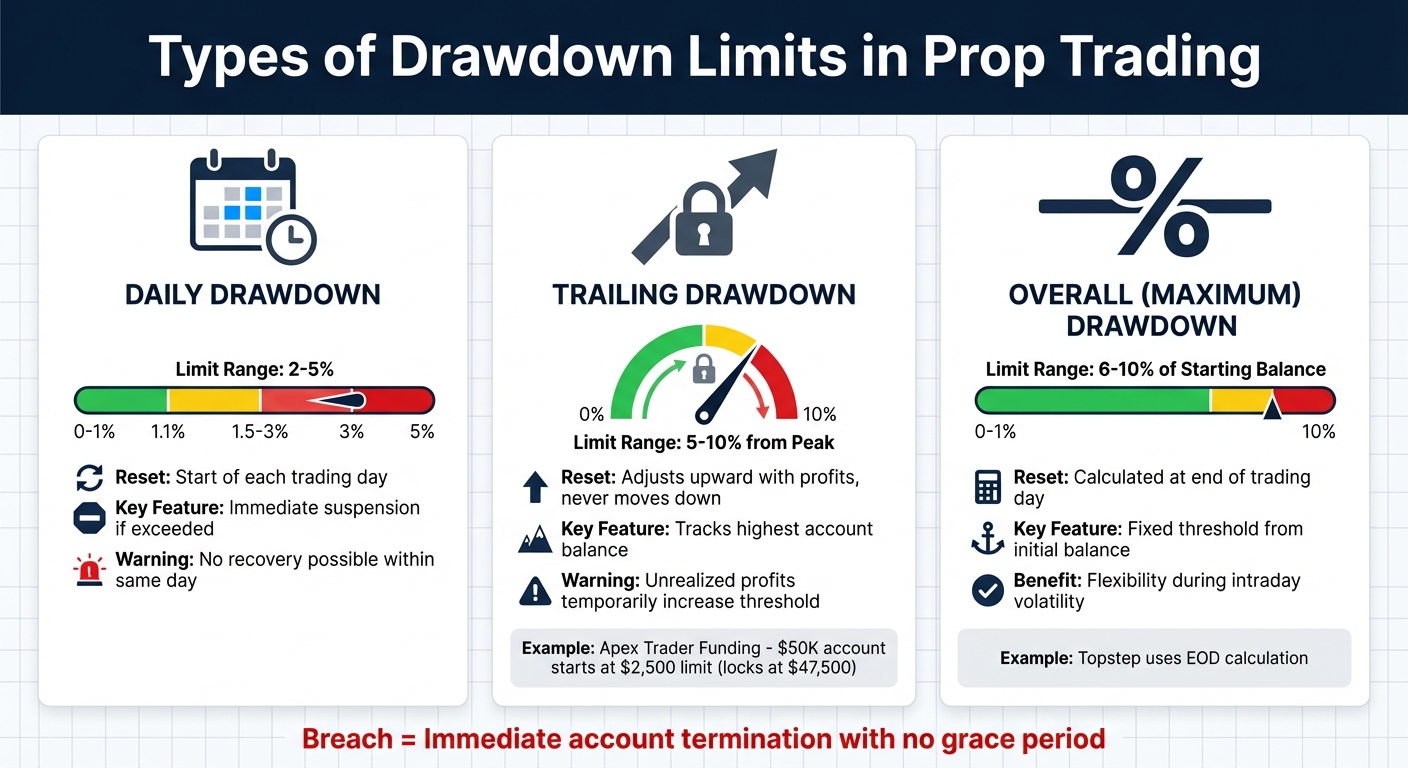
Types of Drawdown Limits in Prop Trading Firms
Types of Drawdown Limits
Prop trading firms use specific drawdown structures to safeguard their capital. Here’s a breakdown of the three main types:
- Daily Drawdown: This limit resets at the start of each trading day and usually falls between 2–5% of your account value. If you exceed this limit during the day, your account is immediately suspended or closed – even if you recover losses later in the session.
- Trailing Drawdown: This limit tracks your highest account balance (or equity) and adjusts upward as you earn profits. However, it never moves back down. Most firms set this limit at 5–10% from your peak. For example, Apex Trader Funding applies a trailing drawdown to a $50,000 evaluation account. The threshold starts at $2,500 (locking liquidation at $47,500) and increases as profits grow.
- Overall (Maximum) Drawdown: This is a fixed end-of-day limit, typically set between 6–10% of your starting balance. Firms like Topstep calculate this limit at the close of each trading day, offering flexibility during volatile intraday movements without triggering immediate breaches.
Each type of drawdown is calculated differently. For instance, Tradeify, which provides instant funding, uses an equity-based trailing drawdown. This adjusts in real time with your floating profit and loss, including unrealized gains. While unrealized profits temporarily increase your threshold, a market reversal on open positions could still lead to a breach, even if your closed balance remains safe.
What Happens When You Exceed Drawdowns
Breaching a drawdown limit has immediate and severe consequences. Once you cross the threshold, your account is terminated without warning, grace periods, or appeals. This means losing your funded status, accumulated profits, and any pending payouts. Prop firms enforce these rules using automated liquidation systems that monitor accounts 24/7.
For example, in September 2025, a trader with an Apex Trader Funding $50,000 evaluation account hit an intraday peak of $50,875. This automatically adjusted the trailing drawdown threshold to $48,375. When the trader closed their position at $50,100, the threshold stayed at $48,375, leaving only a $200 buffer from the original $2,500 drawdown. If they had incurred an additional $300 loss, the account would have been permanently closed.
These strict policies highlight the importance of capital protection for prop firms. Since you’re trading their money, these limits prevent any one trader from causing significant losses. Knowing which drawdown structure your firm uses – and keeping a close eye on it during each session – is essential for maintaining your funded status and building a successful trading career. Up next, we’ll look at strategies to manage risk within these limits.
Risk Management Strategies for Drawdowns
How to Size Your Positions
Position sizing is all about deciding how much capital you’re willing to risk on a single trade. A common approach is the 1% rule – risk just 1% of your account equity per trade. For instance, if your account is $100,000, you’d risk $1,000 per trade. More cautious traders might lower this to 0.5% during evaluations or even 0.25% for accounts over $200,000.
Here’s the basic formula: Position Size = (Account Balance × Risk %) ÷ Stop Loss Distance. So, if you’re working with a $50,000 account, risking 1% (or $500), and your stop loss is 50 ticks away, your position size should ensure that hitting the stop results in a $500 loss.
For markets with high volatility, ATR-based sizing can be a better fit. By setting your stop at 1.5–2.0 times the Average True Range (ATR), you can calculate: Position Size = (Account Balance × Risk %) ÷ (2 × ATR). This method adjusts your risk as market conditions shift. Another essential tool is a drawdown circuit breaker – stop trading completely if you reach 70% of your maximum drawdown or 50–60% of your daily loss limit. This can help you avoid emotional, revenge-driven trading, which contributes to about 60% of failed evaluations.
Next up: securing your positions with strict stop-loss orders.
Setting and Using Stop-Loss Orders
Using automated, server-side stop-loss orders is non-negotiable. These stops execute automatically, even if your trading platform has technical issues. To reduce the chance of being stopped out by market noise, place your stops 5–10 ticks beyond key support or resistance levels, or just past recent swing highs/lows.
Maintain at least a 1:2 risk-to-reward ratio. With this ratio, you only need to win 34% of your trades to break even. A 1:3 ratio lowers the break-even point to about 25%. Bracket or OCO (One-Cancels-the-Other) orders can automate your exit strategy. Once your profit target or stop-loss level is hit, the other order cancels itself. Avoid the temptation to adjust stop-loss levels after entering a trade – this often leads to unnecessary losses.
Creating Personal Daily Loss Limits
To complement position sizing and stop-loss strategies, setting personal daily loss limits is a must. Aim to cap your daily losses at 30–50% of your prop firm’s official limit. For example, if the firm allows a $2,000 daily loss on a $100,000 account, stop yourself at around $1,000. This buffer accounts for slippage, commissions, and impulsive decisions, helping you progress faster toward funded status.
Another approach is the "average win" method – set your daily loss limit equal to your average profitable day. This way, a single losing day can be offset by one typical winning day. You can also try a three-strike rule, which means stopping for the day after three consecutive losses, no matter the dollar amount. This helps prevent emotional exhaustion.
Many platforms now offer automated liquidation features. Once you hit your limit, the platform can log you out, giving you time to regroup. As trader Ansh Das puts it:
"The daily loss limit is a circuit breaker. It stops you from turning a bad day into a disaster".
For more insights on risk management tailored to specific prop firms, check out our in-depth reviews of top firms like Apex Trader Funding, Take Profit Trader, FundedNext Futures, Alpha Futures, Tradeify, Lucid Trading, and Topstep.
Managing Emotions and Psychology During Drawdowns
Once you’ve set up your risk management strategies, the next big challenge is keeping your emotions in check. Losing trades aren’t just a numbers game – they trigger real physical reactions. You might feel your chest tighten, your heart race, or your thoughts spiral. This happens because your brain’s amygdala kicks in, triggering a stress response and flooding your system with cortisol and adrenaline. In this state, your logical thinking (handled by the prefrontal cortex) takes a backseat, leaving you stuck in "fight, flight, or freeze" mode. For traders, the "fight" response often shows up as revenge trading – jumping back into the market to recover losses. Recognizing and managing these reactions is key to staying disciplined in trading.
The psychology of losses is tough: a loss feels about twice as painful as a win feels good. For example, if you lose $500, you’d need to win around $1,250 just to feel emotionally balanced. This explains why one bad trade can spiral into a series of rash, desperate decisions.
How to Avoid Revenge Trading
Revenge trading happens when you abandon your trading plan after a loss. Common signs include doubling your position size to "make it all back", removing stop-losses in the hope of a reversal, or taking trades that don’t align with your strategy. As Babypips.com aptly puts it:
"The strategy that got you to an 80% win rate in demo trading is worthless if you can’t control the voice in your head screaming ‘revenge trade!’ after two losses." – Babypips.com
One effective method to combat this is the 15-minute rule. After a big loss, step away from your screen for at least 15 to 30 minutes. This break helps your cortisol levels drop and allows your rational brain to regain control. Feel tempted to jump back in? Walk away immediately.
Another helpful tactic is the three-strike rule: stop trading for 24 hours after three consecutive losses. This enforces emotional discipline and ensures you stick to your trading plan. Additionally, try the physiological sigh – two short inhales followed by a long exhale – to calm your nervous system and lower your heart rate.
Shifting your mindset can also make a big difference. Start thinking in terms of "R" (risk) instead of dollars. Base your position sizes on a fixed percentage of your account, like 1% to 2%, rather than aiming to recover a specific dollar amount. The market doesn’t care about your breakeven point, and chasing a dollar figure often leads to oversized positions and broken rules.
Spotting Signs of Emotional Fatigue
Emotional fatigue can creep up on you, often unnoticed until mistakes pile up. Watch for warning signs like repeating the same errors over multiple days, feeling anxious before the market opens, or obsessively checking charts after hours.
When these signs appear, it’s time for a mandatory break. Some traders use a "circuit breaker protocol", reducing their risk per trade (e.g., from 0.5% to 0.25%) when their account hits a specific drawdown level, such as 3%. Others keep a mindset journal alongside their trade log, noting their mood (e.g., frustrated, calm, impatient) to identify patterns between emotions and performance.
Having a pre-written recovery plan can also save you from emotional decision-making. For instance, keep a note near your desk that says, "If I take two consecutive losses, then I pause for 30 minutes", or "If I feel rushed or impatient, I skip the session entirely". This approach removes the burden of making decisions when emotions are high. As trading coach Justin Trading puts it:
"Discipline isn’t just about following rules – it’s about protecting your future self from today’s emotions." – Justin Trading
If you’re trading with firms that enforce strict drawdown rules, understanding their requirements can help you set better emotional boundaries. For example, firms like Apex Trader Funding, Take Profit Trader, and Topstep have specific guidelines that can shape your psychological approach. Building on these emotional management techniques, the next step is learning how to safeguard your profits with effective exit strategies.
sbb-itb-46ae61d
Building Profit Buffers for Account Protection
Once you’ve mastered emotional discipline, the next step is shifting your focus from just managing losses to actively protecting your gains. Securing profits does more than grow your account – it pushes your trailing drawdown line higher, creating a buffer that helps shield you from liquidation.
Securing Profits with Partial Exits
Partial exits are a smart way to lock in profits while keeping some market exposure. When a trade hits new highs, consider scaling out by closing a portion of your position – maybe 50% or 75%. This approach allows you to secure gains while keeping your balance close to the rising drawdown line. That way, even if the remaining position retraces, your protective cushion remains intact.
End-of-day (EOD) models can also help adjust your protection through realized profits. For instance, firms like Lucid Trading, FundedNext Futures, and Alpha Futures use EOD drawdown models. These models temporarily increase your Maximum Loss Limit (MLL) based on realized profits. For example, if your minimum balance is $48,000 and you realize a $500 profit, your MLL for that session rises to $48,500. This gives you a bit more breathing room before hitting your liquidation limit.
Another key tactic is setting a daily profit target and stopping trading once you hit it. As Earn2Trade wisely advises:
"The first rule of compounding: Never interrupt it unnecessarily."
After a big win, resist the temptation to overtrade or take on unnecessary risks.
Protecting Realized Gains
Just as risk management helps build a cushion, protecting your realized gains ensures that buffer stays intact. Treat profits as protected capital only after your trailing drawdown reaches its "lock" point – usually your starting balance plus $100. Until then, aim to maintain a safety margin of $100–$300 above your auto-liquidation threshold. This helps avoid unexpected liquidations due to minor dips or commission costs.
When you’ve secured profits, think about reducing your position size rather than increasing it. Experienced traders know that hitting new equity highs can actually increase risk. For example, Earn2Trade highlighted two traders: Michael and Joanne. After a $1,000 winning week, Michael increased his position size and traded aggressively, which led to a trailing drawdown violation. Joanne, however, recognized the risks of new highs. She halved her position size, focused on high-probability trades, and successfully preserved her account. As FunderPro puts it:
"The goal is not to win big. The goal is to stay in the game."
During times of high volatility or after significant gains, switching to micro contracts can help. This allows you to stay active in the market while protecting your profit buffer. Remember, drawdown calculations are based on your net equity after accounting for commissions and fees. Ensuring your realized profits cover these costs is key to maintaining your safety margin.
Adapting to Market Conditions
Once you’ve established profit protection, the next step is adjusting your strategy to match changing market conditions. Long-term account stability depends on your ability to adapt, especially when market environments shift. Strategies that work well in calm, trending markets might lead to losses during periods of high volatility or shifts in asset correlations.
Reducing Position Size During High Volatility
When markets become volatile, stop-losses need to be wider to avoid being prematurely triggered by market noise. This means reducing position sizes to keep your dollar risk consistent. A good tool for this is the Average True Range (ATR), which measures market movement. Set stop-losses at 2x or 3x the ATR to allow trades enough room to develop.
As volatility rises, cutting the number of contracts you trade is crucial. Many experienced traders halve their risk per trade during extreme volatility. For instance, when the VIX surpasses 25, it’s common to lower risk from 1% per trade to 0.5%. This small adjustment can make the difference between weathering a turbulent market and facing significant losses.
Here’s a breakdown of how to adjust risk and stop width based on volatility levels:
| Volatility Level | Risk per Trade | Max Positions | Stop Width |
|---|---|---|---|
| Low (VIX < 15) | 1.5% | 8 | 1 ATR |
| Medium (VIX 15-25) | 1.0% | 6 | 1.5 ATR |
| High (VIX > 25) | 0.5% | 4 | 2 ATR |
Additionally, it’s wise to close positions or move stops to breakeven at least 15 minutes before major news events like FOMC announcements or Non-Farm Payrolls reports. These events can cause unpredictable price gaps, and even the best risk management strategies may not fully protect against slippage during such times.
Managing exposure across correlated instruments is another critical step in volatile markets.
Managing Correlation Between Instruments
Trading multiple highly correlated instruments might seem like diversification, but it actually increases your risk. Instruments with a correlation coefficient above +0.7 should be treated as a single risk exposure. For example, trading ES and NQ futures simultaneously often doubles your risk on the same market movement.
Currency pairs provide a clear example. EUR/USD and GBP/USD typically move in the same direction, while EUR/USD and USD/CHF often move inversely due to their shared USD component. If you’re long on both EUR/USD and GBP/USD, a dollar rally could impact both positions, amplifying your losses.
To manage this, reduce position sizes by 25% when trading assets that are highly correlated to your existing positions. Another effective approach is monitoring your total exposure, or "portfolio heat", across all positions. Keep this exposure capped between 4% and 8% to avoid correlated losses from spiraling out of control. This precaution helps ensure that a single market event doesn’t trigger multiple stop-losses and push you into a significant drawdown.
Daily Monitoring and Performance Tracking
Keeping a close eye on drawdown metrics can be the difference between maintaining your funded status and losing your account entirely. Many violations happen simply because traders lose track of how close they are to their risk limits. Knowing exactly how much room you have to operate is essential. Here’s how you can calculate your drawdown buffer at the start of each session.
Calculating Your Drawdown Before Each Session
Your drawdown buffer represents the gap between your current account balance and the firm’s liquidation threshold. This calculation depends on the type of account you’re trading:
- EOD Accounts: The threshold is tied to the previous day’s settled balance and only increases after profitable trading days.
- Trailing Drawdown Accounts: The threshold is based on your highest intraday equity peak (including open trades) minus the drawdown amount.
- Static Accounts: The threshold remains fixed at your starting balance.
To determine your buffer before trading, subtract the liquidation threshold from your current account balance. If you’re using Rithmic, you can check the "Auto Liquidate Threshold" in RTrader Pro, while Tradovate users can locate this in the account dropdown. It’s smart to maintain a $100–$300 buffer above the liquidation threshold to account for commissions and small market fluctuations. For EOD accounts, note that realized profits during the day temporarily increase your Maximum Loss Limit for that session, giving you more flexibility until the reset at the next session.
Once you’ve calculated your session’s safety cushion, it’s crucial to keep an eye on your maximum drawdown and profit ratio throughout your trading day.
Tracking Maximum Drawdown and Profit Factor
Maximum drawdown is a critical metric – breaching it by even $1 often results in immediate account termination. Trailing drawdowns, in particular, can be tricky since they adjust upward with equity peaks but never decrease. This means that an intraday equity high can permanently reduce your safety cushion, even if the trade closes at a smaller profit.
"As your risk-per-trade increases, your probability of hitting your max drawdown goes up exponentially." – A. Volkov
Statistical analysis shows that even with a 55% win rate and a 1.5:1 risk-to-reward ratio, risking 2% per trade leads to about a 62% chance of hitting a 10% maximum drawdown. Lowering the risk to 0.5% per trade under the same conditions reduces the probability of hitting that drawdown to under 1%. To stay safe, ensure your risk per trade doesn’t bring your equity within 25% of your breach level. Setting alerts at 75%, 50%, and 25% of your trailing buffer can help you stay ahead of potential violations.
Conclusion: Long-Term Success as a Funded Trader
Keeping a funded trading account alive requires more than just skill – it demands a strong focus on capital preservation and unwavering discipline. Transitioning from a "challenge mentality" to a "funded mentality" means prioritizing survival over chasing aggressive profits. For instance, reducing your risk per trade from 2% to just 0.5% significantly lowers the likelihood of hitting a 10% maximum drawdown – from 62% to less than 1%. This shift in mindset separates short-term participants from those building sustainable trading careers.
The strategies outlined here – like proper position sizing, disciplined stop-loss use, profit buffering, and emotional circuit breakers – act as a safety net for your account. Implementing mechanical rules, such as halving position sizes after a -2% drawdown or pausing trading for three days at -4%, helps remove emotional decision-making. These guardrails are critical in avoiding the "death spiral" of revenge trading, a common reason why nearly 80% of funded accounts fail. Together, these tools provide a framework for preserving your account and ensuring steady growth.
"Your edge is useless if you can’t survive long enough for it to manifest." – A. Volkov
This quote captures the essence of long-term trading success. Protecting your gains not only prevents you from hitting trailing drawdown limits but also sets the stage for scaling your account. By consistently demonstrating discipline and profitability, you can grow your account from $100,000 to $500,000 or more. Adopting methods like the 3-2-1 approach – three trading days per week, two trades per day, and a one percent weekly profit target – helps reduce overtrading and impulsive mistakes.
Ultimately, successful funded trading is about treating your account as a business asset, not a gamble. Focusing on the process over daily profit and loss encourages disciplined risk management, emotional control, and the adaptability needed for long-term achievement.
For more tips, reviews, and essential trading tools, visit DamnPropFirms.
FAQs
How do I calculate my drawdown buffer before I trade?
To figure out your drawdown buffer, start by identifying the maximum loss permitted under your firm’s drawdown rules. These rules might be static, trailing, or based on end-of-day balances. Once you know the limit, use a drawdown calculator to pinpoint the amount or percentage you can afford to risk. From there, adjust your trade size and the risk you take on each trade to stay within this buffer. This approach helps you avoid violations and keeps your account stable.
What’s the safest risk per trade to avoid blowing a funded account?
The safest approach to risk per trade is generally sticking to 1-2% of your account balance. This range helps keep your account stable while staying within acceptable drawdown limits. Be sure to adjust your risk according to the specific drawdown rules of your funded account to avoid surpassing limits and to maintain steady performance.
How can I stop revenge trading after a losing streak?
To prevent revenge trading, it’s crucial to identify what triggers your emotions and implement disciplined strategies. If you’ve taken a loss, step away for a moment to regain clarity. Stick to your trading plan, no matter how tempting impulsive decisions might feel in the heat of the moment.
Risk management tools, such as drawdown limits, can help you stay grounded and protect your account. Above all, focus on maintaining long-term consistency rather than trying to recover losses quickly. Keeping your emotions in check and following a well-thought-out strategy are essential for preserving your account and avoiding costly mistakes during a losing streak.