
Consistency rules and profit targets are key tools used by futures prop firms to evaluate traders. Here’s what you need to know:
- Consistency Rules: These limit the percentage of total profits a trader can earn in a single day, often set at 20-50%. This ensures traders avoid high-risk strategies and focus on steady, repeatable performance.
- Profit Targets: Specific dollar goals traders must hit, typically 5-10% of the starting account balance, to qualify for payouts or account upgrades.
For example, if a firm has a 40% consistency rule and a $3,000 profit target, no single day’s profit should exceed $1,200. Exceeding this can raise the profit target, delaying payouts. The best futures prop firms, including Tradeify and FundedNext Futures, use these rules to encourage disciplined trading, with some offering flexibility or tiered adjustments for subsequent payouts.
Traders can stay compliant by:
- Spreading profits across multiple days.
- Tracking daily gains to avoid exceeding limits.
- Using tools like the Consistency Rule Calculator to monitor progress.
These rules are designed to filter out risky trading behaviors and help traders develop sustainable strategies.
How The Consistency Rule REALLY Works (Calculator Included)
sbb-itb-46ae61d
How Consistency Rules Work at Different Prop Firms
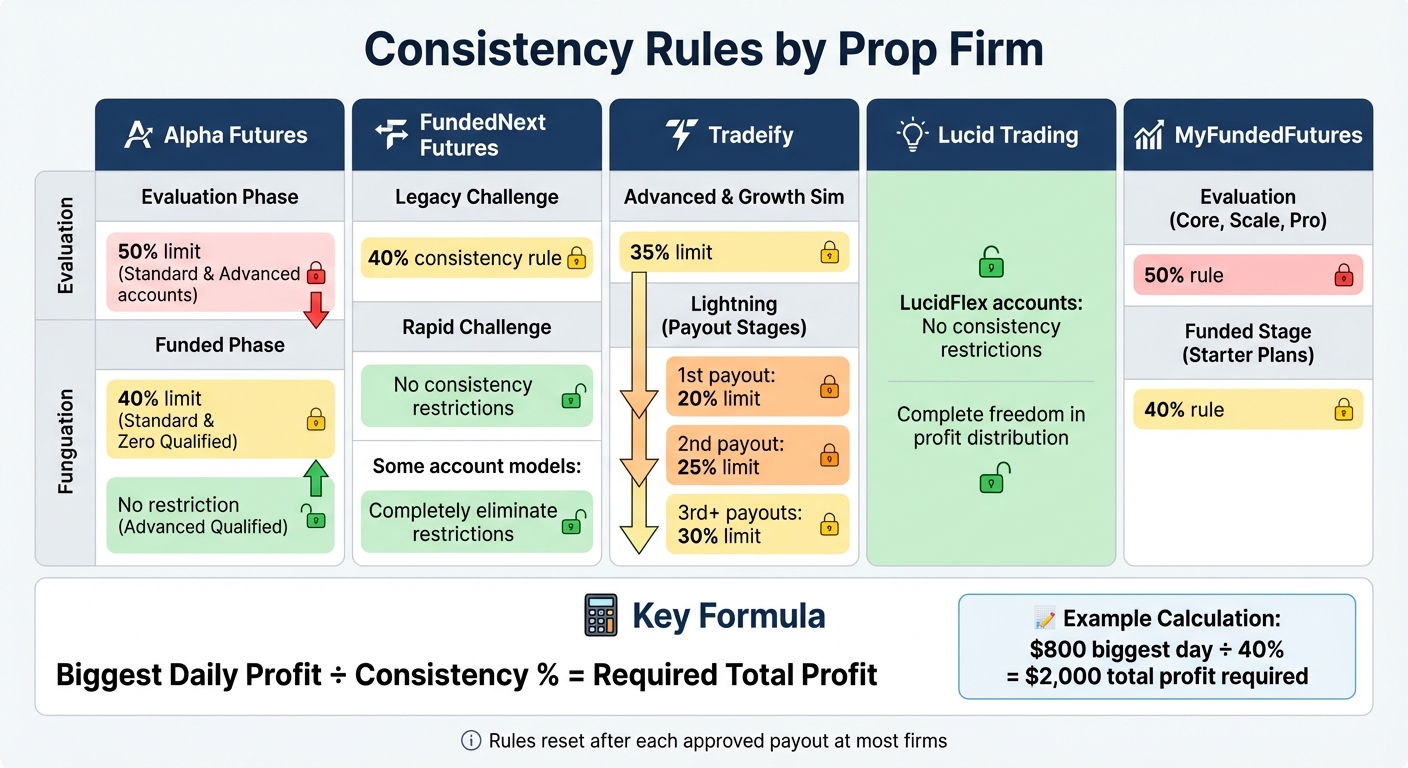
Consistency Rules Comparison Across Major Futures Prop Firms
Consistency Rule Examples by Firm
Prop firms enforce consistency rules differently, and these thresholds often dictate payout eligibility. For example, Alpha Futures sets a 50% limit for Standard and Advanced Evaluation accounts. This means your largest single-day profit cannot exceed 50% of your total net profit during the evaluation phase. Once you qualify, the rules tighten: Standard and Zero Qualified accounts drop to a 40% limit, while Advanced Qualified accounts are free from this restriction.
On the other hand, FundedNext Futures offers more flexibility. Some of their account models completely eliminate consistency restrictions, providing traders with fewer constraints.
Tradeify takes a tiered approach. For Advanced and Growth Sim accounts, the limit is set at 35%. Lightning accounts (instant funding) start with a stricter 20% limit for the first payout. This percentage increases to 25% for the second payout and 30% for the third and subsequent payouts. This progressive system rewards traders for steady performance across multiple withdrawal cycles.
Here’s a simple formula to calculate the required total profit based on your biggest daily profit and the consistency percentage:
Biggest Daily Profit ÷ Consistency % = Required Total Profit
For example, if your largest single-day profit is $800 and the rule requires 40% consistency, you’d need a total profit of $2,000 before making a withdrawal.
Next, let’s dive into how these rules apply specifically to instant funding accounts.
Consistency Rules for Instant Funding Accounts
Instant funding accounts often come with unique consistency rules. For example, Lucid Trading offers LucidFlex accounts with no consistency restrictions, allowing traders complete freedom in managing their profit days. In contrast, Tradeify applies a gradual consistency rule to its Lightning accounts. These accounts start with a 20% limit for the first payout, increasing to 25% for the second payout and 30% for subsequent payouts. This system encourages a track record of consistent performance while offering more flexibility over time.
Another key point is how consistency rules reset. At firms like Tradeify and Alpha Futures, the consistency requirement typically resets after each approved payout. This means traders must meet the rule again for every new withdrawal. This is different from evaluation accounts, where the rule usually applies only during the assessment phase.
If you’re considering instant funding, it’s crucial to understand whether the firm uses a flat percentage or a gradual model. This will directly impact your daily profit targets and how quickly you can withdraw funds. By tailoring your strategy to these thresholds, you can better align with the firm’s payout criteria and optimize your trading approach.
How Consistency Rules Affect Your Trading Strategy
Consistency rules force you to rethink how you approach every trade. Rather than chasing large, risky positions, the focus shifts to spreading profits over multiple days. This means adjusting your position sizing – reducing the risk per trade while increasing the number of trades. For example, if you typically risk 1% of your account per trade, try cutting that to 0.5% and doubling the setups. This strategy helps ensure that no single winning day overshadows your overall profit. As MyFundedFutures explains:
The habits that gave them one big win will eventually give them one catastrophic loser.
By taking smaller, frequent trades, you create a steady performance record, which is exactly what prop firms look for.
It’s also crucial to maintain a fixed risk per trade. Inconsistent risk levels can disrupt your profit consistency, making it harder to meet targets. Once you’ve fine-tuned your position sizing and risk management, the next step is distributing profits effectively.
Meeting Profit Goals While Following the Rules
Reaching profit targets while staying within consistency rules requires careful planning. Let’s say you’re working with a $50,000 account and a $3,000 profit target under a 20% consistency rule. In this case, no single day’s profit should exceed $600. This approach emphasizes steady daily gains over relying on a few exceptional days.
What if you have an unusually profitable day? Don’t worry – your account remains in good standing. The key is to continue trading smaller, high-probability setups to grow your overall profit pool gradually. Use this formula to track your progress:
Biggest Daily Profit ÷ Consistency % = Total Profit Required
To stay on track, regularly update your largest daily profit in the Consistency Rule Calculator. This tool helps you understand your position and plan your next steps with precision. As you progress through account stages, your trading strategy should adapt accordingly.
Adapting Your Strategy for Each Account Stage
Consistency rules play a critical role during the evaluation phase, acting as a filter for traders. For example, firms like MyFundedFutures enforce a 50% rule during evaluation for their Core, Scale, and Pro plans. If you hit your profit target with one large win, you’ll need to continue trading until that win accounts for less than 50% of your total profit.
Once you move into the funded stage, the rules often shift. Take Tradeify Lightning accounts as an example – they use a gradual model: 20% consistency for the first payout, 25% for the second, and 30% for all subsequent payouts. This allows you to aim for slightly higher daily profits as you prove consistent performance. On the other hand, MyFundedFutures Starter Plans apply a 40% consistency rule only during the funded stage.
The takeaway? During evaluation, lower your leverage to navigate early challenges. As rules become more flexible in later payout cycles, you can adjust your position sizing accordingly. Keep an eye on your "best day" metric – if it approaches 30–40% of your total profit, scale down your trade size to balance profit distribution. This proactive mindset ensures you stay payout-eligible and in control of your trading journey.
Meeting Profit Targets Without Breaking Consistency Rules
How Profit Targets and Consistency Rules Connect
Profit targets and consistency rules act as a two-part filter for prop firm payouts. The profit target sets the goal, while the consistency rule ensures your journey to that goal is steady. Many futures prop firms enforce a consistency rule, limiting any single trading day to 20% to 40% of your total profit. This prevents traders from relying on one lucky trade to pass evaluations or qualify for payouts.
Breaking the consistency rule doesn’t shut down your account. Instead, it triggers a "moving profit target." The new minimum profit requirement is calculated using this formula: Biggest Trading Day Profit ÷ Consistency Percentage = Minimum Total Profit Required.
For instance, the FundedNext Futures Legacy Challenge applies a 40% consistency rule. On a $50,000 account with a $2,500 profit target, the daily limit is $1,000. If you earn $1,200 in one day, your profit target increases to $3,000 ($1,200 ÷ 0.40). That means you’ll need to make an additional $500 before requesting a payout.
Tradeify uses a similar approach. On a $150,000 Lightning account with a $9,000 profit goal and a 20% consistency rule, the maximum allowed profit for a single day is $1,800. If you earn $2,500 in one day, your profit target jumps to $12,500, delaying your payout until you meet the new requirement.
Understanding these rules is crucial to avoid setbacks, as discussed below.
Common Problems and How to Solve Them
One common issue is failing to track your largest winning day. Many traders celebrate big wins without realizing how those wins impact their payout timeline. For example, a trader with Funded Futures Family earned $6,650 over five days, but their best day accounted for $4,100. With a 40% consistency rule, that single day exceeded the limit (40% of $6,650 is $2,660). As a result, their profit target increased to $10,250, requiring an additional $3,600 in gains before they could request a payout.
To avoid this, set daily profit caps based on your account size and consistency rule. For a 20% rule, aim for these benchmarks: $300/day on a $25,000 account, $600/day on a $50,000 account, or $1,200/day on a $100,000 account. Stop trading once you hit these caps. This strategy prevents unintentionally raising your profit target and delaying your payout.
Another challenge is not accounting for rule changes between different account stages. For example, Alpha Futures enforces a 50% rule during evaluation but relaxes it to 40% in the funded stage. Similarly, Tradeify Lightning accounts start with a 20% rule for the first payout, which increases to 25% for the second payout and 30% for subsequent payouts. Always confirm the current consistency percentage before planning your trades for the week.
Finally, use the Consistency Rule Calculator before requesting a payout. By inputting your largest winning day, you can verify whether you’ve met the total profit requirements. This quick check can help you avoid administrative delays and ensure you’re fully eligible for a payout. Having the right tools and staying informed can make all the difference in meeting your targets smoothly.
Tools and Tips for Staying Compliant
Using the Consistency Rule Calculator
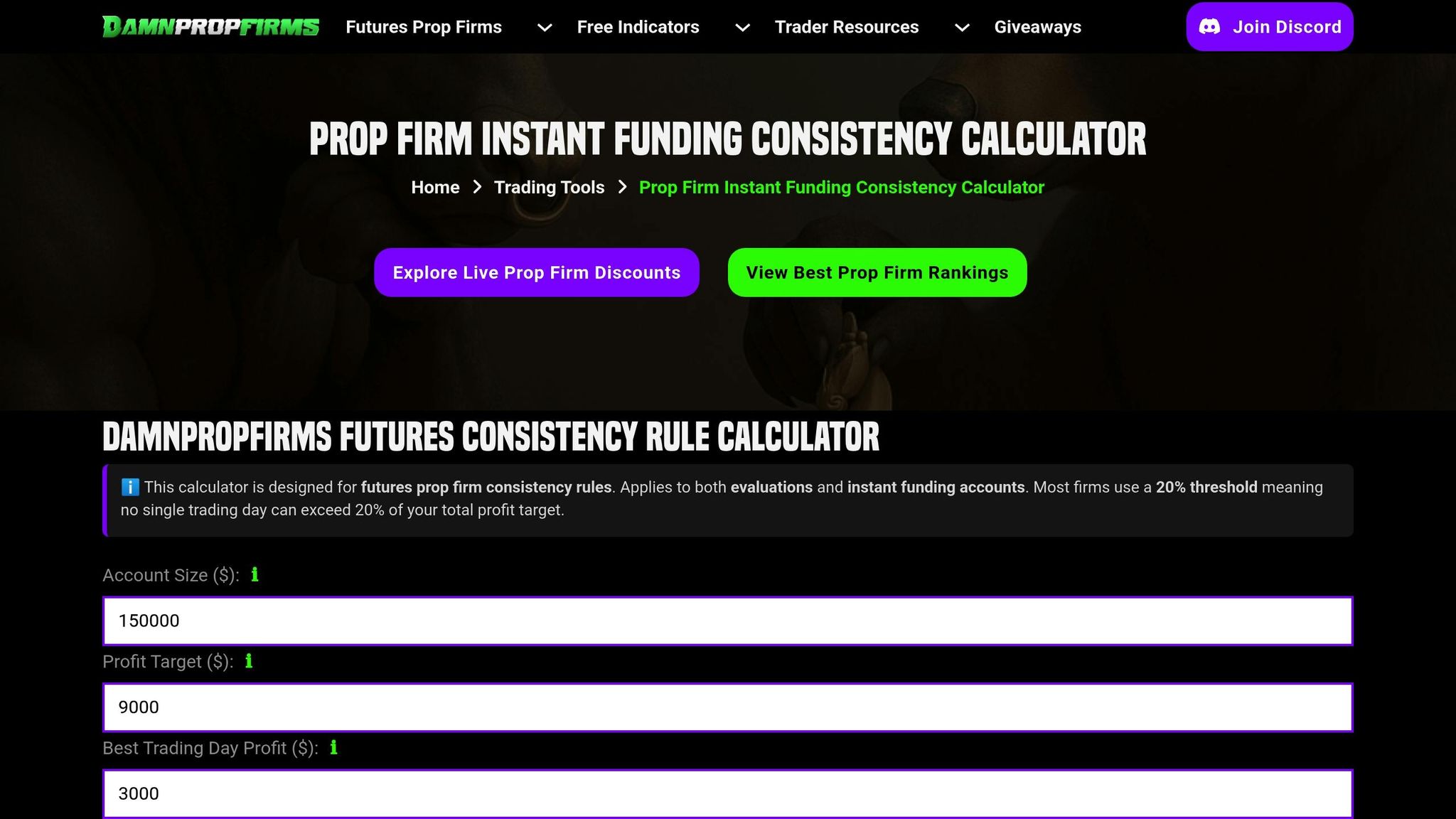
The Consistency Rule Calculator on DamnPropFirms simplifies the process of checking your eligibility before requesting a payout. All you need to do is enter your account size, profit target, and the largest trading day. If your biggest trading day exceeds the allowed threshold, the calculator adjusts your profit target using this formula: Biggest Profit Day ÷ Consistency % = Total Profit Required.
For example, on a $25,000 account with a 20% rule, the calculator suggests keeping daily profits under roughly $300. For a $100,000 account, the daily cap is around $1,200.
Trade journals and platform trackers can also help you stay within limits by monitoring your "biggest day" in relation to your overall profits. Tools like Tradeify provide dashboards that display your consistency percentage in real time. On the other hand, advanced traders often rely on tools like Bookmap, which uses liquidity visualization to identify and steer clear of high-volatility market setups.
By automating these checks and using the right tools, you can focus on refining your trading strategy while staying compliant.
Learning from Established Prop Firms
In addition to digital tools, studying the rules and structures of established prop firms can help you refine your approach. For example, Apex Trader Funding offers scaling opportunities of up to $6 million, rewarding traders who consistently perform well over time.
FundedNext Futures provides two options: the Legacy Challenge, which includes consistency rules, and the Rapid Challenge, which skips these rules during the evaluation phase. Meanwhile, Alpha Futures outlines how rules adapt as you move through different account stages.
Understanding how these firms operate allows you to pick accounts that match your trading style and develop strategies that align with their compliance frameworks. This approach not only ensures adherence to rules but also helps you grow as a trader.
Conclusion
Consistency rules and profit targets form the backbone of successful trading, ensuring profits come from repeatable skills rather than occasional wins. These rules protect both firm capital and individual accounts by prioritizing consistent performance over luck. As MyFundedFutures aptly states:
The consistency rule is a filter that separates professionals from gamblers and prepares you for the realities of live funded trading.
Rather than penalizing traders for exceeding consistency thresholds, most modern firms take a more flexible approach. Instead of terminating accounts, they adjust the profit target so that your largest trading day aligns with the allowed percentage. This adjustment lets you refine your strategy and continue trading without starting from scratch.
Steady profit distribution, keeping track of peak gains, and using reliable tools are key to thriving in prop trading. For example, while a 20% threshold is common across many firms, Tradeify offers a dynamic consistency model. Their approach starts with a 20% limit for the first payout, increases to 25% for the second, and reaches 30% for subsequent payouts.
To stay on track, use trusted tools to verify your progress. Before requesting a payout, check your status with the Consistency Rule Calculator. Additionally, explore detailed reviews of firms like Topstep and Take Profit Trader to find accounts that align with your trading style. These resources, combined with disciplined trading, can help you scale your account and maximize payouts over time.