
Futures proprietary trading firms provide traders with capital in exchange for a share of profits. Many firms charge recurring monthly fees for evaluation accounts, which can add financial pressure. However, some firms offer a one-time fee model, eliminating ongoing costs and allowing traders to focus on long-term strategies. According to our futures prop firm reviews, Here’s a quick look at the top futures prop firms with no recurring fees:
- Apex Trader Funding: Offers accounts up to $300,000, with 100% profit on the first $25,000 and a 90% split after. Payouts every 8 days.
- FundedNext Futures: Accounts from $25,000 to $100,000 with 100% profit split. Payouts within 24 hours.
- Lucid Trading: Two models (LucidBlack and LucidDirect) with accounts up to $150,000 and a 90% split. Payouts in as little as 15 minutes.
- Tradeify: Instant funding accounts up to $150,000, offering up to 100% profit split. Payouts processed within minutes.
- Topstep: Uses a Trading Combine model with accounts up to $150,000. Offers 100% profit on the first $10,000 and daily payouts.
Quick Comparison
| Firm | Account Sizes | Profit Split | Payout Speed | Fee Model |
|---|---|---|---|---|
| Apex Trader Funding | Up to $300,000 | 100% first $25K, 90% after | Every 8 days | One-time fee + activation |
| FundedNext Futures | $25K to $100K | 100% | Within 24 hours | One-time fee |
| Lucid Trading | Up to $150,000 | 90% | 15 minutes to 2 days | One-time fee |
| Tradeify | Up to $150,000 | 90%-100% | Within minutes | One-time fee |
| Topstep | Up to $150,000 | 100% first $10K, 90% after | Daily payouts (TopstepX) | One-time fee + activation |
To choose the best firm, consider factors like profit splits, payout speeds, and risk management policies (e.g., trailing vs. end-of-day drawdowns). A one-time fee model can save traders up to 72% compared to recurring fees, making it a cost-effective option for those seeking flexibility and reduced financial stress.
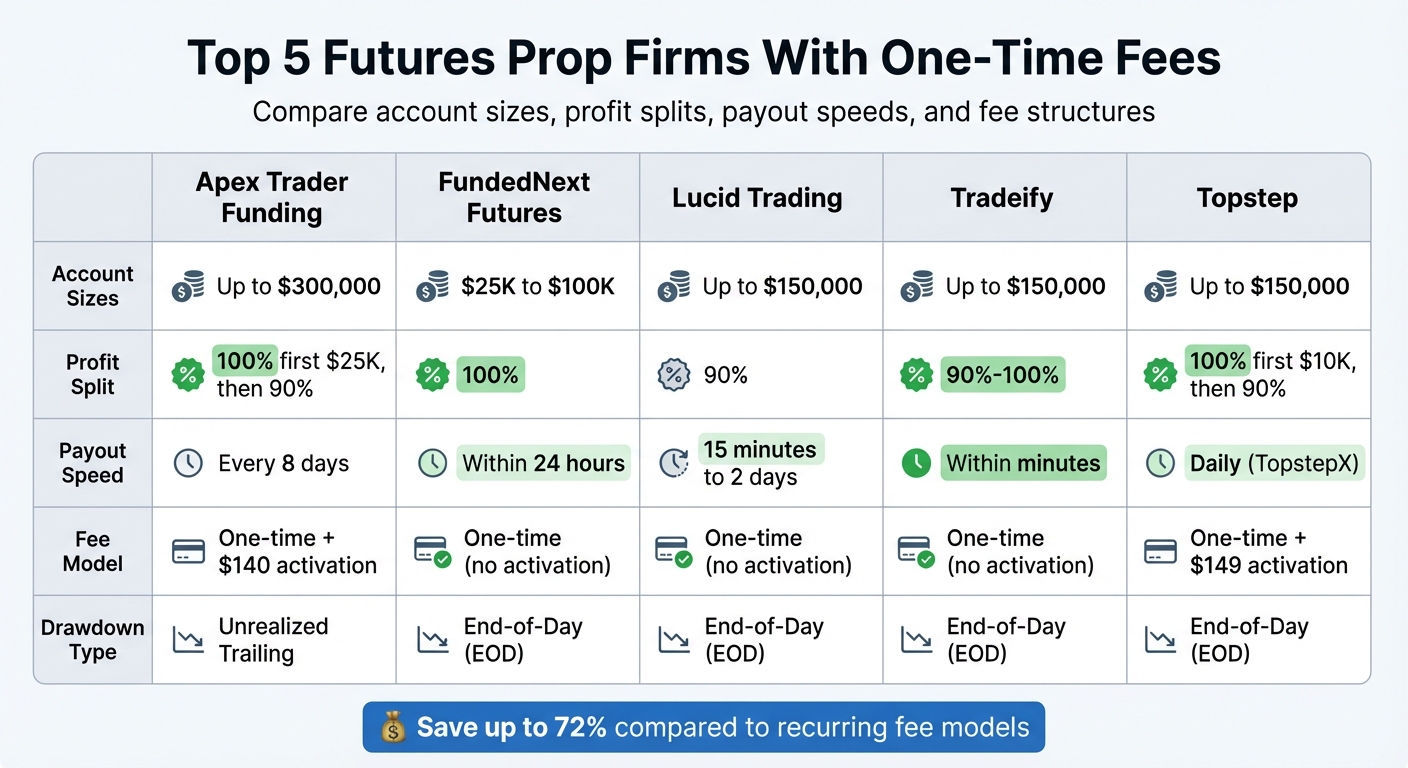
Futures Prop Firms Comparison: Fees, Profit Splits, and Payout Speeds
Top 5 Futures Prop Firms of 2025 – Instant Funding, No Consistency & Fast Payouts
sbb-itb-46ae61d
Best Futures Prop Firms With One-Time Fees
These firms simplify trading by charging a single upfront fee instead of monthly subscriptions, allowing traders to focus entirely on their strategies.
Here’s a closer look at some of the top firms offering this model.
Apex Trader Funding

Apex Trader Funding provides account sizes of up to $300,000 and offers traders 100% of the first $25,000 in profits, followed by a 90% split on additional earnings. Payouts are processed every 8 days, and traders can manage up to 20 accounts, with the potential to scale their total funding to $6 million. This firm operates on a one-time fee system, ensuring no recurring payments.
FundedNext Futures
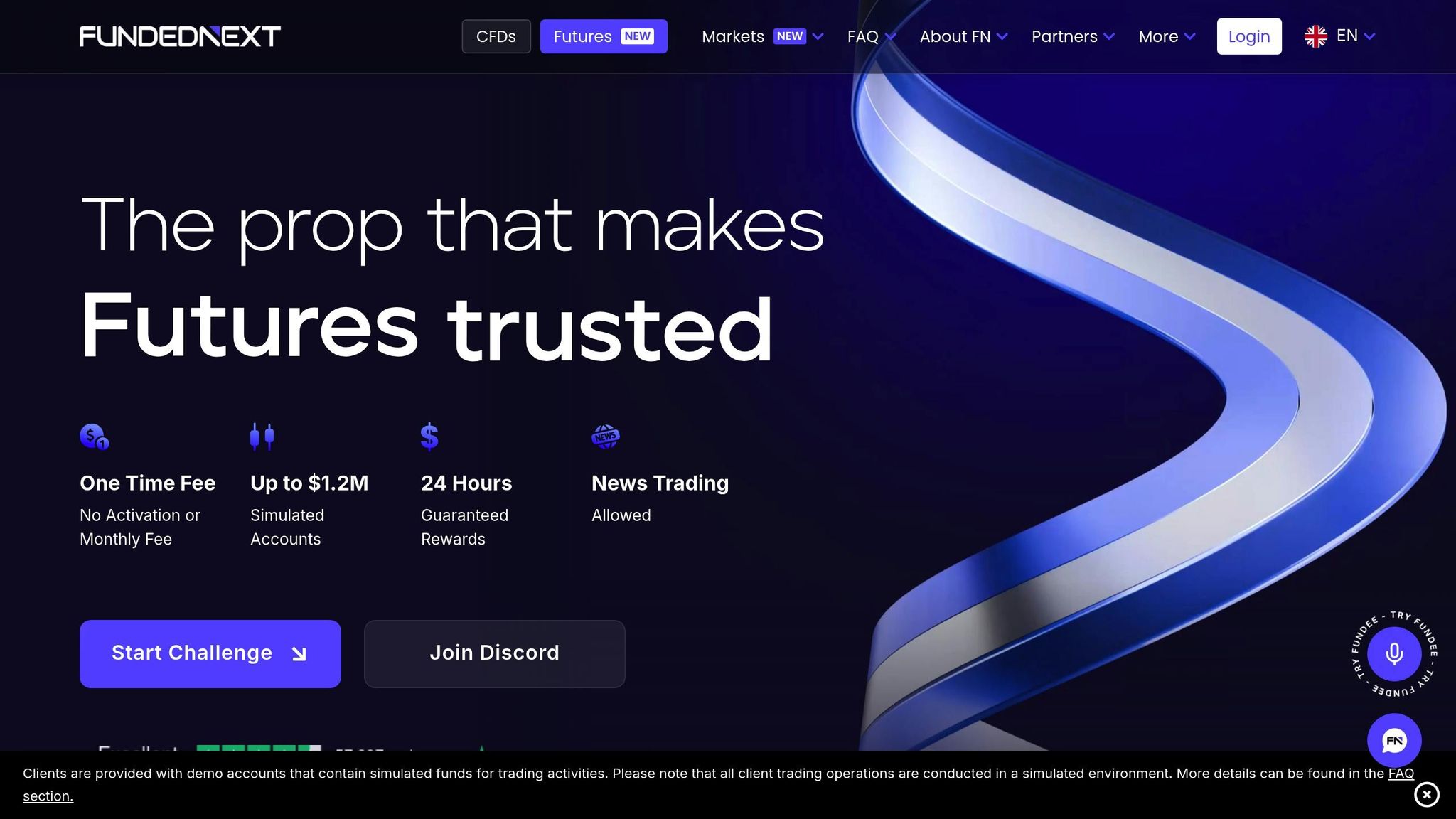
FundedNext Futures offers accounts ranging from $25,000 to $100,000 with clear pricing: $99 for $25,000, $199 for $50,000, and $399 for $100,000. Traders benefit from a 100% profit split, and payouts are processed within 24 hours. If a payout is delayed, the firm guarantees $1,000 in compensation. Supported platforms include Tradovate, NinjaTrader, and TradingView, and funded accounts are subject to a 40% consistency rule. The firm also uses an End-of-Day (EOD) drawdown system.
Lucid Trading
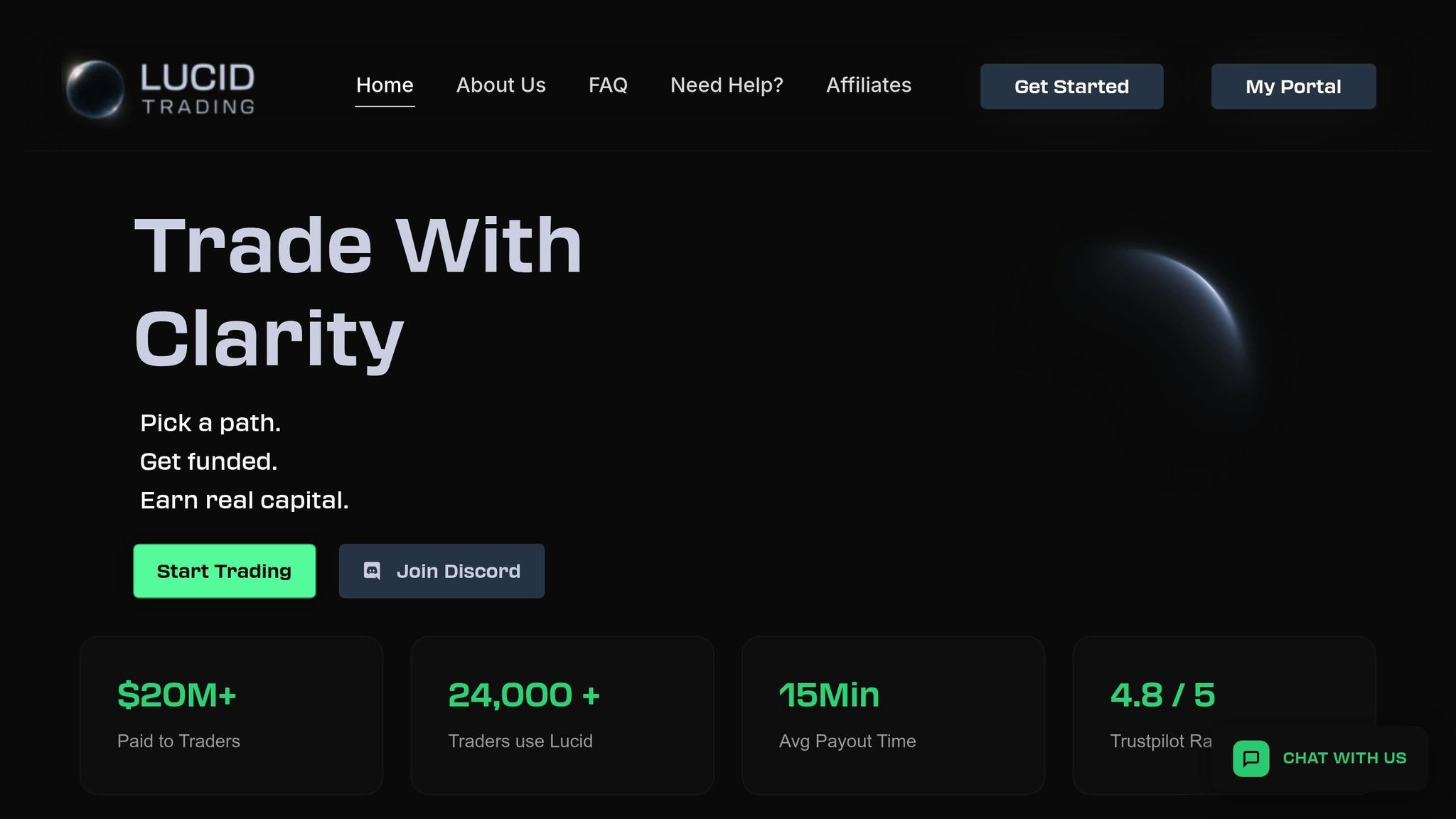
Lucid Trading offers two funding models: LucidBlack for premium evaluations and LucidDirect for instant funding, both requiring a one-time fee. The firm has distributed over $20 million to more than 24,000 traders and boasts a 4.8/5 rating on Trustpilot from 1,685 reviews. Accounts go up to $150,000, with a 90% profit split. For LucidDirect accounts, a 20% consistency rule applies. Payouts are typically processed in 15 minutes, with a maximum wait time of 2 business days. Reset fees vary by account size: $75 for $25K, $100 for $50K, $170 for $100K, and $225 for $150K.
Tradeify

Tradeify stands out with its "Lightning" instant funding accounts, which skip the evaluation phase entirely. Account sizes go up to $150,000, offering profit splits between 90% and 100%. Their flagship $150,000 account includes a $6,000 max loss limit and is highly regarded for its instant funding feature. Payouts are processed within minutes, and the firm applies a 20% to 30% scaling consistency rule. Like others, Tradeify uses an EOD drawdown system.
Topstep

Topstep uses a Trading Combine model, requiring traders to pass an evaluation before receiving funding. The firm offers a 100% profit split on the first $10,000, followed by 90% on additional profits. Account sizes can reach $150,000, and the TopstepX program allows for daily payouts to eligible traders. Their one-time fee structure ensures there are no ongoing subscription costs.
One-Time Fee Futures Prop Firms Compared
Choosing the right futures prop firm depends on your trading preferences, so it’s essential to compare fees, profit splits, payout speeds, and risk management policies. Here’s a breakdown of some top futures prop firms to help you decide.
- Apex Trader Funding: Offers a $50,000 account for about $33 during sales, plus a one-time $140 activation fee, making the total roughly $173.
- Tradeify: No activation fee, which keeps costs lower overall.
- Lucid Trading: Similar to Tradeify, it doesn’t charge an activation fee.
- FundedNext Futures: Charges about $72 for a $25,000 account evaluation with no additional activation fee.
- Topstep: Requires a $149 activation fee after completing the Trading Combine.
Profit Splits
Profit-sharing arrangements vary significantly between firms:
- Apex Trader Funding: Traders keep 100% of the first $25,000 in profits, then 90% afterward.
- FundedNext Futures: Offers a standard 80% profit split.
- Lucid Trading and Tradeify: Provide splits ranging from 90% to 100%, depending on the account type.
- Topstep: Profit splits range from 50% to 90%, depending on performance.
Payout Speeds
How quickly you can withdraw earnings is another key factor:
- Lucid Trading: Processes withdrawals in about 15 minutes.
- Apex Trader Funding: Takes up to 8 days.
- FundedNext Futures: Processes payouts in 3 to 5 days.
- Topstep: Offers daily payouts through their TopstepX feature.
Risk Management
Different firms also have varying risk management policies:
- Apex Trader Funding: Uses an unrealized trailing drawdown, which adjusts based on your highest intraday profit.
- Topstep, Tradeify, FundedNext Futures, and Lucid Trading: Employ an end-of-day drawdown calculated at market close.
How to Pick a One-Time Fee Futures Prop Firm
Selecting the right futures prop firm starts with understanding drawdown types. End-of-Day (EOD) drawdown updates only at the market close based on your closed balance. This provides flexibility during intraday volatility, making it ideal for traders who hold positions through market fluctuations. Firms like Lucid Trading, FundedNext Futures, and Take Profit Trader use this model. Meanwhile, Unrealized Trailing Drawdown tracks your highest profit point in real-time during a trade, which can be restrictive. For example, Apex Trader Funding follows this approach. If you’re an intraday trend trader, EOD drawdown is often a better fit, as it helps avoid premature stop-outs caused by normal market swings.
Consistency rules are another key factor. These rules determine payout eligibility by limiting how much of your total profits can come from a single trading day. Common thresholds are 20%, 30%, or 40%. If your strategy relies on occasional large wins, avoid firms with strict 20% rules. Instead, look at firms like Take Profit Trader or specific accounts at Lucid Trading (such as LucidFlex), which remove these rules entirely once you’re funded. To ensure your strategy aligns with a firm’s requirements, DamnPropFirms offers a Consistency Rule Calculator that can help you evaluate your compatibility before committing. After this, review any hidden fees and payout terms for a full picture.
When comparing fees, don’t just look at the upfront cost. Check for activation fees, which vary by firm. For example, firms like Take Profit Trader and Lucid Trading have no activation fees, keeping costs straightforward. Make sure you calculate the total cost of ownership, including evaluation fees, resets, and any activation charges, rather than focusing solely on the initial price tag.
Payout frequency and buffer requirements are also crucial. Some firms, like Lucid Trading, process withdrawals in about 15 minutes, while others, such as Apex Trader Funding, operate on an 8-day cycle. Confirm minimum buffer requirements, as failing to meet these could delay or block your payout. Withdrawing below the required buffer might even result in account restrictions.
Finally, think about how each firm supports account growth. For example, Apex Trader Funding allows up to 20 accounts at once, with a payout potential of $70,000 every 8 days. In contrast, firms like Tradeify and Take Profit Trader cap accounts at five. Using cloud-based trade copiers can help manage multiple accounts efficiently. Match the firm’s rules to your trading style – scalpers might handle trailing drawdowns well, while swing traders benefit more from EOD drawdowns to avoid unnecessary stop-outs. Choose a firm with scaling options that fit your long-term strategy for steady growth.
Conclusion
Switching to a one-time fee model can lead to significant savings – up to 72% compared to recurring fee structures. For instance, a $50,000 account might cost just $116 under this model, while a traditional three-month evaluation would run about $296, saving you 61%. For larger accounts like $150,000, the savings become even more pronounced, reaching up to 72% when compared to a six-month evaluation period. Plus, you sidestep the extra costs of activation fees, which typically range from $100 to $169, avoiding the dreaded "pay twice" scenario.
This pricing structure offers more than just financial benefits. By eliminating the stress of recurring billing cycles, traders can focus on identifying high-quality trade setups without the pressure of monthly deadlines. It also allows you to sit out during unfavorable market conditions, ensuring you only trade when the odds are in your favor. As Phidias Prop Firm states:
Activation fees create a toxic psychological environment that undermines disciplined trading.
The one-time fee model aligns the firm’s success with yours, as they earn through profit splits rather than relying on resets or subscription fees.
When evaluating these models, be sure to calculate your Total Cost of Funding (TCF), factoring in evaluation fees, activation charges, and potential reset costs. It’s also essential to understand whether the firm uses an end-of-day (EOD) drawdown or an unrealized trailing drawdown, as well as its consistency rules, to ensure they fit your trading approach.
For a deeper dive into drawdown policies, payout speeds, and consistency requirements, check out the detailed reviews of Apex Trader Funding, FundedNext Futures, Lucid Trading, Tradeify, and Topstep. To ensure your trading history aligns with firm-specific rules, the Consistency Rule Calculator can be a helpful tool.
FAQs
What’s the catch with “one-time fee” prop firms?
When it comes to "one-time fee" prop firms, the appeal lies in their simplicity. Instead of dealing with recurring activation or monthly fees, traders make a single upfront payment. This means you can trade for as long as you want without worrying about ongoing charges. It’s a straightforward way to cut costs and stay focused on trading, free from the hassle of repeated financial obligations.
Which drawdown type is better: EOD or trailing?
When deciding between drawdown types, it all comes down to your risk tolerance and trading strategy. Static drawdowns set fixed risk limits, keeping things consistent. On the other hand, trailing drawdowns shift with market performance, giving you room to adapt. The choice depends on which approach fits your trading style better.
How do consistency rules affect my payouts?
Consistency rules often cap the profit you can earn in a single day, usually at about 20% of your total profit target. This approach requires traders to spread their earnings over several days while staying within these daily limits to qualify for withdrawals. The goal of these rules is to promote steady, disciplined trading and avoid situations where a single, large gain might jeopardize withdrawal eligibility.