
Drawdown limits in trading accounts can make or break your success. They determine how much you can lose before your account is closed – and this directly impacts your ability to request payouts.
Here’s what you need to know:
- Drawdown Types: There are three main types – Trailing, End-of-Day (EOD), and Static. Each calculates losses differently, affecting your trading flexibility.
- Trailing Drawdown: This adjusts as your account grows, locking in profits but reducing your safety margin. Exceeding this limit results in immediate account closure and loss of payouts.
- Daily Drawdown: Limits the maximum loss you can take in a single day. Breaching it leads to instant account termination.
- Payout Impact: Violating any drawdown rule cancels your payout eligibility, even if you’ve accumulated profits.
To manage drawdowns effectively:
- Maintain a buffer above your liquidation point.
- Spread risk across multiple days to avoid breaching limits.
- Follow consistency rules to ensure smooth payouts.
Understanding these rules is critical for protecting your account and securing payouts.
Understanding Drawdown & Floating PnL: Here’s What You Need to Know!
What Is Drawdown in Futures Prop Trading?
Drawdown refers to the percentage decrease from a previous peak in your trading account’s value. Here’s the formula:
Drawdown % = (Peak Value – Trough Value) / Peak Value × 100%.
For example, if your account drops from $50,000 to $30,000, the drawdown is 40%.
Proprietary trading firms (prop firms) enforce strict drawdown limits to safeguard their capital and evaluate traders’ risk management skills . Exceeding these limits can lead to serious consequences, such as account closure, loss of funding, or the termination of your contract. With this foundation in place, let’s explore the types of drawdowns and how they affect your ability to request payouts.
Trailing Drawdown
A trailing drawdown adjusts as your account grows, locking in profits while capping potential losses. For instance, if you start with a $100,000 account and have a 10% trailing drawdown, the initial stop-loss is set at $90,000. If your account grows to $110,000, the stop-loss moves up to $99,000. However, once the threshold increases, it does not move back down – even if your balance decreases.
Here’s a real-world example: In September 2025, an Apex Trader Funding evaluation began with a $50,000 account and a $2,500 trailing drawdown limit. The initial threshold was set at $47,500. If the account peaked at $50,875, the drawdown threshold would adjust to $48,375. Closing the day at $50,100 would leave only a $1,725 buffer before hitting the limit.
Violating the trailing drawdown rule has severe consequences. All open positions are closed, and the account may be permanently forfeited. This means losing any accumulated profits and the ability to request payouts. Some firms set the trailing drawdown to lock at your starting balance plus a small buffer (e.g., $100), ensuring their capital is protected while allowing you some flexibility to trade.
Daily Drawdown
Daily drawdown limits the maximum loss you can take in a single trading day. Typically, this limit is around 4–5% of your account balance. For example, on a $50,000 account with a 4.5% daily drawdown, the maximum allowable loss is $2,250. If you lose $2,251 in a single day, your account could be terminated immediately. This limit applies to both realized losses (from closed trades) and unrealized losses (from open positions).
Here’s how it works: Imagine your account balance is $100,000, but a $5,000 unrealized loss on open positions reduces your equity to $95,000. If your daily drawdown limit is 5% ($5,000), you’ve already hit the threshold – even if your nominal balance hasn’t changed.
Breaking the daily drawdown rule is a serious violation. It not only disqualifies you from requesting payouts but usually results in account closure. Knowing whether your firm calculates drawdowns as a flat dollar amount, a percentage, or a trailing figure is crucial for planning your trades and staying within the rules. Mastering these mechanics is key to managing risk and keeping your payout eligibility intact, as we’ll discuss further in the next sections.
How Drawdown Limits Affect Payout Eligibility
Trailing and daily drawdown limits have a strict and immediate influence on your payout eligibility. If you breach a drawdown limit, it doesn’t just end your trading for the day – it permanently terminates your account and nullifies any pending or future payout requests. Even if you’ve accumulated $10,000 in profits, exceeding the drawdown limit by even a single dollar can cost you everything. Prop firms emphasize adherence to rules over sheer profitability, meaning even the most successful traders can lose payout eligibility if they violate these limits.
For firms using intraday trailing drawdown, your account can fail during a live trade if a pullback breaches the trailing stop – even if the trade was profitable. For example, say your account equity peaks at $52,000, and your trailing drawdown is set at $2,500. This locks your threshold at $49,500. If a trade pulls back and your equity dips to $49,499, your account is immediately liquidated.
"If an account hits the max drawdown, that account is failed. It is quite literally the maximum drawdown."
- Isaac, Author, ImanTrading
On the other hand, End-of-Day (EOD) drawdown calculates the limit only after the market closes. This approach allows traders to weather intraday fluctuations, as long as the settled balance at the end of the day remains above the threshold. Regardless of the method, however, breaching the drawdown limit results in the loss of payout eligibility.
How Trailing Drawdown Affects Payout Requests
When you request a payout, your account balance decreases, but the trailing drawdown threshold remains locked at its highest point, reducing your safety margin. For instance, if your Apex Trader Funding account grows from $50,000 to $55,000, and your trailing drawdown is set at $2,500, the threshold locks at $52,500. If you withdraw $3,000, your balance drops to $52,000 – leaving just a $500 buffer before hitting the drawdown limit. Any loss beyond this cushion triggers account termination.
Since the trailing drawdown threshold doesn’t adjust downward, it’s wise to maintain an extra buffer of $100–$300 to account for minor fluctuations or commissions. Apex Trader Funding, which has paid out over $500 million to traders following these rules, typically sets the trailing drawdown lock at the starting balance plus $100 once the account is funded. Daily drawdown limits, however, affect payout timing differently, as outlined below.
How Daily Drawdown Affects Payout Timing
Exceeding a daily drawdown limit – typically around 5% of your account – results in immediate account termination. For example, if you’re managing a $100,000 account and lose more than $5,000 in a single day, your account is closed, and you’re blocked from requesting payouts for that period. This rule applies to both realized losses (from closed trades) and unrealized losses (from open positions), meaning even a floating loss can disqualify you.
Daily drawdown limits work hand-in-hand with trailing drawdown rules to encourage consistent, disciplined trading. Some firms also impose consistency rules, ensuring no single trading day contributes more than 30–40% of your total profit. Violating the daily drawdown rule not only prevents future payout requests but also cancels any pending eligibility.
"This rule prevents traders from over-leveraging and blowing up funded accounts, ensuring that payouts go to those who trade with proper risk management."
sbb-itb-46ae61d
Drawdown and Payout Rules at Top Prop Firms
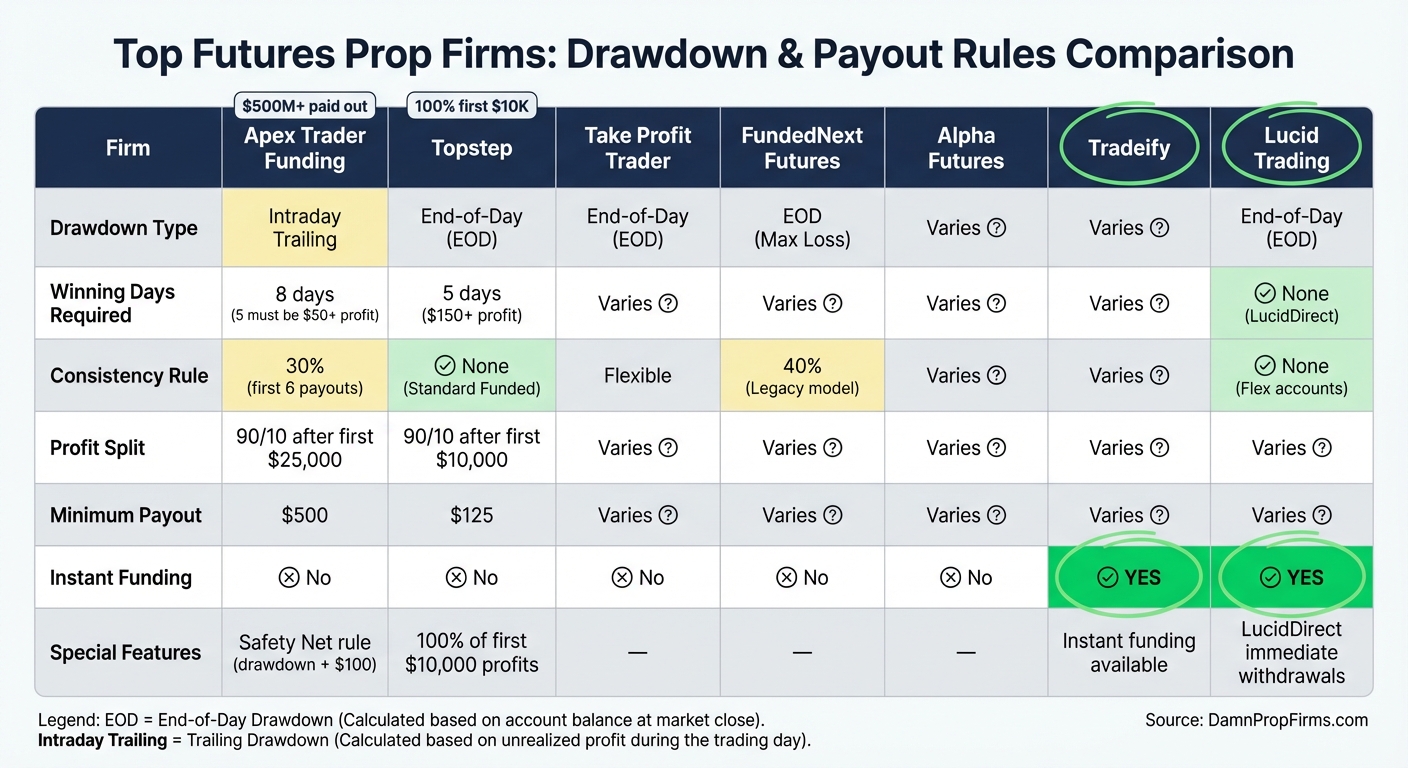
Futures Prop Firms Drawdown and Payout Rules Comparison
Futures prop firms have specific drawdown and payout rules that can significantly affect when and how you receive your earnings. Some firms use intraday trailing drawdown, which adjusts in real time, while others rely on End-of-Day (EOD) drawdown, where limits are calculated after the market closes. Knowing these differences is key to picking a firm that matches your trading preferences and risk tolerance. For a deeper dive, check out the Apex Trader Funding review.
Drawdown Limits and Payout Rules by Firm
Below is a comparison of drawdown policies, payout requirements, and profit splits across leading futures prop firms.
Firms like Lucid Trading and Tradeify stand out by offering instant funding, letting traders bypass the evaluation phase and jump straight into a funded account.
| Prop Firm | Drawdown Type | Winning Days Required | Consistency Rule | Profit Split | Minimum Payout | Instant Funding |
|---|---|---|---|---|---|---|
| Apex Trader Funding | Intraday Trailing | 8 days (5 must be $50+ profit) | 30% (first 6 payouts) | 90/10 after first $25,000 | $500 | No |
| Topstep | End-of-Day (EOD) | 5 days ($150+ profit) | None (Standard Funded) | 90/10 after first $10,000 | $125 | No |
| Take Profit Trader | End-of-Day (EOD) | Varies | Flexible | Varies | Varies | No |
| FundedNext Futures | EOD (Max Loss) | Varies | 40% (Legacy model) | Varies | Varies | No |
| Alpha Futures | Varies | Varies | Varies | Varies | Varies | No |
| Tradeify | Varies | Varies | Varies | Varies | Varies | Yes |
| Lucid Trading | End-of-Day (EOD) | None (LucidDirect) | None (Flex accounts) | Varies | Varies | Yes |
Apex Trader Funding has a Safety Net rule (drawdown limit plus $100) for the first three payouts and requires traders to follow a 30% consistency rule for the first six payouts. Meanwhile, Topstep allows traders to keep 100% of their first $10,000 in profits (for accounts opened before January 12, 2026), followed by a 90/10 split. However, Topstep’s EOD drawdown resets the Maximum Loss Limit to $0 after the first payout, meaning traders must build a new profit cushion before making further withdrawals.
For those looking to skip evaluations, Lucid Trading offers "LucidDirect" accounts, which allow immediate withdrawals. Similarly, Tradeify provides instant funding, catering to experienced traders who want to start earning payouts right away. Lucid’s "LucidFlex" accounts are also noteworthy – they eliminate funded-stage consistency rules and daily loss limits, relying on EOD drawdown to ease trading pressure.
For more detailed comparisons, payout structures, and fee breakdowns, visit the DamnPropFirms review pages. Tools like the Consistency Rule Calculator can help ensure your trading stays within required thresholds, avoiding payout delays. Understanding these rules is essential for managing drawdowns and ensuring smooth payouts.
How to Manage Drawdown and Secure Payouts
To secure payouts and manage drawdowns effectively, discipline and consistent monitoring of your account are essential. The difference between receiving a payout and losing your account often boils down to a few key habits. Regular, steady gains are more reliable than occasional big wins, especially since many prop firms enforce strict rules on daily losses and profit distribution, which directly affect your payout eligibility.
Track Your Equity Curve and Position Size
Your equity curve reflects the highest unrealized peak your account has achieved. In firms like Apex Trader Funding, the trailing drawdown adjusts to that peak – even if your trade retraces before closing. For example, if your trade peaks at $875 but exits at $100, the drawdown threshold remains tied to the $875 peak, quickly reducing your safety margin.
To avoid unexpected liquidations, maintain a buffer of $100–$300 above your liquidation threshold. Take advantage of platform-specific tools like RTrader Pro’s "Auto Liquidate Threshold" or Tradovate’s account dropdown menu to monitor drawdowns in real-time. When you hit a new equity peak, reduce your position size to slow the upward adjustment of the trailing drawdown, ensuring you preserve a safety cushion. These steps are critical for meeting daily consistency requirements.
Use Consistency Rules
Consistency rules are designed to prevent risky "all-in" trading and encourage steady profit distribution across multiple days. Most firms require that no single trading day accounts for more than 20% to 35% of your total profits before you can request a payout. Violating this rule won’t usually result in losing your account, but it will delay payouts by increasing the profit target needed to bring your largest day into compliance. Following these rules not only stabilizes your earnings but also ensures you remain eligible for timely payouts.
To simplify this, use the DamnPropFirms Consistency Rule Calculator before submitting a payout request. The calculation is straightforward: Biggest Profit Day ÷ Consistency % = Total Balance Needed. For instance, if your largest profit day is $2,500 on a $150K account with a 20% rule, your total profit requirement becomes $12,500 ($2,500 ÷ 0.20) before you can withdraw. To avoid exceeding the 20% rule, aim for daily profit targets based on your account size: $300 for $25K, $600 for $50K, $1,200 for $100K, and $1,800 for $150K. Diversifying risk further strengthens your position.
Spread Risk Across Multiple Days
Minimizing large single-day losses is key to avoiding daily drawdown violations. Limit your risk to 1–3% of capital per trade and always set stop-loss levels before entering a position. Instead of aiming for one big win, focus on consistent daily targets, such as $200–$300, to distribute profits evenly and stay within consistency limits.
After a particularly profitable day, reduce your position sizes to prevent that day from disproportionately affecting your consistency score. This also helps protect against daily drawdown breaches. If a single day’s profit exceeds the allowed percentage (e.g., 25%), continue trading with smaller, steady gains to increase the total profit denominator and bring your account back into compliance. Additionally, avoid trading during restricted news windows, as significant gains from news-driven trades (exceeding 50% of total profit) could result in account downsizing or disqualification from payouts.
Key Points on Drawdown and Payout Management
Understanding drawdown rules is critical for protecting your payouts. If you exceed daily or trailing drawdown limits, your account is immediately closed – regardless of your overall profit. This makes disciplined risk management and a clear understanding of how drawdown is calculated absolutely essential.
One practical way to manage drawdown is by carefully sizing your positions. Position sizing – the amount you risk per trade – is your first line of defense against violating drawdown limits. For instance, on a $100,000 account with a $5,000 drawdown limit, risking $250 to $500 per trade allows for 10–20 trades before hitting the limit. On the other hand, risking $1,000 per trade might only give you about five trades before breaching the same threshold. This calculated approach helps cushion against losing streaks, keeping your account and payout eligibility intact.
Drawdown policies vary by firm, so it’s crucial to understand the specifics before committing. Some firms implement static drawdowns based on your starting balance, while others apply trailing drawdowns that adjust as your profits grow. For example, Apex Trader Funding uses an unrealized trailing drawdown, which tracks the highest point of open trades – even if those trades later reverse. This can quickly shrink your safety margin. By contrast, firms like Lucid Trading and FundedNext Futures use an End-of-Day (EOD) drawdown. EOD drawdowns ignore intraday fluctuations and only evaluate your balance at market close, offering a bit more breathing room.
These differences highlight the importance of firm selection. When evaluating firms, compare their drawdown policies, consistency rules, and payout schedules. Tools like the DamnPropFirms Consistency Rule Calculator can help you ensure that your trading style aligns with a firm’s specific requirements. Generally, firms using EOD drawdowns provide greater flexibility in volatile markets, while those with trailing drawdowns demand stricter position management but often have lower evaluation costs.
To succeed consistently, traders often maintain a buffer of $100–$300 above their liquidation point, track their equity curves daily, and spread risk across multiple trading days. Keeping this buffer intact is key to managing market volatility. By mastering these principles, drawdown limits become manageable guidelines rather than insurmountable barriers.
FAQs
Does a payout lower my trailing drawdown buffer?
No, it doesn’t. A payout has no impact on your trailing drawdown buffer. Trailing drawdowns are tied to your account’s highest equity level and adjust accordingly. They work independently of any payouts, so your buffer remains unchanged regardless of withdrawals.
Do unrealized losses count toward daily drawdown?
Yes, unrealized losses count toward daily drawdown limits in futures prop trading. These losses reflect your account’s risk exposure throughout the trading day, even if they haven’t been finalized.
Which drawdown type is safer: intraday trailing or end-of-day?
End-of-day (EOD) drawdown provides a safer approach for traders by shielding their accounts from the effects of intraday volatility or sudden pullbacks. Unlike intraday trailing drawdown, which adjusts in real-time and can lead to account termination during the trading session, EOD drawdown updates only after the trading day concludes. This setup offers traders more breathing room and flexibility to manage their strategies effectively.