Max Drawdown (MDD) is a critical concept in futures prop trading, defining the maximum loss from an account’s peak before liquidation. Prop firms enforce MDD to protect their capital and encourage disciplined risk management. Traders must understand the differences between static, trailing, and end-of-day trailing drawdowns to align their strategies with firm-specific rules. Here’s a quick breakdown:
- Static Drawdown: Fixed threshold tied to the starting balance; doesn’t change with profits.
- Trailing Drawdown: Adjusts upward with realized or peak equity gains; doesn’t lower after losses.
- End-of-Day Trailing: Updates based on daily closing balance, offering flexibility during intraday fluctuations.
These rules affect position sizing, trading styles, and risk strategies. For example, trailing models demand tighter control of open trades, while static models suit steady growth. Tools like position size calculators and personal loss buffers help traders stay compliant. Ignoring MDD rules can result in account termination and lost progress, so understanding and managing these limits is essential for success.
Understanding Tradeify‘s 3 Types Of Drawdown

sbb-itb-46ae61d
Types of Max Drawdown Rules
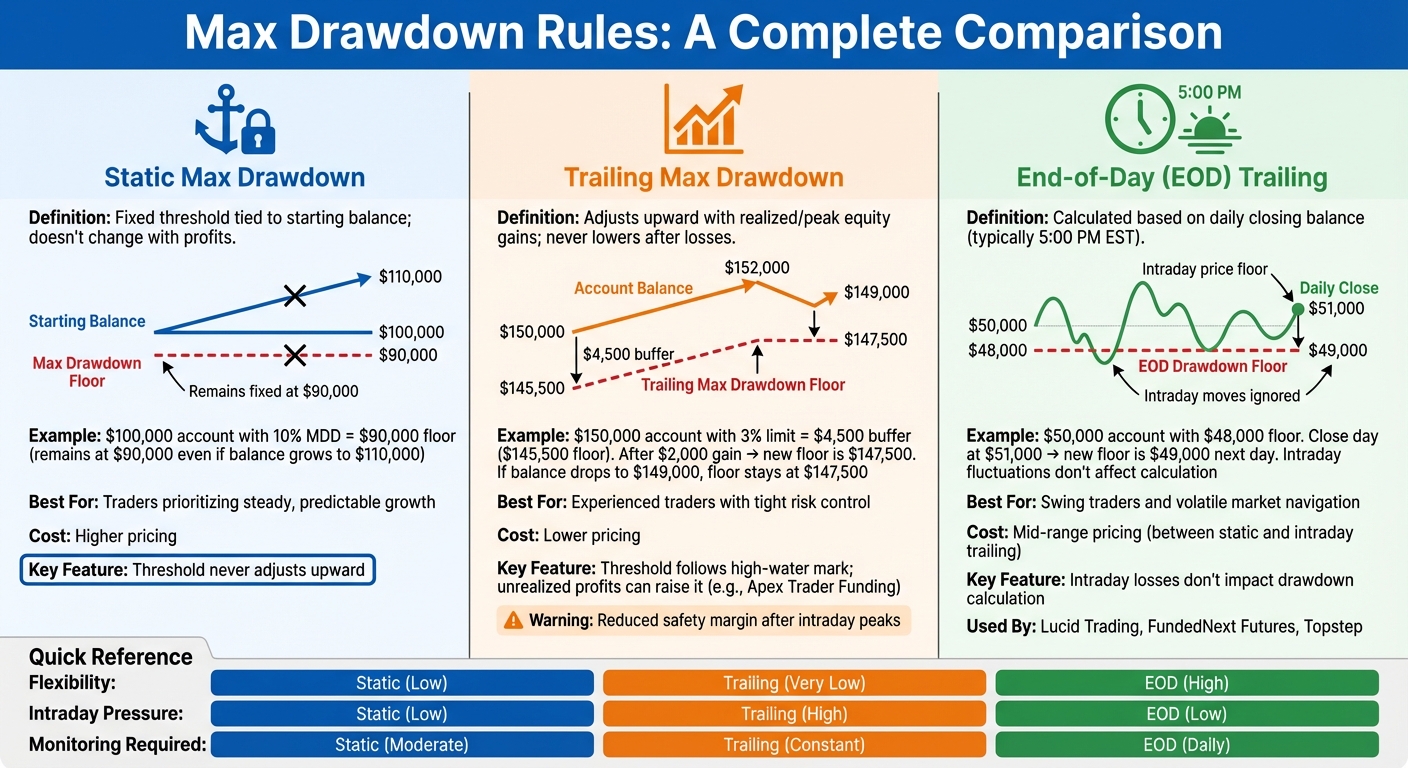
Three Types of Max Drawdown Rules in Futures Prop Trading Compared
Futures prop firms rely on three main types of max drawdown rules, each shaping how traders manage risks and approach their strategies. Picking the wrong type of account for your trading style can set you up for avoidable failures. Here’s a breakdown of these rules, complete with examples and detailed prop firm guides to show how they work in practice.
Static Max Drawdown
With static drawdown, the loss threshold stays fixed at the initial account balance for the entire evaluation or funded period. For instance, if you start with a $100,000 account and the drawdown is capped at 10%, your limit is $90,000. Even if your balance grows to $110,000, the threshold doesn’t change – it remains at $90,000. Any losses must be recovered to the original balance before you can build a larger cushion for further gains.
This setup is ideal for traders who prioritize steady and predictable growth. However, static drawdown accounts are generally priced higher.
Trailing Max Drawdown
Trailing max drawdown adjusts based on your account’s realized equity gains, following a high-water mark. However, it doesn’t drop back down when losses occur. For example, with a $150,000 account and a 3% trailing limit, your initial buffer is $4,500, setting the floor at $145,500. If you make a $2,000 realized gain, raising the balance to $152,000, the drawdown threshold moves up to $147,500 (calculated as $152,000 − $4,500). If your balance later falls to $149,000, the threshold stays at $147,500, leaving just $1,500 in cushion. Falling below $147,500 would breach the limit and close your account.
Timing is a critical factor here. For instance, Apex Trader Funding adjusts the drawdown based on the highest intraday balance. Even unrealized profits can raise the threshold. Let’s say you’re up $1,000 on an open trade, but the position reverses before closing, leaving you with a smaller gain or a loss. The elevated drawdown limit remains, reducing your safety margin permanently.
While this real-time adjustment makes trailing drawdown accounts a lower-cost option, they demand careful management of open trades.
End-of-Day Trailing Drawdown
End-of-day (EOD) trailing drawdown works differently – it’s calculated based on the day’s closing balance, typically at 5:00 PM EST. For a $50,000 account with an initial $48,000 drawdown limit, if you end the day with a balance of $51,000, the new threshold rises to $49,000 for the next trading day.
This model allows for temporary intraday losses without impacting the drawdown calculation. For example, a trader could be up $5,000 mid-day, experience a $2,000 pullback, and still close with a $3,000 net gain. Only the final closing balance is used to adjust the drawdown.
Firms like Lucid Trading, FundedNext Futures, and Topstep use the EOD model to give traders more flexibility. This approach is particularly helpful for swing traders or those navigating volatile markets, as it reduces the pressure of constant intraday monitoring. EOD accounts typically fall in the mid-range for pricing – cheaper than static accounts but more expensive than intraday trailing ones.
How Max Drawdown Rules Affect Risk Management
When it comes to managing risk, understanding the nuances of static, trailing, and end-of-day drawdown models is critical. These models directly impact how much risk you can take per trade, how quickly you can scale up, and which strategies align with your prop firm’s rules without breaching account limits.
Adjusting Position Sizes to Stay Compliant
A common guideline among traders is to risk no more than 1% of your account balance per trade. However, during evaluation phases, many opt for a more conservative 0.5% to create a buffer. The formula for calculating position size is straightforward:
Position Size = (Account Balance × Risk %) ÷ Stop Loss Distance
For futures traders, you’ll need to multiply by the contract’s point value. For example, the S&P 500 ES contract is worth $50 per point. Let’s break it down with numbers:
- Account Balance: $100,000
- Risk: 0.75% ($750 per trade)
- Stop Loss: 10 points
The calculation would look like this:
($100,000 × 0.0075) ÷ 10 = 0.75 contracts.
Since you can’t trade partial contracts, you’d round to 1 contract. If the stop loss widens to 15 points due to market volatility, the position size would need to decrease to stay within the $750 risk limit.
Take Sarah Chen’s example. In February 2026, she passed her FTMO $100,000 Challenge by sticking to these principles. By risking 0.75% per trade, maintaining a 58% win rate, and following a 1:2 reward-to-risk ratio, she kept her losses capped at $750 per trade. This disciplined approach helped her earn $10,847 in Phase 1, $5,340 in Phase 2, and eventually secure monthly profits between $8,000 and $12,000 as a funded trader.
For markets with higher volatility, an ATR-based method can help you adapt:
Position Size = (Account Balance × Risk %) ÷ (2 × ATR)
This formula adjusts for changing conditions, ensuring your risk stays consistent. If your account approaches 70% of the maximum drawdown threshold, it’s often wise to stop trading altogether to protect your capital.
"95% of prop firm evaluation failures come from poor risk management, not bad trading strategies." – dealpropfirm.com
This structured approach to sizing positions helps traders operate within strict drawdown rules while maintaining flexibility.
How MDD Rules Affect Trading Styles and Scaling
Trailing drawdown models can be a challenge for traders looking to scale aggressively. Unlike static drawdown accounts, where profits create a larger safety net, trailing drawdown thresholds rise with your account balance and don’t fall back after losses. This means profits increase the liquidation threshold, leaving less room for error.
Mike Rodriguez learned this the hard way. After failing three Topstep $50,000 Combines due to poor risk management and misunderstanding trailing drawdown, he adjusted his strategy in February 2026. By limiting his risk to 0.6% per trade (around $300) and using a position size calculator for every entry, he passed his fourth attempt in just 22 days. With a $3,180 profit and a 60% win rate, he stayed well within 50% of his maximum drawdown limit.
Scalpers face unique challenges with intraday trailing drawdowns since every open trade affects equity in real time. In contrast, end-of-day models – used by firms like Lucid Trading, FundedNext Futures, and Topstep – are more favorable for swing traders. These firms only evaluate balances after the market closes, allowing for more breathing room.
One key rule: Don’t increase position sizes after a winning streak. Keeping your risk percentage steady (between 0.5% and 1%) allows your dollar risk to grow naturally as your account grows. Remember, a 20% loss requires a 25% gain just to break even, so consistency is critical.
Real-time monitoring and adjusting strategies are essential to stay within drawdown limits.
Monitoring and Managing Risk
Tracking your account in real time is especially important under intraday trailing drawdown rules. Always use server-side hard stops instead of mental stops to avoid losses caused by technical errors or emotional decision-making. Additionally, closing positions 30 minutes before high-impact news events, like FOMC or NFP announcements, can prevent slippage that exceeds your stop loss.
Setting daily loss limits is another smart move. Many traders stop trading once they hit 50–60% of their daily loss limit. For example, after a 1% daily loss, some reduce position sizes by 50%, and if losses reach 2%, they stop trading entirely. Research shows that "revenge trading" – where traders increase position sizes to recover losses – accounts for 60% of breached evaluations.
Another layer of complexity comes from the Consistency Rule. Many firms cap single-day profits at 20–35% of the total profit target. While exceeding this cap doesn’t cause account failure, it increases the overall profit needed before a payout can be requested. Tools like DamnPropFirms’ Consistency Rule Calculator can help you track daily profit thresholds, ensuring your wins are spread out instead of relying on a few big trades.
For traders managing multiple accounts, firms like Apex Trader Funding allow up to 20 accounts with a combined scaling potential of $6 million. Using trade copying platforms can synchronize risk management across all accounts, preventing a single mistake from affecting your entire portfolio.
How to Adapt Risk Management to Prop Firm Rules
Adjusting your trading strategy to align with a prop firm’s max drawdown rules can be the deciding factor between successfully passing an evaluation and losing your account. Each firm has its own unique set of rules, so understanding these before you place your first trade is crucial. This knowledge allows you to fine-tune your risk buffers and make the most of the available tools within the firm’s parameters.
Understanding Firm-Specific Rules
When it comes to drawdowns, firms often follow different models, requiring traders to adapt accordingly. For example, Apex Trader Funding uses an unrealized trailing drawdown system. This means the drawdown is based on your highest intraday equity peak. Even if a trade closes at a lower point, the system still "remembers" the peak. On a $50,000 account, the liquidation point starts at $48,000. If you make a $100 profit, pushing your equity to $50,100, the threshold moves up to $48,100. If your equity dips below this level at any point – even intraday – you lose the account.
On the other hand, firms like Lucid Trading, FundedNext Futures, and Topstep use end-of-day (EOD) trailing drawdowns. These only update after the market closes, offering swing traders more flexibility during intraday fluctuations. Meanwhile, Tradeify provides instant funding with specific static or trailing drawdown limits, which you can review on their page. To compare these variations – like intraday versus EOD drawdown models – check out the verified reviews on DamnPropFirms.
Calculating Personal Risk Buffers
To avoid hitting a firm’s hard drawdown limit, it’s smart to establish your own personal loss threshold. A common strategy is to limit your risk to 50% of the firm’s maximum drawdown (MDD). For instance, on a $10,000 account with a 5% MDD, you would set your personal loss cap at $250. This can be calculated using the formula:
Personal Buffer = (Firm MDD % × Account Size) × 0.5
For accounts with trailing drawdowns, it’s crucial to monitor daily equity peaks. Let’s say your account grows to $102,000, and the firm’s drawdown limit is 4% below the peak ($98,000). In this case, you might set your personal stop at $99,000. This approach reduces your risk of breaching the limit while accounting for factors like slippage, commissions, or sudden volatility. Conservative traders often stick to personal limits of 2–4%, scaling down position sizes as they approach their buffer. If you hit 70% of your personal threshold during a trading session, it’s worth considering stepping away for the day.
Using Tools for Risk Management
Once you’ve set your risk buffer, take advantage of tools to help you maintain discipline. For example, the Consistency Rule Calculator from DamnPropFirms allows you to simulate max drawdown scenarios before risking real capital. By entering your firm’s specific rules – like Apex’s trailing MDD or Take Profit Trader’s thresholds – you can see how different position sizes impact your buffer.
Additionally, use your trading platform’s alert system to stay on top of your risk. Set notifications to trigger when you reach 80% of your MDD threshold, giving you an early warning to adjust. If you’re managing multiple accounts – Apex allows up to 20 accounts with $6 million in combined funding – tools like TradeSyncer can help synchronize risk management across all positions. This prevents a single mistake from snowballing into larger losses. Lastly, track your largest daily profits against the firm’s consistency rule (usually 20–35% of total profits) to ensure steady gains and avoid delays in payouts.
What Happens When You Breach Max Drawdown Rules
Penalties for Breaching MDD
If you exceed the max drawdown (MDD) limit, the consequences are immediate and severe. Your trading account is terminated on the spot, cutting off access to funded capital. Any open positions are liquidated without warning or a grace period.
In addition to losing your account, you also lose any eligibility for payouts. For those in an evaluation phase, breaching the MDD wipes out all progress, forcing you to restart the challenge from scratch. However, it’s worth noting that traders are not held personally responsible for losses beyond the initial evaluation fee.
To regain a funded account, you’ll typically need to pay for a new evaluation or reset your account. Reset fees vary by firm – for instance, some charge $40 for a $50,000 account or $104 for a $150,000 account. Activation fees after evaluation can range from $83 to $169. It’s also important to keep in mind that only about 5% of traders in funded programs manage to achieve consistent profitability. To steer clear of these penalties, maintaining strict risk management is critical.
How to Avoid Breaching MDD Rules
Effective risk management is the cornerstone of avoiding MDD breaches. Building on earlier strategies like adjusting position sizes and monitoring risk, here are additional steps to help you stay within limits.
- Set Personal Loss Limits: Establish a daily loss cap that’s 30%-50% below the firm’s MDD threshold. For example, if your drawdown limit is $2,000, consider setting a hard stop between $1,000 and $1,400. This buffer accounts for slippage, commissions, and market volatility.
- Adjust After Losing Streaks: If you face two or three consecutive losing days, immediately reduce your position size or take a break from trading.
- Use Bracket Orders: One-cancels-the-other (OCO) orders can automate your exits and help control risk effectively.
If intraday trailing drawdowns are particularly difficult to manage, consider firms with end-of-day (EOD) trailing rules. Firms like Lucid Trading, FundedNext Futures, or Alpha Futures evaluate your account balance only after the market closes, giving you more flexibility during the trading day.
Another helpful tip: close all positions before the market closes. This practice shields you from overnight volatility, which could otherwise trigger an MDD breach while you’re away from your screen. By sticking to these strategies, you can better manage your risk and protect your trading account.
Conclusion
Max drawdown rules are a key part of managing risk in futures prop trading. Understanding the differences between static, trailing, and end-of-day drawdown models can help you choose a firm that aligns with your trading style and risk tolerance. These rules complement the strategies discussed earlier, such as adjusting position sizes, maintaining personal loss buffers, and keeping a close eye on your equity in real time to stay within compliance.
For successful traders, these rules act as strategic safeguards. By limiting risk to 1–2% per trade and using stop-loss orders, they protect their accounts from being closed prematurely. It’s worth noting that 90% of success in prop trading comes down to mindset and discipline, not just technical strategies.
If you’re finding intraday trailing drawdowns particularly challenging, firms like Lucid Trading and FundedNext Futures might be a better fit. Their end-of-day evaluation models allow for more flexibility, giving you the chance to recover from intraday fluctuations without putting your account at risk.
DamnPropFirms offers a range of tools to help you navigate the specific rules of different firms. You can use the free Consistency Rule Calculator to check payout eligibility, compare drawdown models for different firms like Apex Trader Funding, Take Profit Trader, and Topstep, and access in-depth guides to understand complex trading mechanics. Plus, with over 3,000 traders in the Damn Good Traders Discord community, you’ll find plenty of support as you fine-tune your approach to risk management.
FAQs
How do I know which drawdown type fits my trading style?
When deciding on a drawdown type, think about how it matches your trading style. Fixed drawdowns set firm risk limits, making them a great choice for traders who value discipline and steady control. On the other hand, trailing drawdowns adjust as your account grows, offering more flexibility and a dynamic approach to risk. Weigh your need for strict control against the desire for adaptability to find the option that best complements your strategy.
Should I size trades off account balance or remaining drawdown buffer?
When managing trades, it’s often smarter to base your position sizes on your remaining drawdown buffer instead of your total account balance. Why? This method helps you manage risk more effectively, stay compliant with prop firm rules, and reduce the chance of early account termination. By focusing on the drawdown buffer, you’re aligning your risk strategy with your account’s current condition, which helps protect your profits and limit losses during challenging periods.
How can I avoid raising a trailing drawdown with unrealized gains?
Managing trades carefully is key to avoiding issues with a trailing drawdown when dealing with unrealized gains. To stay within the limits set by your prop firm, keep a close eye on your open positions. If necessary, adjust your position sizes and consider locking in profits before hitting the drawdown threshold. It’s also crucial to fully understand your firm’s specific rules regarding unrealized gains and trailing drawdowns to avoid any potential account restrictions.