
Consistency rules in trading evaluations are often misunderstood, leading to failed challenges or payout delays. These rules aren’t just about hitting profit targets – they assess how profits are earned and distributed. Many prop firms enforce limits, like capping the percentage of profits from a single trading day (e.g., 30%), requiring consistent lot sizes, or mandating a minimum number of trading days. Missteps, such as uneven trade sizes or strategy changes, can result in stricter requirements or disqualifications, even if profit goals are met. Understanding firm-specific guidelines is key to success. Tools like the Consistency Rule Calculator can help traders stay compliant.
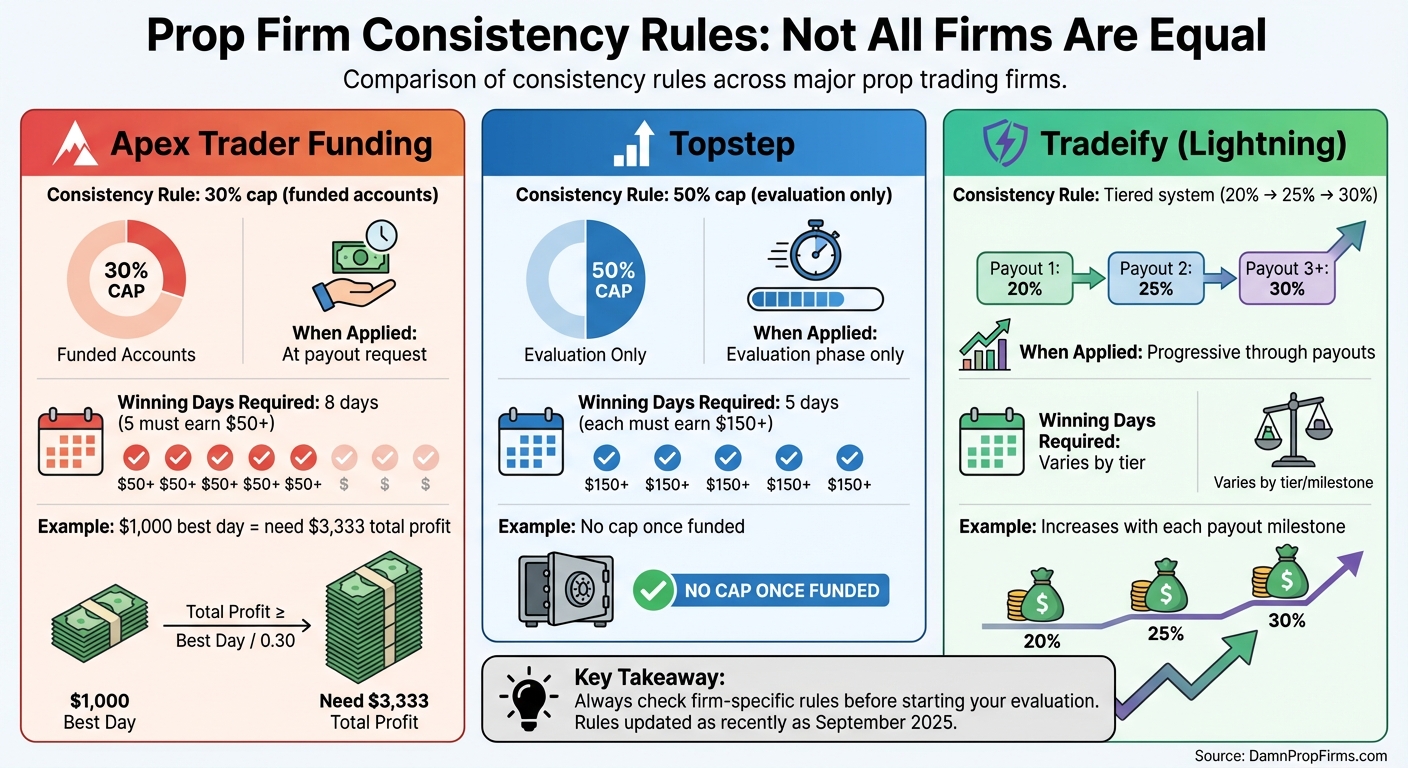
Prop Firm Consistency Rules Comparison: Apex vs Topstep vs Tradeify
Prop Firm 20% Consistency Rule Explained!
1. All Prop Firms Use the Same Consistency Rules
It’s a common misconception that all prop firms follow the same consistency rules. But the reality? What passes at one firm might not fly at another.
Take Apex Trader Funding as an example. They enforce a 30% rule for funded accounts – your biggest winning day can’t make up more than 30% of your total profit when you request a payout. So, if you have a $1,000 winning day, your total profits need to hit about $3,333 to meet the rule. On the other hand, Topstep applies a 50% consistency rule, but only during the evaluation phase. Once you’re funded, the consistency cap disappears entirely. These differences underline the importance of carefully reading each firm’s guidelines before diving in.
Other firms mix things up even more. For example, Apex requires eight winning days (with at least five earning $50 or more) to qualify for payouts. Topstep, however, only asks for five winning days, but each must bring in $150 or more. Then there’s Tradeify, which uses a tiered system for its Lightning accounts – the consistency rule starts at 20%, then increases to 25%, and finally 30% as you progress through payouts.
"Apex’s 30% consistency rule can delay payouts after a single strong trading day." – Team Topstep
These variations make it clear: not all prop firms are created equal. Understanding these rules allows you to pick a firm that aligns with your trading style, shattering the myth that consistency rules are the same across the board.
Before starting your evaluation, dig into the specifics of your chosen firm. Resources like DamnPropFirms provide detailed breakdowns of consistency requirements for major firms like FundedNext Futures and Take Profit Trader. Keep in mind that rules often change – Tradeify, for instance, updated theirs as recently as September 12, 2025. Always check the latest terms before you start trading.
2. You Can Only Fail by Hitting Drawdown Limits
A common misconception among traders is that only drawdown limits lead to evaluation failure. While staying within drawdown limits and hitting profit targets might seem like a guaranteed path to success, that’s not always the case. Prop firms often have strict rules about consistency, and breaking these can result in rejection – even if other criteria are met.
For example, in November 2025, trader Ngan Pham hit the profit target at Topstep but still failed the evaluation. Why? A single high-probability trade with a larger position size accounted for nearly 70% of the day’s profit target. Topstep rejected the evaluation, citing "inconsistent profit distribution", as the best-performing day exceeded their 50% limit. This highlights how firms prioritize steady, consistent performance over sporadic big wins.
Uneven trade sizes can also signal issues with risk management. For instance, trading 10 contracts one day and just 0.5 the next suggests inconsistency rather than a reliable strategy. Firms like FTMO and Seacrest Funded enforce rules to keep position sizes within a specific range – usually no more than twice your average lot size.
"A single, large win, however skillful it may seem, is viewed by prop firms as an indicator of high-risk behavior, not a sustainable strategy." – Ngan Pham, Content Creator
At firms such as Tradeify, breaking the consistency rule can lead to tougher requirements. For instance, if your best day generates $2,500 under a 20% rule, your total profit target increases to $12,500 before you can request a payout. While the account remains active, you’ll need to continue trading until your profit distribution aligns with their standards.
3. Hitting Profit Targets Quickly Doesn’t Break Consistency Rules
Traders often assume that hitting profit targets quickly reflects skill, but prop firms view this differently. Making rapid gains with large, inconsistent trades can violate consistency rules, even if you’re profitable. Prop firms care about how you make money, not just the amount. That’s why they enforce rules to cap daily profit contributions.
One common rule is the "Maximum Daily Profit" limit, which restricts how much of your total profit can come from a single day. These thresholds usually range between 20% and 50% of your cumulative profits. For instance, under a 30% rule, if you earn $1,000 on your best trading day, your total profit must reach at least $3,333 for that day to comply. Until then, you’ll need to focus on smaller, consistent wins to balance the daily profit ratio.
Uneven position sizing is another issue that raises red flags. Jumping from one contract to ten in pursuit of quick gains suggests poor risk management. Firms like FundedNext Futures enforce rules that keep lot sizes consistent, typically allowing no more than double your average size. Sudden spikes in leverage resemble gambling rather than a sound trading strategy. As PropFirmHero explains:
"Traders who generate profits spread across many days demonstrate repeatable skill, not just a lucky moment. That matters to firms writing checks."
Even if you hit your profit target within a few days, most firms require a minimum number of active trading days – usually between 5 and 10 – to prove your strategy is sustainable. A single big trade doesn’t demonstrate consistency; it highlights risk-taking. These rules act as behavioral filters, helping firms avoid funding traders who might blow their accounts with one overleveraged position. Ultimately, sustainable performance is what prop firms value most.
To stay compliant and avoid these pitfalls, focus on disciplined trading. Opt for smaller, frequent trades instead of chasing one massive win. Spread your profits across multiple sessions for a more balanced equity curve. Keep your risk steady by maintaining consistent position sizes, whether measured in dollars or percentages. Tools like the Consistency Rule Calculator at DamnPropFirms can help you monitor your "best day" ratio and ensure you meet your firm’s specific requirements before requesting a payout.
sbb-itb-46ae61d
4. Changing Strategies Mid-Evaluation Is Acceptable If You’re Profitable
Some traders believe that making a profit is all that matters when switching strategies mid-evaluation. But for prop firms, it’s not just about the money you make – it’s about how you make it. Consistency is key. While steady profit distribution is crucial, sticking to a uniform trading approach is just as important. Abruptly changing your strategy, even if it results in profits, can violate a firm’s consistency rules and lead to a failed evaluation.
One major red flag is sudden shifts in lot sizes. For instance, if you start an evaluation trading one contract and then jump to five contracts to hit your profit target faster, firms might view this as reckless. These sudden changes can appear more like gambling than disciplined trading. Fred Harrington, Founder of Vetted Prop Firms, sums it up perfectly:
"The evaluation is testing your trading behavior, not just your profits."
Most firms require lot size variations to stay within a 10–20% range. Exceeding this limit – even if the trades are profitable – can void your evaluation entirely.
But it’s not just about position sizing. Evaluations are designed to determine if your profits come from a repeatable system or just sheer luck. If you start with a swing trading approach but later switch to aggressive scalping, or if you suddenly risk 5% per trade instead of your usual 1%, it signals a lack of discipline. As MyFundedFutures explains:
"Consistency rules separate professional traders from gamblers who happened to catch one lucky break."
Prop firms want traders who can deliver steady results across various market conditions. They’re wary of those who change tactics just to speed up their profits. Even if you hit your profit target, erratic strategy shifts can lead to serious consequences. Some firms might raise your profit target if they detect inconsistent behavior, while others could freeze your payout requests until you demonstrate stable trading. In the worst-case scenario, your evaluation might be disqualified entirely – regardless of your account balance. Failing to stick to your plan during the evaluation process raises doubts about your ability to handle real capital.
To steer clear of these pitfalls, keep your risk parameters stable throughout the evaluation. Maintain consistent position sizes, risk the same percentage per trade, and stick to the strategy you started with. If you’re tempted to take bigger risks near the end, remember that firms prioritize discipline over speed. The goal isn’t just to pass the evaluation – it’s to prove you can trade responsibly with someone else’s capital.
For more tips and tools, including a Consistency Rule Calculator, check out DamnPropFirms.
5. Consistency Rules Only Matter During Evaluations
A common misconception among traders is that consistency rules vanish once they pass an evaluation and secure funding. In reality, several prominent prop firms continue to enforce these rules on funded accounts. Breaking them can lead to frozen payouts or even account termination.
Take Apex Trader Funding, for instance. They require that your best trading day accounts for no more than 30% of your total profits. Similarly, Tradeify has a sliding scale for its Lightning accounts (introduced after September 12, 2025): 20% at the first payout, increasing to 25% and then 30%. Meanwhile, MyFundedFutures enforces a 40% limit for their Starter Plan. These rules are in place to ensure that even funded traders stick to risk management protocols.
If your best day exceeds the allowed percentage, most firms will pause withdrawals until you bring the ratio down by trading further. This "dilution" process compels you to keep trading, which can increase the risk of hitting drawdown limits. Unfortunately, some traders, eager to fix their ratios, fall into overtrading or revenge trading, which can lead to losing their funded accounts entirely.
On the other hand, not all firms extend these rules beyond the evaluation phase. Topstep and Take Profit Trader, for example, only apply consistency requirements during the challenge phase. To avoid surprises, always review the fine print of your firm’s policies before requesting your first payout. Tools like the Consistency Rule Calculator can help you monitor your performance and ensure you stay within the required percentage.
Fred Harrington, Founder of Vetted Prop Firms, sheds light on why these rules matter even for funded traders:
"Firms aren’t just funding traders – they’re managing risk. A trader who scores big in one trade could easily blow an account the next day."
To align with these expectations, adopt disciplined trading habits for funded accounts. Focus on smaller, more frequent trades, maintain consistent risk percentages, and steer clear of high-volatility trades influenced by news events. The objective isn’t just to pass the evaluation – it’s to demonstrate that you can handle real capital responsibly over the long haul.
Conclusion
Consistency rules create structured, repeatable strategies that help traders transition into working with real capital. The five misconceptions we’ve discussed highlight why less than 1% of participants typically advance to the live-capital stage. The problem isn’t always about generating profits – it’s often about misunderstanding or disregarding the rules that distinguish professional trading from gambling.
These rules aren’t one-size-fits-all. They differ widely between firms and cover more than just drawdowns. Many firms even extend these guidelines into the funded trading phase. For instance, firms like Tradeify implement tiered scaling systems, Apex Trader Funding enforces a 30% cap, and FundedNext Futures has specific threshold requirements.
Before diving into your next evaluation or requesting a payout, consider using the Consistency Rule Calculator on DamnPropFirms to double-check your numbers. You can also find in-depth reviews of firms like Take Profit Trader, Alpha Futures, and Topstep to understand their unique expectations before committing. These steps not only help you meet firm-specific requirements but also contribute to building a sustainable trading career.
The traders who thrive long-term are those who view consistency rules as training tools, not roadblocks. Success comes from disciplined and measured trading. To take your strategy to the next level, consider joining the Damn Good Traders Discord community. With over 3,000 members, it’s a hub for traders sharing insights, tips, and updates to help you grow your trading career.
FAQs
What counts as a “best day” for a consistency rule?
A "best day" under a consistency rule refers to the single day with the highest profit during a trading period. Many proprietary trading firms cap this at a certain percentage of total profits – usually between 20% and 50% – to promote steady performance rather than relying on a single standout day. Be sure to review your firm’s specific guidelines, as these percentages can differ.
How do I fix my consistency ratio without overtrading?
To keep your consistency ratio in check while avoiding overtrading, aim for steady, disciplined trading practices. Instead of chasing massive gains in a single session, distribute your profits across several days. This approach not only reduces pressure but also aligns with the typical percentage threshold (often 20-40%) set by most prop firms for your best trading day. Regularly evaluate your performance and focus on managing risk effectively to maintain a balanced approach.
Do consistency rules still apply after I’m funded?
Consistency rules don’t stop applying once you’re funded. Prop firms enforce these rules to make sure traders remain disciplined and maintain steady performance over time. The goal is to prevent reliance on just a handful of highly profitable days, encouraging responsible trading habits and setting traders up for long-term success.