Partial exits in futures trading involve closing parts of your position at predetermined price levels. This strategy helps manage risk, lock in profits early, and reduce emotional stress during trades. While it can slightly lower maximum potential profits, it improves consistency, reduces drawdowns, and boosts risk-adjusted returns. Here’s a quick overview:
- Pre-Entry Planning: Decide position size, set risk limits (e.g., 1–2% of account value), define profit targets (e.g., 1:1 reward-to-risk ratio), and establish stop-loss levels.
- Trade Execution: Ensure entry signals align with your plan, allocate contracts for exit tranches, and adjust stop-losses after hitting targets.
- During Trade: Take partial exits at key levels (e.g., ATR multiples or Fibonacci extensions), trail stops for remaining positions, and monitor market signals for reversals.
- Post-Exit Review: Log planned vs. actual exits, analyze market conditions, and refine your strategy based on results.
This approach works well with prop firm rules, ensuring compliance with drawdown and profit consistency requirements. While partial exits add complexity and costs, they offer a structured way to manage trades effectively.
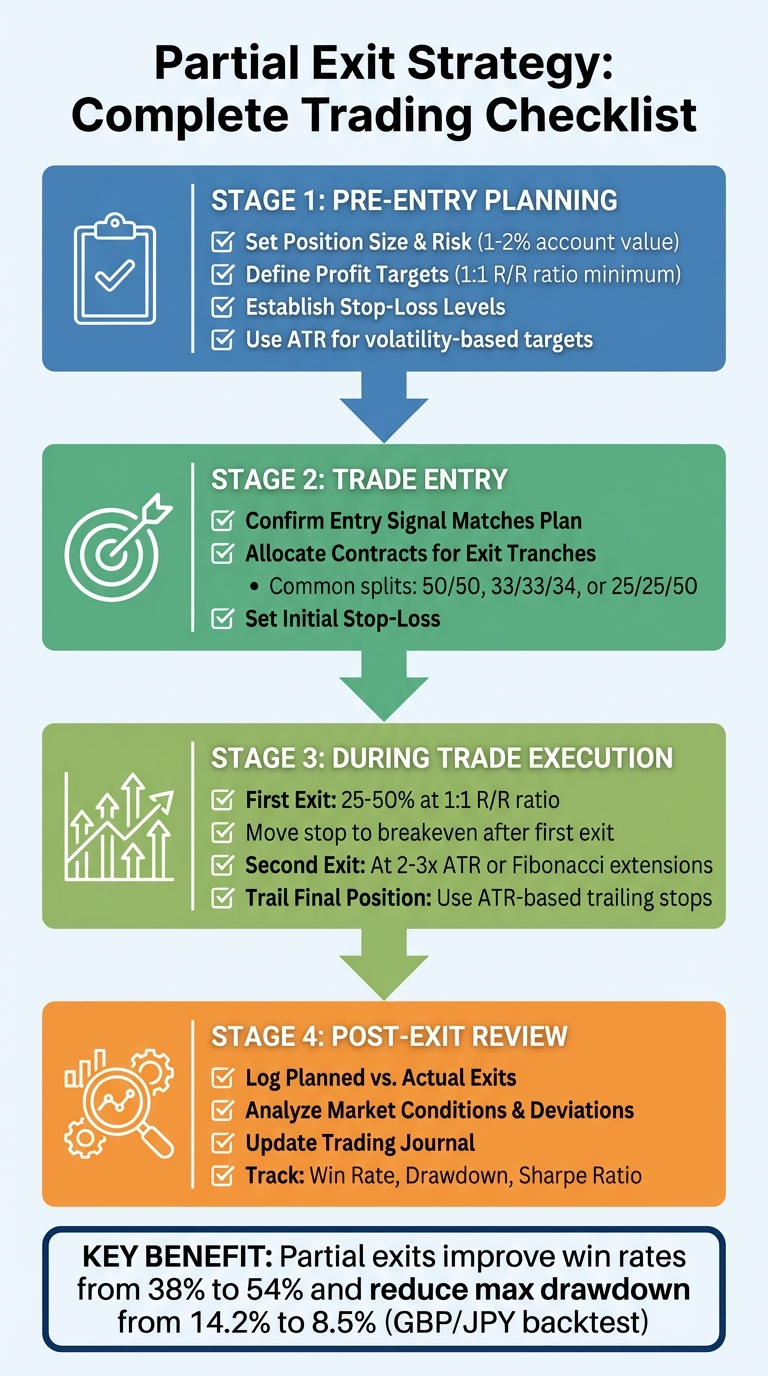
4-Stage Partial Exit Trading Checklist for Futures Traders
Learn 2 Trade | How to Use Partial Closes: Lock In Profits & Manage Risk Like a Pro
Pre-Entry Planning Checklist
Having a solid pre-entry plan is key for managing risks and executing partial exits effectively in futures trading. The best traders treat positions as flexible, adjusting them as the market evolves. That adaptability starts with proper preparation before you even enter a trade.
Set Position Size and Risk Parameters
Start by deciding how many contracts to trade based on your account size and how much risk you’re comfortable taking. A common guideline is to limit risk to 1–2% of your total account value per trade. For instance, if you have a $50,000 account, that means risking between $500 and $1,000 on a single trade.
If you have a smaller account, Micro futures (like MES or MNQ) are a great option because they allow for partial exits. Standard contracts don’t give you that flexibility since you can’t scale out of a single unit. For a $50,000 account, you could trade 3–5 Mini contracts or 9–10 Micro contracts.
For traders using a prop firm, it’s important to understand how their drawdown models work – whether it’s End-of-Day (EOD) or Intraday – and whether there are rules requiring profits to be spread across multiple trading sessions.
Once you’ve nailed down your position size and risk limits, the next step is to set clear profit targets for your partial exits.
Define Profit Targets and Exit Levels
After determining your position size, map out specific price levels where you’ll lock in profits. Many professional traders use the 1:1 Reward-to-Risk (R/R) ratio as a benchmark: take 33% to 50% of your position off the table once your profit matches the amount you initially risked. For example, if your risk is $500, your first partial exit would be at a $500 profit.
Market volatility is another factor to consider. The Average True Range (ATR) indicator can help you gauge how much the market typically moves over a set period, giving you realistic profit targets. In calmer markets, you might aim for a smaller ATR multiple for your first exit, while in more volatile conditions, you could widen the target to 2× or 3× ATR to avoid getting stopped out too early.
You can also use technical tools to fine-tune your targets. Fibonacci extensions help identify potential resistance levels where trends might lose momentum. Volume Profile highlights price levels with heavy trading activity – ideal spots for partial exits. Additionally, indicators like RSI or Bollinger Bands can signal when a market move is overextended, providing opportunities to take profits before a reversal.
Finally, make sure to set precise stop-loss levels to protect your capital.
Set Stop-Loss Placement
Your stop-loss should align with your risk tolerance and adjust as the trade progresses. Once you hit your first profit target, move your stop-loss to breakeven to protect your remaining position. This way, even if the market turns against you, the worst-case scenario is breaking even.
"By mastering partial exits, you transform your strategy from a rigid bet into a dynamic risk-mitigation tool".
Volatility also affects stop-loss placement. In highly volatile markets, consider widening your stop-loss to 2× the usual range and cutting your position size by 50%. This reduces the chance of being stopped out by normal market fluctuations while still safeguarding your capital from significant losses.
Trade Entry Checklist
After careful pre-entry planning, executing your trades with discipline is key to making your partial exit strategy work. Many traders stumble here – letting emotions take over or failing to stick to their planned approach. A structured checklist can help you stay focused and set the stage for a successful trade.
Confirm Entry Signal Matches Plan
Before entering a trade, check that your entry signal aligns with your pre-established criteria. Use technical filters like RSI, ATR, or price action patterns to validate the signal. Don’t forget to consider the broader market context. For instance, look for volume spikes that indicate heightened market interest, evaluate the trend’s strength, and time your entry carefully. The "Power Hour" between 3:00 PM and 4:00 PM ET is often a great window for entries due to increased volatility and liquidity. If your signal arises during a low-volume period or contradicts the market trend, it might be wise to hold off and wait for a better setup.
To minimize emotional decision-making, think about automating your entry process. Tools like Pine Script, Python, or MQL can help you predefine entry logic and set multiple take-profit orders, ensuring your partial exit plan is followed precisely.
Once your entry signal checks out, it’s time to allocate your position into exit tranches.
Allocate Contract Quantities for Exit Tranches
After entering a trade, divide your position into specific tranches for partial exits. Keep in mind that futures contracts can’t be split into fractions – each order must involve at least one full contract.
A popular method among seasoned traders is the 1:1 reward-to-risk (R/R) framework. For example, you could exit 50% of your position once your profit equals your initial risk. If you’re trading 4 contracts, you might close 2 at the first target, 1 at the second, and hold the last as a "runner" with a trailing stop. Other common splits include dividing positions into thirds (33/33/34) or quarters (25% increments).
Here’s a quick comparison of allocation strategies:
| Allocation Strategy | Tranche 1 | Tranche 2 | Tranche 3 (Runner) |
|---|---|---|---|
| The Simple Half | 50% (1/2) | 50% (1/2) | N/A |
| The Thirds Split | 33% (1/3) | 33% (1/3) | 33% (1/3) |
| The 25/25/50 Split | 25% (1/4) | 25% (1/4) | 50% (1/2) |
Determine your total position size based on your account size and risk tolerance, then divide it into tranches before executing the trade.
Set Initial Stop-Loss and Adjustment Rules
Protect your capital by placing an initial stop-loss as soon as you enter the trade. Use the ATR to set a stop that accounts for normal market fluctuations, reducing the chances of being stopped out too early.
When your first partial exit is hit, adjust your stop-loss to breakeven. Locking in that initial profit can ease psychological pressure and help you manage the rest of the trade with a clear head.
If you’re trading with a proprietary firm like Apex Trader Funding or Tradeify, be mindful of their strict rules. Many firms enforce daily loss limits and drawdown restrictions. To avoid slippage, aim to close all positions by 4:55 PM ET, ahead of the mandatory 4:59 PM ET close. Near the end of the session, use market orders instead of limit orders to ensure your trades are executed and comply with the firm’s requirements.
During-Trade Partial Exit Execution Checklist
When your trade is live, sticking to a clear partial exit plan can make all the difference. Following these steps ensures you manage risk and lock in profits effectively.
Execute the First Partial Exit
The first partial exit usually occurs at a 1:1 reward-to-risk ratio or when the price hits a key technical resistance level. Many traders choose to close 25–50% of their position at this point, with 50% being a common choice.
Here’s an example: Suppose you’re trading 3 Crude Oil (CL) contracts, entering at $75.00 with a $2.00 risk per contract. Your first target would be $77.00. Selling 1 contract at that level locks in enough profit to cover the risk on the entire position.
Once you’ve taken this first exit, move your stop-loss to breakeven. This adjustment protects your initial capital, turning the trade into a "risk-free" opportunity where any additional gains are pure profit.
"A common professional tactic is to move the stop-loss for the remaining contracts to the entry price (breakeven) immediately after the first scale-out target is hit. This ensures the trade becomes ‘risk-free’ in terms of initial capital." – QuantStrategy.io Team
For traders with smaller accounts, Micro futures like MES or MNQ are a good alternative. Unlike standard contracts, Micros allow for smaller, more precise partial exits.
Handle Subsequent Partial Exits
After locking in your first profit, use market signals to determine the timing of your next exits. A good rule of thumb is to aim for a second target at 2x or 3x the Average True Range (ATR), which aligns with the market’s current volatility.
Many traders use a "laddering" approach, placing sell orders at incremental levels. For instance, if your first exit was at a 1:1 ratio, your next exit might be at the 1.618 Fibonacci extension, where you close another 25% to 40% of your position.
Technical indicators like MACD and RSI can guide your decisions here. For example, consider selling when the MACD histogram starts shrinking or crosses below the signal line. Similarly, if the RSI crosses above 70, it might be a good time to take additional profits.
For those trading with a prop firm, be mindful of consistency rules. Firms like Apex limit your best trading day to 30% of total profits, while Top One Futures allows up to 45%. Exiting too much on a single large move could violate these rules and impact your payout eligibility. Check DamnPropFirms for specific firm policies to avoid surprises.
After hitting your second and subsequent targets, the focus shifts to managing the remaining "runner" position.
Trail the Final Exit
The last portion of your trade, often called the "runner", is your chance to capitalize on extended market trends. Trailing stops are key to balancing risk and reward here.
Set ATR-based trailing stops at 1.5x or 2x the ATR. This approach allows for natural price fluctuations while protecting against sharp reversals. The dynamic stop adjusts with volatility, giving your trade room to breathe.
Also, watch for RSI divergence as a potential exit signal. If the price hits a new high but the RSI forms a lower high, it could signal a weakening trend – an ideal time to close out the runner before a reversal.
"By taking partial profits, you protect your capital, soothe your psychology, and – most importantly – keep a portion of your position active for those rare, massive trend extensions." – QuantStrategy.io Team
One last tip for prop traders: Know whether your firm uses End-of-Day (EOD) or Intraday trailing drawdown. EOD trailing only updates at the market close, giving your trade more room during the day. Intraday trailing, on the other hand, adjusts in real time based on unrealized profits, which can be stricter on your account. Firms like Tradeify and FundedNext Futures have different drawdown policies, so review your firm’s rules before letting a runner develop.
sbb-itb-46ae61d
Post-Exit Review Checklist
A thorough post-exit review can turn every trade into a valuable learning experience, helping you fine-tune your partial exit strategy over time. These reviews lay the groundwork for improving your trade execution and making adjustments to your risk management approach.
Log Planned vs. Actual Exits
After executing your trade, take the time to evaluate how it played out compared to your original plan. Start by noting your planned exit price versus the actual fill price. This allows you to calculate slippage, especially during high-volume periods like the Power Hour.
Record any differences in the planned versus executed tranche percentages. Additionally, note whether you used Limit or Market orders for your exits.
If you’re trading with a prop firm, keep track of how each exit aligns with the firm’s consistency rule. For example, at Apex Trader Funding, a single trading day’s profits cannot exceed 30% of your total earnings, while FundedNext Futures sets this cap at 40%.
| Data Category | Specific Fields to Log | Purpose |
|---|---|---|
| Execution | Fill Price, Slippage (ticks/pips), Order Type | Evaluate execution efficiency and associated costs. |
| Strategy | Tranche Number, % of Position, Indicator Value (RSI/ATR) | Ensure adherence to your technical plan. |
| Risk | Realized R/R, Stop-Loss Level, Drawdown Impact | Track capital preservation and account health. |
| Compliance | % of Total Profit (Consistency), Daily Loss Status | Confirm eligibility for prop firm payouts. |
Analyze Market Conditions and Deviations
Take a closer look at any deviations during trade execution. Were these tied to emotional factors like fear or greed? Understanding these moments is key to improving discipline.
Also, review the market context at each exit. Document technical indicator values such as RSI levels, Bollinger Band positions, or ATR readings when you closed each tranche.
For traders working with funded accounts, consider how your exits impacted your drawdown floor. If your firm uses an EOD (End-of-Day) trailing drawdown, the drawdown updates only at market close based on closed P&L. However, with Intraday trailing, unrealized profit spikes can adjust the drawdown in real time, which adds a layer of risk management complexity.
"EOD trailing only updates at market close. If you’re up $2,000 intraday and your position reverses, your drawdown level doesn’t move – only your closed P&L matters. Intraday trailing moves in real time with your unrealized profits." – FundedTraderIntel
Update Trading Journal for Refinement
Use your findings to improve your trading journal entries. Focus on updating your risk management rules and refining the criteria for partial exits. For instance, if you find yourself consistently achieving your first target at a 1:1 reward-to-risk ratio but struggling with later exits, you might switch to using ATR multiples instead of fixed percentage targets.
Track metrics like your Sharpe ratio and maximum drawdown to assess whether partial exits are improving your risk-adjusted returns. Over time, this approach should help smooth your equity curve compared to an "All-In, All-Out" method.
Finally, ensure your strategy aligns with the specific rules of your prop trading firm. Stay updated on policies for firms like Tradeify, Top One Futures, and Alpha Futures, which are regularly updated on DamnPropFirms.
Integration with Prop Firm Rules
Prop Firm Compatibility
Partial exits align well with the rules set by leading futures prop firms. Firms such as Apex Trader Funding, Take Profit Trader, FundedNext Futures, and Alpha Futures allow traders to use flexible exit strategies, as long as they stay within the firm’s drawdown and consistency rules.
For traders looking for immediate access to capital, Lucid Trading and Tradeify offer instant funding accounts that support partial exits without requiring an evaluation phase. These accounts often feature trailing drawdown caps of 4–6% and profit splits ranging from 80% to 90%, enabling traders to implement multi-tranche exits right from the start.
Understanding your account’s contract limits is just as important as managing risk. For instance, an Apex $50,000 End-of-Day (EOD) Performance Account allows up to 4 contracts, which means you can plan exits in increments (e.g., 1-1-1-1). As account sizes increase, contract limits also expand – a $150,000 account allows 10 contracts for EOD models and 12 for Intraday models. Always confirm your account’s tier-specific contract limits before finalizing your exit strategy. Additionally, ensure your approach aligns with all funded account rules.
Key Considerations for Funded Accounts
Consistency rules are a major factor when managing funded accounts. For example, Apex Trader Funding enforces a 50% consistency rule, meaning no single profitable day can contribute more than 50% of your total net profit since your last payout. Tradeify applies tiered consistency rules: Lightning accounts cap at 20% for the first payout, increasing to 25% for the second and 30% for subsequent payouts. Growth Sim accounts, however, have a flat 35% consistency rule.
"The consistency rule is designed to reduce risk, prevent ‘all-in’ gambling style trades, and encourage discipline." – DamnPropFirms
Using partial exits can help spread profits across multiple trading sessions, reducing reliance on a single large win. For instance, if you trade 10 E-mini contracts on Apex, you could partially exit 4 contracts at a $500 profit. This strategy not only reduces exposure but also minimizes the risk of a full reversal that could breach your daily drawdown limit [22,23].
Firms like Apex Trader Funding have strict rules regarding consistency and drawdown, making partial exits a practical way to lock in gains and manage daily risk. Apex’s intraday trailing drawdown adjusts in real time with your peak unrealized profits and does not decrease. By locking in profits through partial exits, you can limit the increase in your trailing drawdown when the market moves against your position. Tools like the Consistency Rule Calculator on DamnPropFirms let you test various partial exit strategies to ensure compliance with firm-specific rules.
For firms without consistency restrictions – such as Lucid Trading’s LucidFlex account or FundedNext’s Legacy Challenge – there’s more freedom to let profitable trades run without worrying about daily profit caps. However, you still need to respect drawdown limits and meet minimum trading day requirements. For example, Apex requires 5 qualifying trading days and minimum profit thresholds (e.g., $200 for a $50,000 Intraday account) before you can request a payout.
Advantages and Disadvantages of Partial Exits
Partial exits play a vital role in risk management, offering both clear benefits and certain trade-offs that traders need to weigh carefully.
One of the main advantages is that partial exits allow traders to lock in gains early, which lowers the break-even point for their trades. For example, in a 12-month backtest of a GBP/JPY trend-following strategy, using a scaled exit approach (selling 50% at 1:1 and the remaining 50% at 3:1) led to some impressive results. The win rate jumped from 38% to 54%, the maximum drawdown decreased from 14.2% to 8.5%, and the profit factor improved from 1.45 to 1.62. This method transforms trades that initially show profit but later reverse into "partial wins" instead of full losses, which helps create a smoother equity curve.
On the flip side, partial exits come with some downsides. In markets with strong trends, this strategy often results in lower overall profits. Additionally, the multiple transactions involved mean higher costs due to repeated commissions, which can be particularly burdensome for smaller accounts.
"Partial exits are a tool for professional longevity, providing a statistical edge that favors the survivor over the gambler." – QuantStrategy.io Team
Another challenge is the added complexity in execution. Managing multiple exits manually can increase the likelihood of errors. To address this, many traders rely on automation or scripts to streamline the process. Even with automation, there’s still the risk of price gaps or sudden drops, where the remaining position might hit a stop-loss at a less favorable price than expected.
Comparison Table
Here’s a breakdown of how partial exits compare to all-in exits:
| Aspect | Partial Exits | All-In Exits |
|---|---|---|
| Profit Locking | Gradual; reduces reversal risk | Single point; higher exposure to reversals |
| Emotional Control | High; "house money" effect reduces stress | Prone to hesitation or trader’s remorse |
| Upside Potential | Retains a portion for trend extensions | Full exit caps maximum gain at target |
| Complexity | Requires multiple orders and active management | Simpler execution with single order |
| Win Rate | Higher; converts potential losses into partial wins | Lower; binary outcome (win or loss) |
| Transaction Costs | Higher due to multiple commissions | Lower; single set of fees |
This table highlights the trade-offs, helping traders decide which approach aligns best with their strategy and goals.
Conclusion
Partial exits bring a structured, repeatable approach to managing risk in futures trading. The checklists provided in this article guide traders through every stage of a trade – from planning before entry to analyzing results after exiting. By securing profits at predetermined levels and keeping runner contracts for potential trend extensions, traders can protect their capital while avoiding the stress of all-or-nothing decisions.
Backtesting results underscore the benefits of this disciplined approach, showing improved win rates and reduced drawdowns through consistent scaling out. This highlights the value of careful preparation and execution. By defining position sizes, profit targets, and stop-loss levels ahead of time, traders can eliminate emotional decision-making in volatile markets. During execution, using a structured checklist ensures that the initial exit at a 1:1 reward-to-risk ratio covers the trade’s risk, while trailing stops on remaining contracts take advantage of extended trends. Post-trade analysis completes the process, offering opportunities to refine strategies based on real-world outcomes.
For traders working with firms like Apex Trader Funding or Take Profit Trader, partial exits align well with rules that limit single-day profits to 25–45% of total gains.
"Risk management is boring. It’s mechanical. It removes excitement and ‘big wins’ from trading. That’s exactly why it works." – DealPropFirm
FAQs
What’s the simplest partial-exit plan for beginners?
The easiest way for beginners to implement a partial-exit strategy is by setting straightforward rules to lock in profits as the trade moves in their favor. One popular method is to close a portion of the position – say, 50% – once the trade reaches half of the target profit. The remaining position can then be managed using a trailing stop or a preset exit level. This approach helps lower risk and simplifies trade management, making it a great starting point for those new to trading.
How do I set partial-exit targets using ATR?
To determine partial-exit targets using Average True Range (ATR), start by calculating the ATR for your selected timeframe. Once you have the ATR value, multiply it by a factor that aligns with your trading strategy (for example, 1.5 or 2). Then:
- For long positions: Add the calculated value to your entry price.
- For short positions: Subtract the calculated value from your entry price.
This method adjusts for market volatility, providing a structured way to set partial-exit points.
Do partial exits help avoid prop-firm drawdown and consistency issues?
Partial exits are a smart way to manage risk, especially in unpredictable markets. They allow traders to lock in some profits while reducing their overall exposure. This strategy helps lower the chances of hitting drawdown limits or breaking the consistency rules often required by prop firms. By safeguarding trading capital and staying within the rules, partial exits help traders steer clear of penalties or even losing their accounts.