Understanding the regulatory reporting standards of futures prop firms is crucial for traders. These standards ensure risk management, compliance, and transparency in payouts. Each firm has its own rules, including drawdown models, payout structures, and consistency requirements. This article compares eight leading firms, highlighting their reporting practices, audit processes, and payout systems.
Key Highlights:
- Apex Trader Funding: Offers End-of-Day and Intraday drawdown models with a six-step payout ladder, requiring traders to follow a 50% consistency rule.
- Take Profit Trader: Provides real-time dashboards for compliance tracking, with on-demand payouts processed within 12 business hours.
- FundedNext Futures: Enforces a 2% Price Limit Rule and processes payouts within 24 hours; traders can earn up to 95% profit splits.
- Alpha Futures: Focuses on an End-of-Day drawdown system, with strict rules against prohibited trading practices.
- Tradeify: Known for fast payouts (under 60 minutes) and simple rules, with no activation fees.
- Lucid Trading: Offers real-time reporting tools and a flexible payout system with no activation fees.
- Purdia: Combines simulated trading with live brokerage accounts, requiring weekly communication with risk managers.
- Topstep: Features institutional-grade audit standards and a platform integrated with CME data, offering a 100% profit split on the first $10,000.
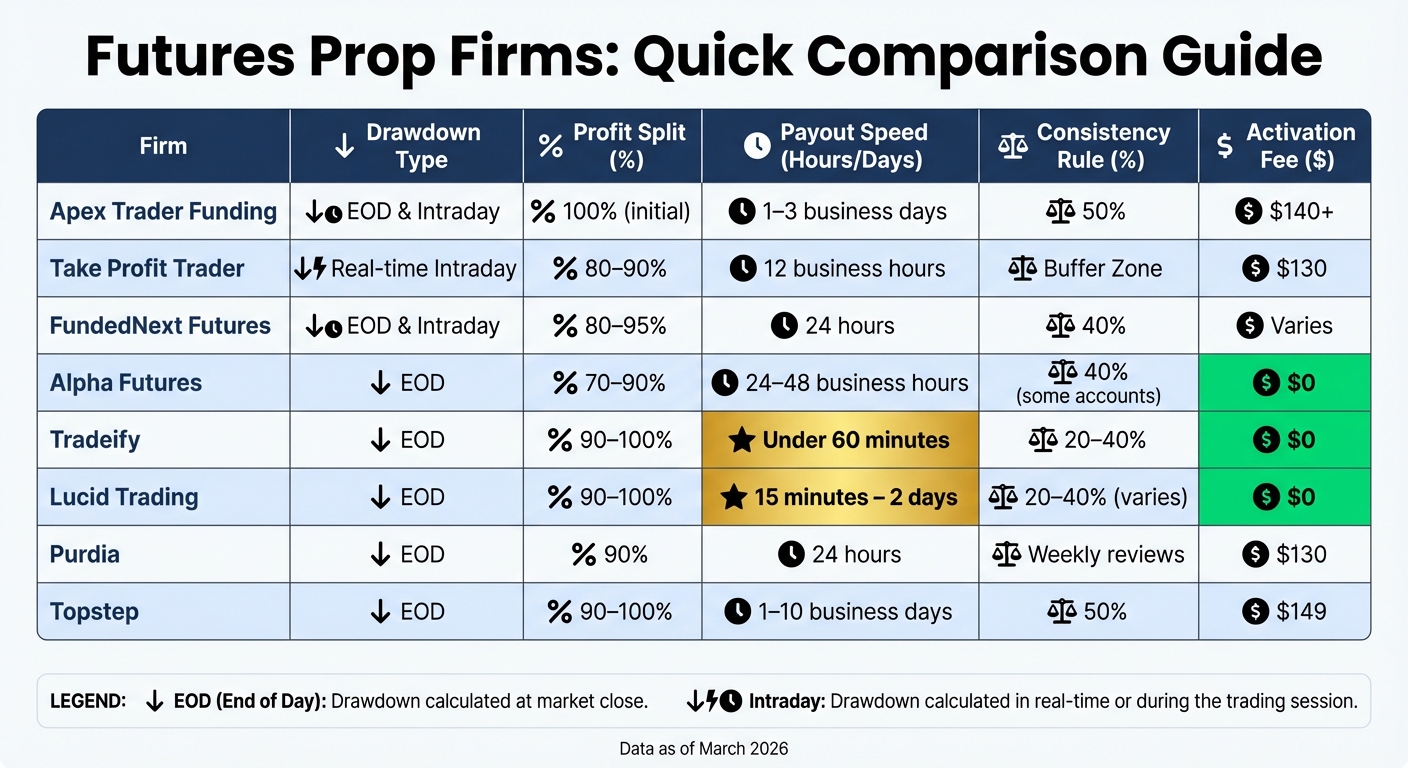
Quick Comparison:
| Firm | Drawdown Type | Profit Split | Payout Speed | Consistency Rule | Activation Fee |
|---|---|---|---|---|---|
| Apex Trader Funding | EOD & Intraday | 100% (initial) | 1–3 business days | 50% | $140+ |
| Take Profit Trader | Real-time Intraday | 80–90% | 12 business hours | Buffer Zone | $130 |
| FundedNext Futures | EOD & Intraday | 80–95% | 24 hours | 40% | Varies |
| Alpha Futures | EOD | 70–90% | 24–48 business hours | 40% (some accounts) | $0 |
| Tradeify | EOD | 90–100% | Under 60 minutes | 20–40% | $0 |
| Lucid Trading | EOD | 90–100% | 15 minutes – 2 days | 20–40% (varies) | $0 |
| Purdia | EOD | 90% | 24 hours | Weekly reviews | $130 |
| Topstep | EOD | 90–100% | 1–10 business days | 50% | $149 |
Each firm caters to different trading styles. For fast payouts, Tradeify is a top choice. For structured compliance, Topstep and Apex stand out. Select a firm that aligns with your trading goals and risk management needs.
Futures Prop Firms Comparison: Drawdown Models, Profit Splits, and Payout Speeds
1. Apex Trader Funding

Trade Reporting Transparency
On March 1, 2026, Apex Trader Funding introduced separate End-of-Day (EOD) and Intraday drawdown models to improve clarity in risk management. The firm operates using a simulated funding model, meaning all trades in Performance Accounts (PAs) are executed in a simulated environment rather than through live brokerage accounts. This setup ensures transparency in performance evaluation and aligns with the firm’s regulatory reporting practices.
Apex employs a 50% consistency rule in trade reporting, requiring profits to be distributed across multiple trading sessions. This rule prevents a single profitable day from accounting for 50% or more of the total net profit since the last payout. Additionally, traders must complete at least five qualifying trading days, with each day meeting specific minimum profit thresholds: $100 for $25,000 accounts, $200 for $50,000 accounts, $250 for $100,000 accounts, and $300 for $150,000 accounts. Before approving the 100% payout split, all payouts undergo a compliance review. These measures integrate seamlessly with the firm’s detailed auditing procedures.
Audit Trail Requirements
Apex enforces audit trails tailored to each drawdown model. For EOD trailing drawdown, the threshold is recalculated daily at 4:59:59 PM ET based on the account’s closing balance and applied during the next trading session. The Intraday model, on the other hand, adjusts the drawdown threshold in real time, factoring in peak balances, including unrealized profits, as positions gain value.
To maintain active status, traders must complete five qualifying (non-consecutive) trading days while adhering to the 50% consistency rule. Intraday accounts are also subject to an inactivity audit, requiring at least one trading day with $150 net profit within any 150-day period. Apex allows traders to manage up to 20 active Performance Accounts simultaneously, with these stringent monitoring practices forming the backbone of the firm’s payout process.
Payout Structure Reporting
As of March 1, 2026, Apex removed traditional payout windows, enabling traders to request payouts weekly once they meet eligibility criteria. Payouts are processed via Rise, a third-party platform that supports ACH, bank transfers, and cryptocurrency transactions, typically completed within 1–3 business days.
Apex now follows a six-step payout ladder for $50,000 accounts, starting with a $1,500 cap on the first payout and increasing to $3,000 by the sixth. The "Safety Net" rule applies to the first three payouts, requiring the account balance to exceed the drawdown limit by $100 before withdrawals above the $500 minimum are allowed. For example, with a $50,000 account and a $2,000 drawdown, the Safety Net is set at $52,100, and a minimum balance of $52,600 is needed to request a payout. Apex’s payout structure is supported by its strong reputation, reflected in a 4.4/5 rating from over 17,669 reviews.
sbb-itb-46ae61d
2. Take Profit Trader

Trade Reporting Transparency
Take Profit Trader offers traders a real-time dashboard to track compliance with the 50% consistency rule and drawdown limits. This dashboard also monitors counter-positioning to ensure accurate reporting. For PRO+ accounts, trades are routed directly to the exchange, aligning execution and reporting with actual market data. All trades must be executed manually, and trading is restricted during blackout periods surrounding major economic news.
Audit Trail Requirements
Instead of maintaining its own audit trail, Take Profit Trader relies on regulated brokers like Tradovate and NinjaTrader, as well as CME-approved data providers such as Rithmic, to handle order execution, risk management, and trade fills. The firm avoids practices like internalizing orders, price manipulation, or acting as a counterparty, ensuring the audit trail reflects genuine market conditions. As the company explains:
"The National Futures Association (NFA) nor the CFTC require that Take Profit Trader (or any futures funding firm) be part of any organization. We take regulation seriously, and therefore only use regulated brokers and CME approved data providers."
Traders are required to complete identity verification and submit tax forms (W-9 for U.S. residents or W-8 BEN for international traders) before payouts are processed. To keep PRO accounts active, traders must execute at least one trade per calendar week (Sunday to Friday), with a "traded-day" defined as holding an open position for a minimum of one minute. Between January 1, 2023, and August 31, 2023, 20.37% of registered users successfully passed their trading tests [9,12]. These stringent audit practices support the firm’s smooth payout process, detailed below.
Payout Structure Reporting
Take Profit Trader allows on-demand daily payouts with no minimum withdrawal for PRO+ accounts and none for PRO accounts [13,14]. Payouts are processed within 12 business hours, and the profit split ranges from 80% for PRO accounts to 90% for PRO+ accounts. A one-time $130 activation fee applies to all account sizes upon passing the evaluation. Withdrawals exceeding $250 are free, while those of $250 or less incur a $50 fee. For PRO accounts, traders must maintain a balance above the "Buffer Zone" (equal to the maximum drawdown) to qualify for the full 80% profit withdrawal without risking account closure.
As a U.S.-based firm founded in March 2021, Take Profit Trader adheres to international sanctions and regulatory standards, maintaining a list of over 120 restricted countries [9,13].
Top 5 Futures Prop Firms & Their Rules Explained for Beginners
3. FundedNext Futures
FundedNext Futures stands out in the futures prop trading world with its distinctive trading limits and compliance measures, similar to some of the best prop firms with instant funding.
Trade Reporting Transparency
FundedNext Futures enforces a strict 2% Price Limit Rule, prohibiting trades within 2% of the CME price limit (which is typically set at 7%). If a product’s net change hits 5%, trading must pause. The firm actively monitors and restricts certain strategies – such as latency arbitrage, spoofing, layering, wash trading, and multi-order spam – to uphold market fairness.
Another notable rule is the 40% consistency requirement, which prevents traders from relying too heavily on a single profitable day. If one day’s profit exceeds 40% of their total, traders must continue trading to balance their performance before receiving a payout. Reporting is facilitated through platforms like Tradovate and NinjaTrader, offering real-time metrics, drawdown tracking, and execution logs. These detailed reporting systems seamlessly integrate with the firm’s comprehensive audit processes.
Audit Trail Requirements
FundedNext reserves the right to initiate compliance reviews at any time, asking traders to explain their trades or share their strategies.
Trading platforms connect directly with CME exchange data, ensuring all order messages are electronically recorded in line with exchange-level regulations. Traders must pass KYC, CDD, and EDD checks, which include submitting government-issued IDs and, in some cases, participating in video verification sessions. Additionally, traders are required to report any technical issues within seven calendar days. To keep accounts active, they must execute at least one trade every 7 days during the challenge phase and at least one every 30 days in the funded phase. These audit protocols are paired with a responsive and well-defined payout system.
Payout Structure Reporting
Performance-based payouts are processed within 24 hours, and if delays occur due to the firm’s error, traders are compensated with a $1,000 bonus. As stated by the company:
"If FundedNext delays your payout beyond 24 hours (excluding trader or processor errors), you automatically earn an extra $1,000."
Payout schedules depend on the account type. Rapid accounts allow withdrawals every 3 days without requiring benchmark days. Legacy accounts require 5 benchmark days and offer payouts every 5 days. Bolt accounts enable payouts starting from Day 1 once a buffer is met. The profit split starts at 80% and can increase to 95% with certain add-ons. Additionally, traders earn a 15% profit share even during the evaluation phase. With a Trustpilot rating of 4.5/5 from over 60,699 reviews, FundedNext has built a reputation for maintaining clear and reliable reporting standards.
4. Alpha Futures

Alpha Futures takes a unique approach to trader support with its End-of-Day (EOD) balance-based trailing drawdown system, which simplifies reporting for intraday traders.
Trade Reporting Transparency
Alpha Futures employs technology to ensure compliance, but its standout feature is the EOD balance-based system. This approach calculates the 4% Maximum Loss Limit (MLL) based on end-of-day balances rather than intraday equity peaks. The result? Traders aren’t penalized for unrealized gains. Once the MLL matches the account’s starting balance, it becomes fixed, offering a clear safety net [23,25,26].
The platform also includes a Daily Loss Guard, set at 2% of the account balance, which locks the account for the day if triggered. Unlike some firms, this doesn’t lead to immediate termination, and the account’s status is displayed transparently on the dashboard [22,25]. Additionally, Alpha Futures enforces strict rules against prohibited trading practices like "all or nothing" strategies, account rolling, and micro-scalping (trades under 2 minutes or fewer than 10 ticks). High-frequency trading systems generating over 100 trades per day are also restricted [24,25,26].
Audit Trail Requirements
Alpha Futures adheres closely to CME Group rules and regulations. Before advancing to the Qualified phase, all passed evaluations undergo a detailed review to ensure compliance with policies. The firm’s London-based structure, as a sister company to Alpha Capital Group, underscores its commitment to regulatory standards [23,26]. Traders benefit from integrations with platforms like Tradovate, NinjaTrader, Quantower, and TradingView, ensuring exchange-level compliance.
One unique policy is the restriction on payout requests for Standard and Zero Qualified accounts if a single trading day contributes 40% or more of total profits. This requirement is waived for Advanced accounts once they are funded [22,23,25].
Payout Structure Reporting
Alpha Futures processes payouts quickly – within 48 business hours, though most are completed in just 24 hours via Rise [22,26]. The automated dashboard tracks qualifying winning days (defined as days with $200 or more in profit), and payout requests are enabled after five such days for Advanced and Zero plans [22,26].
| Account Type | Payout Frequency | Profit Split | Consistency Rule | Min/Max Payout |
|---|---|---|---|---|
| Standard | Bi-weekly (every 14 days) | 70% → 80% → 90% | 40% applies | $200 / $15,000 |
| Zero | Weekly (after 5 winning days) | 90% flat | 40% applies | $200 / $1,500–$3,000 |
| Advanced | Weekly (after 5 winning days) | 90% flat | None | $1,000 / $1,500–$15,000 |
For Standard accounts, profit splits increase with each successful payout [22,26]. However, withdrawals on Standard and Zero accounts reduce the Maximum Loss Limit dollar-for-dollar in the drawdown buffer [23,25]. With over 2,600 reviews and a 4.9/5 rating on Trustpilot as of early 2026, Alpha Futures has built a reputation for clear and trustworthy reporting [23,26].
5. Tradeify

Tradeify stands out in the world of regulatory reporting with its efficient trade protocols and audit systems, making it a favorite among traders.
Tradeify has streamlined its processes by eliminating activation fees and offering withdrawals in under 60 minutes. With over $150 million paid out to traders as of early 2026, it has built a reputation for speed and clarity.
Trade Reporting Transparency
Tradeify operates through Tradovate and NinjaTrader, ensuring all trades are executed on CME Group exchanges (CME, CBOT, COMEX, NYMEX) using CME-approved data providers like dxFeed or Rithmic. This setup guarantees genuine Depth of Market (DOM) visibility.
The platform offers an automatic trade journal and a "Sage Score" feature to evaluate trading discipline. Traders can monitor their accounts in real time, track drawdowns, and follow consistency rules through a dedicated dashboard. To discourage microscalping, at least 50% of profits must come from trades held for more than 10 seconds.
These transparency measures are complemented by strict audit and payout practices, ensuring accountability at every step.
Audit Trail Requirements
While Tradeify isn’t directly regulated by the CFTC or NFA, its broker partnerships ensure trades meet regulatory standards. All positions must close by 4:59 PM ET daily, and the firm enforces robust risk management rules, including trailing drawdowns and consistency caps – 20% for Lightning accounts and 35% for Growth and Advanced accounts. The built-in trade journal helps traders maintain compliance and an audit trail before requesting payouts. Additionally, Tradeify allows up to five simulated funded accounts per household, with a combined funding limit of $1 million.
Payout Structure Reporting
Tradeify processes payouts every day, including weekends, often completing them within hours. Traders keep 100% of the first $15,000 in profits, with a 90/10 split thereafter. After five successful payouts, traders can qualify for "Tradeify Elite" status, granting access to real capital and daily payouts.
| Account Type | Monthly Fee | Drawdown Type | Consistency Rule | Activation Fee |
|---|---|---|---|---|
| Advanced | $69–$129 | Real-time Intraday | 35% | $0 |
| Growth | $139–$339 | End-of-Day (EOD) | 35% | $0 |
| Lightning Funded | $349–$729 (one-time) | End-of-Day (EOD) | 20% | $0 |
| Select | $159–$359 | End-of-Day (EOD) | 40% (evaluation only) | $0 |
In the U.S., payouts are reported as 1099-NEC income [[19]](https://tradeify.co/post/best futures prop firms for beginners). With a 4.7/5 rating on Trustpilot from over 2,400 reviews, Tradeify earned recognition from Prop Firm Match in 2025 for having the "Best Payout Process" and being the "Most User Friendly Prop Firm".
6. Lucid Trading
Lucid Trading, launched in early 2025, has built a reputation for its clear reporting practices and rules designed with traders in mind. With over 2,629 reviews and an impressive 4.7/5 rating, the firm has paid out millions to traders while adhering to strict compliance measures.
Trade Reporting Transparency
Lucid operates in a simulated futures trading environment, offering traders real-time access to their trade data. The platform supports several tools, including Rithmic, Tradovate, NinjaTrader, and Quantower, ensuring all trade details – like order logs, entry/exit prices, and timestamps – are securely recorded and unalterable.
The firm uses automated systems to flag prohibited activities, such as those often monitored when trade copying in futures, such as microscalping, spoofing, and high-frequency trading (HFT). For instance, trades where more than 50% of profits come from positions held for five seconds or less are flagged for microscalping. Unlike firms with ambiguous "gambling" clauses, Lucid allows flipping (quick trades to meet minimum day requirements) and news trading, provided all activities are fully documented in the audit trail.
Audit Trail Requirements
When flagged by automated systems, accounts undergo manual review by Lucid’s compliance team to ensure adherence to company policies. Metrics such as daily profit and loss (PnL), largest trades, and time spent in trades are analyzed to distinguish legitimate activity from system manipulation under the firm’s "Genuine Scalping" policy.
"Lucid Trading employs both automated and manual verification processes to ensure payouts are secure and accurate." – QuantVPS
Traders can access a real-time dashboard displaying the same data used in internal audits, enabling them to monitor their compliance before requesting payouts.
Regulatory Compliance
Lucid goes beyond trade monitoring by enforcing strict regulatory compliance. The firm prohibits individuals disciplined by the National Futures Association (NFA) or the U.S. Commodity Futures Trading Commission (CFTC) from using its services. All registration information must be accurate and complete, ensuring a clear record of account ownership for regulatory purposes.
"If you are a convicted felon, have been disciplined by the National Futures Association, have been disciplined by the U.S. Commodity Futures Trading Commission… you are not eligible to use the Website, Software, and/or Services." – Lucid Trading Group LLC
Lucid also includes a Risk Disclosure Statement in compliance with CFTC Rule 4.41, which outlines the limitations of simulated performance. Non-U.S. traders are required to submit a W8-BEN form and confirm that their activities occur outside the United States.
Payout Structure Reporting
Lucid Trading prioritizes efficiency and trust in its payout process. Once approved, payouts are processed within 2 business days, with most delivered in just 15 minutes. Traders retain 100% of their first $10,000 in profits, with a 90/10 profit split applied thereafter. The minimum payout amount is $500 across all account types.
The firm enforces consistency rules based on account type, tracked through the audit trail. For LucidDirect accounts, no single day’s profit can exceed 20% of the total for a payout cycle. LucidPro accounts follow a 40% consistency rule (for accounts purchased after November 28, 2025), while LucidFlex accounts have no funded consistency requirement.
| Account Type | Consistency Rule | Daily Loss Limit (DLL) | Drawdown Type |
|---|---|---|---|
| LucidPro | 40% | Fixed (Soft Breach) | End-of-Day Trailing |
| LucidFlex | None (Funded) | None | End-of-Day Trailing |
| LucidDirect | 20% | Fixed (Soft Breach) | End-of-Day Trailing |
Lucid stands out by charging $0 in activation fees and offering account sizes of $25,000, $50,000, $100,000, and $150,000. The firm’s end-of-day (EOD) trailing drawdown system minimizes risks from intraday spikes, a feature that has earned it praise from traders.
For a more detailed analysis of Lucid Trading’s reporting standards, check out our internal review page.
7. Purdia

Purdia Capital helps traders progress from simulated environments to live brokerage accounts funded with real capital. With a 4.5/5 Trustpilot rating based on 64 reviews (as of February 2026), the firm is known for its clear reporting practices and adherence to regulatory standards. For a deeper dive into Purdia’s approach, check out our Purdia review page.
Trade Reporting Transparency
Purdia collaborates with Tradovate, a registered Futures Commission Merchant, and uses a Power of Attorney agreement to define roles between Tradovate, Purdia Capital, and the trader. This setup ensures all trading activities align with U.S. federal regulations. According to Purdia Capital:
"Tradovate is a registered Futures Commission Merchant (FCM) and adheres to U.S. Federal regulations and guidelines, including oversight from the SEC and other financial regulatory authorities." – Purdia Capital LLC
To maintain compliance, all trading positions must be closed by 3:45 PM Central Time daily. Any open positions after this time are automatically liquidated, preventing unauthorized overnight trades. This strict approach to trade execution is complemented by Purdia’s detailed audit processes.
Audit Trail Requirements
Each funded trader at Purdia is assigned a dedicated Risk Manager who conducts weekly one-on-one calls. These sessions focus on reviewing performance, analyzing trading patterns, and fine-tuning risk parameters. As Purdia Capital outlines:
"All traders in Live Funded Accounts are required to communicate regularly with their assigned risk manager. Most commonly, this communication takes the form of weekly one-on-one calls." – Purdia Capital LLC
The onboarding process for Live Funded Accounts typically takes about 5 business days, covering compliance checks and broker setup. Traders must actively engage with their Risk Manager, as failure to maintain communication can result in immediate suspension of their account.
Regulatory Compliance
Purdia prioritizes regulatory compliance to safeguard both the firm and its traders. All traders moving to live accounts must complete Know Your Customer (KYC) and Anti-Money Laundering (AML) verifications. This process includes:
- A government-issued photo ID
- Social Security number (for U.S. citizens)
- Proof of residence, such as a utility bill or bank statement dated within the last 90 days
Additionally, Purdia enforces a Daily Loss Limit (DLL), which is capped at 33% of the account’s maximum drawdown. These measures ensure a secure trading environment while promoting responsible risk management.
Payout Structure Reporting
Purdia enables traders to request payouts within 24 hours, offering flexibility with daily withdrawals. The firm operates on a 90/10 profit split, allowing traders to keep 90% of their earnings.
| Account Feature | Requirement |
|---|---|
| Activation Fee | $130 (one-time) |
| Profit Split | 90/10 (Trader/Firm) |
| Payout Processing | 24 hours |
| Minimum Withdrawal | $100 |
| Days Before First Payout | 10 trading days |
| Payout Recommendation | Withdraw no more than 40% of total lifetime profits to maintain a trading buffer |
To explore more about Purdia’s compliance measures and account offerings, visit our detailed review page.
8. Topstep

Topstep has been a leader in the futures prop trading space since 2012, boasting over $300 million in trader payouts. Known for its emphasis on compliance and clear trade reporting, Topstep has earned a 4.6/5 rating based on hands-on testing and community feedback as of March 2026. For a full breakdown of its features, check out our Topstep review page.
Trade Reporting Transparency
Topstep’s TopstepX platform integrates TradingView charts and CME data to provide real-time, accurate insights. Each day at 5:00 PM CT, the platform generates a Trade Report that helps with account scaling and risk assessment.
One standout feature is The Tilt™ Sentiment Indicator, which shows real-time data on trader positions (long vs. short) across the platform. According to internal data, traders using TopstepX experience an 86% higher success rate in passing the Trading Combine. To maintain discipline, all positions must be closed by 3:10 PM CT daily. Automated systems enforce rules, such as blocking oversized orders or liquidating positions if the Daily Loss Limit is exceeded. These tools ensure a smooth audit process, detailed further below.
Audit Trail Requirements
Topstep Brokerage LLC is registered with the U.S. Commodity Futures Trading Commission (CFTC) as an introducing broker and is a member of the National Futures Association (NFA ID 0567079). The firm’s Risk Disclosure states:
"Topstep Brokerage LLC… is registered with the U.S. Commodity Futures Trading Commission as an introducing broker and is a member of the National Futures Association (NFA ID 0567079)." – Topstep Risk Disclosure
Topstep’s audit operations adhere to U.S. standards outlined in 17 CFR § 38.552, ensuring unalterable, sequential trading records. By using direct CME data feeds, the platform guarantees that trade execution and price data meet exchange regulations.
To safeguard program integrity, Topstep actively monitors for "Prohibited Conduct" like spoofing, price manipulation, and account stacking. Many traders manage multiple accounts using trade copying to streamline execution. The Compliance Team investigates flagged activity to prevent fraudulent actions.
Regulatory Compliance
Topstep enforces strict KYC verification to confirm trader identities and prevent fraud. Its regulatory registration provides oversight not commonly found with newer or offshore firms. Additionally, the firm employs a "Consistency Target" rule, which caps a trader’s largest winning day at 50% of total profits. This ensures that success stems from consistent strategies rather than one-off gains. Before receiving their first payout, traders must complete a "Benchmark Trading Day" as a final check on their risk management and rule adherence.
All trading is confined to regulated CME Group futures contracts, ensuring compliance with exchange-level reporting standards. This regulatory infrastructure supports a secure and efficient payout process.
Payout Structure Reporting
Topstep’s payout system allows traders to keep 100% of their first $10,000 in profits. Beyond that, the profit split shifts to 90/10 in favor of the trader. Payouts are handled through the Rise platform, offering ACH and international wire transfer options. Transfers are typically completed within 1–10 business days. To qualify for a payout, traders need at least 5 winning days (with profits of $200 or more). Weekly payouts are standard, but traders with over 30 winning days in a Live Funded Account can request daily payouts.
| Account Size | Monthly Fee | Profit Target | Max Contracts | Activation Fee |
|---|---|---|---|---|
| $50K | $49 | $3,000 | 5 | $149 (one-time) |
| $100K | $99 | $6,000 | 10 | $149 (one-time) |
| $150K | $149 | $9,000 | 15 | $149 (one-time) |
Topstep uses an end-of-day drawdown calculation, which gives traders more leeway to handle market fluctuations compared to platforms with intraday trailing drawdowns. This structured approach to drawdowns and profit sharing highlights Topstep’s dedication to transparency and trader accountability. For more insights, visit our Topstep review page.
Pros and Cons
Here’s a quick breakdown of how eight trading firms stack up across key compliance and transparency metrics as of March 1, 2026:
| Firm | Reporting Transparency | Audit Readiness | Compliance Strength | Drawbacks |
|---|---|---|---|---|
| Apex Trader Funding | Strong – Offers flexibility with EOD and Intraday models; clear 6-step payout process | Moderate – Complex rules like the Safety Net and 50% consistency requirements | Moderate – Simulated accounts subject to compliance checks | High activation costs (starting at $140); consistency rules may delay payouts |
| Take Profit Trader | Strong – Allows immediate withdrawals after meeting the buffer; some plans waive activation fees | Moderate – Requires a Buffer Zone before the first payout | Moderate – Simulated accounts with verified payouts | News trading blackout periods; activation fees of $130 for certain plans |
| FundedNext Futures | Strong – Quick payout processing (as fast as three days) | Moderate – Real-time reporting features | Moderate – Operates from UAE, with different oversight compared to U.S.-based firms | Offshore jurisdiction could raise tax compliance concerns for U.S. traders |
| Alpha Futures | Moderate – Standard simulated reporting model | Moderate – Verified payout history | Moderate – Scores 4.6/5 on Prop Firm Match | – |
| Tradeify | Very Strong – U.S.-based with no activation fees; 4.8/5 rating from 131 verified reviews | Strong – Path to Elite Live accounts after five successful payouts | High – Operates under U.S. oversight; provides 1099-NEC reporting | 90/10 profit split without an initial 100% grace period |
| Lucid Trading | Strong – LucidFlex program eliminates consistency rules in the funded stage | Moderate – Verified payout history; 4.7/5 rating from over 2,629 reviews | Moderate – Standard simulated model | – |
| Purdia | Moderate – Standard simulated reporting | Moderate – Verified payouts | Moderate – Newer firm working to establish its reputation | Less experience compared to industry leaders |
| Topstep | Very Strong – Features TopstepX platform; commission-free | Very Strong – Institutional-grade audit standards with direct CME data feeds | High – Registered as a CFTC introducing broker; 4.6/5 rating | Strict requirements like Benchmark winning days and 50% consistency rule |
This table highlights the pros and cons of each firm, helping traders align their choices with their individual priorities. For more details about each firm’s reporting practices, check out our futures prop firm reviews and guides on DamnPropFirms.
For traders who value audit readiness, Topstep stands out with its institutional-level standards. On the other hand, FundedNext is ideal for those who prioritize fast payouts, processing withdrawals in as little as three days. However, U.S.-based traders should consider the regulatory differences tied to FundedNext’s UAE operations.
If compliance is your main focus, Topstep or Tradeify may be the better fit. For scalability, Apex offers flexibility, while FundedNext delivers speed. Explore DamnPropFirms for in-depth reviews to find the firm that best matches your trading approach and compliance needs.
Conclusion
Regulatory reporting standards differ widely among firms. For instance, Topstep earns a solid 4.5/5 for its reporting features, while Tradeify stands out with a transparency rating of 4.8/5. Meanwhile, Lucid Trading is notable for its verified payout records – such as a $3,000 payout request that resulted in a $2,700 deposit under its profit splits across futures prop firms. Their LucidEscrow model, exclusive to the LucidLive tier, provides structured financial arrangements that appeal to traders seeking clear and transparent record-keeping. On the other hand, Apex Trader Funding offers flexible drawdown models while maintaining strict consistency rules.
These examples show how different firms tailor their services to meet varied trader preferences. For instance, FundedNext Futures processes payouts in as little as three days, a feature that may appeal to traders prioritizing quick access to funds.
The right choice ultimately depends on your trading style and compliance needs. Scalpers often prefer intraday trailing drawdowns, while swing traders may benefit from end-of-day models that help manage volatility. To explore these options further and find a firm that aligns with your trading strategy, visit DamnPropFirms.
FAQs
How do EOD and intraday drawdowns change my risk?
End-of-Day (EOD) drawdowns focus on your closing balance, leaving out any intraday market swings and resetting at the end of each trading day. This approach is particularly useful for swing traders or those who don’t monitor their accounts constantly.
On the other hand, intraday drawdowns are more dynamic. They adjust in real-time based on your highest equity during the trading day, including open positions. This means they require more active monitoring and quick decision-making.
Both types of drawdowns influence your overall risk profile. Intraday models, in particular, demand closer attention to prevent potential account closures.
Which firms use live brokerage execution vs simulated trading?
Most futures prop firms rely on live brokerage execution, allowing traders to place real trades using actual capital and receive payouts. However, some firms begin with simulated trading during the evaluation phase. In this setup, traders operate in a virtual environment to demonstrate their skills before moving to live accounts. For example, firms like Apex Trader Funding provide live execution only after traders successfully complete the evaluation process, while simulated trading is primarily used for initial testing and performance verification.
What usually triggers a payout compliance review?
A payout compliance review usually happens when specific rules are broken. Common triggers include exceeding drawdown limits, showing inconsistent trading performance, or not meeting requirements like minimum trading days or profit targets. These problems can lead to delays or even denial of withdrawal eligibility.