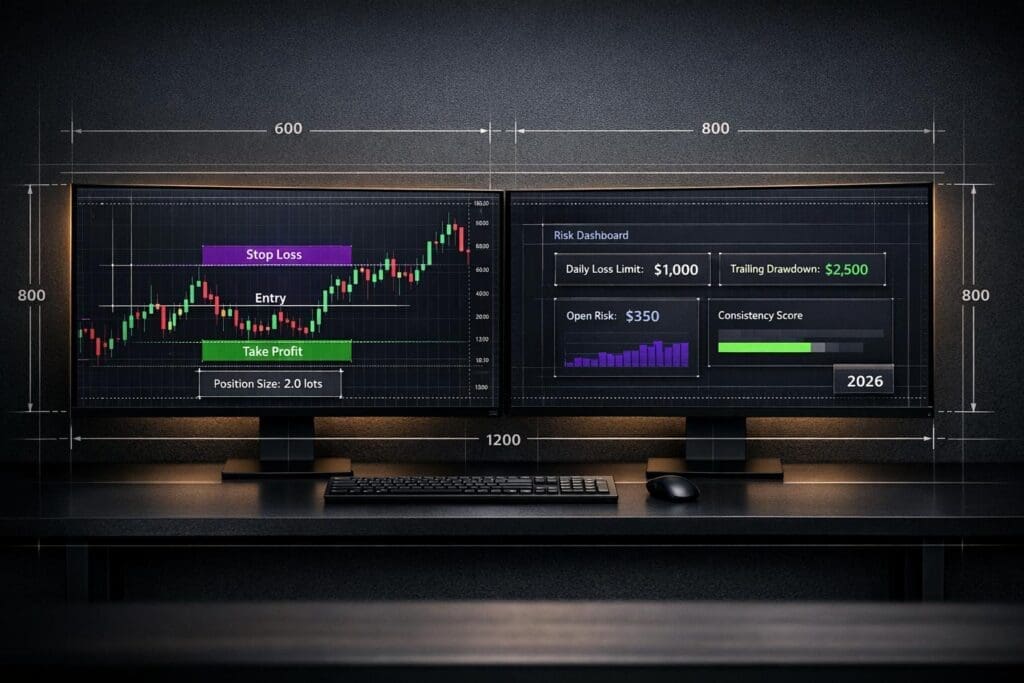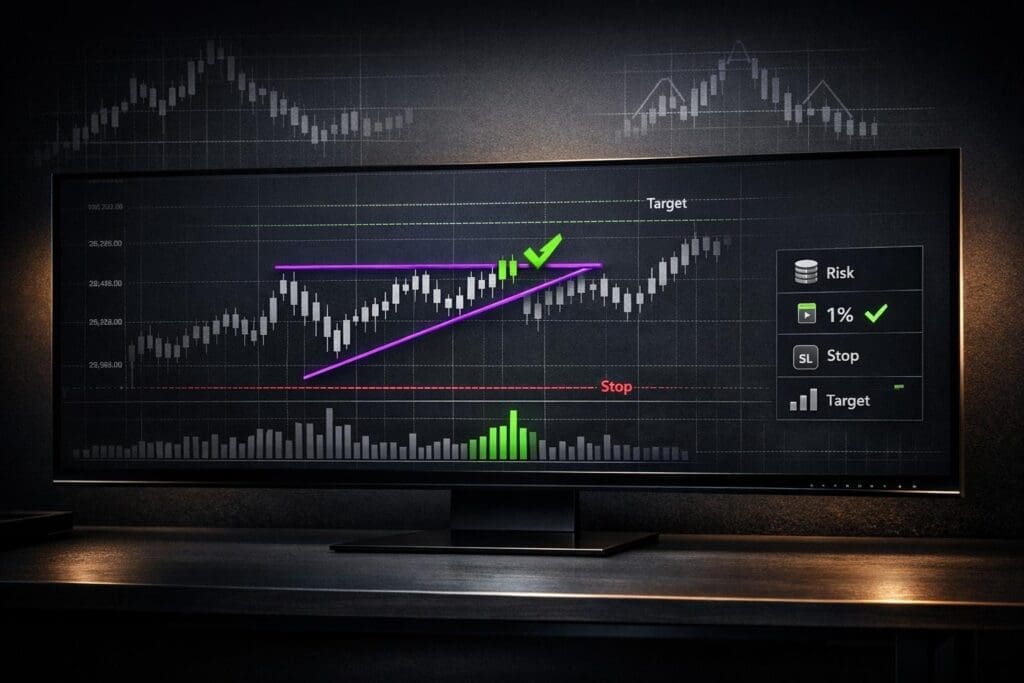
Funding tiers in futures prop firms allow traders to access increasing levels of capital by meeting specific performance benchmarks. Here’s how it works:
- Start Small, Scale Big: Traders begin with a base account (e.g., $50,000) and can scale up to manage $250,000 or more by demonstrating consistent profitability and disciplined risk management.
- Evaluation Phase: Most firms require traders to pass a simulated trading test with profit targets (5–10%) and strict loss limits to qualify for funded accounts.
- Profit Splits & Rewards: Funded traders typically start with an 80–90% profit share, increasing to 95% at higher tiers, along with perks like faster payouts and larger position sizes.
- Strict Rules: To advance, traders must follow rules like drawdown limits, consistency requirements (e.g., no single day accounting for more than 40–50% of profits), and minimum trading activity.
- Scaling Benefits: Higher tiers unlock more capital, better profit-sharing, and tools like analytics platforms or trade-copying software.
The system balances risk and reward, ensuring traders grow responsibly while safeguarding firm capital. Select a firm that matches your trading style and goals to maximize your potential.
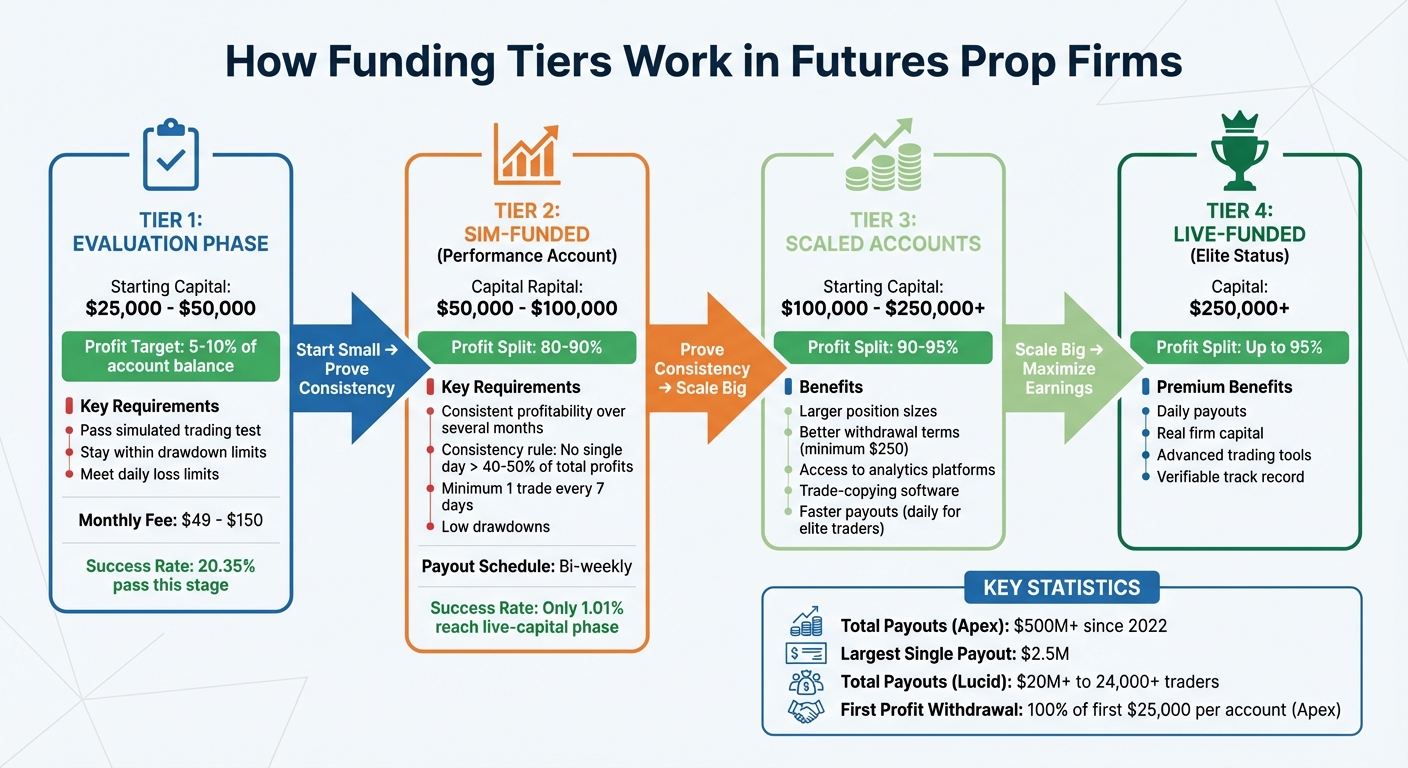
Futures Prop Firm Funding Tiers: Progression Path from Evaluation to Live Trading
How Funding Tiers Work
What Are Funding Tiers?
Funding tiers represent the levels traders progress through as they demonstrate their trading abilities. Most futures prop firms start traders in an evaluation phase, where they trade using simulated capital to showcase their skills. If they pass this phase, they move to sim-funded status, where they still trade with simulated funds but can earn real payouts from their profits. For top-performing traders, the ultimate goal is reaching live-funded accounts, where they manage actual firm capital.
In the evaluation phase, traders must prove they can achieve profit targets while staying within risk limits. Once funded, the focus shifts toward consistent performance and safeguarding capital. Over time, as traders show reliability, firms may grant access to larger account sizes through scaling programs. Progression through these tiers is tied to meeting clear performance benchmarks.
Rules for Moving Up Tiers
Advancing through funding tiers requires traders to meet specific performance standards. During the evaluation phase, they must achieve profit targets – usually between 5% and 10% of their account balance – without exceeding maximum drawdown or daily loss limits. These rules are enforced automatically by the firm’s software, which disqualifies traders immediately if limits are breached.
Once traders move to funded accounts, profit targets are often removed, but strict risk management rules remain. Advancement to higher tiers depends on several months of consistent profitability, low drawdowns, and disciplined trading. Many firms also implement consistency rules, such as limiting any single day’s profit to 40–50% of total earnings during a payout cycle. This ensures that progress is based on repeatable skills, not one-off successes.
To maintain active status, most firms require traders to place at least one trade every seven days. This rule keeps traders engaged and continually demonstrating their capabilities. Meeting these benchmarks unlocks the advantages of scaling.
Scaling Benefits at Higher Tiers
As traders meet performance requirements and move up the tiers, the benefits grow significantly. Higher tiers come with larger capital allocations, ranging from $50,000 to $250,000 or more. This means even modest percentage gains can translate into substantial dollar profits.
Profit-sharing arrangements also improve, often increasing from 80–90% to as much as 95% for the highest-level traders. Additionally, withdrawal terms become more favorable, with elite traders gaining access to daily payouts instead of the standard bi-weekly schedule. These rewards highlight the value of maintaining discipline and proving the ability to manage larger positions responsibly.
sbb-itb-46ae61d
Why Funding Tiers Help Futures Traders
Lower Risk for New Traders
For those just stepping into futures trading, starting with smaller account sizes can be a game-changer. Many firms offer beginner-friendly tiers ranging from $25,000 to $50,000, with monthly evaluation fees between $49 and $150. This setup minimizes the financial risks for new traders while allowing them to experiment with strategies in a real market setting. For instance, a $50,000 account might come with a $3,000 profit target and a $2,000 drawdown limit.
The tiered system also emphasizes strict risk controls. Features like daily loss limits and maximum drawdown thresholds help traders avoid emotional decisions that could quickly drain their accounts. Additionally, position limits – usually 2–3 mini contracts for a $50,000 account – encourage precision over high-volume trading. As noted by My Funded Futures:
A disciplined trader on a small account can often earn more than a reckless trader on a big account – My Funded Futures
This structured approach not only protects new traders but also sets the stage for long-term success as they build consistency and discipline.
Rewards for Steady Performance
Consistency pays off in the tiered funding system. Traders who deliver steady results over time are rewarded with better profit-sharing arrangements and more flexible risk management options. While many firms start with an 80% profit split, consistent performers can increase their share to as much as 90% or even 95%. However, it’s worth noting that the journey isn’t easy – only 20.35% of evaluation accounts make it past the initial stage, and just 1.01% of traders reach the live-capital phase. For those who do, the rewards include more favorable withdrawal terms, with minimums dropping to as low as $250 in advanced tiers.
Additional Tools and Resources
As traders move up the tiers, they often gain access to advanced tools and resources. Firms may provide analytics platforms that allow traders to track risk metrics in real time. Some also offer trade-copying software, enabling traders to diversify their strategies by managing multiple smaller accounts instead of concentrating risk in a single position. These tools support the disciplined trading practices that are essential for success, which we’ll explore further in the next section on making the most of funding tiers.
Ultimate Futures Prop Firm Tier List 2025 (From A 7 Figure Trader)
Funding Tier Examples from Top Futures Prop Firms
Let’s break down how funding tiers operate using examples from some of the leading futures prop firms. Each firm has its own unique structure, tailored to different trader needs and goals.
Apex Trader Funding Tier Structure
Apex Trader Funding offers account sizes ranging from $25,000 to $300,000, each with specific profit targets and drawdown rules. For instance, their $50,000 account requires traders to hit a $3,000 profit target while staying within a $2,500 trailing drawdown during the evaluation phase. Once funded, traders move into the Performance Account (PA) stage, where the trailing drawdown gradually increases until it locks at the starting balance plus $100.
Apex also allows traders to scale up using a multi-account system, enabling them to copy trades across as many as 20 funded accounts simultaneously. This approach has contributed to the firm paying out over $500 million since 2022, including a single payout of $2.5 million. Notably, traders keep 100% of the first $25,000 in profits per account, and contract limits start at 50% capacity, fully unlocking once safety thresholds are met.
Take Profit Trader Progression System

Take Profit Trader uses a Buffer Zone model to guide traders through their funding process. To qualify for an 80/20 profit split, traders must first build a Buffer Zone equal to the account’s maximum drawdown. One standout feature is that traders can withdraw profits from day one of their PRO account, bypassing the typical waiting periods seen with other firms.
Lucid Trading Instant Funding Tiers
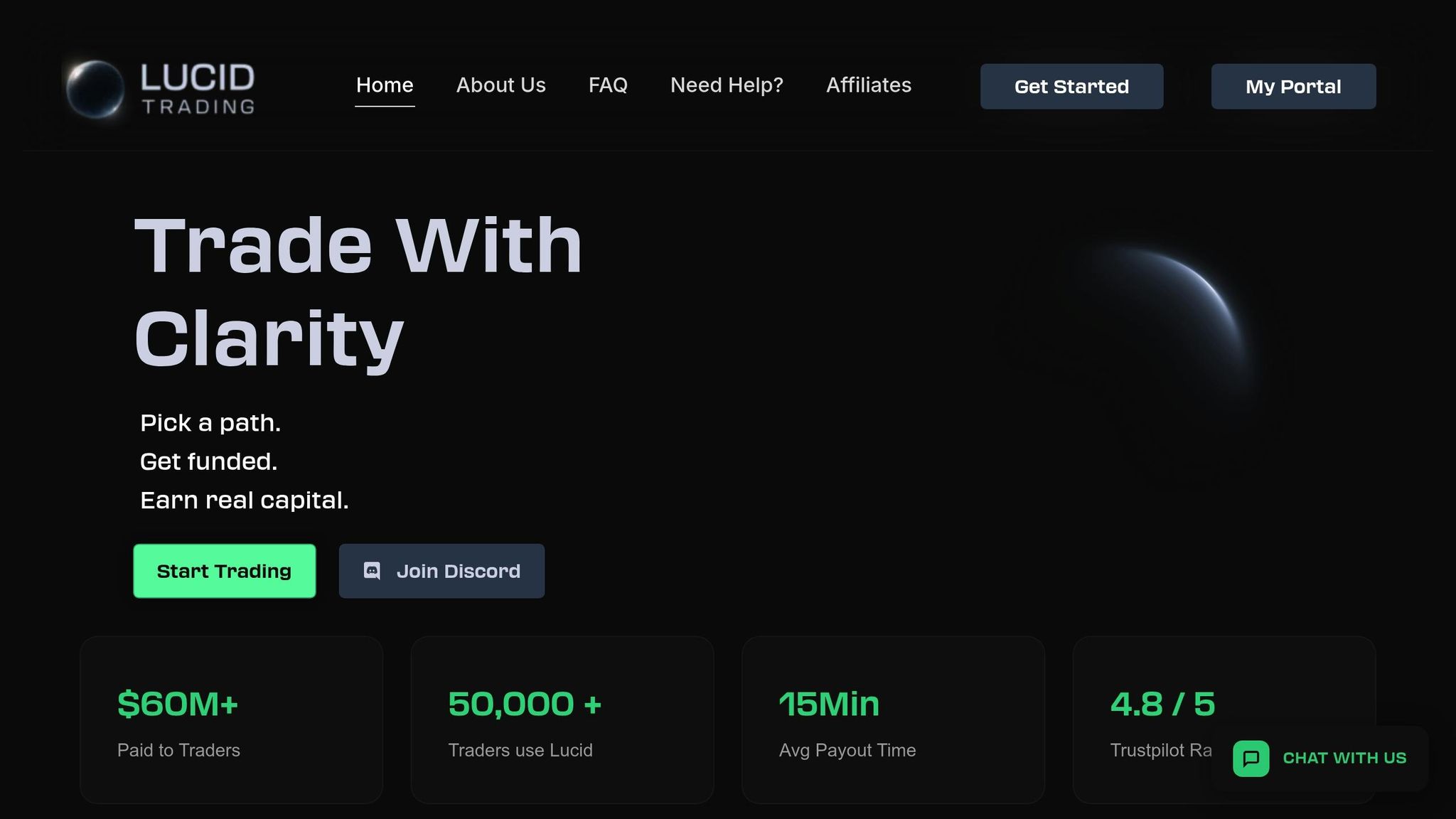
Lucid Trading offers two paths to funding: LucidTest (evaluation-based) and LucidDirect (instant funding). LucidDirect lets traders skip the evaluation phase and start earning immediately, but it comes with stricter consistency rules – no single day can account for more than 20% of total profits, compared to 35% for those in evaluation accounts.
Lucid Trading has processed over $20 million in payouts to more than 24,000 traders, with withdrawal requests typically completed in just 15 minutes. The firm uses an end-of-day (EOD) trailing drawdown system, giving traders more flexibility during market hours. Account sizes range from $25,000 to $150,000, with one-time fees between $75 and $225. Unlike many competitors, Lucid Trading does not charge monthly subscriptions or activation fees. Traders advance through three stages: Evaluation/Direct, LucidPro (simulated funded), and LucidLive, where they trade real capital and establish verifiable track records.
These examples highlight how different firms tailor their funding structures to suit diverse trading styles and goals. Understanding these systems is crucial as you map out your journey through the funding tiers.
How to Succeed with Funding Tiers
Learn Each Firm’s Rules
Before diving into trading, it’s crucial to understand the specific rules set by each firm. These guidelines can vary widely. For instance, Apex Trader Funding enforces a 30% Consistency Rule. This means that no single trading day can account for more than 30% of your total profit. So, if your best trading day earns you $1,500, you’ll need a total profit of at least $5,000 before you’re eligible for a payout or can move to the next tier.
Another common rule is the 5:1 maximum risk-to-reward ratio. If you’re aiming for a 10-tick profit, your stop loss must not exceed 50 ticks. Breaking this rule, even once, could result in account closure or denial of your payout request. Additionally, many firms prohibit hedging, which means you can only hold positions in one direction (long or short) in the same or closely related markets. Understanding these rules thoroughly helps you avoid costly mistakes and ensures you’re prepared for scaling funded accounts with risk management.
Track Your Performance with Tools
Once you’re familiar with the rules, it’s time to monitor your performance closely. Performance tracking tools can be invaluable here, helping you stay compliant and on top of your metrics. For example, the Consistency Rule Calculator from DamnPropFirms allows you to check if your daily profits fall within the acceptable range. All you need to do is input your highest profit day, and the tool calculates the minimum total profit required for you to qualify for withdrawals or tier advancements. To find this threshold manually, divide your highest profit day by 0.3.
Tracking tools are also helpful for managing contract scaling restrictions. Most firms limit you to trading only 50% of your maximum allowed contracts until you reach a safety buffer. This buffer is typically calculated as your initial balance plus the trailing drawdown plus $100. For example, on a $50,000 account, you’d need to reach $52,600 before you can trade full position sizes. Keeping an eye on this threshold can help you avoid unintentional violations, which might otherwise result in additional compliance time – sometimes as much as eight extra days.
By using these tools, you can safeguard your progress and align with the firm’s expectations for steady, responsible performance.
Prioritize Consistency Over Speed
Success in funding tiers isn’t about racing through them – it’s about demonstrating consistent, disciplined trading. Evaluations are designed to test your ability to maintain long-term performance, not just achieve quick profit spikes. For instance, a $3,000 gain on your first day might seem impressive, but under the 30% rule, this would push your required total profit to $10,000, making it harder to advance and increasing your overall risk.
Firms also keep a close eye on metrics like Maximum Adverse Excursion (MAE), which measures the extent of open losses relative to your total profit. Even if a trade eventually turns profitable, allowing it to swing too far into the red could trigger a violation. To avoid this, focus on controlled risk management and avoid overly aggressive position sizing. The goal isn’t just to pass the evaluation quickly – it’s to show that you can manage drawdowns, maintain proper position sizing, and handle the emotional challenges of trading. Only then will the firm trust you with real capital.
Conclusion
Funding tiers provide futures traders with a way to grow their capital and earnings while removing personal financial risk. This structure emphasizes discipline and consistent performance rather than chasing quick profits. It allows traders to progress from managing $50,000 accounts to handling $250,000 or more, while also offering better profit splits at higher levels.
To build a lasting trading career, traders must master each firm’s specific rules – such as the 30% Consistency Rule – and maintain detailed performance records. Prioritizing steady growth and strong risk management over aggressive strategies is key. This mindset distinguishes traders who merely pass evaluations from those who achieve long-term success with funded accounts.
Selecting the right proprietary trading firm is just as important as developing a solid trading strategy. DamnPropFirms simplifies this process by comparing top futures prop firms like Apex Trader Funding, Take Profit Trader, and Lucid Trading. The platform provides verified reviews, exclusive discounts (often up to 80–90% off with code DGT), and free tools like the Consistency Rule Calculator to help traders meet payout requirements.
With a growing community of over 3,000 traders in the Damn Good Traders Discord and in-depth resources on topics like drawdown strategies and multi-account copy trading, you’ll have access to everything you need to succeed. Whether you’re managing your first $50,000 account or scaling up to 20 accounts, DamnPropFirms offers the reviews, discounts, and tools to support your journey.
FAQs
What’s the difference between evaluation, sim-funded, and live-funded?
Evaluation accounts come with specific guidelines that traders must follow, including hitting profit targets and staying within drawdown limits, to qualify for live funding. Sim-funded accounts, often referred to as demo or practice accounts, are used during the evaluation phase or for honing trading skills. Once traders successfully pass evaluations, they are granted live-funded accounts, which enable them to trade using actual firm capital. These accounts also allow traders to share profits under prearranged terms, presenting opportunities to grow and increase payouts.
How do consistency rules affect payouts and tier upgrades?
Consistency rules in futures prop trading are designed to reward steady, disciplined performance. These rules often cap how much profit from a single day can contribute toward your overall target. This approach encourages traders to distribute their gains over multiple days rather than relying on one big win. By following these guidelines, traders can become eligible for payouts and move to higher funding tiers. This not only showcases their ability to trade consistently but also highlights effective risk management skills.
What should I check before choosing a funding tier or firm?
Before choosing a funding tier or a prop firm, take a close look at key details like drawdown limits, profit splits, and payout timelines to make sure they align with your trading style and objectives. It’s also crucial to understand the firm’s evaluation process, including their risk management rules and any scaling opportunities they offer. Don’t forget to check the firm’s reputation by reading verified reviews and exploring features like instant funding or flexible payout options. These steps can help set you up for a smoother and more rewarding trading experience.