Reset fees are a key expense for futures traders, especially when exceeding drawdown limits. Here’s what you need to know:
- Reset Fees: Vary widely across firms. Some charge flat fees (e.g., $80 for Apex Trader Funding legacy accounts), while others tie fees to account size (e.g., $35–$239 for Blue Guardian).
- Drawdown Types: Firms use either End-of-Day (EOD) or Intraday Trailing Drawdowns, affecting the frequency and cost of resets.
- Daily Loss Limits: Some firms enforce limits that pause trading without account failure; others remove them entirely.
- Instant Funding: Options like Lucid Trading‘s LucidDirect or Tradeify‘s Lightning Accounts let traders skip evaluations but often include stricter rules and higher costs.
Quick Comparison
| Firm | Reset Fee | Drawdown Type | Daily Loss Limit | Instant Funding |
|---|---|---|---|---|
| Apex Trader Funding | $80–$100 (legacy accounts) | EOD or Intraday | Varies by account | No |
| Tradeify | $85–$189 | End-of-Day | Varies by account | Yes (Lightning) |
| Take Profit Trader | $100 (Eval), $399–$1,299 (PRO) | EOD (Eval) / Intraday (PRO) | Removed for Test accounts | No |
| Topstep | Monthly subscription | End-of-Day | $1,000–$3,000 | No |
| Blue Guardian | $35–$239 | End-of-Day | 3% (Standard), None (Guardian) | Yes (Instant Guardian) |
| Lucid Trading | $70–$245 | End-of-Day | Varies by account | Yes (LucidDirect) |
| Purdia Capital | $99 | EOD or Intraday (Pro) | $250–$2,000 (soft limit) | Yes |
Key Takeaway: Choose a firm based on your trading style and budget. EOD drawdowns are more forgiving, while instant funding options suit traders ready to skip evaluations. Always consider reset fees and drawdown policies when selecting a firm.
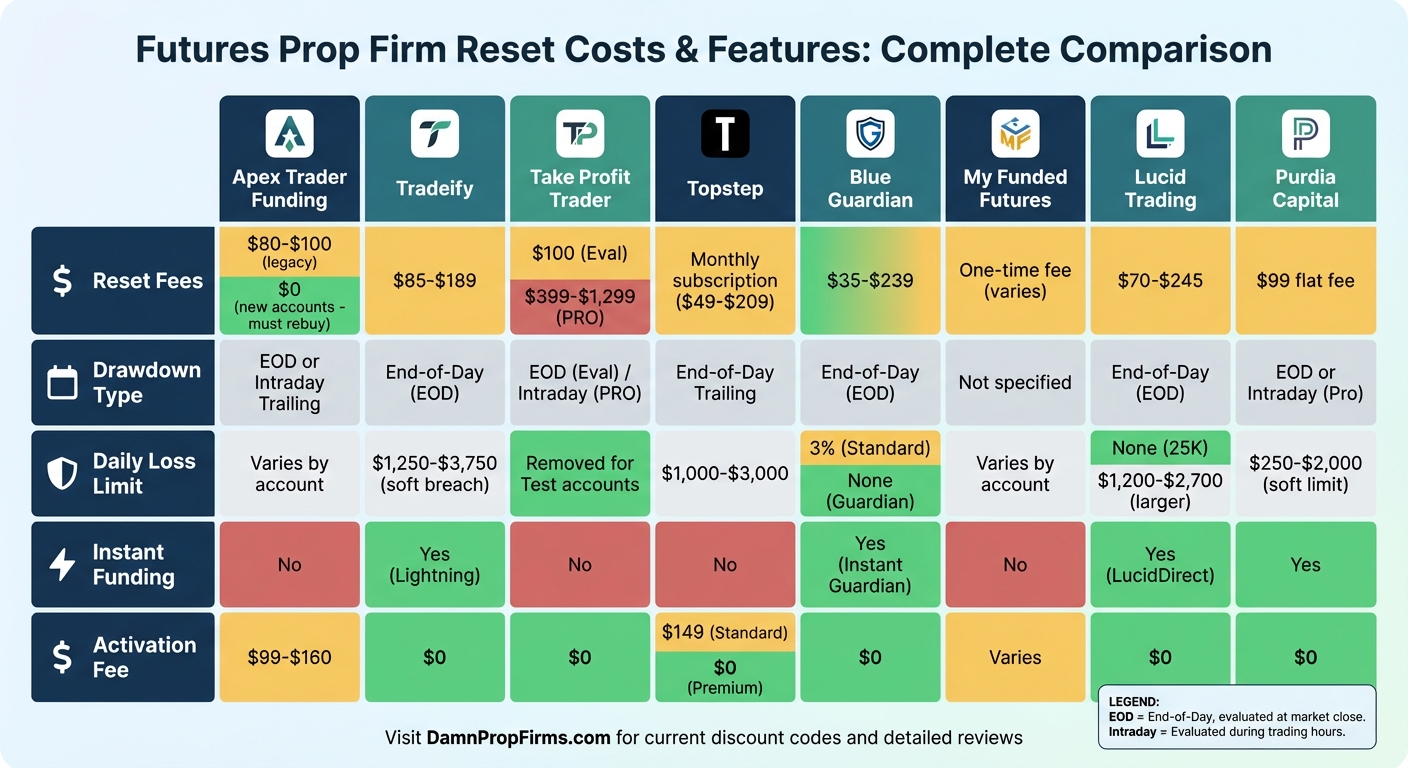
Futures Prop Firm Reset Costs and Features Comparison Chart
1. Apex Trader Funding

Reset Fee
Starting March 1, 2026, Apex Trader Funding removed reset fees for all new evaluation accounts. If you exceed the drawdown or daily loss limit, you won’t be able to reset the account – you’ll need to buy a new evaluation at the full price. This marks a shift from their earlier fee structure.
For legacy accounts (purchased before March 1, 2026), resets are still available. These cost $80 on Rithmic and $100 on Tradovate platforms, with automatic resets applied at monthly renewal if the evaluation fails.
Drawdown Type
Apex Trader Funding provides two drawdown options: End-of-Day (EOD) Trailing Drawdown and Intraday Trailing Drawdown.
- The EOD model calculates your drawdown at the end of each trading day (4:59:59 PM ET). This approach gives traders more flexibility to handle market fluctuations.
- The Intraday model, however, monitors your peak balance in real time, including unrealized profits. The drawdown threshold adjusts upward with your open profits. While this method can lock in gains, it also increases the risk of account failure if unrealized profits reverse. As a result, traders using the Intraday model may face more frequent account failures and higher costs overall.
These drawdown models also impact how trading limits, such as daily loss caps, are applied.
Daily Loss Limit
EOD evaluations come with a Daily Loss Limit (DLL), which temporarily halts trading for the day without failing the account. For instance, a $25,000 account has a $500 DLL. On the other hand, Intraday evaluations do not include a DLL during the evaluation phase. Without this buffer, Intraday accounts are at greater risk of immediate failure, potentially leading to higher overall expenses due to the need to repurchase evaluations at full price.
For a more detailed breakdown and to find current discount codes, check out Apex Trader Funding on DamnPropFirms.
sbb-itb-46ae61d
2. Tradeify

Reset Fee
Tradeify’s reset fees vary depending on the type of account. For the Select Evaluation, there’s a flat $95 reset fee. In contrast, the Growth Evaluation has a tiered structure, with fees ranging from $85 for a $50,000 account to $189 for a $150,000 account.
For Lightning Funded accounts, which provide instant funding, resets are not an option. If a trader fails with a Lightning account, they must repurchase the account at the full one-time fee. These fees range between $329 and $759, depending on the account size.
Drawdown Type
All Tradeify accounts use an End-of-Day (EOD) trailing drawdown. This system locks the drawdown at $100 above the starting balance once specific profit milestones are achieved. While the drawdown threshold is enforced in real time – meaning significant intraday losses can still lead to failure – the EOD method generally allows for greater flexibility compared to real-time drawdowns.
Daily Loss Limit
The Select Evaluation does not impose a Daily Loss Limit. However, both Growth Evaluations and Lightning Funded accounts include a "soft breach" daily loss limit. This limit temporarily halts trading for the day if exceeded, with thresholds ranging from $1,250 to $3,750, depending on the account size.
Instant Funding Availability
Lightning Funded accounts skip the evaluation phase entirely, offering instant funding. However, these accounts come with specific conditions. They do not allow resets and require traders to follow a progressive consistency rule, increasing from 20% to 30% after successive payouts. For more details and any current discount codes, check out Tradeify on DamnPropFirms.
3. Take Profit Trader

Reset Fee
Take Profit Trader uses a two-tier system for reset fees, creating a noticeable difference in cost between evaluation and funded accounts. For Test (Evaluation) accounts, the reset fee is a flat $100, regardless of account size – from $25,000 to $150,000. Plus, each monthly renewal includes a free reset.
However, things change significantly once you reach PRO (funded) status. Reset fees for PRO accounts range from $399 to $1,299, depending on the account size – for instance, resetting a $50,000 PRO account costs $649. PRO accounts allow up to three resets; after that, the account is closed, and traders must start a new Test evaluation.
"Only pay for an immediate reset if you breached early in your billing cycle and are confident you can pass before the next renewal."
– Paul, Author, ProTradingVibes
If you breach your Test account close to your renewal date (within 7–10 days), it’s usually smarter to wait for the free reset rather than paying $100. For PRO accounts, the high reset fees often make starting a new evaluation ($150–$360) the cheaper option.
Drawdown Type
The drawdown rules differ significantly between stages and are often a key reason traders breach their PRO accounts. During the Test phase, an end-of-day (EOD) trailing drawdown is used. This means the drawdown level is only updated at the end of the trading day, offering more flexibility to handle intraday market swings.
Once you move to a PRO account, the drawdown shifts to an intraday trailing model. Here’s the catch: as soon as a new profit peak is reached – even if your trades are still open – the drawdown threshold adjusts immediately, tightening your risk parameters.
"The drawdown type switch from Test to PRO… is the biggest trap in TakeProfitTrader that causes PRO resets."
– Paul, Author, ProTradingVibes
When you reach PRO+ status (usually after earning $5,000 in PRO profits), the drawdown reverts to the more forgiving EOD trailing model. At this stage, you also gain access to live market execution and a 90/10 profit split. These shifts in drawdown rules can significantly influence your approach to risk management.
Daily Loss Limit
As of January 2025, Take Profit Trader removed the daily loss limit for Test accounts, giving traders more flexibility during the evaluation phase. PRO+ accounts also operate without a daily loss limit. This policy sets Take Profit Trader apart from other futures prop firms that still enforce strict daily loss rules across most account types.
Instant Funding Availability
Take Profit Trader does not offer instant funding as a way to skip the evaluation process. Instead, traders must complete a one-step evaluation over a minimum of five trading days. Once the profit target is met, account activation is immediate, allowing a quick transition to PRO status.
For more details and current discount codes, check out Take Profit Trader on DamnPropFirms.
4. Topstep

Reset Fee
Topstep stands out with its flexible pricing and reactivation options. Operating on a subscription model, it offers two pricing tiers:
- Standard Path: Costs $49 to $149 per month (based on account size ranging from $50,000 to $150,000) and includes a one-time $149 activation fee after passing the evaluation.
- No Activation Fee Path: Priced at $109 to $209 per month, this option eliminates the activation fee entirely.
If you breach your Trading Combine, the cost to reset is simply your next monthly subscription fee (e.g., $49 or $109 for a $50K account). Each renewal also includes a free Reset Credit, allowing you to restart the evaluation without additional charges.
For traders who reach funded status and fail their Express Funded Account (XFA), Topstep offers the Back2Funded program. This program skips the evaluation process and reinstates you directly to funded status. The costs are $599 for a $50,000 account, $699 for a $100,000 account, and $829 for a $150,000 account. While this option is on the pricier side, it’s a rare offering in the futures prop trading world and can be used up to twice per XFA.
Drawdown Type
Topstep employs an end-of-day trailing drawdown system. This means the drawdown adjusts only at the close of the trading day, based on your account balance at that time. Intraday profit peaks won’t affect the drawdown threshold, offering traders more flexibility during volatile market conditions.
"The Topstep trailing drawdown follows new end-of-day account highs and sets the maximum loss limit for the account. Once the drawdown reaches the starting balance, it stops trailing."
– Topstep Review 2026
For example, in a $50,000 account, the drawdown stops trailing once it reaches the initial balance of $50,000. This structure is often more forgiving compared to intraday trailing models.
Daily Loss Limit
Topstep enforces a Daily Loss Limit to help manage risk:
- $1,000 for $50,000 accounts
- $2,000 for $100,000 accounts
- $3,000 for $150,000 accounts
Hitting this limit pauses trading for the day but does not result in account failure. This is an important distinction from breaching the Maximum Loss Limit, which would close the account.
Instant Funding Availability
Topstep requires all traders to complete its one-step Trading Combine evaluation before accessing an Express Funded Account. However, once you hit your profit target during the evaluation, your funded account is activated immediately with no additional waiting period, thanks to their Instant XFA Activation feature.
These features highlight how Topstep positions itself in the competitive futures prop trading market. For more information and discount codes, check out Topstep on DamnPropFirms.
5. Blue Guardian
Reset Fee
Blue Guardian keeps reset fees affordable across both evaluation models. The cost depends on account size: resetting a $25,000 account costs $35 for the Standard Evaluation or $39 for the Guardian Evaluation. For larger accounts, a $50,000 reset costs $70 or $79, a $100,000 reset costs $136 or $159, and a $150,000 reset costs $200 or $239. These are some of the most competitive rates among futures prop firms, and there’s no activation fee to worry about.
| Account Size | Standard Evaluation Reset | Guardian Evaluation Reset |
|---|---|---|
| $25,000 | $35 | $39 |
| $50,000 | $70 | $79 |
| $100,000 | $136 | $159 |
| $150,000 | $200 | $239 |
Next, let’s take a closer look at Blue Guardian’s drawdown model and how it supports traders in managing risk.
Drawdown Type
Blue Guardian uses an End-of-Day (EOD) drawdown for its futures evaluations. This means the drawdown updates only after the trading session ends. The benefit? Traders have more breathing room during volatile intraday swings since temporary dips won’t count against you – as long as your account closes the day above the threshold.
The Guardian Evaluation model goes a step further by eliminating the daily loss limit entirely and focusing solely on the EOD trailing drawdown. Compared to the intraday trailing models many competitors use, this approach gives traders more flexibility and reduces the need for constant monitoring.
Now, let’s explore how Blue Guardian’s daily loss limits complement its drawdown model.
Daily Loss Limit
For Standard Evaluations, Blue Guardian enforces a 3% daily loss limit, while Guardian Evaluations remove this limit altogether. Meanwhile, Instant Guardian accounts – designed for traders who skip the evaluation phase – come with a stricter 2% daily loss limit.
To help traders avoid unintended breaches, Blue Guardian offers a feature called the "Guardian Shield." This tool automatically closes all open trades if your account’s P&L hits a -2% loss, providing an extra layer of protection.
Instant Funding Availability
Blue Guardian also offers instant funding through its Instant Guardian program, which skips the evaluation process entirely. Account sizes range from $25,000 to $150,000, with pricing between $395 and $995. However, these accounts come with stricter rules: a 2% daily loss limit, a 4% trailing drawdown, and no reset options if the account breaches these limits.
For those just starting out, Blue Guardian offers a $10 Starter account. This comes with $5,000 in simulated capital, making it one of the most accessible entry points in futures prop trading. For more information and current discount codes, visit Blue Guardian on DamnPropFirms.
6. My Funded Futures
Reset Fee
My Funded Futures follows a straightforward approach to reset fees, charging a one-time fee that depends on the account size. This transparent pricing helps traders plan their budgets without worrying about surprise costs or recurring monthly charges.
Now, let’s take a look at how the firm handles drawdowns.
Drawdown Policy
Although the exact mechanics aren’t fully detailed, My Funded Futures has structured its drawdown policy to maintain performance integrity during evaluations. Traders are encouraged to consult the official guidelines for a complete understanding of the rules.
Daily Loss Limit
To encourage disciplined trading, My Funded Futures enforces a daily loss limit on its evaluation accounts. The specific thresholds depend on the account size and program type, so it’s essential to review the terms carefully to avoid unintentional resets.
These policies play a key role in managing costs effectively during both the evaluation process and funded trading periods.
Instant Funding Availability
At this time, My Funded Futures does not provide instant funding. Unlike firms such as Lucid Trading, Tradeify, Legends Trading, and Purdia Capital that offer immediate access to funded accounts, My Funded Futures requires traders to successfully complete the evaluation process before accessing a funded account.
For more information and the latest discount codes, check out My Funded Futures on DamnPropFirms.
7. Lucid Trading
Reset Fee
Lucid Trading structures its reset fees based on account size, with costs ranging from $90 for a 25K account to $245 for a 150K account. Resetting through the dashboard is economical, costing only 30–40% of a new evaluation fee.
For instance, resetting a LucidPro 100K account costs about $70, which saves $129.50 compared to purchasing a new evaluation at $199.50. Similarly, a LucidFlex 50K reset costs around $61, offering a significant discount compared to starting fresh. To sweeten the deal, Lucid Trading provides one free reset for every five LucidFlex accounts purchased, allowing traders to maximize value by applying the free reset to their largest breached account.
Lucid Trading’s approach to risk management includes clear drawdown policies that set it apart.
Drawdown Type
Lucid Trading employs an End-of-Day (EOD) trailing drawdown, a system designed to bring stability and limit unnecessary resets. While breaches are enforced in real-time if your balance hits the limit during a session, the EOD system helps traders avoid account closures due to short-term market volatility.
Once a trader surpasses the set threshold, the Max Loss Limit becomes static, locking at the initial balance plus $100. This creates a safety net as the account grows, providing added peace of mind.
Daily Loss Limit
The 25K account stands out by having no daily loss limit, giving traders maximum flexibility. For larger accounts, specific limits apply: $1,200 for 50K accounts, $1,800 for 100K accounts, and $2,700 for 150K accounts. On LucidDirect and LucidPro accounts, hitting the daily loss limit results in a soft breach. Instead of terminating the account, trading is paused for the rest of the day, allowing traders to regroup.
Instant Funding Availability
Lucid Trading also offers instant funding through its LucidDirect program, letting traders bypass the evaluation phase and start trading for payouts within 5–15 minutes of purchase. However, LucidDirect accounts come with a 20% consistency rule, meaning no single day’s profits can exceed 20% of the total profit during a payout cycle.
For the latest updates and discount codes, visit Lucid Trading on DamnPropFirms.
Stop Paying Reset Fees On Trader Funding Evaluations – TopStep, Apex, TradeDay, etc
8. Purdia Capital

Let’s take a closer look at Purdia Capital’s fee structure, drawdown policies, and instant funding options.
Reset Fee
Purdia Capital charges a flat $99 reset fee for most evaluation accounts, including Pro, EOD, and Beginner Step 2 accounts. However, the Beginner Evaluation account comes with a perk: one free daily reset during Step 1. Additionally, if an evaluation account fails during its monthly renewal, it automatically resets without any extra cost.
Drawdown Type
Purdia Capital uses an End-of-Day (EOD) trailing drawdown for most accounts. This system updates based on the closed balance at the end of each trading day, reducing the impact of intraday market fluctuations. On the other hand, Pro Evaluation accounts feature an intraday trailing drawdown, which tracks unrealized equity highs in real time. This setup presents a tougher challenge, making it better suited for experienced traders.
Daily Loss Limit
The firm applies a "soft" daily loss limit, which halts trading for the day if reached but doesn’t result in account failure. These limits vary depending on the account type:
- Beginner accounts: $250–$500
- EOD evaluation accounts: $1,000–$2,000
- Static Instant Funding accounts: $300–$500
Pro Evaluation accounts, however, do not have a daily loss limit.
Instant Funding Availability
Purdia Capital offers instant funding accounts, which skip the evaluation phase entirely. Traders can start directly in a Simulated Funded Account, with account sizes ranging from $25,000 to $150,000. The one-time fees begin at $244 for a 25K EOD account and go up to $1,609 for a 150K Static account. It’s important to note that these accounts don’t allow resets – if the drawdown is breached, the account closes, and traders must purchase a new one.
To move from a Simulated Funded Account to a Live Funded Account, traders must complete 10 trading days, with at least five of those being profitable, while also meeting the minimum daily profit targets.
For the most up-to-date pricing and discount codes, check out Purdia Capital and other top futures prop firms on DamnPropFirms.
Pros and Cons
Futures prop firms vary significantly when it comes to reset fees, drawdown policies, and instant funding options. This comparison adds to the earlier breakdowns, helping you evaluate reset costs alongside drawdown risks. Here’s a quick summary of the key differences among firms.
Take Profit Trader and Lucid Trading stand out with $0 activation fees, while Apex Trader Funding charges between $99 and $160 for activation. If you’re looking for a one-time payment option, firms like Topstep and My Funded Futures offer models that remove recurring monthly fees. These can be a better deal if your evaluation period extends beyond 30 days.
When it comes to drawdown types, End-of-Day (EOD) drawdowns, used by Tradeify, Topstep, and Take Profit Trader, allow more flexibility during the trading day compared to intraday trailing models. For instance, Apex’s intraday trailing drawdown adjusts in real time with equity peaks, meaning even a slight pullback during a winning trade could trigger a reset. To illustrate, on a 50K account, Tradeify’s total cost of $103 is much lower than Apex’s $195 when activation fees are included.
For traders seeking to skip evaluations, instant funding is a game-changer. Firms like Tradeify, Lucid Trading, Purdia Capital, and Legends Trading offer this option. Lucid Trading is particularly appealing with its $0 activation fees and EOD drawdown on instant accounts. However, Tradeify applies scaling consistency rules (20% to 30% per payout cycle) to discourage risky, single-trade strategies.
| Firm | Reset Fee | Drawdown Type | Daily Loss Limit | Instant Funding Availability |
|---|---|---|---|---|
| Apex Trader Funding | $99–$160 activation | EOD or Intraday Trailing | Varies by account | No |
| Tradeify | Varies | End-of-Day | Varies by account | Yes (Lightning) |
| Take Profit Trader | $0 activation | EOD (Eval) / Intraday (Pro) | Varies by account | No |
| Topstep | One-time payment model | EOD Trailing | Varies by account | No |
| Blue Guardian | $85 (or free with renewal) | Not specified | Not specified | No |
| My Funded Futures | One-time payment model | Not specified | Not specified | No |
| Lucid Trading | $0 activation | End-of-Day | Varies by account | Yes (LucidDirect) |
| Purdia Capital | $99 flat fee | EOD or Intraday (Pro) | $250–$2,000 (soft limit) | Yes |
Ultimately, the choice between firms comes down to balancing cost and flexibility. Firms with no activation fees and EOD drawdowns are ideal for beginners, offering more room for error. On the other hand, firms with intraday trailing drawdowns and higher fees may appeal to experienced traders looking for faster payouts and better scaling opportunities. For the latest comparisons and discount codes, visit DamnPropFirms to find the best match for your trading style.
Conclusion
When comparing reset costs, several firms stand out. Take Profit Trader, Lucid Trading, and Tradeify all offer $0 activation fees, making them appealing for traders looking to minimize upfront costs. Meanwhile, Apex Trader Funding provides steep discounts of 80–90% on evaluation fees, though activation fees are required. For traders who frequently reset, these savings can add up significantly over time.
Each firm’s fee structure and drawdown model suits different trading strategies. End-of-day (EOD) drawdowns provide more flexibility, making them ideal for beginners and swing traders. On the other hand, intraday trailing drawdowns – like those on some Apex Trader Funding accounts – can lead to resets during regular price fluctuations, potentially increasing costs.
For instant funding options, Lucid Trading offers LucidDirect accounts with $0 activation fees and EOD drawdowns, while Tradeify‘s Lightning accounts feature profit splits of 90–100%. Additionally, Purdia Capital uses a brokerage-style model with a balanced 1:1 drawdown-to-profit ratio, although reset costs can vary.
"Lucid is the cleanest setup with no activation fee and strong EOD drawdowns." – DamnPropFirms
Ultimately, your choice should align with your trading style and priorities. Beginners may prefer firms with EOD drawdowns and no activation fees, while scalpers could benefit from Apex Trader Funding’s ability to scale up to 20 accounts using TradeSyncer. Cost-conscious traders should focus on firms that avoid hidden fees. For the latest discounts and rule updates, visit DamnPropFirms. These insights can help you make an informed decision that matches your trading goals and budget.
FAQs
When is a reset cheaper than buying a new evaluation?
Resetting an account can often save you money compared to starting a new evaluation, especially when the reset cost is much lower. For instance, Lucid Trading provides account resets for as little as $228. This can be a more budget-friendly choice than paying for a brand-new evaluation. It’s always a good idea to compare the costs to see which option makes the most sense for your situation.
How do EOD vs intraday trailing drawdowns change my real reset risk?
EOD trailing drawdowns reset at the close of each trading day, giving traders a fresh start and reducing the likelihood of reaching a total reset limit. On the other hand, intraday trailing drawdowns adjust throughout the trading day. This means that if losses pile up before the market closes, the risk of triggering a reset increases. Understanding this difference is crucial for traders as it directly affects how they handle positions and manage their overall risk.
What hidden rules make instant funding harder than evaluations?
Hidden rules, such as strict drawdown limits, mandatory minimum trading days, and profit split restrictions, can make instant funding a tougher path for traders. These requirements often call for quicker compliance and stricter rule-following, limiting the flexibility traders might have when compared to evaluation-based challenges.