
Scaling readiness is about proving you can handle larger trading accounts by consistently meeting performance benchmarks and managing risks. Proprietary trading firms, like Apex Trader Funding and Topstep, evaluate traders on profit targets, consistency, and risk management before increasing account sizes.
Key takeaways:
- Profit Targets: Typically 5%-10%, adjusted by account size.
- Consistency Rules: Ensure profits aren’t from a single lucky trade.
- Risk Limits: Drawdowns usually capped at 5%-10%.
- Scaling Timeframes: Reviews every 30-120 days depending on account level.
- Tools for Success: Trade copying platforms, consistency calculators, and risk tracking tools streamline scaling.
Scaling up is a step-by-step process – focus on steady growth, disciplined execution, and staying updated on firm policies to maximize your potential.
4 Step Plan To Scale Your Prop Trading (Safely)
sbb-itb-46ae61d
Core Metrics for Scaling Readiness
Understanding how performance is evaluated is crucial when assessing scaling readiness. Let’s break down the key metrics that prop firms use to measure success.
Profit Targets and Consistency Rules
Prop firms set profit targets based on account size, with expectations adjusting as the account grows. For smaller accounts ($10,000–$50,000), traders are typically required to hit profit targets of 10% to 15% within 30 to 60 days. As account sizes increase to intermediate levels ($100,000–$200,000), the targets drop slightly to 8% to 12%, with a longer timeframe of 60 to 90 days. For advanced accounts ($200,000–$500,000), the target narrows to 6% to 10%. At the elite level, where accounts exceed $500,000, the focus shifts to achieving around 5% profit per quarter.
This structure highlights the shift from aggressive growth to capital preservation as account sizes grow. Consistency rules also play a big role – ensuring that traders don’t qualify based on one lucky trading day. For example, Apex Trader Funding enforces a 50% consistency rule. This means no single profitable day can account for more than 50% of your total net profit during a payout cycle.
Drawdown Limits and Risk Management
Drawdown limits are another critical factor, typically ranging from 5% to 10% across most firms. Exceeding these limits results in either immediate disqualification or the need to reset scaling eligibility. Prop firms also evaluate traders’ adherence to disciplined risk management practices. This includes consistent use of stop-loss orders, maintaining steady lot sizes, and avoiding risky trading behaviors.
At Apex Trader Funding, traders must keep their account balance above the "Safety Net" level, which is the drawdown limit plus a small buffer (usually $100). For example, on a $50,000 account, the balance must stay above $52,100 to remain eligible for payouts and scaling. This reinforces the importance of protecting capital.
Minimum Timeframes for Scaling Eligibility
Scaling reviews are typically conducted every 60 to 90 days to ensure performance consistency across different market conditions. The timeframe required for scaling increases with account size. For example:
- Starter accounts: 30–60 days of steady performance
- Intermediate accounts: 60–90 days
- Advanced accounts: 90–120 days
- Elite accounts: 120+ days of consistent results
Additionally, many firms require traders to meet a minimum number of qualifying days. At Apex Trader Funding, traders must complete at least 5 qualifying days – days where they meet the minimum profit targets – before requesting a payout. They also have an activity rule requiring at least one $150 net profit day within 150 consecutive calendar days to keep a Performance Account active. For a $10,000 starter account, scaling up to $100,000 typically takes 6 to 12 months of consistent trading.
Performance Benchmarks from Top Prop Firms
Top proprietary trading firms have established benchmarks that highlight different strategies for scaling accounts. These benchmarks demonstrate how firms tailor their structures to help traders grow and manage their accounts effectively.
Apex Trader Funding

Apex Trader Funding offers a unique multi-account scaling model. Traders can manage up to 20 Performance Accounts simultaneously, with each account scaling to $300,000. This setup allows for a combined capital pool of up to $6 million. Unlike many other firms, Apex doesn’t impose restrictions on contract sizes based on account balance, meaning traders can maximize their position sizes from the start.
A key feature is the 50% consistency rule, along with a requirement of five qualifying days and periodic $150 net profit days. For instance, trader Carlos V. achieved payouts exceeding $400,000 in 2024. More information can be found on the Apex Trader Funding review page. This model stands out compared to the approaches of other firms discussed below.
Take Profit Trader

Take Profit Trader focuses on gradual account growth through its Trader Career Path. Accounts can scale up to $400,000, using a fixed drawdown model with automatic upgrades once profit targets are met on lower-tier accounts. Monthly pricing ranges from $60 for $25,000 accounts to $220 for $200,000 Gauntlet Mini accounts.
The firm emphasizes consistent profitability, with each tier requiring specific profit thresholds. Withdrawals are available from day one, and there are no activation fees. For more details, visit the Take Profit Trader review page.
Topstep

Topstep uses a structured Trading Combine evaluation process, which spans 30 to 90 days. Risk management is a priority, with daily drawdown limits ranging from 3% to 5%.
Successful traders move on to funded accounts starting at $150,000 and can access better profit splits as they demonstrate consistency. After five payouts from an Express Funded Account, traders are upgraded to a Live Funded Account. This upgrade removes the $5,000 payout cap and allows for daily withdrawals once traders achieve 30 winning days. These milestones are designed to guide traders toward scaling their accounts effectively.
Scaling Requirements Comparison Table
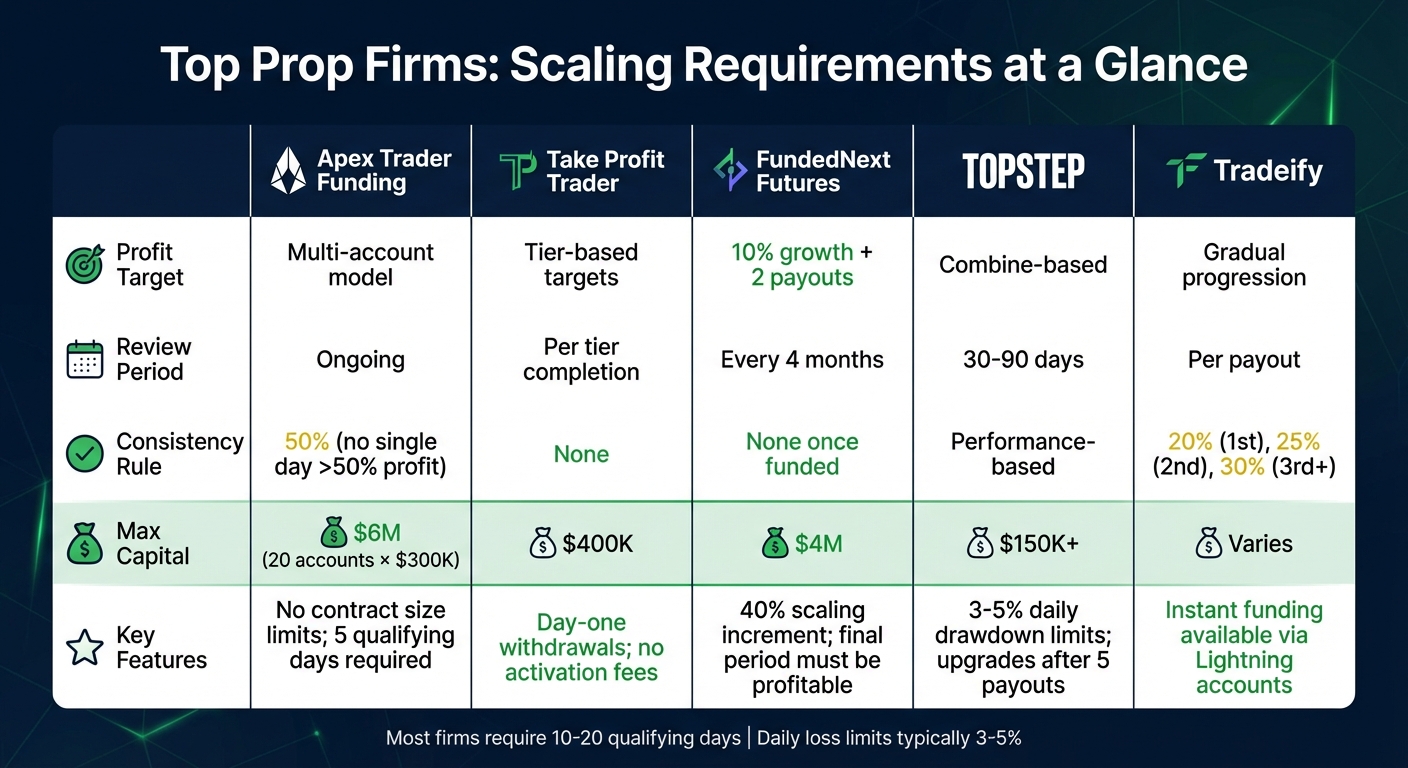
Prop Firm Scaling Requirements Comparison: Profit Targets, Review Periods, and Max Capital
Scaling Metrics Comparison
The table below provides a clear comparison of how some top futures prop firms handle scaling. Each firm has its own approach, setting specific metrics that influence your growth potential.
| Prop Firm | Profit Target | Review Period | Consistency Rule | Max Capital | Key Features |
|---|---|---|---|---|---|
| Apex Trader Funding | Multi-account model | Ongoing | 50% (no single day >50% profit) | $6M (20 accounts × $300K) | No contract size limits; 5 qualifying days required |
| Take Profit Trader | Tier-based targets | Per tier completion | None | $400K | Day-one withdrawals; no activation fees |
| FundedNext Futures | 10% growth + 2 payouts | Every 4 months | None once funded | $4M | 40% scaling increment; final period must be profitable |
| Topstep | Combine-based | 30-90 days | Performance-based | $150K+ | 3-5% daily drawdown limits; upgrades after 5 payouts |
| Tradeify | Gradual progression | Per payout | 20% (1st), 25% (2nd), 30% (3rd+) | Varies | Instant funding available via Lightning accounts |
Most firms require traders to complete 10 to 20 qualifying days to demonstrate consistent performance. Maintaining daily loss limits – typically around 3-5% – is crucial to avoid setbacks in scaling progress.
Scaling methods differ significantly. For example, FundedNext offers a 40% capital increase after meeting specific criteria, while Apex allows scaling through multiple accounts. Using trade copiers, traders can efficiently manage 8-10 funded accounts within seconds.
These variations cater to different trading styles and risk preferences. For instance, Apex’s approach, which places no limits on contract size, is ideal for traders seeking to take on larger positions. Understanding these metrics helps align your strategy with the firm’s scaling framework, ensuring your trading goals are supported effectively.
How Traders Can Achieve Scaling Readiness
Improving Consistency and Risk Management
Approach each trading day with the same discipline you’d apply after receiving funding. Instead of aiming for one big win, focus on steady, achievable profit goals – around 5%–10% – over a stretch of 10 to 20 trading days. This kind of consistency is key to long-term success.
Stick to strict risk management rules. Limit individual trade risks to 1%–2% and cap daily losses at 3%–5%. Regularly monitor your daily and weekly profit and loss, and keep an eye on critical metrics like your win rate, win/loss ratio, and drawdown. These numbers can quickly reveal any issues that need attention.
Before scaling up, make sure you’ve mastered your trading strategy across 3–4 funded accounts. Once you’ve shown consistent returns and avoided breaking any rules, you can expand to 8–10 accounts. Use trade copying tools to replicate your positions in real time across these accounts, streamlining the process.
To take it further, explore tools that automate strategy replication, making the scaling process more efficient.
Using Tools and Resources
To ensure you’re meeting firm-specific requirements, tools like DamnPropFirms‘ Consistency Rule Calculator can be a lifesaver. For example, if a firm like Apex Trader Funding has a 30% consistency rule, and your largest winning day is $1,500, you’ll need to achieve at least $5,000 in total profit before requesting a payout or scaling.
Trade copying software, such as TradeSyncer, is another game-changer for traders. This tool automates strategy replication across multiple accounts from firms like Take Profit Trader, Topstep, and Tradeify. For example, in 2024, trader Carlos V. used automation on several Apex Trader Funding accounts, earning over $400,000 in total payouts. Start with test trades to confirm accurate position sizing and stop-loss synchronization before fully scaling.
For more advanced insights, tools like Bookmap can give you a competitive edge. With features like real-time order flow visualization and liquidity heatmaps, Bookmap helps you pinpoint entries that align with the strict risk-to-reward requirements of prop firms. Additionally, the Damn Good Traders Discord community offers real-time trade setups and profit/loss insights from over 3,000 active traders.
Staying informed about firm-specific policies is also crucial to scaling success.
Staying Updated on Firm Policies
Firm policies can change frequently, and staying updated is critical for maintaining your momentum. Platforms like DamnPropFirms provide verified reviews and the latest updates on policy changes for popular firms like Apex Trader Funding, FundedNext Futures, and Alpha Futures.
Make it a habit to check for updates on profit targets, drawdown limits, and qualification requirements at least once a month. Some firms, such as Lucid Trading, Tradeify, Legends Trading, and Purdia Capital, even offer instant funding options, which can speed up your scaling timeline.
Finally, keep an eye out for discount codes and promotional offers on DamnPropFirms. These can help you cut evaluation costs as you prepare multiple accounts for scaling.
Conclusion
Scaling readiness is all about hitting specific benchmarks that show you can handle larger amounts of capital responsibly. Top proprietary trading firms typically look for profit targets in the 5–10% range, strict adherence to drawdown limits, and consistent performance over 10–20 trading days.
Each firm has its own approach to scaling, so understanding their requirements is key. Some firms, for example, allow traders to grow from a single account to managing up to $6 million across 20 accounts. Knowing these details can help you choose a firm that aligns with your trading style and long-term goals.
As discussed, disciplined execution paired with effective tools is the backbone of successful scaling. Tools like consistency calculators and trade copiers, such as TradeSyncer, aren’t just helpful – they’re crucial for staying on track. For instance, traders using these systems have achieved payouts exceeding $400,000 through platforms like Apex Trader Funding, proving the importance of systematic execution and automation.
Staying updated on policy changes is just as important. Firms like Apex Trader Funding and Lucid Trading introduced major updates in early 2026, including shifts to end-of-day drawdown models and revised payout structures. Missing these updates can disrupt your scaling plans or lead to poor account choices. Platforms such as DamnPropFirms offer verified reviews and timely updates, helping traders avoid costly missteps.
Think of scaling as a step-by-step process rather than a quick milestone. Start by mastering one account, build consistency across 3–4 accounts, and then expand to 8–10 accounts with proper automation and risk controls. Each stage builds on the last, and rushing can lead to unnecessary risks. Proprietary firms that pay out millions annually reward traders who demonstrate steady discipline and repeatable success – not sporadic wins.
FAQs
How do I know I’m ready to scale up?
When you consistently hit your profit goals, stick to your prop firm’s risk management rules, and maintain disciplined trading habits over time, you’re in a good position to scale up. Key signs include meeting performance standards like drawdown limits, proper position sizing, and managing trade frequency effectively. If you can sustain success across multiple trades and days without breaking any rules, it’s a clear indication that you’ve built the consistency and discipline required to grow your account.
What counts as a consistency rule violation?
A consistency rule violation occurs when a trader steps outside the boundaries of their firm’s trading rules. This might involve things like going over daily loss limits, using incorrect position sizes, or not sticking to the trading behavior the firm expects. To steer clear of these issues, make sure to carefully review the specific guidelines your proprietary trading firm has in place.
Which tools help me scale multiple accounts safely?
To manage multiple prop firm accounts responsibly, traders can rely on tools like the Futures Prop Firm Consistency Calculator. This tool helps ensure they stick to firm-specific rules, lowering the risk of account violations. Additionally, trade copiers and automation platforms, such as NinjaTrader or SyncFutures, simplify the process of executing trades across several accounts, reducing the chances of manual mistakes. By combining these tools with disciplined adherence to scaling guidelines, traders can efficiently handle and expand their funded accounts.