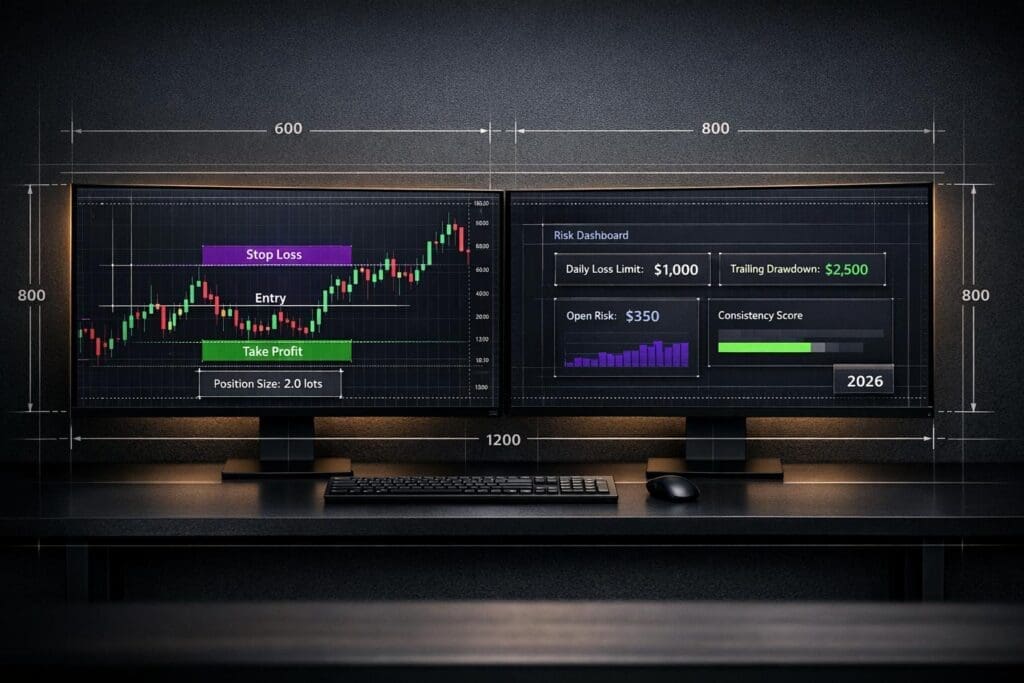
In futures prop trading, managing risk and scaling capital are the two key factors for long-term success. Prop firms allocate funds to traders based on strict rules, ensuring both risk control and consistent performance. Here’s what you need to know:
- Risk Management: Firms enforce daily loss limits ($500–$5,000) and maximum drawdowns (2%–5%) to protect capital.
- Scaling Capital: Traders who hit profit targets (5%–15%) can see allocations grow by 25%–100%, potentially managing accounts up to $20 million.
- Position Sizing: Risk per trade is typically 0.5%–1% of account balance, with position limits tied to account size and market volatility.
- Consistency Metrics: Firms evaluate steady performance, capping single-day profits at 40% of total gains to ensure repeatable strategies.
- Volatility Adjustments: Tools like the VIX index guide traders to reduce exposure during turbulent markets.
Success hinges on discipline: follow firm rules, manage risk tightly, and aim for steady growth. Tools like trade copiers and consistency calculators can streamline multi-account management. For more details, see the full breakdown of risk controls, scaling strategies, and firm-specific rules.
Risk-Based Capital Allocation Rules
Risk-based allocation rules are designed to protect traders from catastrophic losses and help them maintain long-term viability. Prop firms closely monitor both your account balance and real-time equity, which includes floating profit and loss from open positions. A single poorly managed trade can result in a breach before it’s even closed. With 60% of evaluation breaches linked to revenge trading, these automated safeguards are crucial for curbing impulsive behavior. Below, we’ll explore the key risk controls that shield your account in volatile markets.
"Your primary job as a trader is not to maximize gains on every trade, but to stay in the game long enough to let your edge play out over time." – Prop Firm Plus
Maximum Drawdown Limits
Maximum drawdown limits cap how much you can lose before the firm steps in. Most prop firms enforce limits between 2% and 5% of your allocated capital. For instance, on a $50,000 account with a 5% drawdown limit, losing $2,500 would trigger account suspension.
During evaluations, firms often use trailing drawdowns. These adjust upward as your equity hits new highs, including unrealized gains, but never drop back down. This means that even if your overall account remains profitable, a sudden market reversal could still result in a breach if your equity dips below the adjusted threshold.
| Drawdown Type | How It’s Calculated | Impact on Your Trading |
|---|---|---|
| Static Drawdown | Fixed dollar amount from the starting balance | Easiest to manage; profits increase your safety buffer |
| Trailing Drawdown | Tracks the highest equity peak | More restrictive; profits don’t extend the buffer |
| End-of-Day (EOD) | Based on balance at market close | Better for swing traders; ignores intraday swings |
To protect yourself, consider setting a personal stop at 70% to 80% of the firm’s drawdown limit. For example, if the maximum drawdown is $2,500, stop trading once losses hit $1,750 to $2,000. This buffer can help you avoid sudden disqualifications caused by rapid market movements or slippage.
Position Sizing Caps
Position sizing determines how many contracts you can trade based on your account balance and risk tolerance. The formula looks like this:
Position Size = (Account Balance × Risk %) ÷ (Stop Loss Distance in Ticks × Tick Value)
For example, on a $50,000 account risking 1% ($500) with a 10-tick stop (worth $12.50 per tick), you could trade 4 contracts. If you increase the stop-loss distance, the number of contracts you can trade decreases to maintain the same dollar risk.
Prop firms generally cap position sizes at 10% to 15% of your account balance per trade. When markets become more volatile, reducing your position size can help manage risk. For specific strategies, refer to the volatility adjustment section.
Daily and Trailing Loss Thresholds
Daily loss limits reset every 24 hours and typically range from $500 to $5,000, depending on your account size. For a $50,000 account, a common daily cap is around 3%, or $1,500. Exceeding this limit can result in a locked account for the day or even suspension of your evaluation.
To avoid blowing through your daily cap, some firms enforce a "2-Strike Rule", which requires traders to stop after two consecutive losses.
Trailing loss thresholds, on the other hand, track your highest equity peak – including open positions – and adjust upward as your account grows. Once a new high is established, it becomes your new baseline, leaving less room for error. As one source explains:
"Trailing drawdown makes recovery harder. After losses, drawdown threshold doesn’t improve until you exceed previous high." – dealpropfirm.com
To stay ahead, lock in profits by converting unrealized gains into cash through partial exits or trailing stops. This way, you can avoid a scenario where a market reversal pushes your equity below the trailing threshold. Before each session, calculate the exact level that would trigger a breach based on your current trailing floor. Knowing these numbers keeps you disciplined and helps safeguard your capital session by session.
Performance-Based Capital Allocation Strategies
Once traders meet the necessary risk controls, firms shift their focus to evaluating consistent, repeatable profits. Performance-based scaling rewards traders who maintain steady profitability over 60 to 90-day periods. This approach complements earlier risk-based measures, creating a path for account growth.
Profit Targets and Scaling Plans
Scaling plans in proprietary trading firms are often structured into tiers, each with defined profit targets. For example, a starter account ranging between $10,000 and $50,000 might require traders to achieve a 10% to 15% profit margin to progress. At higher levels, like elite accounts, the required profit percentage drops – often around 5% per quarter – but comes with stricter drawdown limits.
Capital increases for traders meeting monthly profit targets (typically between 5% and 12%) can range from 25% to 100%. Some firms add additional criteria, such as maintaining a Sharpe ratio above 2.0, to unlock quarterly capital increases of 25% to 50%. For traders starting with a $10,000 account, scaling up to $100,000 in allocation usually takes 6 to 12 months of consistent performance.
"Risk management is the core priority. Capital allocation grows only when a trader demonstrates discipline, stability, and respect for defined loss limits." – FunderPro
Many traders achieve growth by managing multiple accounts at once. For example, Apex Trader Funding allows traders to manage up to 20 accounts, with total allocations reaching several million dollars. These firms often provide tools like trade copiers to ensure consistency across portfolios. As traders near key profit milestones or payout thresholds, they are advised to reduce position sizes to avoid a "last-mile" drawdown that could jeopardize their progress.
This structured approach to scaling naturally emphasizes the importance of consistent daily performance.
Consistency Metrics and Account Increases
Profitability alone isn’t enough – firms also evaluate how profits are generated. A common rule caps any single day’s profit contribution at 40% of the total profit. For instance, at MyFundedFutures, the Starter Plan enforces this 40% rule during the funded stage.
"The consistency rule is a requirement that ensures traders generate profits through steady, repeatable performance rather than relying on a single outsized trade." – MyFundedFutures
Exceeding this threshold doesn’t lead to immediate disqualification, but it does require traders to continue generating profits until the percentage from the "big day" falls below the limit. To meet these consistency metrics, traders are encouraged to use smaller positions and spread their gains more evenly across trading days. Additionally, firms often require a minimum number of active trading days – typically five or more – to confirm that a trader’s strategy is sustainable and repeatable over time.
As traders scale up, maintaining disciplined risk management becomes even more critical. For instance, while risking 1% per trade might be appropriate for a $50,000 starter account, traders often lower this to 0.25% per trade on a $1,000,000 elite account. This gradual reduction in risk prioritizes capital preservation and supports the smooth, upward equity curve that firms value most.
Position Sizing and Leverage Rules for Futures Contracts
Initial and Maintenance Margin Requirements
Futures margin works as a performance bond, ensuring that traders fulfill their contractual obligations – it’s not the same as borrowing money. Exchanges set two primary thresholds: the initial margin, which is the amount required to open a position, and the maintenance margin, which is the minimum balance needed to keep that position active.
Take the E-mini S&P 500 (ES) contract as an example. With a notional value of around $240,000, the initial margin requirement is roughly $13,200 – about 5.5% of the contract’s value. Similarly, the E-mini Nasdaq-100 (NQ) contract typically requires an initial margin of $19,000, or about 5.0% of its notional value. This built-in leverage means that even a small market move, such as a 1% drop, can have a major impact. At 20:1 leverage, that 1% move could wipe out 20% of your margin deposit.
| Contract | Point/Tick Value | Initial Margin (Est.) | Margin % |
|---|---|---|---|
| E‑mini S&P 500 (ES) | $50 per point | $13,200 | 5.5% |
| E‑mini Nasdaq‑100 (NQ) | $20 per point | $19,000 | 5.0% |
| WTI Crude Oil (CL) | $10 per tick | $5,500 | 7.3% |
| Gold (GC) | $10 per tick | $12,000 | 5.0% |
Prop trading firms often impose additional risk controls beyond the exchange’s margin requirements. For example, while the CME might require $13,200 for a single ES contract, prop firms enforce daily loss limits and drawdown thresholds that effectively limit the number of contracts you can trade. If your account balance dips below the maintenance margin, a margin call is triggered. However, in most prop trading setups, you’ll likely hit the firm’s daily loss limit before reaching this point. These rules form the foundation for calculating position sizes, which we’ll break down next.
Contract Limits by Account Size
Position sizing builds on margin requirements, helping traders determine how many contracts they can trade while staying within their risk tolerance. A common rule of thumb in the industry is to risk between 0.5% and 1% of your account equity on a single trade. For instance, with a $50,000 account, risking 1% ($500) on a trade with a 20-tick stop (approximately $250 per contract) allows you to trade up to 2 standard ES contracts.
For more flexibility, traders often use Micro E-mini contracts (MES). These smaller contracts have a $5-per-point value compared to $50 for standard ES contracts, allowing for finer adjustments in position sizing. Under similar risk parameters, traders might choose to trade 2 to 5 Micro contracts instead of standard contracts.
Here’s an example of position sizing based on a 20-tick stop for ES contracts:
| Account Size | Recommended Risk (1%) | Stop Loss (ES Ticks) (≈ Risk per Contract) | Max Position Size (Standard ES) |
|---|---|---|---|
| $50,000 | $500 | 20 ticks (≈ $250) | 2 contracts |
| $100,000 | $1,000 | 20 ticks (≈ $250) | 4 contracts |
| $150,000 | $1,500 | 20 ticks (≈ $250) | 6 contracts |
Risk controls like account-specific limits and trailing drawdowns provide an added layer of safety. For instance, at Apex Trader Funding, the trailing drawdown adjusts with every tick of open equity. This means your safety buffer doesn’t expand as your profits grow. In a $50,000 evaluation account with a $2,500 maximum loss (leaving a $47,500 threshold), many traders stick to 1 Mini or 2–3 Micro contracts to maintain a comfortable margin. It’s smart to stop trading once you’ve used 70–80% of your daily drawdown limit, as this helps avoid breaches caused by slippage or sudden market volatility.
Volatility and Market Condition Adjustments
Adjusting for volatility is a key strategy to protect capital during unpredictable market conditions.
VIX-Based Position Reductions
Market volatility isn’t constant. When it spikes, a position that once seemed safe can quickly become risky. The VIX index, often referred to as the "fear gauge", measures expected volatility in the S&P 500 and helps traders decide when to adjust their exposure.
"Volatility is a regime. When ranges expand, spreads widen, and correlations break, the same position size that felt conservative last month can become reckless overnight." – Jasman Mann, International Trading Institute
A simple way to manage this is by using three VIX thresholds to guide position sizing:
- Below 20: Stick to your usual position sizing and risk.
- 20–30: Reduce your position size by 50%.
- Above 30: Focus only on your strongest trading setups or step back entirely.
This tiered plan helps avoid overexposure when markets are turbulent.
| VIX Level | Market Condition | Recommended Action |
|---|---|---|
| Below 20 | Calm/Low Volatility | Normal position sizing and risk |
| 20–30 | Elevated Volatility | Cut position size by 50% |
| Above 30 | High/Extreme Volatility | Trade only high-conviction setups or pause trading |
In addition to the VIX, the 14-day Average True Range (ATR) can offer more specific insights. When the ATR rises above its 6-month median, institutional traders often reduce their risk per trade by 25–50%.
These tools provide a structured way to manage exposure during volatile markets.
High-Volatility Exposure Limits
In highly volatile conditions, it’s wise to cap total account risk at 3–5% of your balance. This prevents hidden risks that can arise when multiple small trades add up to a significant exposure.
Volatility also brings wider spreads and lower liquidity, which can lead to slippage during trade execution. To counter this, consider scaling into positions more cautiously. For example, if you usually trade 4 ES contracts, enter with just 2 contracts at a time during volatile periods. This approach gives you more control and reduces the risk of poor fills.
Another challenge is how volatility interacts with trailing drawdowns. A sudden market spike can push your account to a new high, raising your drawdown threshold. If the market then reverses quickly, you might hit your drawdown limit even if the trade eventually turns profitable. To mitigate this, lock in partial profits during volatile runs.
Lastly, consider a tiered drawdown system to manage risk as losses accumulate. For example:
- At a 5% drop from your peak: Reduce trade risk by 25%.
- At a 10–15% drop: Cut trade risk by 50%.
- At a 15% drop: Stop trading for 24–72 hours.
This structured approach helps keep risk in check during unstable markets.
sbb-itb-46ae61d
Prop Firm-Specific Allocation Rules
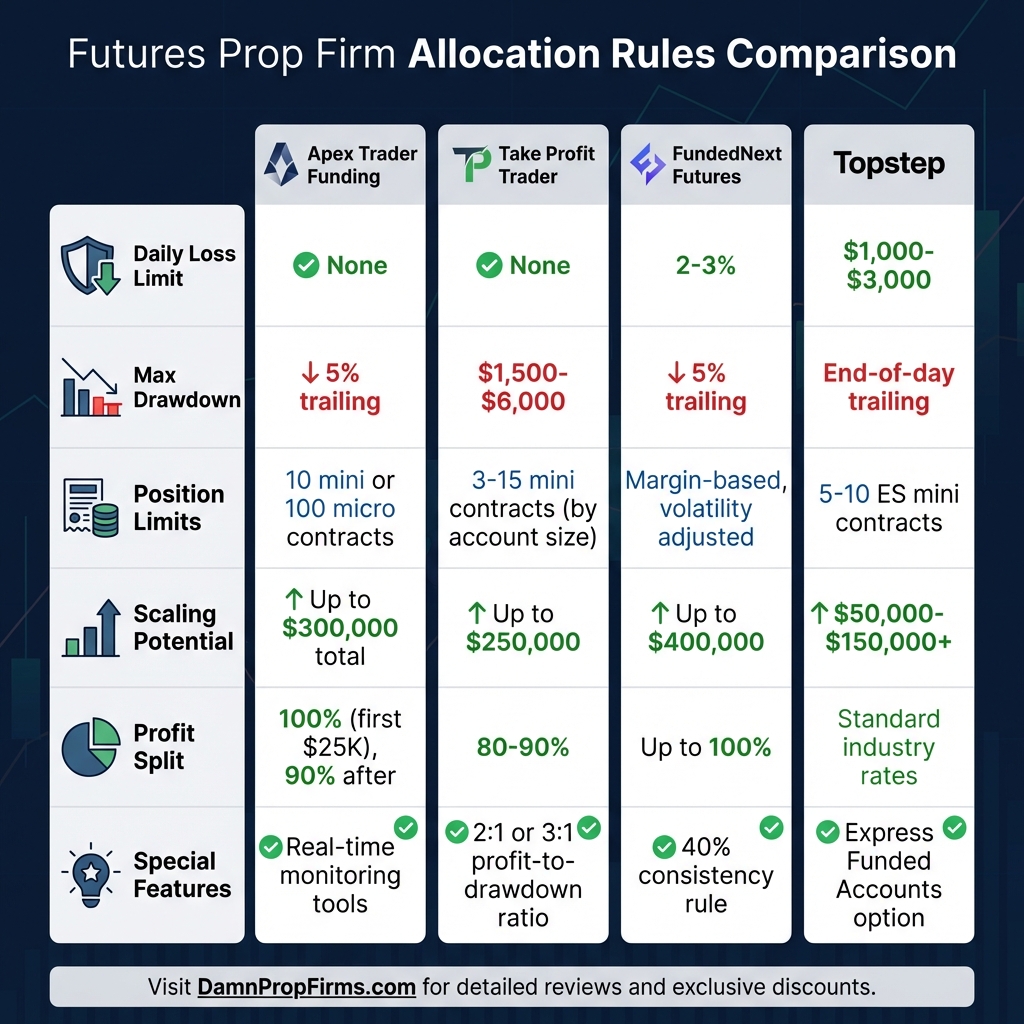
Futures Prop Trading Capital Allocation Rules Comparison by Firm
Futures prop firms each have their own set of rules for capital allocation, covering things like position limits and drawdown thresholds. Knowing these details is crucial for selecting a firm that aligns with your trading preferences and risk tolerance. Let’s break down how some of the top futures prop firms structure their allocation rules.
Apex Trader Funding Rules

Apex Trader Funding uses a trailing drawdown model and does not impose daily loss limits, allowing traders more flexibility during the day. For instance, a $50,000 account has a trailing drawdown of $2,500 (5%). Position limits start at 10 mini contracts or 100 micro contracts. Traders can manage multiple accounts, with some handling up to $300,000 in total capital. The firm evaluates drawdowns at the end of the day and provides real-time monitoring tools to help traders avoid overleveraging. Profit splits are generous – 100% on the first $25,000 in profits and 90% after that. For more details, check out our Apex Trader Funding Review.
Take Profit Trader Rules

Take Profit Trader sets contract limits based on account size, ranging from 3 mini contracts for a $25,000 account to 15 mini contracts for a $150,000 account. They use a trailing drawdown model with a profit target-to-drawdown ratio of 2:1 or 3:1. Drawdown limits vary from $1,500 to $6,000, depending on account size, and there’s no daily loss limit. Traders who maintain consistent performance can qualify for larger accounts, up to $250,000. Profit splits range from 80% to 90%, rewarding steady results. Learn more in our Take Profit Trader Review.
FundedNext Futures Rules

FundedNext Futures enforces both daily loss limits (2–3%) and a trailing max drawdown of 5%. For example, a $100,000 account has a daily loss cap of $2,000. The firm also has a 40% consistency rule, limiting any single day’s profit to 40% of total gains. Position limits are tied to margin buffers, adjusted for volatility. Traders can scale up their accounts by hitting profit milestones, with profit splits reaching 100% after evaluation. For more information, visit our FundedNext Futures Review.
Topstep Rules

Topstep enforces strict daily loss limits, ranging from $1,000 to $3,000 depending on the size of the Trading Combine. They also use an end-of-day trailing drawdown. A $150,000 account, for instance, has a $3,000 daily loss limit and a $13,000 profit target to qualify for funding. Contract limits are capped at 5–10 ES mini contracts. The firm emphasizes risk management, requiring traders to maintain 1–2% risk per trade and trade for a minimum of 5 days. Scaling plans allow traders to grow accounts to $150,000+ with increased contract allowances. The Express Funded Accounts option provides quicker access to capital for experienced traders. See our Topstep Review for more details.
Quick Comparison Table
Here’s a side-by-side look at the allocation rules for these firms:
| Firm | Daily Loss Limit | Max Drawdown | Position Limits (Example) | Scaling Potential |
|---|---|---|---|---|
| Apex Trader Funding | None | 5% trailing | 10 mini or 100 micro contracts | Up to $300,000 total |
| Take Profit Trader | None | $1,500–$6,000 | 3–15 mini contracts by account size | Up to $250,000 |
| FundedNext Futures | 2–3% | 5% trailing | Margin-based, volatility adjusted | Up to $400,000 |
| Topstep | $1,000–$3,000 | End-of-day trailing | 5–10 ES mini contracts | $50,000–$150,000+ |
For more insights and exclusive discounts, visit DamnPropFirms. Their reviews and tools, like the Consistency Rule Calculator, can help you navigate these firms’ rules and find the best match for your trading strategy. Each firm’s approach to capital allocation highlights the importance of aligning your strategy with their risk management guidelines.
Tools for Managing Capital Allocation Rules
Effectively managing capital allocation rules requires the right tools, especially when handling multiple accounts. Without automation, traders often face delays and errors, particularly when managing more than three accounts. Automation tools not only streamline this process but also align seamlessly with broader risk management strategies.
Consistency Rule Calculators
The Consistency Rule Calculator on DamnPropFirms is a handy tool for traders to calculate the total profit required before requesting a payout. The formula is straightforward: Biggest Profit Day ÷ Consistency %. For example, if you’re trading a $150,000 account at Tradeify with a 20% consistency rule, and your most profitable day nets $2,500, you’d need total profits of $12,500 ($2,500 ÷ 0.20) to qualify for a payout.
This method discourages "lottery" trading, where one highly profitable day skews overall performance. Most firms set consistency thresholds between 20% and 35%, though platforms like Topstep and Take Profit Trader allow up to 50%. Exceeding the consistency rule doesn’t result in account termination but raises the profit target until your largest day aligns with the required percentage. By using the calculator, traders can aim for steady daily profits rather than relying on sporadic big wins.
For those managing multiple accounts, automation tools can further simplify these calculations and ensure consistency.
Trade Copying for Multi-Account Scaling
Trade copying tools, such as TradeSyncer, are game-changers for traders managing multiple accounts. These tools replicate trades across accounts within milliseconds, eliminating the delays and errors of manual execution. For example, managing 10 accounts with a $50,000 balance each, and achieving a 2% monthly return, could yield $9,000 per month (at a 90% profit split), compared to just $900 with a single account.
Automated copiers also include multiplier settings to adjust position sizes according to account balances, ensuring consistent risk management. TradeSyncer supports various firms, including Alpha Futures, Apex Trader Funding, Tradeify, Lucid Trading, and FundedNext Futures.
For traders managing more than three accounts, professional trade copiers are indispensable. They replicate trades instantly across all accounts, avoiding slippage and ensuring seamless execution. This level of automation not only saves time but also helps maintain consistent performance across multiple accounts.
Conclusion
Following strict capital allocation rules is crucial for protecting your futures prop trading account. Statistics show that 95% of evaluation failures are due to poor risk management, not flawed strategies. Even if you’ve been consistently profitable, breaching daily loss limits or maximum drawdown thresholds will result in immediate account termination.
The risk controls discussed earlier emphasize the importance of disciplined capital management. To succeed, stick to these core principles: risk only 0.5–1% of your account per trade, stop trading after two consecutive losses, and keep a close eye on real-time equity. These habits separate professional traders from gamblers and can lead to quarterly capital growth of 25–50%.
"Risk management is not optional. It’s not something you add later. It’s the foundation of every successful prop trading career." – DealPropFirm
Set personal circuit breakers at 50–60% of your firm’s limits to create a safety buffer. Always calculate your position size accurately – guesswork has no place in trading. If you’re managing multiple accounts, consider using trade copiers to reduce execution errors.
FAQs
How do I calculate my contract size for a trade?
To figure out your contract size for a futures trade, start by identifying how much you’re willing to risk on the trade and the tick value of the contract. Then, divide your risk amount by the dollar value of a single tick. Keep in mind the contract’s tick size and multiplier when doing this.
For instance, if you’re risking $1,000 and each tick is worth $50, the formula would be: Risk per trade ÷ Tick value. This would give you the number of contracts you should trade. Make sure to adjust your contract size so it aligns with the risk limits of your account.
What’s the difference between static and trailing drawdown?
A static drawdown sets a fixed loss limit that remains constant, no matter how your account performs. On the other hand, a trailing drawdown moves upward as your account hits new highs, offering more room for risk as your account grows. These tools are essential for managing risk in futures prop trading. Knowing how they differ can help you tailor your trading strategy to fit the rules of your prop trading firm.
How can I scale up without breaking consistency rules?
To grow your trading account while sticking to consistency rules, disciplined risk management is key. Follow prop firm guidelines by using strategies like strict position sizing – risking only 1-2% per trade. Spread your profits across multiple days or accounts to steer clear of drawdown violations. Gradually scaling up, starting with smaller accounts, allows you to build a track record of consistency. This approach helps ensure steady growth without jeopardizing your account.