
When trading with prop firms, understanding static and trailing drawdowns is crucial for managing risk and passing evaluations. These drawdown models define how much loss your account can sustain before breaching limits, shaping your trading strategy significantly. Here’s a quick breakdown:
- Static Drawdown: Fixed at the starting balance and does not increase with profits. Offers a stable risk limit, making it easier to plan trades. Ideal for swing and position traders.
- Trailing Drawdown: Adjusts upward as your account equity hits new highs. This dynamic model locks in gains but reduces your safety net, requiring constant monitoring. Best for scalpers and day traders.
Quick Comparison
| Feature | Static Drawdown | Trailing Drawdown |
|---|---|---|
| Risk Limit | Fixed, based on starting balance | Moves up with equity peaks |
| Monitoring Needed | Minimal | High, due to dynamic adjustments |
| Best For | Swing/position traders | Scalpers/day traders |
| Safety Net | Grows as profits grow | Shrinks as equity rises |
Both models have unique challenges and benefits. Static drawdowns are predictable but don’t lock in profits, while trailing drawdowns reward gains but tighten risk limits. Understanding how these work is essential to align with your trading style and avoid account breaches.
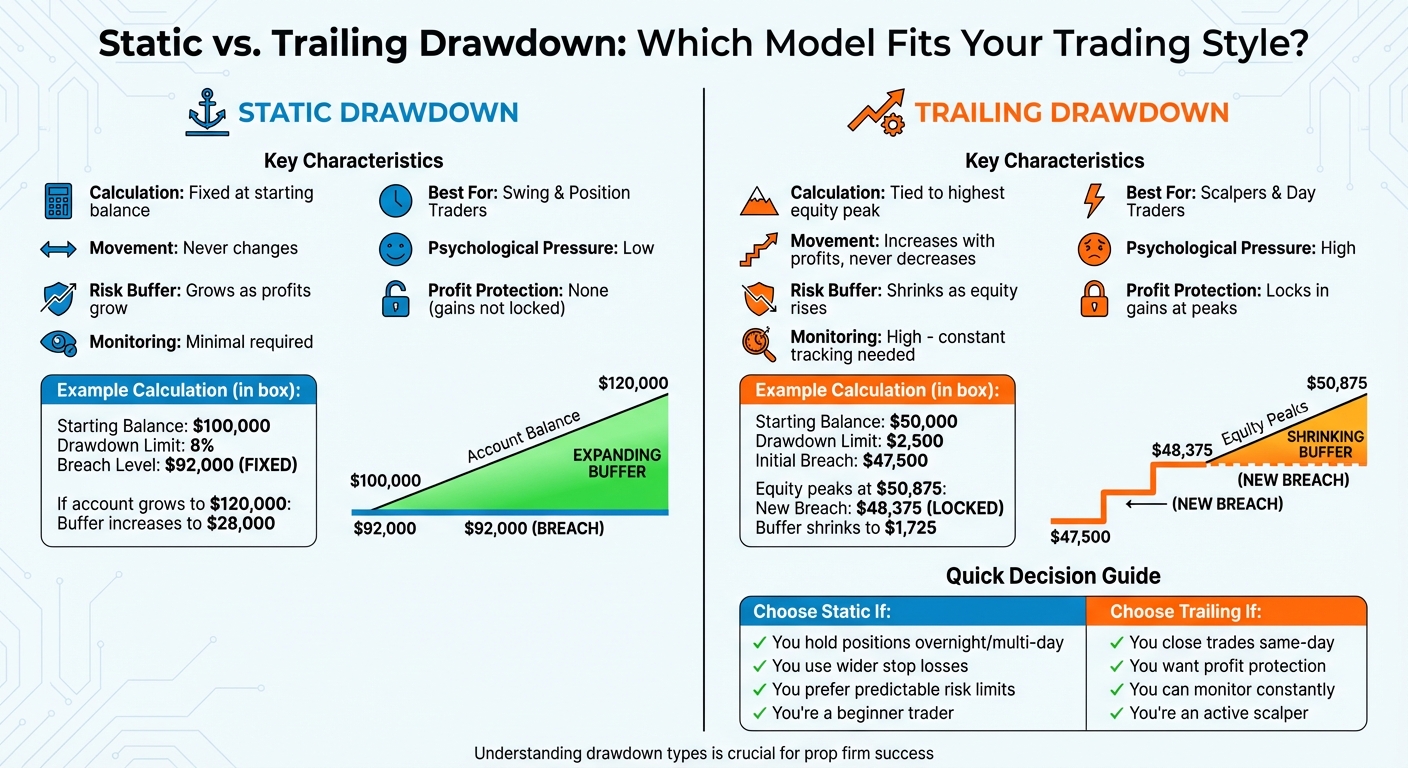
Static vs Trailing Drawdown Comparison Chart for Prop Traders
Static vs Trailing Drawdown: Prop Firm Showdown! Day Trading
What Is Static Drawdown?
Static drawdown is a fixed risk limit that stays anchored to your account’s starting balance. This means your account equity can never fall below a set level, which is determined on day one and remains unchanged – no matter how much profit you make or how high your balance grows.
This setup simplifies risk planning since you know your exact breach level from the start. For example, if your account grows from $100,000 to $115,000, the drawdown floor remains at the original level, creating a larger safety buffer as your profits increase. Let’s break down how static drawdown is calculated and what it means in practice.
How Static Drawdown Works
Static drawdown is based on a straightforward formula:
Starting Balance – (Starting Balance × Drawdown Percentage) = Minimum Allowed Equity.
Here’s an example: If your account starts at $100,000 with an 8% drawdown limit, the calculation would be:
$100,000 – $8,000 = $92,000.
This means your account equity must never drop below $92,000. Even if your account grows to $115,000, the breach level remains locked at $92,000, giving you a $23,000 cushion .
It’s important to note that the drawdown includes all aspects of your trading activity – floating profit and loss, commissions, and swaps. An open losing trade could trigger a breach if your real-time equity hits the set floor. This fixed structure has both benefits and drawbacks, which we’ll explore next.
Pros and Cons of Static Drawdown
Static drawdown has its perks, but it’s not ideal for every trader:
| Advantages | Disadvantages |
|---|---|
| Predictable and easy to track – The breach level stays constant, so you always know your risk. | No profit protection – Gains aren’t locked in, meaning profits can be wiped out if trades go south. |
| Growing risk buffer – As your balance increases, the gap between your equity and the drawdown floor widens. | Can encourage risky behavior – The fixed cushion might tempt traders to over-leverage early on. |
| Great for swing traders – Ideal for those holding positions through market fluctuations. | Less common in futures trading – Many futures firms favor trailing models, making static accounts less available. |
| Lower psychological pressure – You’re not penalized for account growth, unlike with trailing drawdowns. | Higher cost – Static accounts are often priced as premium offerings due to their safer design. |
"Static drawdowns are easy to understand and manage, making them great for beginners. However, they can be a bit limiting since they don’t adjust based on how well you’re doing." – The Trusted Prop
Your trading style plays a big role in deciding if static drawdown is right for you. If you often hold positions overnight or trade during volatile sessions, this model can provide the flexibility to handle market swings without the stress of shifting risk limits.
What Is Trailing Drawdown?
Trailing drawdown is a dynamic risk limit that adjusts upward as your account equity hits new highs, locking in each peak as a new threshold. Unlike static drawdown, which stays tied to your starting balance, trailing drawdown follows your highest equity point. Traders often refer to this as the "ratchet effect" – once the drawdown level moves up due to a profit peak, it stays locked at that higher point. If your equity falls to or below this moving limit, your account is considered breached.
"It’s called trailing because it trails your best equity, not balance. If you’re in a trade and your equity spikes, the trailing drawdown adjusts upward." – Fred Harrington, Founder, Vetted Prop Firms
This approach is widely used by futures prop firms, making it a common structure for traders to navigate. Knowing how it works – and how it can unexpectedly impact your trading – is essential before diving in.
How Trailing Drawdown Works
Trailing drawdown is straightforward: it tracks your account’s highest equity peak and adjusts your breach level accordingly. The formula is:
Trailing Drawdown Level = Highest Equity Reached – Maximum Allowed Drawdown Amount.
Here’s an example: You start with a $50,000 account and a $2,500 trailing drawdown limit. Initially, your breach threshold is $47,500 ($50,000 – $2,500). During a trade, your unrealized equity spikes to $50,875. At that point, the trailing drawdown moves up to $48,375 ($50,875 – $2,500). If the trade reverses and you close it at $50,100, the threshold remains at $48,375 – it doesn’t drop back. Your cushion shrinks from $2,500 to $1,725, even though you’re still in profit.
This "shrinking buffer" effect means that as your account grows, the fixed dollar drawdown limit feels tighter, reducing your effective safety net.
There are three key types of trailing drawdown:
- Intraday (Equity-based): Adjusts in real-time based on unrealized profits. A temporary equity spike can raise the drawdown floor, even if the trade isn’t closed. This type is often the most demanding.
- End-of-Day (EOD): Updates only after the market closes, based on your settled balance. This gives traders some breathing room during intraday fluctuations.
- Breakeven/Locking: Trails your account growth until it reaches your starting balance (or starting balance plus a small buffer), at which point it stops moving and becomes a static limit.
"The unrealized trailing drawdown at Apex Trader Funding is the single biggest rule that trips up traders. Unlike a static drawdown, it moves up with your account’s highest unrealized gains and never moves back down." – Kyle Kozlowski, Editor, DamnPropFirms
For example, in September 2025, Apex Trader Funding’s $50,000 evaluation used a $2,500 trailing drawdown. If a trader’s unrealized equity reached $50,875, the drawdown threshold would rise to $48,375. If the account then dropped to that level without the trader locking in gains, the account would be liquidated – even though the balance remained above the starting $50,000.
This tightening safety net highlights the careful balance required when managing trailing drawdown effectively.
Pros and Cons of Trailing Drawdown
Trailing drawdown comes with both benefits and challenges:
| Advantages | Disadvantages |
|---|---|
| Helps preserve gains by locking in equity peaks. | Requires constant monitoring of equity levels. |
| Encourages traders to secure profits early. | You can breach the threshold while still in net profit. |
| Often lowers account costs since firms take on less risk. | The safety buffer shrinks as your account grows. |
| Promotes disciplined risk management by limiting over-leveraging. | Intraday equity spikes can permanently raise your risk limit. |
"Trailing drawdown is not your enemy, it’s a test. It rewards consistency, punishes recklessness, and separates real traders from lucky ones." – Seb, Maven Trading
Whether trailing drawdown works for you depends on your trading style. Scalpers and active day traders who lock in profits quickly often find it manageable. On the other hand, swing traders holding positions through market swings may find the rising floor adds significant pressure.
Static vs. Trailing Drawdown: Key Differences
Static drawdown stays locked at the starting balance, while trailing drawdown adjusts upward with new equity highs. This fundamental distinction creates vastly different trading dynamics.
Feature Comparison
| Feature | Static Drawdown | Trailing Drawdown |
|---|---|---|
| Calculation Method | Based on starting balance minus a fixed percentage or dollar amount | Tied to the highest equity peak minus the allowed loss amount |
| Movement Pattern | Fixed; does not change | Increases with profits; never decreases |
| Risk Buffer | Grows as profits grow | Can shrink as equity rises |
| Monitoring Needs | Minimal; set from the start | High; requires ongoing real-time tracking |
| Best Trading Style | Swing and position trading | Scalping and day trading |
| Flexibility | Greater buffer as profits accumulate | Tight buffer regardless of profit levels |
With static drawdown, your safety net grows alongside your profits. For instance, thePropTrade offers Classic programs with an 8% static limit on a $100,000 account, meaning the failure level is locked at $92,000. If the account grows to $120,000, the buffer increases to $28,000.
Trailing drawdown operates differently. At Apex Trader Funding, a $50,000 account with a $2,500 trailing limit begins with a $47,500 threshold. If equity peaks at $50,875 during a trade, the threshold rises to $48,375, leaving only a $1,725 buffer – even though the account is in profit.
These contrasting mechanics highlight how each drawdown type influences trading strategies and risk management.
Which Type Is Harder to Manage?
Trailing drawdown is significantly more challenging to manage. Its dynamic nature demands constant attention to floating equity rather than just closed balances. When a trade hits a peak and then reverses, the drawdown floor locks at that high mark, effectively tightening the risk buffer. This can be particularly stressful for traders, as even a profitable account can face a narrow margin for error.
Static drawdown, on the other hand, offers a more relaxed experience. With a fixed failure point established from the outset, swing traders can ride out market fluctuations without worrying that intraday spikes will tighten their drawdown limit. The need to track real-time equity peaks, combined with the unforgiving nature of a limit that only moves upward, makes trailing drawdown far more demanding to handle.
"Trailing drawdown may sound like some boring risk management term, but in reality, it’s the silent killer of prop firm evaluations." – Fred Harrington, Founder, Vetted Prop Firms
"Static drawdown is one of the most predictable, stable, and trader-friendly risk models in the funded trading industry." – thePropTrade
sbb-itb-46ae61d
Choosing the Right Drawdown Type for Your Trading Style
Your trading style and risk tolerance play a big role in choosing the right drawdown model. The timeframe of your trades often determines which model suits you best. For example, swing traders – who hold positions for days or weeks – tend to prefer the consistency of a static drawdown. On the other hand, scalpers, who execute numerous trades daily, often benefit from the discipline enforced by a trailing drawdown.
These two models handle market fluctuations differently. Static drawdown acts as a fixed safety net, giving trades room to withstand normal pullbacks without tightening restrictions. Trailing drawdown, however, continuously adjusts, encouraging traders to lock in gains quickly. This makes it a better fit for those who close positions rapidly, but it can be a challenge for trend traders who rely on extended market movements. Ultimately, your risk tolerance and the type of assets you trade should guide your decision.
Risk tolerance is a key factor. Trailing drawdowns can feel daunting for beginners because the breach level moves as equity peaks. One big win followed by a reversal can permanently raise the risk floor, potentially turning a profitable account into a losing one. Static drawdown removes this concern by keeping the breach level constant, offering a more predictable experience from the start.
The asset class you trade also matters. Futures prop firms, like Apex Trader Funding and Take Profit Trader, often use trailing drawdown models. In contrast, CFD and Forex firms typically favor static drawdowns.
Static Drawdown for Swing and Position Traders
Static drawdown is ideal for swing traders who need flexibility to let positions mature over several days or weeks. This model anchors the breach level to the starting balance, ensuring it never moves upward, even as profits grow.
For instance, Maven Trading offers an 8% static drawdown on its 2-step accounts. On a $100,000 account, the failure level is fixed at $92,000. As the account grows – let’s say to $115,000 – the buffer expands to $23,000. This added cushion gives traders the confidence to increase position sizes without worrying about tighter risk limits.
Static drawdowns also reduce stress during overnight or weekend holds. Market gaps or sudden volatility spikes won’t affect the fixed breach level, allowing traders to focus on their strategy rather than constantly monitoring equity peaks. Once traders build a profit cushion of 2–3%, they gain even more room to let winning trades run.
"Static drawdown is one of the most predictable, stable, and trader-friendly risk models in the funded trading industry." – thePropTrade
Position traders, who hold trades for weeks or months, find static drawdowns especially helpful. This model accommodates natural price retracements in trending markets without triggering violations, making it an excellent choice for longer-term strategies.
Trailing Drawdown for Scalpers and Day Traders
For scalpers and day traders, trailing drawdown offers a structure that rewards discipline. This model is designed to prevent traders from letting profitable trades turn into losses – a common pitfall for high-frequency traders.
The mechanics of trailing drawdown encourage quick exits. When equity spikes, the breach level adjusts upward, pressuring traders to lock in profits before a reversal erases gains. This urgency can be a double-edged sword, but for those who thrive on rapid trades, it’s a valuable tool.
Traders using trailing drawdowns should focus on securing profits early, especially if the firm applies intraday equity-based trailing. Major news events, like CPI releases, can cause sharp market spikes that quickly raise the breach level, leaving traders vulnerable to reversals. Monitoring the highest equity point during each session is crucial, as it determines the new breach level.
"Trailing drawdown is one of the most misunderstood risk management rules in prop firm challenges and one of the most brutal if you get it wrong." – Seb, Maven Trading
Some firms offer hybrid options. For example, TradingFunds uses a "trailing lock", where the drawdown stops moving once the account reaches break-even. This approach provides more flexibility, making it a good fit for traders transitioning from static to trailing models.
How to Manage Trailing Drawdown in Futures Trading
Managing trailing drawdown effectively requires a cautious and calculated approach. Since even a modest profit locks in a higher threshold, it’s wise to treat gains conservatively. For example, a $500 profit should be viewed as moving your limit $500 to $1,000 closer, creating a buffer to absorb sudden market reversals or cover commission fees without breaching your threshold. If your account shows a $47,500 threshold, mentally adjust it to $48,000 to maintain a safety margin. Many experienced traders suggest setting a personal daily loss limit that’s 30% to 50% stricter than the firm’s official cap, especially during volatile sessions, to protect this cushion.
When trading correlated contracts like ES and NQ, consider their combined risk. A sharp move in one can quickly affect the other, doubling your exposure and increasing the chances of exceeding your limit in seconds. After a strong trading session that raises your equity peak, focus on reducing position sizes to safeguard the newly established buffer instead of increasing your risk aggressively.
Position Sizing and Risk Management
Proper position sizing should align with market volatility rather than personal conviction. Tools like the Average True Range (ATR) can help determine how many contracts you can manage without risking a drawdown breach during normal price fluctuations. In higher volatility conditions, reduce your position sizes to keep potential losses within your buffer.
Stick to risking only 0.5%–1% of your account per trade. For instance, on a $50,000 account, this translates to risking $250 to $500 per trade. This disciplined approach ensures you can withstand losing streaks without erasing your progress. Before starting each session, review your trailing threshold and calculate your maximum allowable risk accordingly.
Always keep a $100 to $300 buffer above your liquidation level to account for commissions, slippage, and minor price dips. If you’re trading on an End-of-Day (EOD) trailing model, close all positions before the session ends to avoid overnight price gaps that could trigger a violation at the next market open. By adhering to these guidelines, you can protect your newly established thresholds. To further enhance precision and eliminate emotional decision-making, consider using automation tools.
Using Automation Tools
Automation can help you avoid the emotional pitfalls that often lead to drawdown violations. Bracket orders (OCO) are particularly useful, as they automatically apply a stop-loss and profit target when you enter a trade. This ensures a predefined risk-to-reward ratio and eliminates the need for manual adjustments, which can be critical during fast-moving markets where hesitation can result in significant losses.
"Bracket/OCO Orders… automate exits to prevent hesitation. Brackets enforce defined risk-to-reward and keep drawdown usage predictable during fast markets." – FunderPro
Trading platforms like RTrader Pro offer tools such as the "Auto Liquidate Threshold", which tracks your adjusted stop-loss in real time. Similarly, Tradovate includes features in its account dropdown menu that allow you to monitor your failure line at any moment. Regularly check these tools, especially after profitable trades, to stay informed about your remaining buffer.
For traders managing multiple prop firm accounts, tools like TradeSyncer can sync trades across accounts while providing cloud-based analytics to monitor drawdown levels. This can be particularly helpful for evaluations with firms like Tradeify or FundedNext Futures. Additionally, specialized risk calculators and daily trackers can dynamically adjust your position sizes based on your current buffer, giving you greater control over your risk management strategy.
Conclusion
Grasping the difference between static and trailing drawdowns is key to managing your trading account effectively and choosing the right futures prop firm. A static drawdown stays fixed at your starting balance , while a trailing drawdown moves upward as your equity peaks, tightening your risk cushion . This distinction plays a vital role in shaping your risk management strategy.
The choice between these drawdown types should align with your trading style and risk tolerance. For traders who hold overnight positions, use wider stops, or trade less frequently, a static drawdown provides the stability needed without the stress of a moving target. On the other hand, scalpers and active day traders – focused on small, consistent profits – might benefit from a trailing drawdown, as long as they keep a close eye on unrealized equity to avoid the "silent killer" effect .
"Static drawdowns offer clarity and stability but don’t reward your growth, while trailing drawdowns reward progress but demand tighter discipline." – Propvator
Before committing to a prop firm, it’s crucial to understand how they calculate drawdowns. Intraday trailing is the most aggressive approach, potentially liquidating your account if a trade – despite being profitable – had previously hit a higher equity peak. End-of-day trailing offers more flexibility during active trades, while static models eliminate this concern altogether . Some traders prefer starting with static or breakeven trailing models, which stop adjusting once the account reaches its initial balance, as these can provide a clearer path to sustained profitability .
Choosing the right drawdown model is just as important as mastering your market entries and exits. A mismatch between your strategy and a firm’s drawdown rules is a common reason for account breaches . Whether you value the predictability of a static model or the dynamic challenge of a trailing one, understanding how these impact your risk buffer, position sizing, and mindset will help you trade with more confidence and consistency.
FAQs
What’s the difference between static and trailing drawdown, and how do I choose the right one for my trading style?
The decision between static and trailing drawdown comes down to your trading style and how you approach risk management.
A static drawdown remains fixed at a set dollar amount or percentage based on your initial balance. Its predictability makes it appealing for traders who prefer consistency and a steady risk limit, regardless of how their account performs. This option works well if you value a straightforward plan that doesn’t change as your account grows.
In contrast, a trailing drawdown adjusts upward as your account balance increases, providing more flexibility to accommodate growth while still maintaining risk controls. However, this approach requires closer attention since the drawdown follows your gains and does not reset if your account experiences losses.
If you value simplicity and stability, a static drawdown might be the best fit. But if you’re comfortable with a more dynamic approach and want your risk limits to scale with your profits, consider a trailing drawdown. Ultimately, your choice should align with your risk tolerance, trading habits, and whether you prefer predictability or a more flexible strategy.
What are the risks of using a trailing drawdown in trading?
The main challenge with a trailing drawdown lies in the risk of losing your account if its value drops below the trailing limit. Unlike a fixed drawdown, the trailing limit moves upward as your account grows, effectively locking in profits. However, this also reduces your flexibility, which can lead to sudden disqualification if not handled properly.
For traders, this underscores the importance of a solid risk management strategy. Failing to fully understand or manage a trailing drawdown can lead to unexpected losses or even account termination. To avoid this, plan your trades carefully and keep a close eye on your account balance at all times.
Is static drawdown suitable for high-frequency trading strategies?
When it comes to high-frequency trading, static drawdown can pose challenges. Since it stays fixed and doesn’t grow alongside your account balance, it can restrict your ability to adapt and effectively manage risks during times of rapid profit swings. In contrast, trailing drawdown offers more flexibility by adjusting in line with your account’s performance. This makes it a more suitable option for strategies that involve frequent trades and fast-changing profits.