Balancing a full-time job with trading can feel overwhelming, but smart time management makes it achievable. Here’s how part-time funded traders can stay efficient without sacrificing their careers or personal lives:
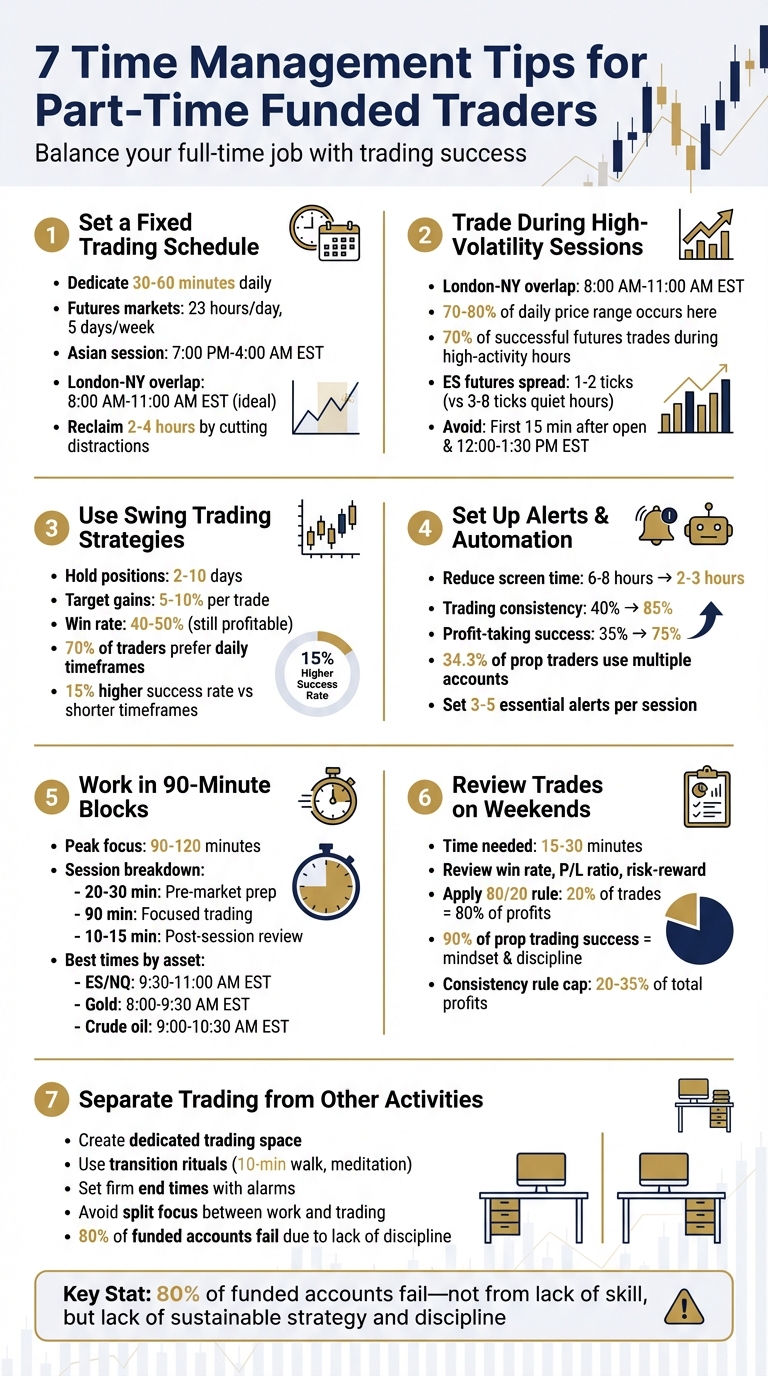
- Set a fixed trading schedule: Dedicate 30–60 minutes daily for focused trading. Use flexible market hours like the Asian session or London–New York overlap for high liquidity.
- Trade during high-volatility sessions: Target periods with strong price movements, like 8:00–11:00 AM EST, to optimize results with minimal screen time.
- Use swing trading strategies: Hold trades for several days to weeks, reducing the need for constant monitoring while aiming for consistent gains.
- Leverage alerts and automation: Use tools like TradingView or trade copying platforms to streamline tasks and stay informed without being glued to your screen.
- Work in focused 90-minute blocks: Avoid overtrading by sticking to a single, highly focused trading session daily.
- Review trades on weekends: Spend 15–30 minutes analyzing your performance, identifying patterns, and planning for the week ahead.
- Separate trading from other activities: Create a dedicated workspace and set clear boundaries to maintain focus and avoid distractions.
7 Time Management Tips for Part-Time Funded Traders
Best Swing Trading Strategies for Part Time Traders
sbb-itb-46ae61d
1. Set a Fixed Trading Schedule
Dedicate a consistent 30–60 minutes each day to trading. This focused time block ensures you can execute strategies effectively without disrupting your personal or professional life. The idea is to pick a time that fits your schedule and stick to it.
Futures markets run nearly around the clock – 23 hours a day, five days a week – from Sunday evening to Friday afternoon. This flexibility means you don’t have to stick to standard market hours. If your job prevents you from trading in the morning, consider the Asian session (7:00 PM–4:00 AM EST) or a quick session before heading to work. For those rare mornings you can trade, the London–New York overlap (8:00 AM–11:00 AM EST) is ideal because of its high liquidity and volume.
Align your strategy with your schedule. Evening traders might find range-trading or mean-reversion strategies more effective than trend-following setups. Most people can reclaim 2–4 hours daily by cutting out distractions – review your routine to find where your time is slipping away.
"Treat your 90-minute window like a doctor’s appointment with the market – non-negotiable, highly focused, and purpose-driven." – Viktor Tachev, MSc in Financial Markets
Separate your prep work from trading. Use your trading window strictly for execution, leaving analysis for another time. This separation keeps you efficient and focused when the market is open. A dedicated workspace and clearly defined trading hours that don’t overlap with your job can also help you avoid burnout.
2. Trade During High-Volatility Sessions
When time is limited, making the most of high-volatility sessions is key for part-time traders. These periods offer the price movement needed to hit targets without requiring constant screen time. One of the best trading windows is the London–New York overlap (8:00 AM–11:00 AM EST). This three-hour stretch is a favorite among prop firm traders because it combines high volume, strong trends, and major news releases. During this window, the market often accounts for 70% to 80% of the daily price range, and roughly 70% of successful futures trades occur during these high-activity hours.
The advantages don’t stop there. For E-mini S&P 500 (ES) futures, the bid-ask spread narrows to just 1–2 ticks during peak sessions, compared to 3–8 ticks during quieter hours. Slippage also drops significantly, from 3–10+ ticks to just 0–1 tick. This tighter spread and reduced slippage ensure better trade execution, helping protect your funded account.
"The London–New York overlap is the best time to trade for prop firms. It gives you the highest probability of hitting targets without taking unnecessary risks." – TradingFunds.com
To maximize your performance during these sessions, choose assets that thrive under these conditions. Gold (XAU/USD) and U.S. indices like NAS100, US30, and S&P500 are highly active during the New York session (8:00 AM–5:00 PM EST), providing strong opportunities for movement. For forex traders, the London session (3:00 AM–11:00 AM EST) is ideal, offering high liquidity and smoother price action. Always keep an eye on the economic calendar – announcements such as the 8:30 AM ET retail sales report can trigger extreme volatility, potentially pushing your trades dangerously close to your prop firm’s drawdown limits.
To fine-tune your trading schedule, follow these timing tips: steer clear of the first 15 minutes after the market opens and avoid trading between 12:00–1:30 PM EST, as these periods often bring unpredictable price swings that can lead to losses. Instead, focus on one or two high-quality trading windows, and avoid the temptation to force trades during slower times.
3. Use Swing Trading Strategies
Swing trading provides part-time funded traders with a practical way to benefit from significant price movements without the need to constantly monitor the markets. Instead of tracking every tick, this strategy involves holding positions for several days to weeks, aiming for consistent gains of 5% to 10% per trade. Typical holding periods range from 2 to 10 days, making it a time-efficient approach. You only need a few minutes each day to review your positions and adjust stop-loss orders, making it ideal for traders balancing other commitments. Plus, it carries financial benefits by reducing trading costs and protecting against slippage.
This strategy also allows you to maintain profitability even with win rates as low as 40–50%, as long as your average winning trades outweigh your losses. For example, a common swing trade setup might involve risking 2–3% of your account to aim for gains of 6–9%. With the added advantage of lower commission costs, swing trading can help you preserve your funded account while freeing up time for other priorities. Liquidity is rarely an issue, as CME Group reported a global average daily volume of 30.2 million contracts in Q2 2025, making it an appealing option for futures traders.
"Swing trading – holding positions for several days to a few weeks – is uniquely suited to the prop firm model. It aligns perfectly with the goal of leveraging large capital for substantial, meaningful gains, not just churning the account for pocket change." – BrightFunded
To get started, focus on daily charts. These help you capture larger price swings while filtering out the noise that often misleads intraday traders. Around 70% of traders prefer daily timeframes for swing trading, reporting a 15% higher success rate compared to shorter timeframes. Tools like moving average crossovers – such as the 20/50-day combination – can help identify multi-day trends. To save time, set price alerts at key levels so you’re only notified when action is needed, rather than constantly watching the charts.
Before diving into swing trading, check the best futures prop firms and their rules regarding overnight and weekend holds. Some firms may have restrictions that could complicate this strategy. Look for firms offering "no-time-limit" evaluations and "no minimum trading days" requirements, as these remove the pressure to execute low-quality trades. For better execution, prioritize liquid CME products like E-mini S&P 500 (ES), Crude Oil (CL), and Gold (GC). Using micro contracts can also help you manage risk more effectively during multi-day holds.
4. Set Up Alerts and Automation
After establishing a structured schedule and trading strategy, automation can help you cut down on manual tasks and streamline your process.
Trading alerts are a game-changer for part-time traders. These alerts notify you of critical price movements, signals, or volume surges, allowing you to step away from your screen while staying informed. Instead of spending 6–8 hours glued to your monitor, you can reduce that to just 2–3 hours. Even better, alerts can help elevate your trading consistency from 40% to 85% and increase profit-taking success from 35% to 75%.
To make the most of alerts, set them at key support and resistance levels with a small buffer – about 5–10 pips or 0.5–1% – to avoid getting triggered by false signals. Many platforms like TradingView (unlimited alerts with a Premium plan), MetaTrader (up to 100 alerts), and ThinkOrSwim (up to 500 alerts) offer mobile push notifications, effectively turning your smartphone into a portable trading assistant. To avoid being overwhelmed, stick to 3–5 essential conditions per session.
For traders juggling multiple funded accounts – such as through Apex Trader Funding or Take Profit Trader – trade copiers can simplify execution. Tools like TradeSyncer or SyncFutures replicate trades across accounts in milliseconds, removing delays and ensuring precision. This is especially useful since 34.3% of prop traders use multiple accounts to spread risk, while 33.8% leverage them for higher overall capital. Unlike local trade copiers that require a Virtual Private Server (VPS) costing $30–$50 monthly, cloud-based options run continuously without needing your computer to stay on.
"One trader. One strategy. Ten accounts. It should be simple. Instead, you’re spending more time clicking between trading platforms than actually trading." – SyncFutures
Before diving into automation, double-check your prop firm’s rules and test your strategies in demo accounts to ensure everything runs smoothly. Most firms, including Apex Trader Funding and Take Profit Trader, allow bots and trade copiers as long as they mimic manual trading actions rather than fully automating decisions. Platforms like NinjaTrader offer advanced tools like Strategy Builder, while Tradovate provides a drag-and-drop AutoBuilder for those without coding experience.
If you’re managing accounts of different sizes, position multipliers can be a helpful tool. For example, for a $50,000 account, you could use a 0.5x multiplier when the master account is $100,000, ensuring contract sizes scale appropriately across tiers. This approach keeps your trading efficient and aligned with your goals.
5. Work in 90-Minute Blocks
Long trading sessions can drain your focus and lead to poor decisions. Studies reveal that human concentration starts to wane after 2 to 2.5 hours of continuous effort, with peak focus lasting just 90–120 minutes. For part-time traders balancing a full-time job, sticking to a single 90-minute trading window ensures you’re working at your sharpest. This focused approach helps you make better trading decisions without exhausting your mental energy.
"The 90-minute rule allows funded traders to trade smarter, not longer. As a result, their minds remain fresh and ready to engage in post-trading activities." – Viktor Tachev, MSc in Financial Markets, Earn2Trade
To get the most out of this time, divide your session into three key phases:
- 20–30 minutes of pre-market prep: Analyze overnight price action, identify key levels, and plan your setups.
- 90 minutes of focused trading: Eliminate distractions and stick to your pre-defined strategies.
- 10–15 minutes of post-session review: Record your trades, review your emotional state, and look for lessons.
This structured routine not only sharpens your skills but also prevents the temptation to overtrade, which can lead to breaches in drawdown limits.
Timing your 90-minute block with high-liquidity periods can further boost your efficiency. For equity index futures like ES or NQ, the 9:30–11:00 AM EST window aligns with strong institutional activity. Gold futures traders should target 8:00–9:30 AM EST during the London/New York overlap, while crude oil tends to see significant movement from 9:00–10:30 AM EST.
Set an alarm to signal the end of your session and close your trading platform immediately. Extending your session after a loss often leads to revenge trading – a risky behavior that can quickly violate drawdown rules on funded trading accounts. Protect your decision-making by sticking to your schedule and logging off on time.
6. Review Trades on Weekends
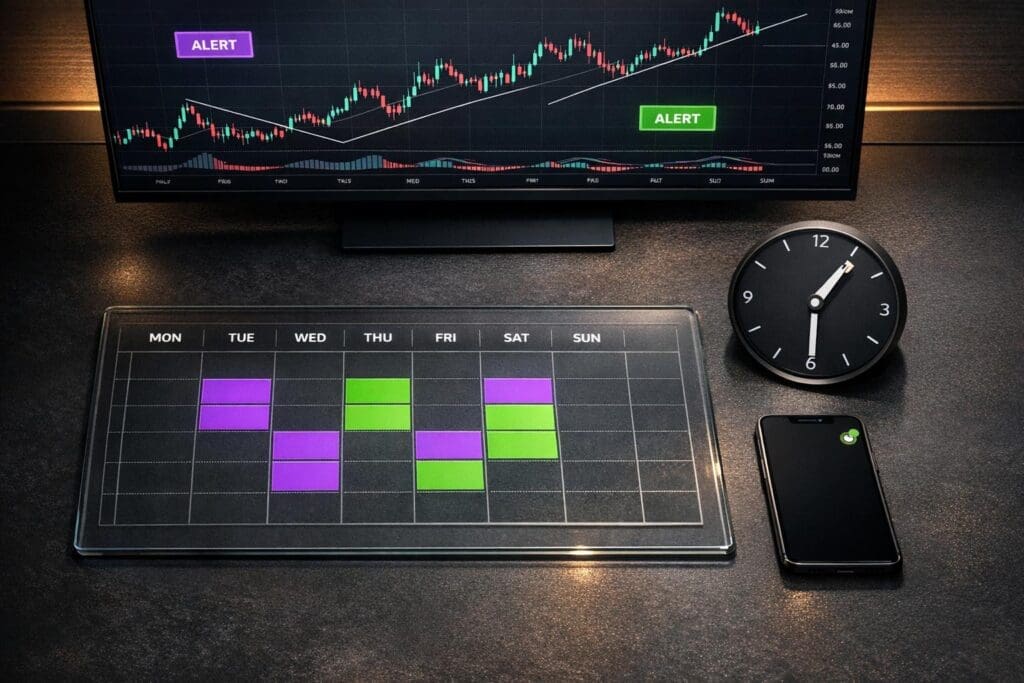
Weekends are a great time to step back and evaluate your trading performance. With a focused approach, this process can take as little as 15–30 minutes. Start by opening your trading dashboard to review key metrics like your win rate, profit/loss ratio, and risk-to-reward performance. Then, take a look at your PnL calendar. This color-coded snapshot of your daily results can uncover patterns you might otherwise miss – like stronger performance earlier in the week or challenges during market close.
Next, dig into the 80/20 rule in your trading. Often, 20% of your trades are responsible for 80% of your profits. Tagging your trades by strategy – whether they’re breakouts, reversals, or trend-following setups – can help you see which approaches are working and which are dragging you down. For instance, if your "A+ Setup" trades are consistently profitable but impulsive entries are hurting your results, you’ve got a clear area to refine. This level of analysis ties back to the structured trading schedule discussed earlier.
"The trade journal tag system is the ideal way to log your mindset at the time to filter through to stop making the same trading mistakes." – TraderWaves Team
Another critical step is conducting a psychological audit. This helps you reinforce the discipline needed for effective time management. Review your journal entries to spot emotional triggers – like fear of missing out (FOMO), hesitation, or revenge trading after losses. Identify the trades where you deviated from your plan and figure out what caused those missteps. It’s worth noting that about 90% of success in prop trading comes down to mindset and discipline, not the trading strategy itself.
Finally, create a clear plan for the week ahead. If you’ve been exceeding risk limits on volatile news days, set alerts to avoid trading during events like FOMC or CPI releases. If you’re struggling with the consistency rule on a funded account, use tools like the Consistency Rule Calculator from DamnPropFirms (https://damnpropfirms.com) to ensure no single winning day overshadows your overall profit targets, which are typically capped at 20%–35% of total profits. Setting aside the same time every weekend for this review can help you build a habit that provides clarity and focus for the upcoming trading week.
7. Separate Trading from Other Activities
Mixing trading with work or personal life can seriously hurt your focus and results. Trying to juggle work spreadsheets and prop firm trading platforms at the same time creates "split focus", which reduces your efficiency in both areas. The brain struggles to handle multiple high-pressure tasks without clear boundaries. By separating trading from other activities, you can give it the attention it deserves, just like during your scheduled trading blocks.
Start by setting up a specific space in your home solely for trading. This could be a desk or a corner that’s completely separate from where you work or spend time with family. Keep this spot free from work documents or anything that might distract you. This setup helps signal your brain that it’s time to focus on trading, encouraging better decision-making. A dedicated space works hand-in-hand with your trading schedule to build discipline and improve concentration.
"Trading is a serious business, and traders who see it as just a past time activity rarely ever succeed at it." – Optimus Futures
To help transition from your day job to trading, adopt a simple ritual. It could be taking a 10-minute walk, meditating for a few minutes, or even brewing a cup of tea before you sit down to trade. Avoid discussing trading with colleagues or clients to keep the boundaries clear and maintain focus.
Lastly, set a firm end time for each trading session. Use an alarm to remind you when your 90-minute trading block is over, then close your trading platform. This prevents you from "watching" the market during personal time, which often leads to impulsive trades or emotional decisions after losses.
Conclusion
Managing your time as a part-time funded trader means prioritizing discipline and consistency to make every minute count. The seven strategies outlined earlier work together to help you safeguard your capital, reduce decision fatigue, and create trading habits that fit seamlessly into your busy life. By sticking to fixed schedules, dedicating focused blocks for trading, and maintaining clear boundaries between trading and personal life, you can set yourself up for steady progress.
Discipline is the cornerstone of long-term success. Studies show that around 80% of funded accounts fail – not because traders lack skill, but because they lack a sustainable strategy and the discipline to follow through. By focusing on high-quality setups during peak volatility hours and conserving mental energy through automation and thoughtful preparation, you can trade smarter, not harder.
"For the first 7 days, do NOT seek to make profit. Seek to adapt to the psychological pressure of a real account." – PropFirmCodes
Start implementing these strategies today. Try the 90-minute rule to structure your trading sessions and schedule a weekend review to prepare for the week ahead. Use tools like OCO orders to manage risk effectively and commit to logging off on time. These small but intentional changes will gradually improve both your trading performance and your overall work-life balance.
As a part-time trader, your focus should be on preserving capital rather than chasing profits, especially in your initial weeks with a funded account. By consistently applying strategies like fixed schedules, weekend reviews, and disciplined execution, you can avoid common pitfalls and build a strong foundation. This disciplined approach is what separates traders who succeed from those who struggle to scale their accounts.
FAQs
How do I pick the best 90-minute trading window for my schedule?
To pick the ideal 90-minute trading window, target periods with increased market activity and price movement. These typically include the first hour after the market opens and the final hour before it closes. Following the 90-minute rule helps you stay sharp and avoid burnout, ensuring you make better trading decisions. Match these high-activity times with your personal routine, and try timeboxing techniques to stay disciplined and focused during your trading session.
Can swing trading work with prop firm rules on overnight holds and drawdowns?
Yes, swing trading can be effective, provided the prop firm permits overnight and weekend holds. Many firms now accommodate longer holding periods, which allows traders to align their swing trading strategies with the firm’s guidelines. It’s essential to carefully check the firm’s rules on drawdowns and holding times to ensure they fit your trading style.
What’s the safest way to use alerts, bots, or trade copiers on a funded account?
To use alerts, bots, or trade copiers on a funded account safely, it’s crucial to stick to the prop firm’s rules and focus on risk-managed setups. Some effective strategies include using stop-loss and take-profit variance, delay settings, and lot scaling to ensure you stay within the firm’s risk limits. Always double-check that your automated settings align with the firm’s policies to reduce risks and prevent account disqualification.