Trade copying allows futures prop traders to replicate trades across multiple accounts automatically, saving time and reducing errors. While this technique can boost income potential, strict rules from prop firms must be followed to avoid penalties or account termination.
Key Points:
- Internal copying is allowed (your accounts only), but external copying (from third-party signals) is usually banned.
- Firms limit the number of active accounts: e.g., Apex Trader Funding allows 20, while Topstep caps it at 5.
- Prohibited actions: cross-account hedging, automated bots, and inconsistent position sizing.
- Compliance requires proportional trade scaling, latency under 100ms, and adherence to firm-specific rules like profit consistency caps (e.g., 30%-50% per day).
- Risk management is critical: firms enforce trailing drawdowns, daily loss limits, and restrictions on micro-scalping.
Pro Tip: Always test the best trade copying platforms on demo accounts and ensure it aligns with each firm’s guidelines to protect your funded status.
How I Use Trade Copiers to Trade Multiple Prop Accounts
sbb-itb-46ae61d
Common Trade Copying Rules Across Prop Firms
Futures prop firms often share a set of trade copying rules designed to ensure fairness and prevent misuse. Knowing these rules can help you avoid costly mistakes and stay compliant, no matter which firm you work with. Here are some of the most common requirements.
Profit consistency caps are a frequent restriction. For instance, Apex Trader Funding enforces a 30% rule, meaning no single trading day can contribute more than 30% of your total profit balance when requesting a payout [5]. You can use a consistency calculator to ensure your daily profits stay within these limits. Some firms are slightly more flexible, allowing up to 40%. These rules discourage traders from relying on one massive win to cash out, as this is seen as an unsustainable trading strategy.
Cross-account hedging is prohibited. This means you cannot hold a long position in one account while simultaneously holding a short position in another account for the same instrument or closely related contracts [2][3]. Some firms, like Tradeify, allow a brief overlap – up to 10 seconds – when manually switching positions. Any overlap beyond this limit can result in immediate termination [2][3]. To avoid accidental violations, make sure your trade copier includes anti-hedging safeguards.
Account ownership and automation rules establish clear boundaries on what’s allowed. You can only copy trades between accounts you personally own. Using third-party signal services or "pass-your-challenge" providers is strictly prohibited and can lead to account bans [2][3][5]. Firms distinguish between trade copiers, which let you retain control over trading, and fully automated bots, which are not allowed [2]. Additionally, many firms require trades to be held for at least 1 to 2 minutes to prevent tick scalping, which exploits simulated order fills [5].
Position sizing consistency is another key rule. Significant differences in trade volumes across your accounts can raise suspicion [5]. When copying trades between accounts of different sizes, ratio-based scaling is essential to maintain proportional risk. For example, if you’re copying trades from a $100,000 account to a $50,000 account, your copier should adjust contract sizes accordingly [2][3]. Tools like Copilink, which offer latencies under 2ms, can help ensure smooth execution and avoid timing mismatches that might accidentally create hedged positions [2][3].
Trade Copying Rules by Prop Firm
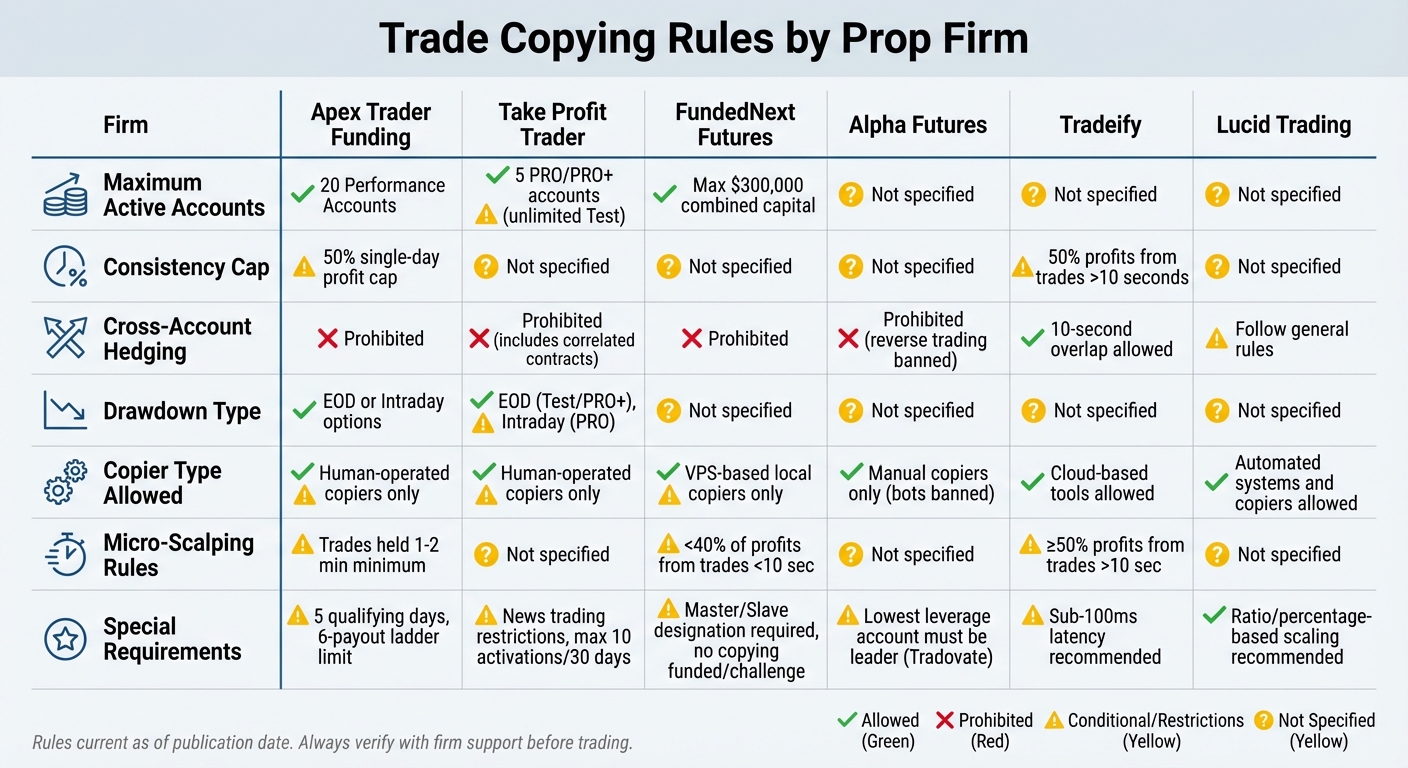
Trade Copying Rules Comparison Across Major Futures Prop Firms
Each prop firm establishes its own rules for trade copying to manage risk and maintain consistency across accounts. Familiarizing yourself with these specific guidelines is essential to staying compliant and protecting your accounts. Here’s a breakdown of the key trade copying policies for major providers.
Apex Trader Funding
As of March 1, 2026, Apex Trader Funding transitioned to a new account structure featuring End-of-Day (EOD) and Intraday Trailing Drawdown models. Legacy evaluations are no longer available, but you can still copy trades across up to 20 active Performance Accounts simultaneously. This limit applies to all account types, including EOD, Intraday, and any remaining legacy accounts.
Apex enforces a 50% consistency cap on single-day net profits and uses a six-payout ladder before accounts transition to live programs. Each account has a lifetime payout potential of about $13,000–$14,500. The choice between EOD and Intraday accounts depends on your trading style: EOD accounts adjust the drawdown threshold only at market close, while Intraday accounts track unrealized profits in real time. To request a payout, you must complete at least five qualifying trading days. For instance, a $50,000 Intraday account requires a minimum balance of $52,600 to qualify for withdrawals.
Since copy trading replicates trades across all accounts, a single high-profit day impacts every account in your stack. To meet the consistency rule, aim for smaller, consistent winning days. Additionally, accounts are capped at six payouts, so it’s crucial to maintain a steady flow of new evaluations to replace accounts that reach their limit. [9]
Take Profit Trader

Take Profit Trader allows unlimited "Test" accounts but restricts active "PRO" or "PRO+" funded accounts to five. Rule 6 explicitly bans holding long and short positions simultaneously across accounts, including correlated contracts like ES/MES and NQ/MNQ. Paul from Prop Trading Vibes explains:
"Rule 6 prohibits holding opposite positions (long vs short) across any accounts under your control – including correlated contracts." [11]
The platform uses real-time monitoring to detect violations, which result in automatic liquidation. News trading restrictions apply to PRO and PRO+ accounts, barring trades one minute before and after major announcements like FOMC, NFP, and CPI releases. Test accounts, however, are exempt from these restrictions.
Both Test and PRO+ accounts operate on EOD trailing drawdown, while PRO accounts use an Intraday trailing drawdown model. Additionally, you can activate up to 10 accounts within a 30-day period. For seamless compliance, ensure your trade copier includes features like a kill switch or news filter. [11]
FundedNext Futures
FundedNext Futures has specific rules for account pairing and capital limits. While copy trading is allowed between your own Challenge accounts, it is strictly prohibited between a funded account and a Challenge account. The total combined capital across all copied accounts cannot exceed $300,000. You must designate one account as the "Master", with others acting as "Slaves."
Only VPS-based local copiers are permitted, as cloud-based tools are banned to avoid compliance issues. The firm also monitors for micro-scalping violations, flagging accounts where 40% or more of total profit stems from trades closed within 10 seconds. [8][6]
Alpha Futures
Alpha Futures allows copy trading as long as a single user executes trades across their own accounts. The individual listed on the accounts must be the one trading. Benjamin Chaffee from the Alpha Futures Help Center elaborates:
"Copy trading in general is permitted as long as it is a single user executing the trades, and it is the single individual listed on the Alpha Futures Accounts." [12]
The firm prohibits automated trading, group trading, and reverse trading (taking opposite positions based on another trader’s signals). Tradovate users must generate API credentials under Settings → API Access and designate the account with the lowest leverage as the leader. Additionally, traders are fully responsible for any software errors or unintended outcomes from trade copiers. To mitigate risks, always test your setup on a demo account before moving to live trading. [12][14]
Tradeify

Tradeify supports third-party cloud-based tools like Tradesyncer for managing multiple accounts and also allows API-based automated trading. To discourage tick scalping, at least 50% of profits must come from trades held longer than 10 seconds. Tradovate users should refer to their platform’s API setup and opt for professional tools with sub-100ms latency to ensure precise execution. [6][14]
Lucid Trading
Lucid Trading permits both automated trading systems and trade copiers, provided they adhere to the firm’s general rules. AJ from the Lucid Trading Help Center advises:
"Traders are fully responsible for any software errors, malfunctions, or unintended outcomes when using automated strategies or copiers." [13]
Before deploying a copier on funded accounts, ensure it is reliable and thoroughly tested. For accounts of varying sizes, ratio or percentage-based scaling is recommended to maintain balance. [14]
Trade Copying Compliance Checklist
To stay within compliance when using a trade copier on funded accounts, follow these steps to ensure your setup aligns with firm-specific rules and avoids costly errors.
Before activating your trade copier, double-check that all copied accounts are registered under the same name. This is a standard requirement across most firms [5]. Also, confirm the maximum number of accounts allowed by your firm. For instance, Apex Trader Funding allows up to 20 accounts, while Take Profit Trader limits traders to five accounts [15]. Staying within these limits is essential for compliance.
Next, ensure you’re connected to the correct trading environment. Funded accounts generally operate on "demo" or "simulation" feeds, not live production environments. Using the wrong feed will result in immediate errors [1]. To test your setup, run a paper trade with a micro contract. This ensures that entries, stops, and targets are accurately replicated across all accounts before involving real capital [4][1].
When managing multiple account sizes, calculate position multipliers to match risk proportionally. The formula is simple: Follower Multiplier = Follower Account Size ÷ Master Account Size. For example, if your master account is $50,000 and a follower account is $100,000, the follower should trade twice the contracts. Adjust these multipliers regularly as account balances change to keep risk in line.
Automated stop-loss settings are critical. Without them, follower accounts could remain exposed after the master account exits, leading to unnecessary risk [1]. Also, enable a "Flatten All" button in your copier settings. This feature allows you to close all positions instantly in case of high volatility or technical issues [1].
Daily monitoring is equally important. Many firms enforce consistency rules, which limit any single day’s profit to 30–40% of your total profits [5]. Additionally, some firms require trades to be held for at least two minutes to avoid triggering tick-scalping violations. Use a centralized dashboard to track key metrics like connection status, P&L synchronization, and daily loss limits [1][3]. Keeping an eye on these metrics ensures your accounts remain synchronized and compliant.
Risk Management Rules for Trade Copying
When it comes to trade copying in futures prop firms, managing risk across multiple funded accounts can be tricky. A single losing trade doesn’t just impact one account – it affects all of them. This means that even a modest risk, like 0.50% per trade, can snowball into a much larger drawdown across your portfolio. For instance, if you’re operating five accounts, one bad trade could lead to a 2.5% drawdown collectively [17]. To tackle this, Purple Trader advises keeping risk per trade between 0.25% and 0.50% in multi-account setups to help avoid breaching collective drawdown limits [17]. This highlights the importance of having strong risk controls in place.
Understanding Drawdown Rules
Different prop firms have varying drawdown rules, and knowing how they work is key. With an End-of-Day (EOD) Trailing Drawdown, the drawdown threshold adjusts at the end of the trading day based on your closing balance. On the other hand, an Intraday Trailing Drawdown updates in real time, following your peak unrealized profit. This requires more cautious monitoring and smaller position sizes [6]. Both types of drawdowns increase as your account reaches new highs but never move downward. At firms like Apex Trader Funding and Take Profit Trader, the trailing drawdown stops once it reaches your starting balance plus a $100 buffer [6].
Contract and Instrument Limits
Prop firms often reduce contract limits when transitioning from evaluation to funded accounts. For example, Apex Trader Funding allows up to 4 contracts during evaluation on a $25,000 account but limits this to 2 contracts in funded accounts [6]. Some firms also impose restrictions, allowing traders to use only 50% of their maximum contract limits until they hit certain milestones in their trailing thresholds [5]. When copying trades between accounts of different sizes, you’ll need to adjust trade sizes using instrument mapping. For instance, if your master account trades ES contracts, you can copy them as MES contracts in smaller follower accounts, using ratio settings to match the account sizes [2][3].
Navigating Consistency Rules
Consistency rules can make things even more challenging. For example, Tradeify enforces a "10-second rule", requiring that at least 50% of profits come from trades held for more than 10 seconds [6][7]. Similarly, FundedNext Futures flags accounts for micro-scalping if 40% or more of profits come from trades closed within 10 seconds [6]. It’s also crucial not to use your full drawdown threshold or Daily Loss Limit as a stop-loss. In volatile markets, slippage could push you past the breach point before your order is executed [6].
Additional Risk Controls for Copiers
To stay ahead of firm-imposed limits, configure copier-level risk controls. Set automated daily loss limits, profit targets, and session lockouts. Using market orders can help reduce execution variance, ensuring follower accounts fill at nearly identical prices [16][17]. To avoid overexposure, implement a global risk cap across your portfolio and steer clear of trading highly correlated pairs like EURUSD and GBPUSD simultaneously. Trading such pairs is essentially one large directional bet rather than a diversified strategy [17].
Technical Requirements for Copy Trading Tools
Getting the technical setup right is essential for ensuring smooth and synchronized trade copying. One of the first things to check is your latency – it should stay below 100 ms. Higher latency can lead to slippage, price mismatches, or even trigger fraud detection systems [10]. For faster execution, tools like Copilink offer speeds as low as 1.6 ms, which is ideal for fast-moving markets such as futures [2]. These performance benchmarks are critical for maintaining both risk management and compliance.
Platform compatibility also plays a key role. NinjaTrader 8 is one of the most commonly supported platforms for local trade copying. Other platforms with strong integration options include Tradovate, TradingView, Quantower, Sierra Chart, and Rithmic [18][19]. Some proprietary trading firms even provide their own built-in trade copying solutions, eliminating the need for third-party software. For instance, Topstep offers TopstepX, while Tradeify uses Tradovate Group Trading, which supports up to five accounts [7][2]. These native tools are typically free and come fully supported by the firm, whereas third-party copiers often require a subscription fee and may offer limited support [7]. These solutions are designed to align with firm-specific trade copying rules.
Your copier should also handle proportional adjustments for partial fills. For example, if the master account only fills 50% of an order, the tool must adjust follower accounts accordingly to maintain precision [10]. Another essential feature is instrument mapping, which allows trades from an E-mini contract on the leader account to be copied to a Micro E-mini contract on smaller follower accounts, automatically adjusting the quantities [2]. This is particularly useful when managing multiple accounts with varying sizes across different firms. This is a common strategy for those scaling Apex accounts to maximize capital efficiency.
To minimize latency to CME Group‘s matching engines, consider using a VPS in Chicago. A Windows VPS with at least 6 CPU cores and 16 GB of RAM ensures smooth, uninterrupted operation around the clock [19][3]. Alternatively, cloud-based copiers like Tradesyncer offer convenience by eliminating the need for a VPS, but they typically have ~100 ms latency compared to the 1–3 ms achievable with local installations [19].
Before going live, it’s crucial to test your setup. Run a full session to ensure entries, stops, targets, and modifications are replicated accurately [3]. Additionally, configure automated circuit breakers in your copier to halt all accounts if a specific loss threshold is reached. Perform daily reconciliations to catch synchronization issues early [10]. Be aware that prop firms can detect copy trading through IP addresses. While using a VPS offers consistency, multiple accounts operating from one location might still raise red flags [20].
Conclusion
Navigating trade copying with futures prop firms requires a sharp focus on each firm’s specific and ever-changing rules. Policies around human-operated trade copiers, automated bots, ownership restrictions, cross-account hedging, and account limits can vary widely. For instance, firms like Apex Trader Funding, Tradeify, and Take Profit Trader all enforce unique policies, making it critical to confirm the latest guidelines before using a copier with a funded account.
To succeed, you’ll need to implement strong technical and risk management strategies. This includes proportional position sizing, setting independent drawdown limits for each account, and ensuring millisecond-level synchronization to reduce slippage and avoid breaking firm rules. Tools like demo account testing, emergency flatten buttons, and daily reconciliations can also help prevent costly synchronization errors.
Since firms frequently revise their rules, staying informed is absolutely necessary. The futures prop firm landscape is constantly shifting, with updates to terms of service, account structures, and copying policies happening regularly. Resources like DamnPropFirms are invaluable, providing verified reviews, firm comparisons, and tools like the Consistency Rule Calculator to help traders stay compliant. Whether you’re scaling up with firms such as Topstep, FundedNext Futures, Alpha Futures, Lucid Trading, or Purdia, understanding the fine print is essential to safeguard your capital and maintain your funded status.
Before deploying your copier, double-check current policies with firm support, as rules can change unexpectedly. Use a Compliance Checklist to ensure your copier setup aligns with the latest requirements. Staying proactive and regularly monitoring updates will go a long way toward achieving long-term success with multiple funded accounts.
FAQs
How do prop firms detect trade copying?
Prop firms can detect trade copying by monitoring specific indicators such as identical trades across multiple accounts, synchronized entry and exit times, and repeated trading patterns. Additionally, they keep an eye on shared IP addresses or devices used to access accounts, which can signal coordinated activity. These measures help them identify unusual behaviors that point to potential copying.
What trade copier settings help prevent cross-account hedging?
To avoid cross-account hedging, configure your trade copier to automatically enforce daily loss limits, trailing drawdowns, and profit targets for each account. Make sure the copier is set up to prevent opening opposite positions in the same instrument across different accounts, as this is a common rule among prop firms. Additionally, adjust position sizes proportionally based on each account’s risk level and size. This helps ensure compliance and reduces the risk of accidental hedging violations.
How do I scale contract size correctly across different account sizes?
To properly manage contract size, it’s important to stick to the specific scaling rules set by your prop firm. These rules often suggest starting with a portion of the maximum contract limit – typically around 50% – and gradually increasing as you meet certain thresholds. For instance, with a $50,000 account, you might need to grow your balance to $52,600 before gaining access to trade the full range of contracts. Following these guidelines helps promote steady account growth while avoiding any penalties for breaking the firm’s rules.