When choosing between Tradeify and Lucid Trading, it boils down to your trading style and priorities. Here’s a quick summary:
- Tradeify: Best for traders seeking automation, long-term scaling, and high flexibility. It supports bots, offers weekend payouts, and maintains a 90% profit split even with live capital. Instant funding starts at $328 (with discounts), and scaling reaches up to $750,000. The Select Flex account removes daily loss limits and consistency rules once funded.
- Lucid Trading: Ideal for budget-focused traders who value fast payouts and broad platform compatibility. Entry costs start at $75, with payouts processed in under 15 minutes. However, bots and VPNs are prohibited, and the profit split drops to 80% at the live stage.
Key Differences:
- Automation: Tradeify allows bots; Lucid prohibits them.
- Payout Speed: Lucid averages 15 minutes; Tradeify processes within 60 minutes, including weekends.
- Profit Split: Tradeify keeps 90% even with live capital; Lucid reduces to 80% at the live stage.
- Entry Cost: Lucid’s lowest is $75; Tradeify’s starts at $97.
Quick Comparison:
| Feature | Tradeify | Lucid Trading |
|---|---|---|
| Entry Cost | $97+ | $75+ |
| Payout Speed | ~60 minutes (7 days) | ~15 minutes (weekdays) |
| Profit Split | 90% (live: 90%) | 90% (live: 80%) |
| Automation | Allowed (with rules) | Prohibited |
| Scaling | Up to $750,000 | Up to $750,000 |
Choose Tradeify for flexibility and automation. Opt for Lucid Trading if you prefer affordability and fast payouts.
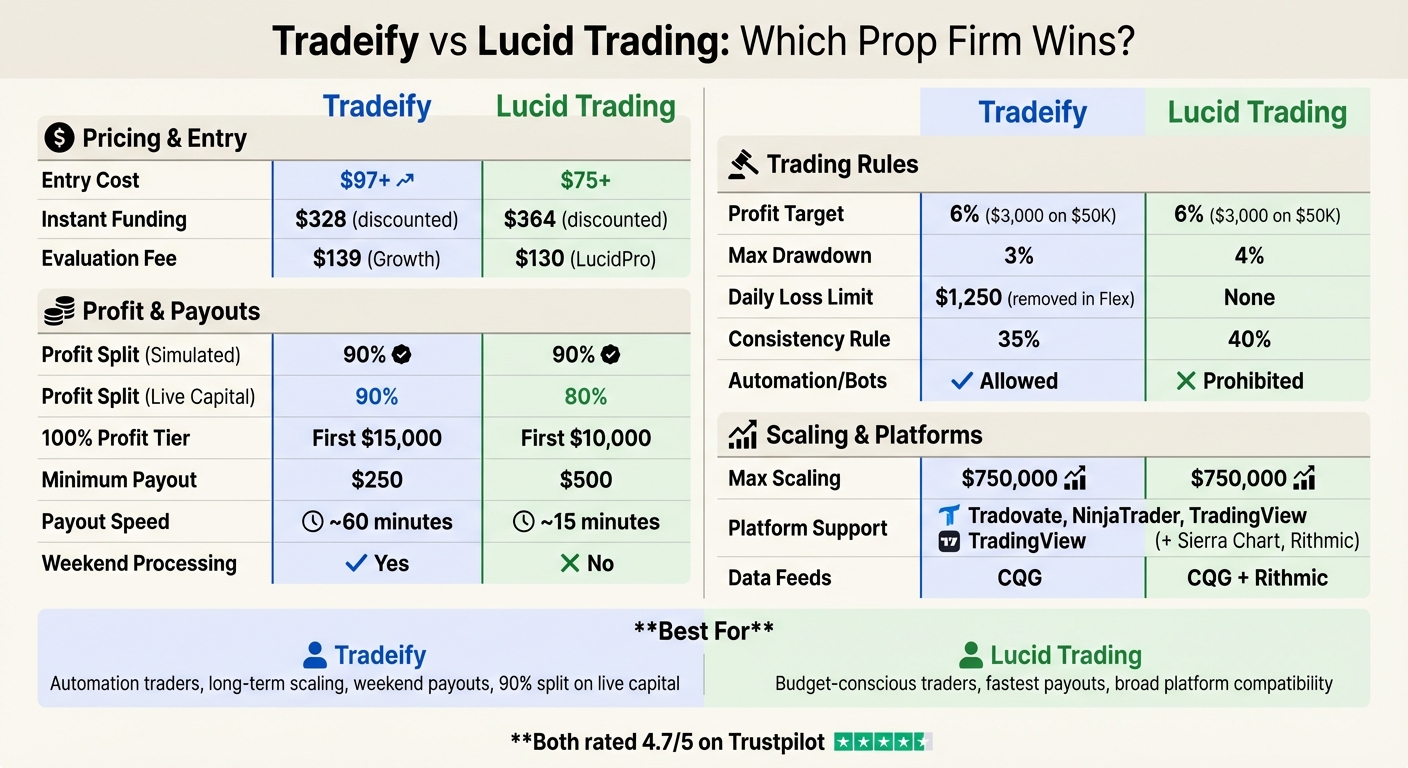
Tradeify vs Lucid Trading: Complete Feature Comparison Chart
Account Types and Pricing
Tradeify Account Options

Tradeify provides three distinct account options tailored to traders’ needs. The Growth account operates on a monthly subscription model, priced at $139 per month but often discounted to $97, until you successfully pass the evaluation. The Select account has a one-time evaluation fee of approximately $159, with the Select Flex variant offering added benefits like no daily loss limits or consistency rules once funded. For traders looking to bypass evaluations entirely, the Lightning account provides instant funding for $469, which frequently drops to $328 with a 30% discount.
Account sizes range from $25,000 to $150,000 across all programs. Both the Growth and Lightning accounts offer a 100% profit split on the first $15,000 of earnings, transitioning to a 90% split afterward. Tradeify supports the use of trading bots, Expert Advisors, and VPNs, making it a popular choice for automated traders.
Lucid Trading Account Options
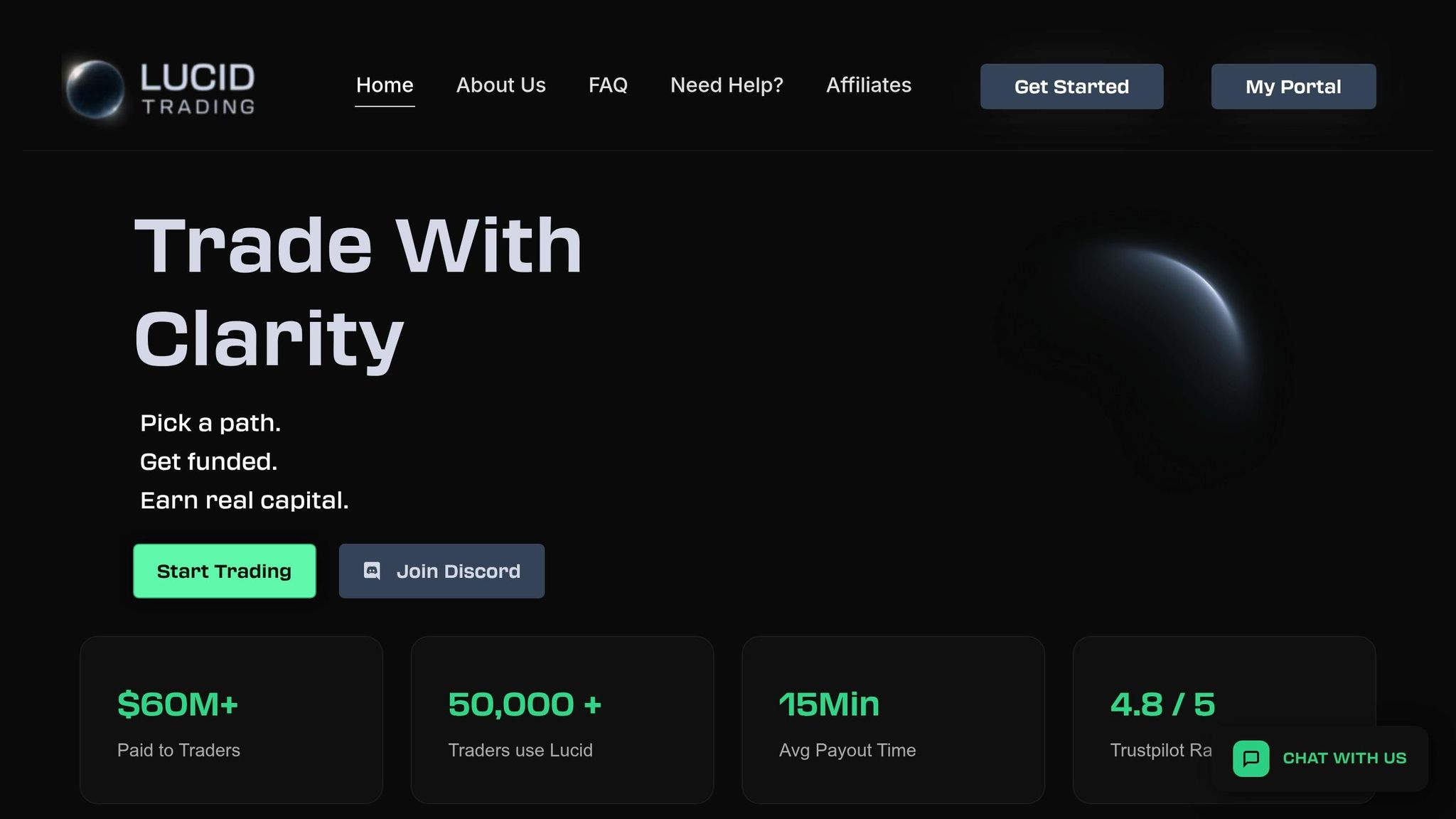
Lucid Trading offers three tiers with varying costs and rules. The LucidFlex tier, priced at $175 for a one-time evaluation fee, eliminates daily loss limits and consistency rules once funded. The LucidPro tier, available for $130 (often discounted to $92.50), stands out by requiring no minimum profitable trading days, enabling traders to complete evaluations in a single session. For instant funding, the LucidDirect option costs $520 at retail, or $364 with a 30% discount.
Lucid Trading’s entry-level pricing starts at just $75 for a $25,000 account, making it more affordable than Tradeify’s minimum. LucidPro accounts offer a 100% profit split on the first $10,000 earned. However, unlike Tradeify, Lucid Trading prohibits the use of trading bots, Expert Advisors, and VPNs. Notably, in February 2026, Lucid merged its "LucidBlack" account type into the LucidPro tier.
Account Structure Differences
When comparing pricing and rules, several key differences emerge between Tradeify and Lucid Trading. For instance, a $50,000 instant funding account costs $328 with Tradeify, while Lucid Trading’s equivalent is $364 – a $36 difference. For evaluation-based accounts, LucidPro is priced at $130, often discounted to $92.50, compared to Tradeify’s $139 Growth subscription.
The rules also vary significantly. Tradeify’s Growth account enforces a 35% consistency rule and a $1,250 daily loss limit, while LucidDirect applies a stricter 20% consistency rule. Both firms use an end-of-day trailing drawdown, but Lucid allows a 4% maximum drawdown, slightly higher than Tradeify’s 3%. Both companies offer scaling potential up to $750,000, though LucidDirect caps scaling at $15,000.
Both firms waive activation fees after evaluations and support major trading platforms, including NinjaTrader, Tradovate, and TradingView. Additionally, Lucid Trading extends compatibility to Rithmic and Sierra Chart, offering broader platform options.
sbb-itb-46ae61d
Profit Targets, Drawdown Rules, and Risk Management
Tradeify’s Profit Targets and Drawdown Policies
Tradeify sets its profit target at 6%, which translates to earning $3,000 on a $50,000 account. The firm calculates drawdown using an End-of-Day (EOD) method, based on the highest closing balance rather than intraday peaks.
For the Growth and Lightning accounts, there’s a strict Daily Loss Limit (DLL) of $1,250 on a $50,000 account. If this limit is breached, the account is terminated. However, the Select Flex option eliminates the DLL, offering more flexibility during volatile trading periods. Growth accounts also enforce a 35% consistency rule in the funded phase, meaning no single trading day can contribute more than 35% of the total profit.
To discourage hyper-scalping, Tradeify requires that at least 50% of your trades or profits come from positions held for longer than 10 seconds. The maximum drawdown is capped at 3% or $2,000 for a $50,000 account, depending on the specific plan.
Lucid Trading’s Profit Targets and Drawdown Policies
Lucid Trading approaches risk management differently while maintaining the same 6% profit target for evaluations – $3,000 on a $50,000 account. Like Tradeify, Lucid uses End-of-Day (EOD) drawdown to protect against intraday volatility triggering violations.
One standout feature is Lucid’s "Locked Max Loss Limit (MLL)" system. This trailing mechanism locks the loss limit once your account reaches a certain balance. For instance, on a $50,000 account, when your balance hits $52,100, the MLL locks at $50,100, just $100 above the starting balance. This feature provides extra security as you grow your profits.
Lucid’s LucidFlex and LucidPro accounts come with no Daily Loss Limit. However, LucidPro requires a 40% consistency rule for payout eligibility, while LucidDirect enforces a stricter 20% consistency rule. Additionally, Lucid offers a slightly more generous drawdown allowance of 4% on some plans, compared to Tradeify’s 3%.
Comparison Table: Profit Targets and Drawdown Rules
The table below highlights the key differences between Tradeify and Lucid Trading:
| Feature | Tradeify ($50K Growth) | Lucid Trading ($50K Flex/Pro) |
|---|---|---|
| Profit Target | $3,000 (6%) | $3,000 (6%) |
| Max Drawdown | $2,000 (3%) | $2,000 (4%) |
| Drawdown Type | End of Day (EOD) | End of Day (EOD) |
| Daily Loss Limit | $1,250 (Hard) | None |
| Consistency Rule | 35% (Funded Phase) | 40% (Payout Eligibility) |
| Drawdown Locking | No | Yes (Locks at $50,100) |
| Min. Payout | $250 | $500 |
Payout Structures and Scaling Opportunities
Tradeify’s Payout and Scaling Plans
Tradeify provides flexible payout options tailored to different account types. With the Select Daily option, traders can access daily withdrawals, while standard accounts operate on a 5-trading-day cycle. What sets Tradeify apart is its weekend payout processing, completing transactions within 60 minutes – even on Saturdays – ensuring funds are available before Monday.
The platform offers a 90% profit split and allows traders to keep 100% of the first $15,000 in profits. Withdrawals start at a minimum of $250, with payment options including Rise, bank transfers, and cryptocurrency. These features are designed to support trader liquidity and provide operational flexibility.
Scaling opportunities are robust, with account growth reaching up to $750,000 across multiple accounts. After completing 5 approved payouts, traders can advance to Tradeify Elite, transitioning to real CME capital through NinjaTrader brokerage. Elite accounts maintain the 90/10 profit split, offer uncapped daily payouts, and include personal risk management support. As of March 2026, Tradeify has distributed over $110 million to more than 80,000 traders.
Lucid Trading’s Payout and Scaling Plans
Lucid Trading takes a different approach to payouts and scaling. Payouts are processed on-demand once eligibility criteria are met. For LucidPro accounts, traders need five profitable days per cycle, with payouts processed every three business days. Meanwhile, LucidLive accounts require eight initial trading days but then allow daily withdrawals. Lucid boasts an impressive processing speed, averaging under 15 minutes.
"Lucid processes payouts in under 15 minutes on average… the fastest I’ve experienced at any prop firm." – Paul, Prop Trading Reviewer
The minimum payout is $500. However, the LucidLive path offers a reduced profit split of 80/20, which is less advantageous compared to Tradeify’s Elite program. These features are aimed at improving trader liquidity and operational efficiency. For more options, you can compare the best futures prop firms to see how these rules stack up against the competition.
Comparison Table: Payout and Scaling Features
| Feature | Tradeify | Lucid Trading |
|---|---|---|
| Standard Profit Split | 90% | 90% |
| 100% Profit Tier | First $15,000 | First $10,000 |
| Minimum Payout | $250 | $500 |
| Payout Frequency | Daily or Every 5 Trading Days | On-Demand / Every 3 Business Days |
| Processing Speed | 60 Minutes | ~15 Minutes |
| Weekend Processing | Yes, 7 days a week | Business days only |
| Max Scaling | $750,000 | $750,000 |
| Live Path Split | 90/10 (Elite) | 80/20 (LucidLive) |
Platform Tools and Features
Tradeify’s Platform and Tools
Tradeify operates through Tradovate, offering web, desktop, and mobile access for traders who need flexibility across devices. Beyond that, it supports NinjaTrader (via Tradovate login), TradingView (with an add-on), Quantower, and WealthCharts – a solid lineup for mobile-focused traders.
One standout feature is Tradeify’s proprietary Sage Score, which evaluates a trader’s discipline and strategy effectiveness. Additionally, the platform includes an integrated trade journal within Tradovate that tracks performance automatically, eliminating the need for third-party apps. As Paul from PropTradingVibes put it:
The integrated trade journal is a genuine bonus – it tracks performance automatically without needing a third-party app.
WealthCharts integration adds another layer of functionality with built-in risk alerts and trade copying tools, making it easier for those managing multiple funded accounts.
For traders who rely on automation, Tradeify allows the use of custom-coded bots and Expert Advisors (EAs), provided they adhere to the 10-second minimum hold rule. This rule requires that at least 50% of trades or profits come from positions held for over 10 seconds. Advanced traders who reach the Tradeify Elite level even gain access to a personal risk manager. The platform emphasizes seamless integration and dependable connectivity to ensure a smooth trading experience.
These features make Tradeify a strong contender, especially when compared to the more data-focused approach of Lucid Trading.
Lucid Trading’s Platform and Tools
Lucid Trading takes a different approach, focusing on broader platform compatibility and real-time monitoring. It supports both CQG and Rithmic data feeds, granting access to platforms like NinjaTrader, Tradovate, TradingView, MotiveWave, Quantower, and Sierra Chart. The dual-feed system is particularly appealing to traders who prefer Rithmic-based tools such as Sierra Chart.
Lucid Trading also offers real-time dashboards to monitor drawdown and consistency rules, making it easier for traders to keep track of their performance throughout the day. The platform provides community guides for setting up TradeSea and managing consistency rules, which can be especially helpful for newer users. For those participating in the premium LucidLive program, the LucidEscrow model adds an extra layer of security for funded traders.
However, algorithmic traders might find Lucid Trading limiting, as the platform generally prohibits trading bots. On the other hand, copy trading is allowed, and the platform fosters a strong sense of community with over 3,000 traders on Discord, where daily giveaways and support resources are available.
Platform Feature Differences
Tradeify and Lucid Trading each bring unique strengths to the table, catering to different types of traders. Lucid Trading’s dual CQG and Rithmic feeds are a draw for those who need platforms like Sierra Chart and MotiveWave. Meanwhile, Tradeify’s support for automated strategies and integrated performance tools like the Sage Score make it appealing for traders who value convenience and automation.
| Feature | Tradeify | Lucid Trading |
|---|---|---|
| Primary Platforms | Tradovate, NinjaTrader, TradingView, WealthCharts | NinjaTrader, Tradovate, TradingView, Sierra Chart, MotiveWave, Quantower |
| Data Feeds | Tradovate / CQG | CQG and Rithmic |
| Bot/EA Support | Allowed (with 10-sec hold rule) | Generally prohibited |
| Sierra Chart Support | No | Yes |
| Performance Tracking | Sage Score & Integrated Journal | Real-time Dashboards |
| Copy Trading | Allowed (internal only) | Allowed |
For traders who need Rithmic-based tools or Sierra Chart, Lucid Trading is a strong choice. On the other hand, those who prioritize mobile access, integrated journaling, and bot-friendly policies may find Tradeify’s ecosystem a better fit.
Choosing Between Tradeify and Lucid Trading
Key Takeaways
Here’s a breakdown of the main differences between Tradeify and Lucid Trading, based on the detailed comparison:
- Both firms use an EOD trailing drawdown system and offer a 90% profit split on simulated funded accounts. However, Tradeify locks its drawdown to a static floor once you reach a specific profit buffer, while Lucid Trading sticks to a fully trailing structure.
- Lucid Trading shines with its fast payout processing – averaging under 15 minutes – and lower entry fees, starting at $75 for a $25,000 account. Its LucidPro evaluation eliminates minimum trading days and allows payouts every three calendar days. However, algorithmic trading is restricted, and the LucidLive program for live capital reduces the profit split to 80/20.
- Tradeify, on the other hand, focuses on long-term scaling opportunities through its Elite program, which keeps the 90% profit split on real CME capital after five approved payouts. The company has processed over $125 million in payouts as of early 2026 and handles payouts seven days a week, even on weekends. The Tradeify Select Flex account stands out by removing daily loss limits and funded consistency rules, offering greater flexibility. Additionally, Tradeify supports automated trading with bots and EAs, provided you follow a 10-second minimum hold rule.
- Instant funding fees are slightly lower with Tradeify, and the absence of additional consistency rules makes it a more flexible choice.
These differences provide a clear framework for deciding which firm aligns better with your trading style and goals.
Final Thoughts
Each firm brings a unique edge to futures prop trading, offering distinct benefits depending on your priorities.
Lucid Trading is ideal if your focus is on budget-friendly options, fast payouts, and platform variety (e.g., Sierra Chart, Rithmic). Its $75 entry fee and sub-15-minute payout times make it a great choice for traders looking for quick cash flow.
Tradeify is better suited for traders using automated strategies, aiming to scale up to real exchange capital while maintaining a 90% profit split, or valuing weekend payout processing. The Select Flex account, which removes consistency rules and daily loss limits once funded, offers unmatched flexibility. As Paul from Prop Trading Expert highlighted:
Tradeify Select Flex’s no-consistency + no-DLL funded rules are unmatched. No other futures firm gives you both.
Both firms hold a 4.7/5 rating on Trustpilot, proving their reliability. Ultimately, the choice comes down to which features align with your trading strategy and goals.
Best Instant Funding Prop Firm 2025? 🔥 Tradeify vs Lucid Trading Full Breakdown!
FAQs
Which firm is better for automated trading?
Tradeify stands out as the better option for automated trading because it explicitly permits the use of Expert Advisors (EAs) and trading bots – tools that are essential for executing automated strategies. On the other hand, Lucid Trading prohibits the use of EAs and bots, which makes it less appealing for traders who prioritize automation. For those who rely on automated systems, Tradeify offers a more accommodating platform.
How do the drawdown rules work in real trading?
Drawdown rules are designed to set a cap on the losses a trader can face before needing to either stop trading or reset their account. For instance, Lucid Trading enforces a 4% maximum drawdown. Interestingly, some of their accounts drop daily loss limits entirely once funding is secured. On the other hand, Tradeify takes a more cautious approach with a tighter 3% maximum drawdown, accompanied by specific restrictions.
These rules play a crucial role in maintaining risk control and enforcing discipline, particularly for funded accounts. By keeping losses within clearly defined boundaries, they help traders avoid excessive risks and protect their positions.
What should I check before requesting a payout?
Before you request a payout, double-check that you meet the firm’s requirements. This typically includes hitting the minimum payout threshold (like $250 for Lucid Trading) and following all their trading rules. Make sure your account has cleared any necessary evaluations, and confirm the payout schedule – for example, Tradeify processes payouts weekly, while LucidPro does so every 3 business days. Also, stick to the trading restrictions to avoid any delays or possible rejections.