Apex Trader Funding and Tradeify are two prop firms offering traders funding opportunities, but they cater to different needs. Here’s a breakdown:
- Apex: Established in 2021, it’s known for low costs, up to 20 accounts, and no daily loss limits. Traders can earn 100% of their first $25,000 profits, then move to a 90/10 split. It uses a live trailing drawdown, which adjusts in real-time, and payouts occur every 5–10 business days. Apex supports 7+ platforms and offers up to $3 million in funding.
- Tradeify: A newer firm started in 2024, it focuses on fast payouts (often within hours) and flexible funding. It offers options to skip evaluations with "Lightning" accounts and uses an end-of-day drawdown for most plans, allowing intraday flexibility. Profits start with a 90% split, except for the first $15,000 on Growth/Lightning accounts, which is 100%. Maximum funding ranges from $750,000 to $1 million across 5 accounts.
Apex vs Tradeify: Complete Prop Trading Firm Comparison
APEX TRADER FUNDING VS TRADEIFY (BEST PROP FIRMS 2025)
sbb-itb-46ae61d
Quick Comparison
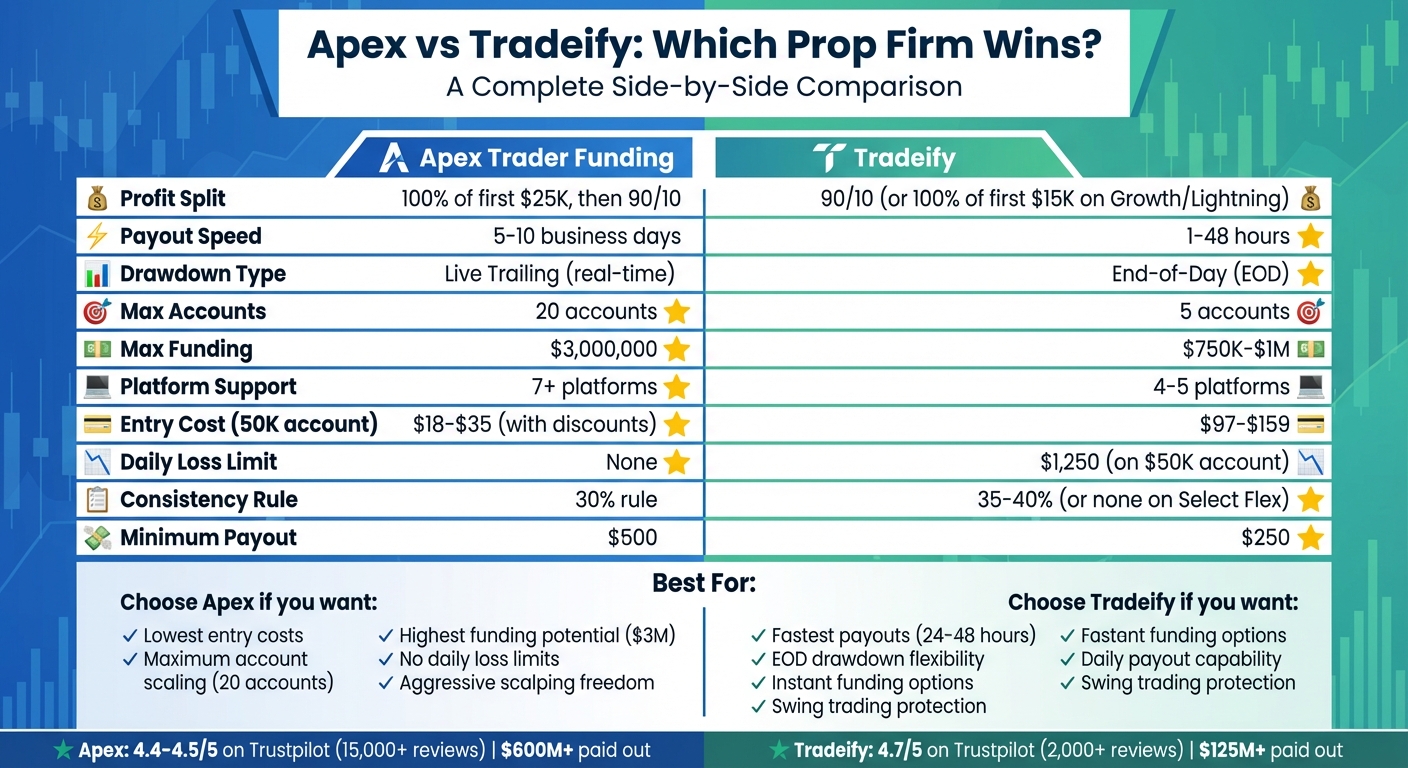
| Feature | Apex Trader Funding | Tradeify |
|---|---|---|
| Profit Split | 100% (first $25K), then 90% | 90% or 100% (first $15K) |
| Payout Speed | 5–10 business days | 1–48 hours |
| Drawdown Type | Live Trailing | End-of-Day (EOD) |
| Max Accounts | 20 | 5 |
| Max Funding | $3,000,000 | $750,000–$1,000,000 |
| Platforms | 7+ | 4–5 |
| Entry Cost | $18–$35 (with discounts) | $97–$159 |
Bottom Line: Apex is ideal for traders looking for lower costs, higher account limits, and no daily loss restrictions. Tradeify is better for those who value fast payouts, EOD drawdowns, and instant funding futures prop firms.
Quick Comparison Table
Here’s a side-by-side look at how Apex Trader Funding and Tradeify stack up. This table highlights the key differences to help you decide which best futures prop firms align better with your trading needs.
| Feature | Apex Trader Funding | Tradeify |
|---|---|---|
| Program Style | 1-Step Evaluation | 1-Step Evaluation & Instant Funding |
| Profit Split | 100% of first $25,000, then 90% | 90% (standard) |
| Payout Speed | Every 5–10 business days | Daily or every 5 trading days (On-demand) |
| Drawdown Rules | Live Trailing (Intraday) | Mixed: End-of-Day (Growth/Lightning) or Intraday (Advanced) |
| Platform Support | 7 platforms (including NinjaTrader, Tradovate, TradingView, Rithmic, WealthCharts, and R Trader Pro) | 4–5 platforms (including Tradovate, ProjectX, NinjaTrader, WealthCharts, and Quantower) |
| Max Accounts | 20 | 5 |
| Scaling Plan | Automatic (Balance-based) | Progressive (Profit milestone-based) |
| Maximum Funding | $3,000,000 across all accounts | $750,000–$1,000,000 depending on account type |
| Minimum Payout | $500 | $250 |
One of the standout differences lies in account limits. Apex allows traders to operate up to 20 accounts, making it a better fit for high-volume traders, while Tradeify caps accounts at 5. This ties directly to their funding limits – Apex offers a maximum of $3,000,000 across accounts, compared to Tradeify’s range of $750,000 to $1,000,000.
The payout structures also vary significantly. Apex gives traders 100% of their first $25,000 in profits before switching to a 90% split, whereas Tradeify sticks with a steady 90% split from the start. On top of that, Tradeify offers more flexible withdrawal options, including daily payouts and a lower minimum of $250, compared to Apex’s $500 minimum with payouts processed every 5–10 business days.
Apex Trader Funding
Apex Trader Funding, a prominent name in futures prop trading, has made waves by paying out over $500,000,000 since 2022 [7]. In September 2025, trader JadeCap set a record with a massive $2,500,000 payout [7][10]. With more than 15,000 reviews on Trustpilot and an average rating between 4.4 and 4.5 out of 5 [3][7], Apex has established itself as a go-to platform for traders seeking significant scaling opportunities and attractive profit splits.
Here’s a closer look at Apex’s standout features, payout process, and trading rules.
Key Features of Apex
Apex offers a simple and efficient evaluation process. Traders can secure account funding after completing a one-step evaluation that requires just 7 trading days [1][7]. One of its most appealing aspects is the 100% profit split on the first $25,000 per account. This means traders can theoretically retain 100% of up to $500,000 in profits if managing 20 accounts simultaneously [1][7][8].
Speaking of account management, Apex allows traders to operate up to 20 accounts at the same time using top trade copying platforms, with a total funding cap of $3,000,000 across all accounts [3][7]. The platform supports over seven trading platforms, including NinjaTrader, Rithmic, Tradovate, WealthCharts, and TradingView, with the platform choice being permanent for each account [12]. Each platform caters to different trading styles. For instance:
- Rithmic is ideal for scalpers and algorithmic traders due to its low-latency execution [12][13].
- Tradovate offers cloud-based accessibility across devices, making it convenient for traders on the go [12][13].
- WealthCharts provides advanced analytics, AI-powered scanners, and a built-in trade copier for strategy-driven traders [12][7].
Apex also stands out by not imposing a daily loss limit, encouraging traders to develop disciplined risk management strategies [1][2].
Payout Process and Speed
Traders can request payouts every 8 trading days, provided they achieve at least 5 profitable days (earning $50+ per day) and meet the minimum withdrawal amount of $500. However, Apex enforces a 30% consistency rule, which limits any single trading day’s profit to no more than 30% of the total profit at the time of withdrawal [7][8][9][10][11].
"The 30% consistency rule is Apex’s most trader-unfavorable funded account feature – more restrictive than Topstep (40%), Alpha Standard/Zero (40%), and Tradeify (zero on Select Flex)." – Paul, Proptradingvibes [9]
For the first 3 to 5 payouts, withdrawals are capped based on account size. For example, a $50,000 account has a maximum withdrawal limit of $2,000 during this period [7][8]. After the 6th payout, these caps are removed [7][11]. Once a request is submitted, it is reviewed within 48 hours, and funds are typically transferred to the trader’s bank account within 3 to 7 business days [7][8].
Trading Rules and Restrictions
Apex employs a "Live Trailing" drawdown system that adjusts with unrealized gains. Alternatively, traders can opt for a "Static" account with fixed drawdowns [7][2].
To request a payout, traders must maintain a minimum account balance. For instance, a $50,000 account requires a minimum balance of $52,600 [7][8]. If an account is blown while a payout is pending, the payout is forfeited. However, if the payout has already been approved, the funds will still be sent, even if the account is subsequently lost [8].
The evaluation fees for a $50,000 account start at approximately $131.33, though discounts often reduce this to $18–$20. Additionally, activating a Performance Account incurs a fee ranging from $85 to $145, depending on the platform and account size [2][3][7].
Tradeify
By early 2026, Tradeify had processed over $125 million in payouts and earned a 4.7/5 rating on Trustpilot from around 2,000 reviews. It’s a platform that appeals to traders who prioritize quick withdrawals and minimal red tape [22]. What truly sets Tradeify apart is its payout speed – most withdrawals are processed within 1 to 4 hours, even on weekends [14][16][6].
The platform offers three funding paths tailored to different trading styles. The Lightning account provides instant funding with no evaluation required. The Select program includes a 3-day evaluation and flexible funding options, while the Growth plan allows traders to qualify in just a single day by hitting a profit target [14][17]. Each plan uses an end-of-day (EOD) trailing drawdown, which updates at 5:00 PM ET based on the closing balance. This feature gives traders more room to navigate intraday volatility [15][6]. Let’s take a closer look at Tradeify’s standout features, payout process, and trading rules.
Key Features of Tradeify
Tradeify’s evaluation process is built for speed. The Growth plan requires just one trading day, while the Select program takes three days [17]. For those who want to skip evaluations altogether, the Lightning account offers immediate payout eligibility for a one-time fee ranging from $329 to $759, depending on account size [15]. This no-evaluation option highlights Tradeify’s focus on rapid funding.
Traders on the Growth and Lightning accounts keep 100% of their first $15,000 in profits, with a 90/10 split applied to earnings beyond that [20][22]. Select accounts, however, start with a profit splits across futures prop firms from the beginning [22]. Additionally, Tradeify doesn’t charge activation fees for the Select and Growth programs [15][6].
The platform supports popular trading tools like Tradovate, NinjaTrader, TradingView, and Quantower, with orders executed via Tradovate [14][16]. It also allows algo and bot trading (with ownership verification) and supports copy trading across up to five personally owned accounts [14][15]. Traders who complete five approved payouts can qualify for Tradeify Elite, a live trading program using real CME capital [15].
Payout Process and Speed
Tradeify is known for its rapid withdrawal processing, often completing payouts within 24–48 hours, including weekends [21][22]. Payments are handled through Rise, which offers options like bank transfers, ACH, and cryptocurrencies such as USDT and USDC [19][21][22].
The minimum withdrawal amount is $1,000 for most accounts, but the Select Daily option allows payouts as low as $250 once a buffer is established [18][20][15]. Maximum payout limits depend on account size and the number of previous withdrawals. For instance, a $50,000 account can withdraw up to $2,000 for the first three payouts, increasing to $2,500 for subsequent requests [18].
Consistency rules vary by account type. Select Flex funded accounts have no consistency requirements, making them the most adaptable option [14][17][6]. Growth accounts enforce a 35% rule, meaning no single day can account for more than 35% of total profits. Lightning accounts use a progressive consistency rule, starting at 20% and increasing to 30% after multiple payouts [14][17].
Trading Rules and Restrictions
One of Tradeify’s standout features is its EOD trailing drawdown. Since it updates only at 5:00 PM ET, intraday drawdowns don’t trigger violations, giving traders more flexibility during volatile market conditions [15][6]. On funded accounts, the trailing drawdown locks permanently at the starting balance plus $100 once a specified profit buffer is reached, creating a fixed safety net [22].
"EOD trailing drawdown across all plans is Tradeify’s biggest competitive advantage, full stop." – Prop Firm Hero [6]
Daily loss limits depend on the account type. Select evaluations have no daily loss limits, while Growth accounts feature a soft breach limit of $1,250 for a $50,000 account [15][6]. Another rule to note is the 10-second requirement: at least 50% of trades or 50% of total profits must come from positions held longer than 10 seconds, reducing excessive micro-scalping [21][22].
Most accounts require 10 trading days between payouts, but the Select Flex option allows payouts after just five winning days [20][22]. KYC verification is managed through the Rise platform and is only necessary before the first payout request [21].
Profit Splits and Payouts
Apex Trader Funding offers traders 100% of the first $25,000 in profits. After reaching this threshold, the profit split changes to a 90/10 ratio, favoring the trader [3]. Tradeify, by comparison, starts with a consistent 90/10 split across all accounts. However, its Growth and Lightning accounts provide a cumulative 100% payout on the first $15,000, rewarding traders who perform consistently and gain quicker access to funding [9]. These initial profit structures set the tone for further differences in withdrawal processes and payout timelines.
"Apex’s 100% first payout applies to a single withdrawal; Tradeify Growth’s 100% applies to the cumulative first $15K – Tradeify’s structure delivers significantly more at 100% for consistent performers." – Paul, ProTradingVibes [9]
Profit splits are only part of the story. Payout frequency offers another layer of distinction. Apex schedules withdrawals twice per month during specific windows (1st–5th and 15th–20th), requiring at least 8 to 10 trading days between requests [2]. Tradeify, on the other hand, provides faster access to funds. Its Select Daily accounts enable daily payouts once a profit buffer is met, while Select Flex accounts allow withdrawals after just five winning days. Growth and Lightning accounts support on-demand payouts once eligibility criteria are met [5]. These differences in payout schedules can significantly impact traders’ cash flow management.
Processing times also vary. Apex typically processes payouts within 1–3 business days using the Rise platform, though some traders have reported waiting up to 8–13 business days during certain payout cycles [9]. Tradeify generally processes payouts faster, completing them within 24–48 hours, and many traders report receiving funds in just a few hours [5]. Both companies use Rise for payment processing, offering options like ACH, bank transfers, and cryptocurrencies such as USDT and USDC [3].
Minimum withdrawal amounts further highlight Tradeify’s flexibility. Apex requires a minimum payout of $500, whereas Tradeify allows withdrawals as low as $250 [3]. Activation fees also come into play: Apex charges $130–$160 for a $50,000 account, while Tradeify’s Growth and Select programs have no activation fees [5]. Finally, Apex enforces a 30% rule, limiting any single day’s profit withdrawal to 30% of the cumulative total. In contrast, Tradeify’s Select Flex plan imposes no such restrictions [9].
Drawdown Rules and Trading Restrictions
Apex Trader Funding uses a real-time intraday trailing drawdown system that adjusts based on your highest unrealized profit. Essentially, your drawdown threshold moves up as soon as your position enters profit – even if the trade hasn’t been closed. In contrast, Tradeify employs a mixed model: Advanced accounts follow an intraday trailing system, while Growth and Lightning (Instant Funding) accounts use an End-of-Day (EOD) trailing drawdown. With EOD, the drawdown only updates at market close, based on your account balance, giving traders more flexibility to navigate intraday volatility. For those holding positions through choppy market conditions, Tradeify’s EOD approach provides extra breathing room.
"EOD Trailing (Tradeify) only updates at market close, so intraday swings don’t hurt you. EOD is much safer for swing trading." – DealPropFirm [2]
Another key difference lies in daily loss limits. Apex does not enforce daily loss limits during the evaluation phase, meaning traders can theoretically lose their entire drawdown buffer in a single day. On the other hand, Tradeify applies a daily loss limit – for instance, $1,250 for a $50,000 account – to help prevent emotional trading and minimize the impact of impulsive decisions [3]. This safeguard is particularly appealing to traders seeking structure and protection against revenge trading spirals.
Consistency requirements further distinguish the two firms. Apex enforces a 50% consistency rule during the funded phase, ensuring that no single trading day contributes more than half of your cumulative profits. Tradeify’s consistency rules vary by account type: Advanced and Growth accounts have a 35% consistency rule, while Lightning accounts tighten this to 20% [4]. Both firms also require traders to close all positions by 4:59 PM ET and prohibit overnight or weekend trades, effectively ruling out multi-day swing trading [1].
Apex’s structure is ideal for aggressive scalpers who focus on quick trades and rapid exits. Meanwhile, Tradeify’s rules cater to disciplined intraday traders who value risk management tools and the flexibility to hold positions longer during the trading day.
Platforms and Account Scaling
When choosing a prop trading firm, it’s not just about profit splits or drawdown rules – platform compatibility and account scalability play a major role too. Apex, for instance, supports 14 trading platforms, including popular options like NinjaTrader, TradingView, WealthCharts, Sierra Chart, and Quantower. As a bonus, Apex throws in a free NinjaTrader license, which could save you around $60 a month.
Tradeify, on the other hand, relies on Tradovate for execution and also supports TradingView, NinjaTrader (on select plans), Quantower, and its proprietary platform, ProjectX. These platform differences set the tone for how each handles account volume and scaling.
Apex has a clear edge for traders managing multiple accounts, allowing up to 20 funded accounts with trade copier support. Meanwhile, Tradeify caps traders at 5 simulated funded accounts, though it offers native group-copying through Tradovate.
Another distinction lies in contract limits. Apex starts traders with half the maximum contracts, unlocking full limits automatically once a set balance threshold is reached. Tradeify, however, takes an incremental approach, increasing contract limits as traders hit profit milestones. For example, on a $50,000 account, Tradeify allows you to scale from 2 to 4 mini contracts after earning $2,000 in profits.
For those who want to skip the evaluation process entirely, Tradeify offers its Lightning Funded account. This option provides immediate simulated funding for a one-time fee. After five successful payouts, traders can advance to "Tradeify Elite" status, gaining access to live CME capital, daily payouts, and the ability to manage up to 5 live accounts. In comparison, Apex requires a 7-day evaluation period but offers a much higher maximum funded amount.
"Apex is ideal for dedicated futures traders… If your strategy uses NinjaTrader or depends on Rithmic’s data feed, Apex is practically built for you." – Ngan Pham, Senior Financial Analyst
For traders focused on scaling a large portfolio with trade copying software, Apex’s support for 20 accounts and broad platform compatibility is a strong fit. However, if you’re after a simpler setup with fewer accounts and an easy path to live trading through the Elite program, Tradeify’s streamlined tools and native copying features might be more appealing. These differences in platform options and scaling strategies make each firm better suited for different trading approaches.
Pros and Cons
When comparing Apex and Tradeify, it’s clear that each firm caters to different trading preferences. Apex, launched in 2021 with over $600 million in payouts, focuses on affordability and high account limits. Meanwhile, Tradeify, a newer player, emphasizes rapid funding and quick payouts, offering traders a different set of perks and challenges [2].
Apex’s standout feature is its affordability. With discounts between 80–90%, a $50,000 account can cost as little as $17.70 to $28.05 [2]. Traders keep 100% of the first $25,000 in profits, followed by a 90% split on additional earnings [1]. Apex also allows for aggressive trading strategies by eliminating daily loss limits. However, its live trailing drawdown, which adjusts in real-time based on unrealized profits, can make it harder to hold positions as gains are "locked in" [1].
Tradeify, on the other hand, offers more flexibility during the trading day with its end-of-day (EOD) trailing drawdown, which only updates at market close [1]. Payouts are another highlight – often processed within 24–48 hours – and the firm has been recognized with awards like "Best Payout Process" and "Most User Friendly" by Prop Firm Match in 2025 [6]. That said, Tradeify comes with higher entry costs, ranging from $97 to $159 for a $50,000 account [2], and traders are capped at five accounts compared to Apex’s twenty [2].
Here’s a side-by-side comparison of the key pros and cons for each firm, both of which rank among the top futures prop firms:
| Firm | Pros | Cons |
|---|---|---|
| Apex | • Extremely low cost ($17.70–$28.05 with discounts) • 100% profit split on the first $25,000 • No daily loss limits • Up to 20 accounts and $3M in maximum funding |
• Live trailing drawdown can restrict trading • Strict 30% consistency rule • Payouts processed twice a month |
| Tradeify | • EOD drawdown updates at market close • Payouts processed in 24–48 hours • Instant funding options • Modern integration with Tradovate and TradingView |
• Higher entry costs than Apex • Limited to 5 accounts • Shorter track record as a newer firm • Stricter 35–40% consistency rules |
Trustpilot reviews also highlight these differences. Apex has a rating of 4.4/5 to 4.5/5 from over 15,900 reviews, while Tradeify scores slightly higher at 4.6/5 to 4.8/5 from more than 2,000 reviews [2]. Ultimately, your decision will hinge on what matters most: low costs and high account limits (Apex) or faster payouts and more lenient drawdown policies (Tradeify).
Which Firm Fits Your Trading Style
Choosing the right prop firm hinges largely on your trading style. If you’re an aggressive scalper aiming for quick profits and prefer unrestricted trading, Apex Trader Funding might be your ideal match. With no daily loss limits, you can leverage your entire drawdown buffer in a single day if necessary. Plus, Apex allows up to 20 simultaneous accounts with a maximum funding limit of $3,000,000, offering plenty of room for growth [2] [3]. These features cater to traders who thrive in fast-paced environments and value full trading autonomy.
On the other hand, Tradeify is tailored for swing traders who need flexibility during market fluctuations. Its End-of-Day (EOD) drawdown policy updates only at market close, shielding positions from intraday volatility [2]. Payouts are typically processed within 24–48 hours, and some plans even offer daily withdrawals. For seasoned traders who want to bypass evaluations, the "Lightning" instant funding accounts provide immediate access to capital [2] [5].
"Apex wins on freedom (no daily limit). Tradeify wins on drawdown type (EOD vs Live Trailing) and instant funding options." – DealPropFirm [2]
For beginners in prop trading, Apex’s low entry cost combined with a 100% profit split on the first $25,000 earned makes it an accessible starting point [3]. However, if you struggle with overtrading during volatile sessions, Tradeify’s daily loss limits can act as a safeguard to prevent significant losses in a single session [2].
For professionals managing larger portfolios, Apex stands out with its higher account limits and the ability to scale up to $3,000,000 in funding [3]. Meanwhile, if your focus is on liquidity and fast payouts, Tradeify’s on-demand payout structure offers unmatched convenience [2].
Conclusion
Choosing the right prop trading firm depends on your trading style and risk tolerance. Apex, established in 2021, has paid out over $600 million to traders. It offers funding for up to 20 accounts with a combined total of $3,000,000 and provides a 100% profit split on the first $25,000. With entry costs often ranging between $18–$35 (thanks to frequent discounts), Apex is an attractive option for scalpers who prioritize flexibility, especially with no daily loss limits [2].
On the other hand, Tradeify, launched in 2024, has distributed over $10 million in payouts and holds an impressive 4.7/5 rating on Trustpilot [2]. Its End-of-Day drawdown, fast payouts (within 24–48 hours), and "Lightning" instant funding make it a solid choice for swing traders, despite its higher entry fees [2][5].
As DealPropFirm puts it:
"Apex wins on price ($28.05 vs ~$99) and freedom (no daily limit). Tradeify wins on drawdown type (EOD vs Live Trailing) and instant funding options." – DealPropFirm [2]
The drawdown structure is a critical factor. Tradeify’s End-of-Day drawdown is ideal for traders who need to weather market fluctuations, while Apex’s live trailing drawdown caters more to scalpers aiming for quick profits. Ultimately, the best fit will depend on your trading approach, risk management style, and financial goals.
FAQs
Which drawdown type is safer for my strategy?
The answer depends on your risk tolerance and trading style. Tradeify uses an End-of-Day (EOD) trailing drawdown. This approach calculates losses based on the daily closing price, which helps minimize intraday risk. On the other hand, Apex Trader Funding uses a live trailing drawdown. This method allows for greater flexibility during trading hours but comes with increased intraday risk.
If you’re focused on conservative risk management, the EOD trailing drawdown is often seen as the safer choice.
How soon can I request my first payout?
If you’re trading with Tradeify, you can request your first payout as soon as you meet their eligibility requirements. Once the conditions are met, payouts are usually processed within 24 to 48 hours. This quick turnaround ensures traders can access their earnings without unnecessary delays, making it a key benefit of using Tradeify.
What hidden fees should I budget for?
When choosing between Apex Trader Funding and Tradeify, it’s important to be aware of additional fees that may not be immediately obvious. Tradeify’s monthly evaluation fees range from $139 to $359, depending on the program you select, and there may also be platform-related costs to factor in. On the other hand, Apex Trader Funding offers lower account prices, such as $37.40 for a 50K account, but you should double-check for any platform or payout fees that might apply.
The primary costs to watch out for include evaluation fees (notably higher with Tradeify) and any extra charges tied to platforms or payouts. Always read the fine print to avoid surprises.