
Tradeify and Lucid Trading are two popular futures prop firms for Australian traders in 2026. Both provide access to major US futures markets and eliminate activation fees, but they differ in rules, fees, and funding options. Here’s a quick breakdown:
- Tradeify: Known for fast payouts (as quick as 60 minutes), a 90/10 profit split (100% on the first $15,000), and flexible funded accounts like Select Flex, which removes daily loss limits and consistency rules after funding. Monthly subscription fees apply for evaluations.
- Lucid Trading: Offers a 90/10 profit split (100% on the first $10,000 for legacy accounts), 15-minute payout processing, and one-time evaluation fees. LucidFlex accounts also remove daily loss limits and consistency rules after funding.
Quick Comparison
| Feature | Tradeify | Lucid Trading |
|---|---|---|
| Payout Speed | 60 minutes | 15 minutes |
| Profit Split | 100% on first $15k, then 90% | 100% on first $10k (legacy), 90% |
| Evaluation Fee | $159/month (50k Select) | $130 (one-time, 50k LucidFlex) |
| Daily Loss Limits | None on Select Flex | None on LucidFlex |
| Platforms | Tradovate, NinjaTrader, etc. | LucidX, Sierra Chart, etc. |
| Trustpilot Rating | 4.7/5 (2,000+ reviews) | 4.8/5 (1,600+ reviews) |
Choose Tradeify for fast payouts and flexible rules, or Lucid Trading for platform variety and one-time fees.
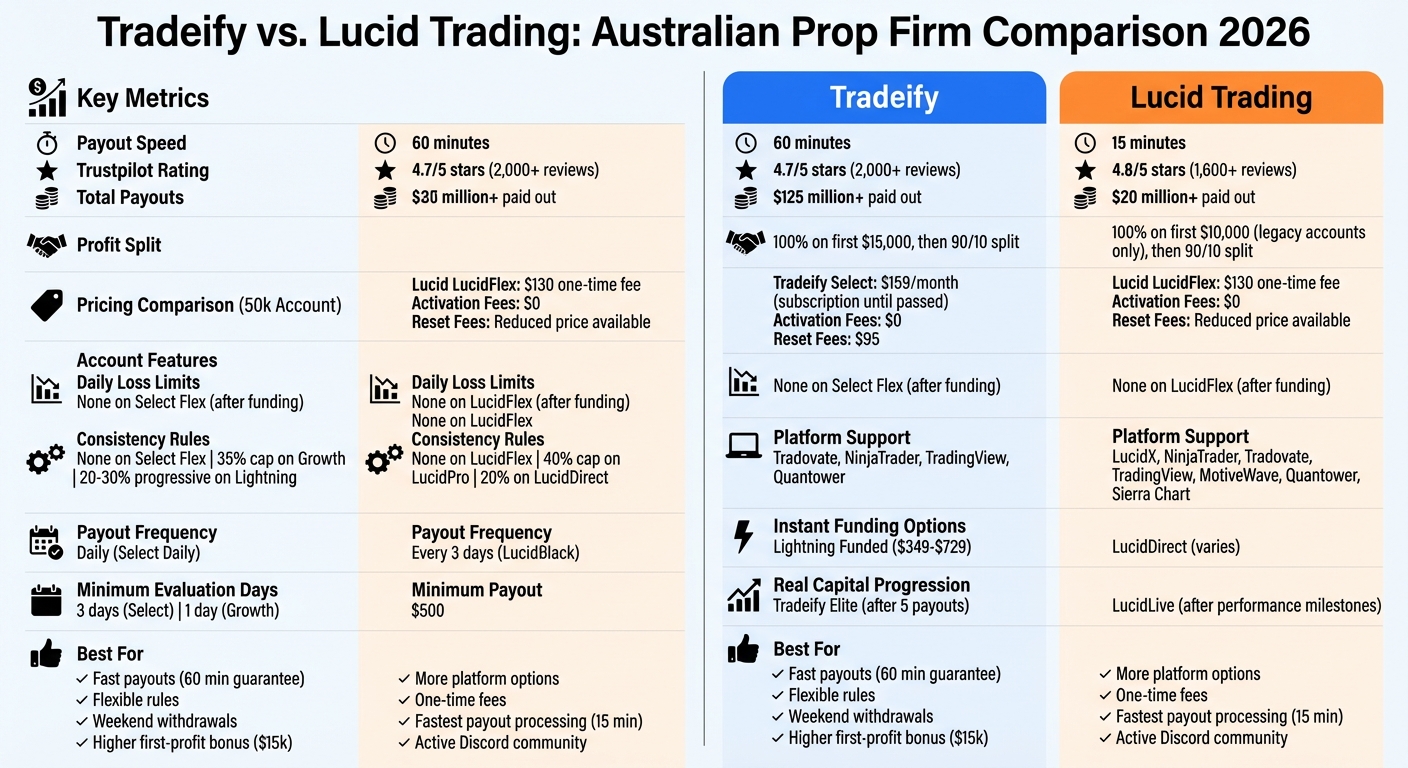
Tradeify vs Lucid Trading: Complete Feature Comparison for Australian Traders 2026
Trading Rules and Drawdown Limits
Both Tradeify and Lucid Trading use an End-of-Day (EOD) trailing drawdown system for their main account models. This means the drawdown limit is updated only after the session closes at 5:00 PM ET, based on your highest end-of-day balance, rather than during live trading hours. For Australian traders dealing with volatile US indices like NQ or ES during late-night or early-morning sessions, this method reduces the risk of account failures caused by intraday price swings.
Drawdown locking comes into play when your funded account reaches a specific balance, typically calculated as the starting balance plus the maximum drawdown plus $100. For example, on a $50,000 account, the drawdown locks at $52,100. Once this threshold is reached, the drawdown floor becomes fixed and no longer adjusts. Tradeify’s Select Flex model takes this further: after your first payout, the drawdown locks at the starting balance (zero), ensuring the account is safe from drawdown violations going forward.
"After the first payout, the trailing drawdown locks at zero – meaning the account can no longer fail due to drawdown. This is a major advantage for traders looking for long-term stability." – Nordic Trader
Here’s a breakdown of each firm’s rules and drawdown policies.
Tradeify Rules and Drawdown Policies

Tradeify has specific guidelines, including a 10-second minimum hold rule. At least 50% of trades or profits must come from positions held longer than 10 seconds, which discourages high-frequency micro-scalping. Consistency requirements vary depending on the account type. For Growth accounts, the best trading day is capped at 35% of total profits. Lightning accounts follow a progressive cap: 20% for the first payout, 25% for the second, and 30% for subsequent payouts.
The Select Flex model eliminates both the daily loss limit (DLL) and consistency rules once the account is funded, giving traders more freedom. Growth accounts, however, use a "soft" DLL of $1,250. This pauses trading for the day if breached but doesn’t result in account failure. Meanwhile, Select Daily and Lightning accounts maintain stricter active DLLs. Across all account types, holding positions over the weekend is not allowed.
Lucid Trading follows a similar structure but with some notable differences.
Lucid Trading Rules and Drawdown Policies
Lucid Trading’s LucidFlex accounts mirror Tradeify’s flexibility by removing consistency rules and daily loss limits once funded. However, the LucidPro account enforces a strict 40% consistency cap, while LucidDirect (an instant funding option) applies a 20% consistency rule. LucidFlex and LucidBlack accounts have no DLLs in either the evaluation or funded stages, whereas LucidPro and LucidDirect accounts maintain active DLLs.
LucidBlack accounts also feature an EOD trailing drawdown that locks in a similar manner to Tradeify’s system. Lucid requires a minimum of 2 evaluation trading days (compared to Tradeify’s 3 days for Select accounts), and traders can request payouts every 5 profitable days once funded. These differences in rules can significantly impact long-term trading stability, especially for Australian traders managing accounts during volatile periods.
Account Fees and Pricing
Both Tradeify and Lucid Trading have done away with activation fees, making it less expensive to get started.
Tradeify operates on a monthly subscription model for its evaluation accounts. For example, the 50k Select account costs $159 per month, while the 50k Growth account is $139 per month – fees continue until you successfully pass the evaluation. If you need to reset your account, fees generally range between $85 and $95. For those seeking instant funding, Tradeify offers Lightning Funded accounts with one-time fees: $349 for 25k, $509 for 50k, $629 for 100k, and $729 for 150k.
Lucid Trading, on the other hand, uses a one-time fee structure for its LucidBlack and LucidDirect models, meaning there’s no recurring monthly charge. Fees for LucidFlex accounts start at $100 for 25k, $130 for 50k, $225 for 100k, and $315 for 150k. Plus, promotional codes can slash these fees by up to 50%. For LucidPro evaluations, there are no activation fees, though monthly costs may vary depending on the specifics.
"Tradeify focuses on straightforward funding… removing the friction of high activation fees." – Brett Simba
The pricing strategies of these two firms offer unique advantages, particularly for Australian traders looking to balance affordability and flexibility. Here’s a quick look at how the fees compare:
Fee Comparison Table
| Feature | Tradeify (50k Select) | Lucid Trading (LucidFlex 50k) |
|---|---|---|
| Evaluation Fee | $159/month | $130 (One-time) |
| Activation Fee | $0 | $0 |
| Monthly Rebilling | Yes (until passed) | No |
| Reset Fee | $95 | Reduced price available |
| Instant Funding Cost | $509 (Lightning 50k) | Varies (LucidDirect) |
| Profit Split | 90/10 | 90/10 |
Funding Options and Payout Speeds
Funding Models
Both Tradeify and Lucid Trading provide traders with multiple funding options, catering to different needs and goals. These include challenge-based paths and instant funding opportunities.
Tradeify offers three main funding models:
- Growth: A rapid evaluation path with a minimum pass time of just 1 day.
- Select: Requires a minimum of 3 days to pass and eliminates consistency rules and daily loss limits once funded.
- Lightning Funded: Provides instant access to funds without requiring any evaluation.
Once traders complete five payouts, they gain access to Tradeify Elite, where they transition to trading with real capital instead of simulated funds.
Similarly, Lucid Trading offers comparable flexibility through its funding paths:
- LucidFlex: A 2-day minimum pass option that removes consistency rules and daily loss limits after funding.
- LucidPro: A slightly longer evaluation period requiring at least 5 days to pass.
- LucidDirect: Instant funding with no evaluation required.
Lucid also features the LucidLive program, which grants traders access to real capital after hitting specific payout cycles or performance targets.
Payout Timelines and Profit Splits
After securing funding, the next priority for traders is how quickly they can access their earnings. Both firms emphasize fast and reliable payout systems that cater to the needs of active traders.
Tradeify stands out with payout processing times as quick as 60 minutes. In fact, trader Pascal Kemelong shared his experience, stating that his payout was approved in under 2 minutes, and the funds were in his bank account within 10 minutes – on a Saturday. Another trader reported earning over $47,000 through payouts, many of which were processed within hours, even on weekends. Tradeify offers a 90/10 profit split, but traders keep 100% of the first $15,000 in profits on Growth and Lightning accounts.
Lucid Trading also prioritizes fast payouts, processing requests within 1–2 hours for same-day approval. Standard payouts may take up to 2 business days. For those with LucidBlack premium accounts, payouts can be requested as frequently as every 3 days, making it one of the industry’s fastest cycles. Lucid offers a standard 90/10 profit split for new accounts, while legacy accounts (created before November 28, 2025) still benefit from 100% of the first $10,000 in profits.
"Tradeify always doing right by their traders… payout request approved in less than 2 minutes and money in my bank account in 10 minutes." – Pascal Kemelong, Trader
These payout speeds and profit-sharing structures highlight the differences between the two firms, offering traders a range of options based on their priorities.
Funding and Payout Comparison Table
| Feature | Tradeify | Lucid Trading |
|---|---|---|
| Instant Funding | Lightning Funded | LucidDirect |
| Fastest Evaluation | 1 day (Growth) | 2 days (LucidFlex) |
| Profit Split | 90% (100% on first $15k) | 90% (100% on first $10k legacy only) |
| Payout Processing | 60 minutes | 1–2 hours (same-day) |
| Fastest Payout Cycle | Daily (Select Daily) | Every 3 days (LucidBlack) |
| Minimum Payout | $250 | $500 |
| Real Capital Path | Tradeify Elite (after 5 payouts) | LucidLive (after reaching performance milestones) |
sbb-itb-46ae61d
Access for Australian Traders
Australian traders are fully supported by both Tradeify and Lucid Trading, with access to all account types and trading on major US futures markets. Tradeify offers evaluation accounts, simulated funded accounts, and a live capital tier called Tradeify Elite. Meanwhile, Lucid Trading serves a global community of over 24,000 traders. Both firms provide connections to CME Group exchanges – CME, CBOT, COMEX, and NYMEX – and support popular platforms like NinjaTrader, Tradovate, and TradingView.
To further engage traders in the Oceania region, Tradeify has named UFC Champion Israel "Izzy" Adesanya as its Global Ambassador.
When it comes to payouts, both firms cater to Australian traders with efficient processes. Tradeify uses Rise and Plane for payouts, offering options like bank transfers and crypto/USDC. Lucid Trading, on the other hand, is known for its quick payouts, often completed within 15 minutes. Keep in mind that payouts are issued in USD, so currency conversion fees may apply.
Account management is also designed with flexibility in mind. Tradeify allows traders to manage up to 5 simulated funded accounts simultaneously. Lucid Trading permits a maximum of 5 funded accounts per household and up to 10 evaluation accounts at the same time. For those looking to advance, Tradeify offers progression to the Tradeify Elite tier on CME exchanges after completing five payouts. Similarly, Lucid Trading provides access to its LucidLive program after traders meet specific payout milestones.
These features ensure Australian traders benefit from streamlined processes, fast payouts, and adaptable account options while trading in transparent markets.
Pros and Cons
Building on the detailed review of rules, fees, and funding options, here’s a breakdown of the key advantages and drawbacks for both Tradeify and Lucid Trading. Each firm brings unique benefits to the table, but they also come with specific trade-offs, particularly for Australian traders.
Tradeify offers a standout feature: a 60-minute payout guarantee, even on weekends. As of February 2026, the firm has paid out over $125 million. Another highlight is the 100% profit split on the first $15,000 earned, a rare perk in the trading industry. Australian traders benefit from zero activation fees on Growth and Select accounts, along with an end-of-day (EOD) trailing drawdown across all account types. Additionally, the Select Flex account eliminates daily loss limits and consistency rules once funded. Customer support is also highly efficient, resolving issues within 5–10 minutes.
On the downside, Tradeify’s monthly subscription fees for evaluations can become costly if traders don’t pass quickly. Another limitation is the discontinuation of its ProjectX platform in February 2026, leaving traders with fewer platform options such as Tradovate, NinjaTrader, TradingView, and Quantower.
Lucid Trading, on the other hand, supports a wider range of platforms, including Sierra Chart and MotiveWave. The firm processes payouts in an average of 15 minutes and has paid out over $20 million to traders. Its LucidFlex account mirrors Tradeify’s flexibility, removing daily loss limits and consistency rules in the funded stage. Lucid Trading also boasts a 4.8/5 Trustpilot rating from over 1,600 reviews and offers quick support, backed by an active Discord community.
However, Lucid Trading’s status as a newer firm might raise concerns for traders looking for a longer track record. Additionally, consistency rules still apply to its Pro and Direct account paths.
Pros and Cons Comparison Table
| Aspect | Tradeify | Lucid Trading |
|---|---|---|
| Payout Speed | 60 minutes guaranteed, including weekends | 15 minutes on average |
| Profit Split | 100% on first $15,000, then 90% | 90% flat across accounts |
| Activation Fees | $0 on Growth and Select accounts | $0 on LucidPro evaluations |
| Drawdown Type | End-of-Day trailing (locks to a static floor) | End-of-Day trailing |
| Flexible Funded Accounts | Select Flex (no daily loss limit, no consistency rule) | LucidFlex (no daily loss limit, no consistency rule) |
| Platform Options | Tradovate, NinjaTrader, TradingView, Quantower | LucidX, NinjaTrader, Tradovate, TradingView, MotiveWave, Quantower, Sierra Chart |
| Customer Support | Resolves issues within 5–10 minutes | Responsive support with an active Discord community |
| Track Record | Over $125 million paid out; 75% repeat customers | Over $20 million paid out; newer firm |
| Trustpilot Rating | 4.7/5 from approximately 2,000 reviews | 4.8/5 from over 1,600 reviews |
| Evaluation Fees | Monthly subscription fees | One-time fee options available |
| Consistency Rules | None on Select Flex | None on LucidFlex; rules apply on Pro/Direct accounts |
Final Recommendations
Tradeify is a standout choice for traders who value speed and adaptability. With a 60-minute payout guarantee available every day of the week and a 100% profit split on the first $15,000 earned, Tradeify ensures quick access to your earnings. Australian traders gain additional perks like zero activation fees on Growth and Select accounts. For those using the Select Flex model, the removal of daily loss limits and consistency rules after funding makes it an attractive option. Experienced traders will also appreciate the seamless transition to live capital through Tradeify Elite, available after five payouts.
Lucid Trading is ideal for traders seeking platform variety and simple trading rules. Supporting platforms like Sierra Chart, MotiveWave, and its own LucidX, it caters to technical traders who rely on advanced data feeds. Payouts can be processed in as little as 15 minutes, though standard processing may take up to two business days. Lucid Trading’s funded accounts, such as LucidFlex, eliminate daily loss limits and consistency requirements by applying a flat 20% consistency cap. With over 1,600 positive reviews on Trustpilot, the firm has built a strong reputation for trader satisfaction.
Both firms excel in providing instant funding and cater to traders looking for quick onboarding. For the fastest payouts, consider Tradeify Lightning, which processes withdrawals in about 60 minutes and features a progressive consistency rule of 20%-30%. On the other hand, LucidDirect offers a flat 20% rule and a wide range of platform options. Tradeify’s partnership with Rise and Plane ensures fast international transfers, with added benefits for Australian traders. Meanwhile, Lucid Trading’s collaboration with Eightcap, a Melbourne-based broker, enhances its appeal for regional traders.
If you’re a daily trader who prefers frequent, smaller withdrawals, Tradeify Select Daily could be a great fit. For swing traders or those with uneven profit patterns, Tradeify Select Flex or LucidFlex might better suit your needs. Review the specifics of each firm to determine which aligns best with your trading style and goals.
FAQs
Which firm is cheaper if I take longer to pass the evaluation?
Lucid Trading often works out to be a less expensive option for traders who anticipate needing more time to pass their evaluation. This is because they charge a one-time evaluation fee, giving traders unlimited time to complete the process without incurring additional expenses. On the other hand, Tradeify operates on a subscription-based model, meaning the longer you take, the more you’ll pay in recurring fees. For those who expect the evaluation to take a while, Lucid Trading’s approach can be a more budget-friendly choice.
How does an EOD trailing drawdown affect my risk on NQ or ES?
An end-of-day (EOD) trailing drawdown sets a loss limit based on the account’s closing balance at the end of each trading day. This approach gives traders more flexibility during intraday sessions, particularly when dealing with volatile indices like NQ or ES. It means traders can navigate larger swings within the day without being immediately disqualified – as long as the closing balance remains above the drawdown threshold. However, any losses that aren’t recovered by the end of the trading day can still trigger the drawdown, making consistent risk management a crucial part of the strategy.
What payout method works best for Australians to reduce FX fees?
Australians looking to cut down on foreign exchange (FX) fees can take advantage of payout methods offered by platforms like Lucid Trading or Tradeify. These platforms provide quick payout services and support direct funding options, which can help reduce the extra costs associated with currency exchange.