When selecting a Rithmic prop firm, focus on these key areas to maximize your trading potential:
- Rithmic Integration: Ensure the firm provides direct Rithmic credentials and compatibility with professional platforms like NinjaTrader, Sierra Chart, or Quantower. Look for features like server-side orders and low latency for smooth execution.
- Funding Rules: Understand the drawdown model (e.g., intraday, end-of-day, or static) and account scaling options. Some firms allow multiple accounts and higher payout caps, while others enforce stricter rules.
- Payout Terms: Compare profit splits (80–100%), withdrawal frequency, and payout buffers. Firms offering faster payouts and fewer restrictions may suit active traders better.
- Costs: Calculate all fees, including evaluation, activation, Rithmic connection, and platform expenses. Use promo codes or discounts to reduce costs.
- Instant Funding Options: For experienced traders, consider firms offering instant funding to skip evaluations. Compare upfront costs and rules.
Quick Comparison
Focus on firms that align with your trading style and budget. Look for transparent rules, fair splits, and reliable Rithmic performance to improve your chances of success.
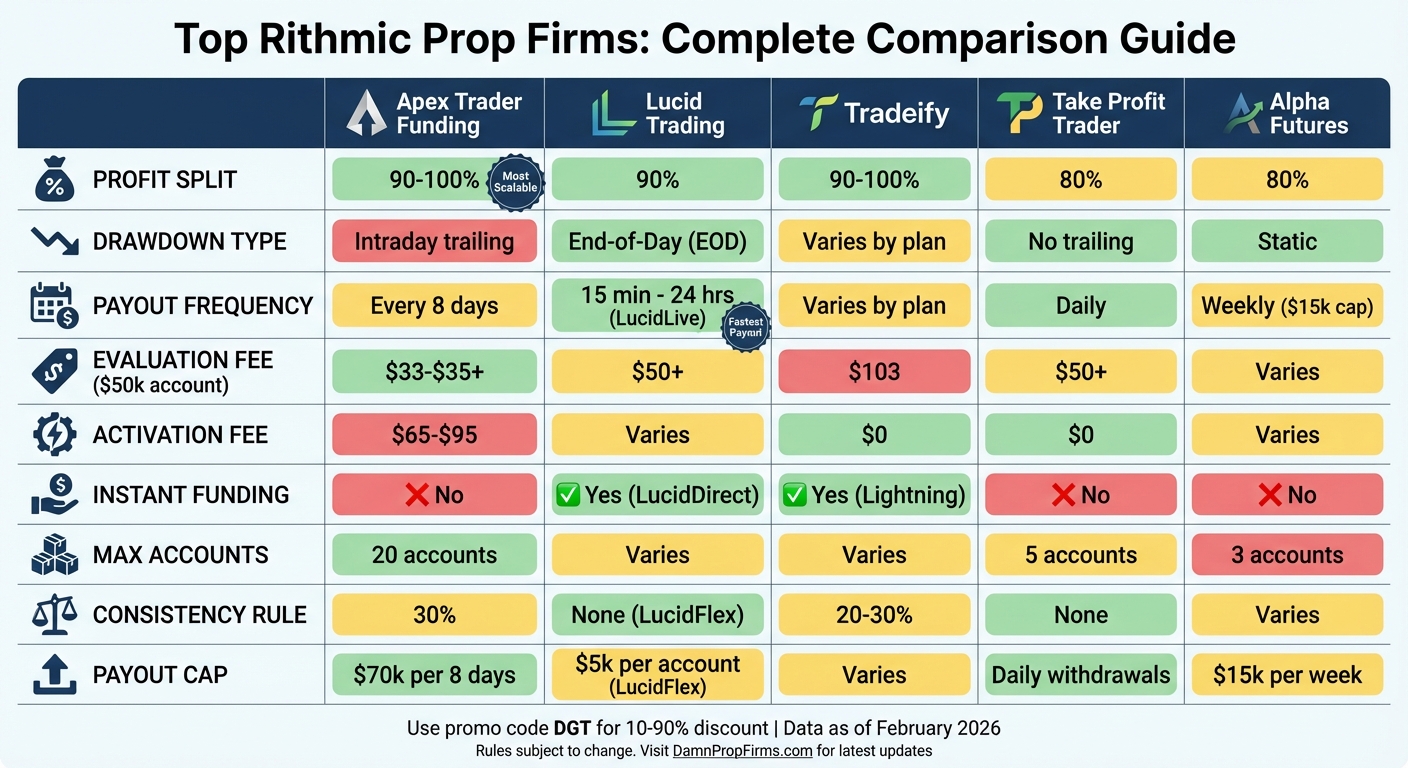
Rithmic Prop Firms Comparison: Features, Costs, and Payout Terms
Apex Trader Funding Rithmic vs Tradovate
sbb-itb-46ae61d
What to Look for in a Rithmic Prop Firm
Choosing the right Rithmic prop firm means carefully weighing technical capabilities, funding terms, and payout structures. The best firms offer reliable tools, fair rules, and competitive profit-sharing to help traders succeed.
Rithmic Connectivity and Platform Performance
A solid Rithmic integration is essential for serious futures traders. The platform’s Direct Market Access (DMA) routes orders straight to exchanges like CME Group, cutting out intermediaries. It handles about 20% of global daily futures volume, with execution speeds under 250 microseconds. Features like server-side bracket orders, trailing stops, and OCO orders ensure that stops remain active even if your connection drops.
For traders analyzing order flow, the Market By Order (MBO) data provides insights into individual orders rather than aggregated price levels. To minimize latency, Rithmic uses servers co-located near CME.
Flexibility is another key factor. Rithmic connects seamlessly with over 20 professional platforms like NinjaTrader, Sierra Chart, Bookmap, and Quantower. When evaluating a firm, check if they provide direct Rithmic credentials instead of limiting you to a web-only interface. If you’re using third-party platforms, ensure compatibility with R|Trader Pro’s "Plug-in Mode" to streamline connections.
"For most prop firm traders, Rithmic offers superior advantages for passing evaluations and sustaining profitability due to its exceptional execution speed." – Phidias Propfirm
Once the technical foundation is clear, it’s time to dive into funding rules and account options.
Funding Rules and Account Options
Understanding a firm’s funding rules and evaluation criteria is crucial to avoid unexpected challenges. Different firms use varying drawdown models. For instance:
- Apex Trader Funding employs an intraday trailing drawdown that resets daily.
- Alpha Futures offers a static drawdown, keeping the maximum loss limit unchanged.
- Lucid Trading uses an end-of-day (EOD) drawdown, calculating losses at the market close.
Account scaling limits also differ. Apex Trader Funding allows up to 20 accounts with a payout potential of $70,000 every 8 days. In contrast, Take Profit Trader limits traders to 5 accounts, and Alpha Futures caps it at 3.
For those wanting to skip evaluations altogether, some firms offer instant funding. Options include Lucid Trading, Tradeify, Legends Trading, and Purdia Capital. These accounts provide immediate capital access but often come with higher fees or stricter rules.
Consistency rules can also impact your trading. Firms like Apex Trader Funding and Legends Trading enforce a 30% consistency rule, limiting daily profits relative to your total. Meanwhile, Take Profit Trader and Lucid Trading’s LucidFlex plan impose no such restrictions during the funded stage.
Once you’ve secured reliable connectivity and fair funding, the next step is evaluating payout terms.
Payout Terms and Profit Splits
After confirming platform performance and funding terms, take a close look at profit splits and withdrawal policies.
Profit splits typically range from 80% to 100%. For example, Apex Trader Funding offers 100% of the first $25,000 in profits, followed by a 90/10 split. Tradeify’s split depends on the chosen plan.
Withdrawal frequency varies by firm. Take Profit Trader allows daily withdrawals, while Apex Trader Funding processes payouts every 8 days. FundedNext even promises payouts within 24 hours, with a $1,000 bonus if they miss the deadline. Lucid Trading’s LucidLive accounts can process withdrawals in as little as 15 minutes to 24 hours.
Watch out for payout buffers, which require a minimum balance before you can withdraw. Traditional accounts may need a $2,500 buffer, but newer options like LucidFlex have eliminated this requirement. Alpha Futures also offers a high payout cap of $15,000 per week on its Advanced accounts.
"With LucidFlex you keep $9,000 [of a $10,000 profit]. With a standard 80/20 firm, you’d only get $8,000. That’s an extra $1,000 per $10K earned – a 12.5% increase in your take-home pay." – SpicyFutures
Firms often use third-party processors like Rise for withdrawals via ACH, wire transfer, or cryptocurrency. Be sure to check the minimum payout threshold for your account. For example, LucidFlex requires a $500 minimum, while LucidLive accounts allow withdrawals starting at $100.
Costs and Discounts to Consider
When evaluating Rithmic prop firms, it’s important to look beyond instant funding and profit splits. Make sure you fully understand all ongoing costs and potential discounts to keep your trading profitable. Hidden charges like activation fees, monthly subscriptions, and platform expenses can quickly add up. Smart traders calculate the Total Cost of Funding (TCF) – a combination of evaluation fees, activation charges, and reset costs – before committing to a firm. Breaking down monthly fees and evaluation costs can help you see the full picture.
Monthly Fees and Evaluation Costs
Evaluation fees typically range from $35 to over $200 per month, depending on the firm and account size. Once you pass the evaluation, additional costs like activation fees often come into play. These one-time fees can vary but generally fall between $75 and $160+ [4, 23].
For instance, Apex Trader Funding offers evaluation fees as low as $35 during sales but adds a $75 activation fee for accounts between $25k and $100k, and $95 for accounts ranging from $150k to $300k. On the other hand, Tradeify eliminates activation fees entirely, making their $103 monthly evaluation fee the actual total cost.
Rithmic’s infrastructure also comes with its own charges. Traders pay a minimum $25/month connection fee, with routing fees of about $0.10 per contract per side ($0.20 for a round turn). Once funded, exchange data fees kick in: CME Level I costs $9–$12 per month, while Level II (Full Depth) costs $41+ monthly. Using multiple devices or platforms can drive these fees even higher.
"Think of Rithmic as the engine that powers your car – you don’t drive the engine directly, but without it, you’re not going anywhere." – PropFirmApp
Some firms bundle these costs during the evaluation phase, but once funded, traders are responsible for covering them. Additionally, third-party platforms like NinjaTrader may require separate licenses, which can add another $60 per month to your expenses. To avoid surprises, calculate all costs upfront. Once you’ve assessed the base expenses, explore available discounts to get the best deal.
Using Discounts and Promo Codes
Promo codes can significantly reduce costs, with discounts ranging from 10% to as much as 90%. DamnPropFirms keeps an updated discounts page featuring verified codes for over 14 trusted firms. The universal code DGT often provides the best discount available at checkout.
For example, as of February 18, 2026, Apex Trader Funding is running a flash sale (ending February 24th at 11:59 PM ET) offering 90% off evaluation accounts. This drops the price for $150k–$300k accounts from $397 to just $39.70. Meanwhile, Lucid Trading provides tiered discounts: new customers get 50% off their first two purchases, and existing customers receive 40% off with code DGT. Similarly, Legends Trading offers an 80% discount on its "Elite Plan", reducing the cost to $64.35 with no activation fees.
Some promotions go beyond price cuts, offering perks like reduced profit targets, bonus account upgrades, or waived activation fees. The DamnPropFirms Discord community, with over 3,000 members, shares real-time flash sale alerts and hosts daily giveaways for free evaluations. Checking the discounts page regularly is a smart move, as deals can change daily.
"The best firm is one that minimizes TCF (Total Cost of Funding) while maximizing the Probability of Payout." – Brett Simba, Tradeify
How to Compare Top Rithmic Prop Firms
When comparing Rithmic prop firms, it’s essential to look at their features side-by-side. Each firm has its own strengths, tailored to different trading styles, goals, and platform preferences. Some focus on helping traders scale, while others emphasize fast payouts or more flexible trading rules. By understanding these differences, you can align your priorities with the firm that fits you best.
Features of Leading Firms
The top Rithmic prop firms each bring unique benefits to the table:
- Apex Trader Funding: Known for scalability, Apex allows you to manage up to 20 accounts and withdraw up to $70,000 every eight days. However, its unrealized trailing drawdown can be restrictive for swing traders holding overnight positions.
- Take Profit Trader: Offers trader-friendly policies like no activation fees, daily withdrawals starting immediately, and no consistency rules.
- FundedNext Futures: Delivers payouts in as little as three days and provides a $1,000 bonus for delays exceeding 24 hours. With an 80% profit split and an end-of-day drawdown, it’s a good option for traders needing flexibility.
- Alpha Futures: Features one of the highest payout caps – $15,000 per week per account – along with generous loss limits and a straightforward one-step evaluation process.
- Tradeify: Offers a "Select" plan that allows you to choose your funded account type after passing the evaluation. It also provides a 100% profit split with no activation fees.
- Lucid Trading: Stands out with its LucidFlex model, which removes daily loss limits once funded. It also offers a 90% profit split – higher than the standard 80/20 split.
- Topstep: A well-known name in the industry, Topstep has faced recent platform stability issues with its ProjectX feature, which has caused execution challenges for some traders.
For traders focusing on institutional order flow, firms like Apex and Lucid provide direct Rithmic credentials, ensuring access to precise Depth of Market (DOM) data.
"If you trade using institutional orderflow analysis, you need raw Rithmic data to see accurate DOM (Depth of Market), CVD (Cumulative Volume Delta), and order book imbalances." – SpicyFutures
Detailed reviews for each of these firms, including their pricing, rules, and platform compatibility, are available on DamnPropFirms. These reviews are consistently updated to reflect any rule changes or new promotions.
Firms Offering Instant Funding
For traders who want immediate access to capital, a few firms offer instant funding options. This approach skips the evaluation process, allowing you to trade live right away. While the upfront cost is higher, it’s ideal for confident traders ready to start earning immediately. Only four firms currently offer instant funding:
- Lucid Trading: The LucidDirect program provides a 90% profit split with an end-of-day trailing max loss, though it enforces a 20% consistency rule.
- Tradeify: Its Lightning instant funding plan offers a 90–100% profit split, with consistency caps that increase over time – starting at 20%, then moving to 25% and eventually 30%.
- Purdia Capital: Features a balanced 1:1 drawdown-to-profit target ratio, meaning your max loss matches your profit target.
- Legends Trading: The Straight to Master program requires adherence to a 30% consistency rule but offers quick support and a transparent structure.
Here’s a quick look at the cost of a $50,000 account with these firms:
| Firm | Cost of $50,000 Account |
|---|---|
| LucidDirect | $343 |
| Tradeify Lightning | $214 |
| Purdia Capital | $275 |
| Legends Trading | $93 |
Instant funding programs often come with stricter consistency rules. For example, LucidDirect caps consistency at 20%, while LucidPro (an evaluation-based program) allows up to 40%. Most instant funding options start with a simulated account, where trades are copied to a live account after meeting specific criteria. LucidFlex, for instance, transitions to a live environment after six payouts, with a $5,000 cap per account.
Use this information to refine your checklist and pinpoint the firm that aligns with your trading style and goals.
Checklist: Questions to Ask Before Choosing a Firm
When deciding on the right Rithmic prop firm, it’s essential to dig into the details of platform compatibility, funding rules, and overall costs. Here’s a breakdown of the key questions to guide your choice.
Does the Firm Provide Reliable Rithmic Integration?
Start by confirming that the firm offers direct Rithmic credentials that work seamlessly with your preferred trading platforms. For instance, Fred Harrington, founder of Vetted Prop Firms, highlighted Apex Trader Funding in February 2026 as a standout provider. They support third-party platforms like NinjaTrader, Bookmap, and Sierra Chart without tacking on hidden platform fees.
Additionally, verify if the firm requires R|Trader Pro to run in the background with "Allow Plugins" enabled – this step is often crucial for maintaining stable connectivity. You’ll also need to log into R|Trader Pro to complete CME Group agreements and activate your data feed. Syncing your Windows clock can help avoid frustrating "Logon failed" errors. Be sure to check if using external software or accessing professional market data leads to extra charges, which can climb as high as $550 per month.
Once you’ve confirmed platform compatibility, take a close look at the funding rules and profit-sharing structure.
Are the Funding Rules and Profit Splits Fair?
Understanding the drawdown structure is critical. Some firms use EOD trailing or static drawdowns, which tend to offer more breathing room during volatile trades. In contrast, intraday trailing drawdowns – calculated from your peak unrealized profit – can be tough for swing traders. Also, find out if the firm allows trading during high-impact news events like FOMC or NFP announcements, as restrictions during these times could limit your strategy.
Profit splits are another key factor. The industry standard in 2026 typically ranges from 80/20 to 90/10 in favor of the trader. Some firms even offer 100% of the first $10,000 to $25,000 in profits. Don’t forget to check the minimum trading days required before your first payout, which can vary from no waiting period to up to 10 days. Look into any "safety net" policies, which usually require your balance to stay above the starting capital plus the drawdown amount. You can use a consistency calculator to ensure your trading plan stays within these payout parameters.
Once you’ve reviewed the rules, it’s time to dive into the costs.
What Are the Total Costs and Available Discounts?
Add up the evaluation and activation fees to get a clear picture of the total cost. For example, a $50,000 account with Apex Trader Funding costs $33 for the evaluation and $65 for activation, totaling $98. On the other hand, My Funded Futures charges $77 with no activation fee. Look for promo codes like "SPICY" or "DGT" to save even more. Also, confirm whether the evaluation fee is a one-time payment or a recurring monthly charge.
If you’re considering instant funding, compare its upfront cost with evaluation-based accounts. For instance, Lucid Trading’s LucidDirect program costs $343 for a $50,000 account, while Tradeify’s Lightning plan is priced at $214.
Finally, see if the firm offers an instant funding option to bypass the evaluation process.
Does the Firm Offer Instant Funding?
If you want to skip the evaluation stage, check whether the firm provides an instant funding program. As of February 2026, firms like Lucid Trading, Tradeify, Legends Trading, and Purdia Capital offer this option.
Keep in mind that most instant funding programs start with a simulated trading phase before transitioning to live accounts. This allows you to build a track record while working within tighter risk controls. Weigh the higher upfront cost against the benefit of immediate access to capital to determine if it’s the right fit for you.
Conclusion
When selecting a Rithmic prop firm, focus on four main factors: reliable connectivity, fair funding rules, transparent payouts, and clear cost structures. Rithmic’s low latency and direct market access are particularly appealing for scalpers and algorithmic traders. That said, firms offering Rithmic credentials can differ in terms of support, rule flexibility, and cost transparency.
Check that the Rithmic integration works seamlessly with your trading platform and that the drawdown models align with your trading strategy. For instance, End-of-Day drawdown models often provide more leeway compared to intraday trailing setups. Also, examine key details like profit splits, minimum trading days required before payouts, and any consistency rules that could impact your approach. Balancing these operational aspects with the associated costs will help you make an informed decision.
Activation fees can range from $0 to $148, so be sure to calculate the full cost before committing.
To simplify your search, visit DamnPropFirms. The site offers side-by-side comparisons, verified reviews from over 3,000 traders, and tools like the Consistency Rule Calculator. Plus, you can use promo code DGT to save 10%–90% on evaluation fees for top-rated firms such as Apex Trader Funding, Take Profit Trader, and Lucid Trading. Use these resources to compare firms efficiently and find the best match for scaling your account and optimizing payouts.