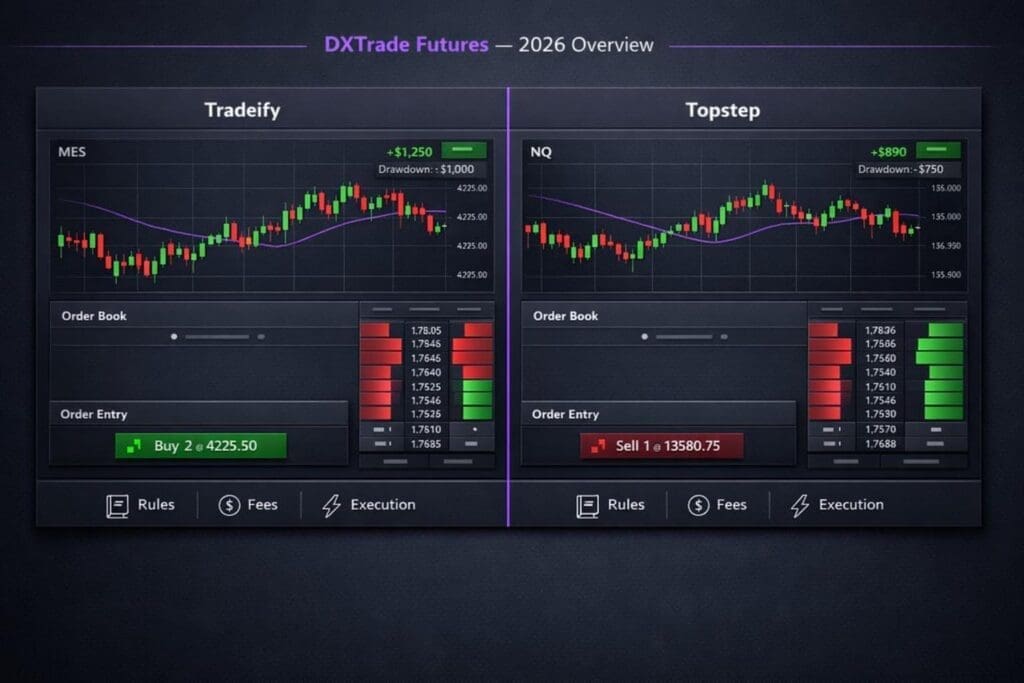
DXTrade XT powers futures trading for Tradeify and Topstep, two of the best futures prop firms in the space. If you’re evaluating which one to join, here’s the deal: Tradeify offers faster evaluations with one-time fees and payouts as quick as 10 minutes. Topstep, on the other hand, has a subscription model and is better suited for newer traders looking for structured coaching and a more gradual path to funding. Both firms leverage DXTrade XT’s advanced tools like Level 2 data and built-in trading journals, but they cater to different trader profiles. But first, it helps to understand how futures prop firms work if you are new to the model. Let’s break it down.
1. Tradeify
Tradeify runs its evaluation and funded trading programs on the DXTrade XT platform, which is packed with tools for risk management and performance tracking. They offer three types of accounts: Select (evaluation-based), Growth (evaluation-based with a different payout structure), and Lightning (instant funding). Prices start at $99 for a $25,000 Growth account and go up to $549 for a $150,000 Lightning account. They frequently run promotions that make their pricing even more attractive.
Platform Features
Tradeify’s use of DXTrade XT brings some serious firepower to the table. You get advanced order types like trailing stops, stop market, and stop limit orders – features you don’t often see in futures trading. The platform also uses volume-aware execution with dxFeed’s Level 2 data, meaning your limit orders fill based on full market depth, not just the top of the book. That’s a big deal if you’re looking for realistic fills.
One of the coolest features is the built-in trading journal. You can tag trades, filter by strategy, and add notes right in the platform – perfect for tightening up your approach. On top of that, the mobile apps for iOS and Android let you enter orders, monitor positions, and access detailed charting on the go. CME futures data is provided via dxFeed, but you’ll need to complete a one-time compliance check to activate your subscription.
These features make Tradeify’s evaluation process highly automated and efficient.
Evaluation Process
Tradeify’s evaluation process is built around automation, using features like trailing drawdowns and minimum trading days to keep traders in check. All accounts use an End-of-Day (EOD) trailing drawdown, which adjusts based on your closing balance but is enforced in real-time during trading. For example, a $50,000 Select account has a $1,000 trailing drawdown and a $3,000 profit target.
One strict rule is positions must be closed by 4:59 PM ET on weekdays – miss that, and you’re in violation [4]. They also enforce a “microscalping rule,” requiring at least 50% of your trades to be held longer than 10 seconds. This rule has caused frustration for high-frequency traders. When setting up your account, you’ll need to pick a platform group (Tradovate-based or Rithmic/TradeSea), and this choice is locked in for that account.
Payout Structure
The payout terms vary depending on the account type. Here’s the breakdown:
- Growth Funded Accounts: You keep 100% of the first $15,000 in profits, then 90% after that. Payouts are processed on a 7-day cycle, but there’s a 35% consistency rule to follow.
- Select Flex and Select Daily Accounts: Both offer a flat 90% profit split. The Select Daily account, however, allows daily payouts through a buffer-based system.
- Lightning Funded Accounts: These revert to the 100%/90% profit split but come with a progressive consistency rule that ranges between 20% and 30%.
Payouts are fast. They can hit your account in as little as 10 minutes, though the official processing time is 24–48 hours. As of February 2026, Tradeify has a 4.7/5 rating on Trustpilot from 1,047 verified reviews [6].
For Select accounts, there’s also a scaling plan. A $50,000 account starts with 2 mini contracts and can scale up to 4 minis once you hit profit milestones of $1,500 and $2,000. This gives traders room to grow as they prove their skills.
2. Topstep
Topstep runs its evaluation and funded trading programs on TopstepX, a platform built on DXTrade XT. It comes with handy tools like a trading journal, a performance dashboard tracking win rates and risk/reward ratios, and automated risk management features [7][2]. Pricing starts at $95/month for a $50,000 Trading Combine and goes up to $229/month for a $150,000 account (as of April 28, 2026) [8]. Activating CME data requires a one-time dxFeed compliance check.
Platform Features
TopstepX uses DXTrade XT’s volume-aware execution and provides both Level 1 and Level 2 market depth feeds. This is a big deal for futures scalpers who rely on accurate fills from full order book depth. The platform also includes automated risk management, which closes out positions at the end of the session to meet Topstep’s strict 3:10 PM CT flat rule [1]. The performance dashboard tracks your trading stats in real-time, like win rates and risk/reward ratios, so you can make adjustments on the fly. These tools support Topstep’s tough evaluation process.
Evaluation Process
To get a funded account, you’ll need to pass the Trading Combine, which is a simulated trading challenge. You have to hit a profit target while staying above the Minimum Loss Limit (MLL) [7]. The platform enforces strict rules, like a Daily Loss Limit and the MLL – breaking the MLL shuts down your account immediately [7]. Plus, all positions and pending orders must be closed by 3:10 PM CT every day [9]. Another rule to note: Topstep doesn’t allow trading in markets within 2% of the CME Price Limit, which could catch you off guard during volatile sessions [10]. These rules are designed to mimic real-world trading conditions.
Payout Structure
Once you pass the Trading Combine, you move to a funded account with a profit splits across futures prop firms of 90/10 (effective January 12, 2026) [8]. You can choose between two payout paths: the Standard Path (requires 5 winning days with $150+ net P&L) or the Consistency Path (requires 3 days where no single day exceeds 40% of your total profit) [8]. Payout caps depend on your account size:
- $50K accounts: $2,000 to $3,000
- $100K accounts: $3,000 to $4,000
- $150K accounts: $5,000 to $6,000 [8]
After 30 non-consecutive winning days in a Live Funded Account, you unlock daily payouts and gain access to 100% of your account balance [7][8]. The minimum payout request is $125, and there’s a $30 processing fee for ACH and wire transfers [8].
sbb-itb-46ae61d
Tradeify vs Topstep: Side-by-Side Comparison
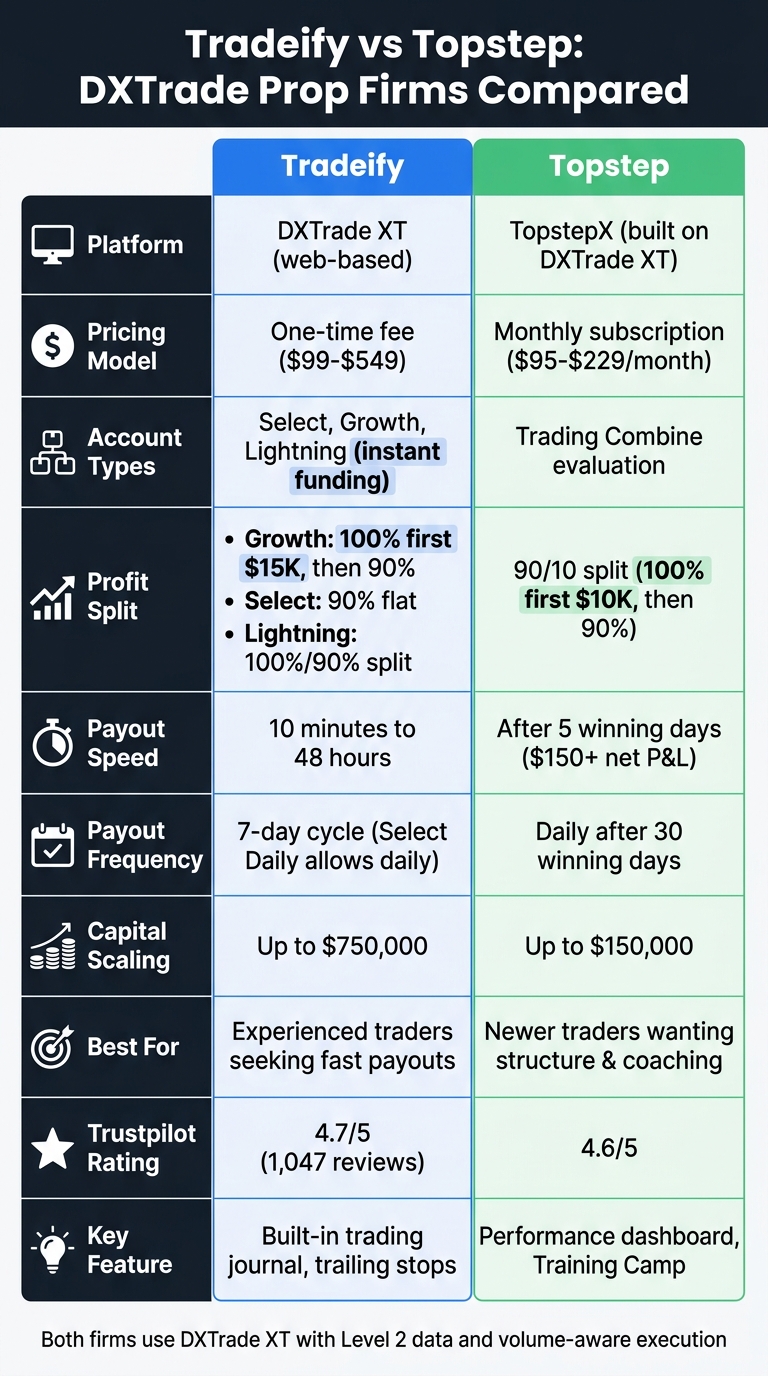
Tradeify vs Topstep DXTrade Prop Firms Comparison
Here’s a breakdown of the key features for Tradeify and Topstep, both running on DXTrade:
| Feature | Tradeify | Topstep |
|---|---|---|
| Platform | DXTrade (web-based) | DXTrade-based |
| Evaluation Tracks | Growth: Soft daily loss limit, no consistency rule – pass in as little as 1 day using proven prop firm strategies. Select: No daily loss limit, but requires 40% consistency (minimum 3 days)[5]. |
Details not specified |
| Profit Split | 80/20 (trader keeps 80%)[11]. | Details not specified |
| Payout Requirements | Elite Live: Daily payout requests allowed, no daily loss limit. | Withdrawals after hitting five winning days[11]. |
| Capital Scaling | Up to $750,000. Note: Growth/Lightning track doesn’t include a scaling option[11]. | Details not specified |
Tradeify stands out with its clearly defined evaluation tracks and payout terms. The Growth track lets you pass quickly (even in one day), while the Select track offers no daily loss limit but introduces a consistency requirement. On the other hand, Topstep’s evaluation details are less transparent, leaving some guesswork for traders.
When it comes to payouts, Tradeify allows daily requests with no daily loss limits, while Topstep ties withdrawals to achieving five winning days. For capital, Tradeify provides access to up to $750,000, though the Growth/Lightning track doesn’t include scaling options.
If you’re looking for flexibility and higher capital potential, Tradeify might be the better fit. But if you prefer a more traditional payout structure tied to performance milestones, Topstep could work better. It all boils down to what aligns with your trading style and goals.
Which Firm Should You Choose?
If you’re a seasoned trader, Tradeify might catch your eye with its one-time fee structure. Instead of dealing with monthly subscriptions, you pay a one-time fee ranging from $149 to $399, depending on the account size you choose. This setup makes it easy to scale quickly, offering funding up to $750,000. Plus, Tradeify uses DXTrade XT’s Level 2 execution, which helps ensure realistic live fills – something experienced traders will appreciate [3].
On the other hand, Topstep caters more to newer traders. Their structured evaluation process, combined with tools like Training Camp and discipline-focused resources, is designed to help you sharpen your trading skills. Topstep also stands out with its profit split: you keep 100% of your first $10,000, then move to a 90/10 split. While it operates on a monthly subscription model (with an activation fee), it’s a setup that provides a supportive environment for those still learning the ropes. Topstep’s strong reputation is reflected in its 4.6/5 rating on Trustpilot.
The decision comes down to your experience level. If you’re confident and want a straightforward fee model, Tradeify is worth considering. But if you’re new and value education and structure, Topstep might be the better choice.
FAQs
What’s the real difference between Tradeify’s Growth, Select, and Lightning accounts?
The key differences between Tradeify’s Growth, Select, and Lightning accounts boil down to their evaluation processes, trading rules, and profit-sharing setups. Each is designed to suit different trading approaches and objectives.
- Growth: This is the beginner-friendly option, aimed at traders who prefer steady progress. It offers a 90% profit split once you hit specific profit thresholds.
- Select: Provides more flexibility, but with tighter restrictions – like being limited to just one contract on a $25K account.
- Lightning: Perfect for those who want instant funding and a fast-track evaluation process. It also includes performance-based rewards, with profit splits reaching up to 90%.
Each account caters to a specific trading style, so pick the one that aligns with how you trade.
Do DXTrade XT’s Level 2 fills feel realistic in prop firm evaluations?
The details about DXTrade XT’s Level 2 fills during prop firm evaluations are unclear. There’s no specific feedback or in-depth analysis available to confirm how realistic they feel.
Which DXTrade futures prop firm is better for payouts: Tradeify or Topstep?
Tradeify stands out for payouts, especially when using DXTrade for futures. Their payout system is impressively fast, often processing within hours – even on weekends. While Topstep has built a solid reputation in the industry, Tradeify’s focus on quick payouts and flexible funding options makes it a go-to choice for traders who value getting their profits fast.