Trade execution metrics are critical for futures prop traders to measure discipline, manage risk, and maintain consistency. Each firm enforces unique rules, such as Apex Trader Funding’s 30% Consistency Rule or Tradeify’s requirement that 50% of profits come from trades held over 10 seconds. These metrics shape trading strategies, payout eligibility, and risk thresholds. Here’s a quick breakdown:
- Apex Trader Funding: Flexible scaling with no daily loss limits, but strict intraday trailing drawdown and a 30% loss cap on open trades.
- Take Profit Trader: No daily loss limits and day-one withdrawals, but restrictions on news trading.
- Topstep: Offers 100% profit on the first $10,000, but limits payouts to 50% of the balance and enforces end-of-day drawdowns.
- FundedNext Futures: Fast payouts and no daily loss limits, but strict micro-scalping rules.
- Tradeify: Automated payouts and increased loss limits after 6% profit, but enforces a 10-second trade duration rule.
Key takeaway: Understanding these rules is essential for aligning with a firm that matches your trading style.
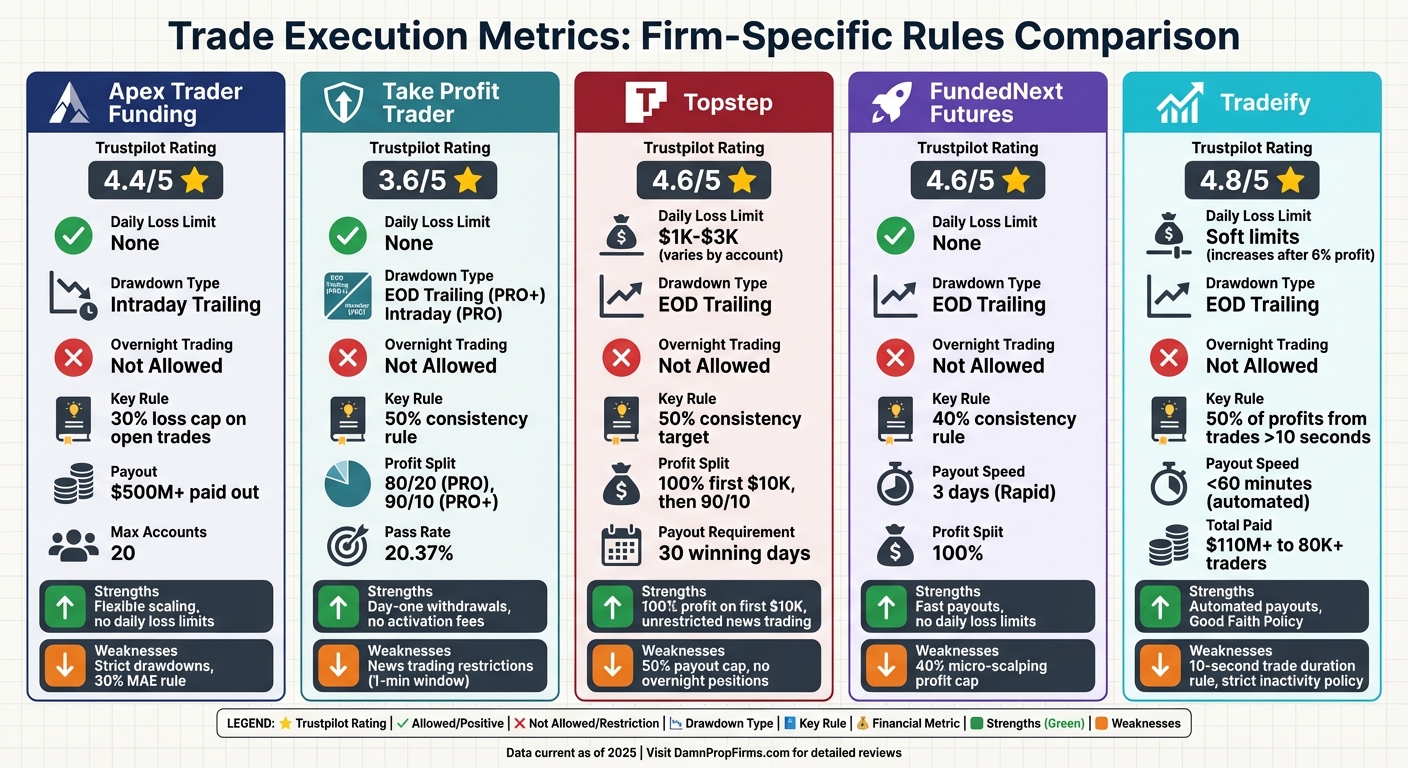
Futures Prop Firm Comparison: Execution Metrics and Rules
Biggest Prop Firm HIDDEN Rules?!!
Quick Comparison
| Firm | Key Strengths | Primary Weaknesses | Trustpilot Rating |
|---|---|---|---|
| Apex Trader Funding | Flexible scaling, no daily loss limits | Strict drawdowns, 30% loss cap | 4.4/5 |
| Take Profit Trader | Day-one withdrawals, no activation fees | News trading restrictions | 3.6/5 |
| Topstep | 100% profit on first $10,000 | 50% payout cap, no overnight trading | 4.6/5 |
| FundedNext Futures | Fast payouts, no daily loss limits | Micro-scalping restrictions | 4.4/5 |
| Tradeify | Automated payouts, flexible rules | 10-second trade duration requirement | 4.8/5 |
1. Apex Trader Funding
Apex Trader Funding stands out with its approach to execution and risk management. Since 2022, the firm has paid out over $500 million and holds an impressive 4.5/5 rating on Trustpilot, based on more than 15,000 reviews [3].
Daily Loss Limits
One of Apex’s defining features is the absence of a daily loss limit on its accounts [5]. This flexibility allows traders a better chance to recover from losses. However, all positions must be closed by 4:59 PM ET, as overnight trading is not allowed [3].
"The standout feature is the lack of a daily drawdown limit – you only have a trailing drawdown that eventually locks." – QuantCrawler [5]
Maximum Drawdown
Apex uses an intraday trailing drawdown system that adjusts in real time based on your highest equity peak, including unrealized profits. Once your account surpasses the starting balance by $100, the drawdown locks and no longer moves [3][6]. This means any intraday profit spike permanently raises your risk threshold, regardless of where the final profit settles.
The firm also applies a 30% Negative P&L Rule, which ensures that no single open trade can lose more than 30% of your accumulated profit balance [1][7].
Position Sizing Rules
Scaling your position is limited until a safety buffer is established. For instance, a $50,000 account with a maximum of 10 contracts can only trade 5 contracts until the balance reaches $52,600 (the starting balance plus the trailing drawdown and $100) [1][7]. The maximum number of contracts varies by account size, ranging from 4 contracts on a $25,000 account to 35 contracts on a $300,000 account [5].
| Account Size | Profit Target | Trailing Drawdown | Max Contracts |
|---|---|---|---|
| $25,000 | $1,500 | $1,500 | 4 |
| $50,000 | $3,000 | $2,500 | 10 |
| $100,000 | $6,000 | $3,000 | 14 |
| $150,000 | $9,000 | $5,000 | 17 |
| $300,000 | $20,000 | $7,500 | 35 |
Execution Speed
Apex uses Rithmic to ensure low-latency execution, compatible with NinjaTrader, Sierra Chart, and Quantower [3]. High-frequency trading (HFT) and strategies that exploit the simulation environment are strictly forbidden, with violations leading to immediate account termination [8]. For added flexibility, Tradovate is also available, offering integration with web, mobile, and TradingView platforms [3].
Up next, we’ll take a closer look at how Take Profit Trader compares in these areas.
2. Take Profit Trader

Take Profit Trader stands out by removing several restrictions often found with other firms. With a Trustpilot rating of 4.3/5 from over 1,100 reviews, the company offers profit splits of 80/20 for PRO accounts and 90/10 for PRO+ accounts [11].
Daily Loss Limits
One of the standout features of Take Profit Trader is the absence of a daily loss limit across all account types [9][10]. This gives traders more flexibility compared to best futures prop firms that typically liquidate accounts once a mid-day loss threshold is reached. However, traders must close all positions by 5:00 PM EST daily to avoid account closure [9][10].
Maximum Drawdown
The drawdown rules vary depending on the account type. For Evaluation and PRO+ accounts, the firm uses an End-of-Day (EOD) trailing drawdown, calculated based on the closing balance at the end of each day [9][11]. On the other hand, PRO accounts use an intraday trailing drawdown, which factors in unrealized gains and losses [9][13]. Once the minimum account balance equals the starting balance, the trailing drawdown stops [10][12]. From January to August 2023, the firm reported a 20.37% pass rate, which is above the industry average [9].
Position Sizing Rules
Instead of traditional leverage ratios, Take Profit Trader sets buying power through strict contract limits [12]. The firm enforces a 1:10 mini-to-micro ratio, meaning traders can trade 10 micro contracts for every mini contract allowed [9][12]. Unlike competitors that use scaling plans, traders here can access their full contract limit from the start [9][13]. For example, a $50,000 account allows 6 mini contracts (or 60 micro contracts), with a $3,000 profit target and a $2,000 maximum trailing drawdown [9].
| Account Size | Max Position (Minis) | Profit Target | Max Trailing Drawdown | Monthly Price |
|---|---|---|---|---|
| $25,000 | 3 Contracts | $1,500 | $1,500 | $150 |
| $50,000 | 6 Contracts | $3,000 | $2,000 | $170 |
| $75,000 | 9 Contracts | $4,500 | $2,500 | $245 |
| $100,000 | 12 Contracts | $6,000 | $3,000 | $330 |
| $150,000 | 15 Contracts | $9,000 | $4,500 | $360 |
Minimum Trade Intervals
During the evaluation phase, traders must execute trades on at least 5 separate days to pass [9][11]. Once funded, PRO accounts are capped at 50 executed trades per day, a rule designed to discourage high-frequency trading and system abuse [10]. To keep a PRO account active, traders must place at least one trade per week [9][11]. Additionally, a consistency rule requires that no single trading day can contribute more than 50% of the total profit target during evaluation [9][11].
Execution Speed
PRO accounts operate in a simulated environment but still allow traders to earn real profits. In contrast, PRO+ accounts provide direct access to live markets with real-time fills [9][13]. The firm processes payouts on the same day under ideal conditions, with no minimum withdrawal requirements or waiting periods once traders reach the "Buffer Zone" (earning an amount equal to their drawdown in profit) [9][14]. Traders can manage up to 5 active PRO or PRO+ accounts simultaneously [9][13]. This setup leads us into the next discussion on Topstep’s execution metrics.
3. Topstep

Topstep, established in 2012, stands out with its approach to trading evaluations and profit-sharing. Rated 4.6/5, the firm offers traders the chance to keep 100% of their first $10,000 in profits, followed by a 90/10 split. Subscription costs range from $49 for a $50,000 account to $149 for a $150,000 account, with a $149 one-time activation fee upon passing the Trading Combine.
Daily Loss Limits
Topstep uses a structured approach to daily loss limits: $1,000 for $50,000 accounts, $2,000 for $100,000 accounts, and $3,000 for $150,000 accounts [17][21]. If breached, the system triggers a "soft breach", liquidating positions and locking the account until the next trading session [15][21]. However, as of August 25, 2024, accounts on the TopstepX™ platform no longer have a daily loss limit for new or reset accounts [20][21]. For Live Funded Accounts, the daily loss limit remains in place, calculated on both realized and unrealized P&L, and halts trading for the rest of the day if exceeded [15].
Maximum Drawdown
Topstep calculates its Maximum Loss Limit using an End-of-Day (EOD) trailing drawdown, which evaluates the account balance at the end of each trading day [16][19]. Unlike intraday drawdowns, this method allows traders to weather temporary market fluctuations. As Topstep explains:
"End-of-Day Drawdown allows you to play all four quarters. This is how real trading works. You can ride out the ups, downs, and pullbacks as long as you finish the day above your max drawdown limit" [16].
To ensure compliance, all positions are automatically closed about ten seconds before the market closes at 3:10 PM CT [15]. Additionally, requesting a payout resets the Maximum Loss Limit to $0, reducing the risk buffer for future trades [22].
Position Sizing Rules
Topstep employs a scaling system that adjusts position sizes based on account equity. Initially, accounts have fixed limits, but once traders move to Express Funded Accounts, they transition to a Scaling Plan where buying power grows with account equity [17][21]. For instance, a $50,000 account starts with a maximum of 2 contracts below $1,500, increases to 3 contracts between $1,500 and $2,000, and reaches 5 contracts above $2,000 [23]. In Live Funded Accounts, a Dynamic Live Risk Expansion system adjusts contract limits and risk thresholds in real time based on performance and market conditions [15][23].
Ngan Pham, Senior Financial Analyst at Topstep, elaborates:
"The Scaling Plan controls how many contracts you can trade based on your account balance. It was created to protect traders from over-leverage and to promote steady growth" [23].
Traders can also manage up to 5 Express Funded Accounts simultaneously [18][21].
Minimum Trade Intervals
To pass the Trading Combine, traders must meet a consistency target, ensuring no single trading day accounts for more than 50% of the total profit target [20][22]. This rule encourages consistent strategies rather than reliance on a single profitable day. For payouts in Live Funded Accounts, traders must achieve 30 non-consecutive winning days, with each "Benchmark Trading Day" yielding at least $150 in net profit [15][17]. While there’s no strict minimum interval between trades, minor violations (under 10 seconds) of the scaling plan may be overlooked, while more significant breaches lead to an account review [23].
Execution Speed
The TopstepX platform offers quick execution through a direct CME feed and integrated TradingView charts [22]. According to Topstep, pass rates and payouts are 86% higher on TopstepX compared to third-party platforms [22]. The platform also includes a $5,000 per account payout cap and the Back2Funded program, introduced in late 2025, which allows traders to reactivate closed accounts for a fee between $499 and $729 within 7 days [17][18].
sbb-itb-46ae61d
4. FundedNext Futures
FundedNext Futures provides two trading models – Legacy and Rapid – each with specific risk guidelines. The platform boasts a 4.6/5 rating on TrustPilot and offers a $1,000 bonus for delayed payouts [24]. Pricing starts at $79.99 for a $25,000 Legacy Challenge [24].
Daily Loss Limits
One standout feature of FundedNext Futures is the removal of daily loss limits for both the Legacy and Rapid models [24][26]. However, traders who exhibit high-risk behavior are placed in the Disciplined Trader Program. This program enforces stricter guidelines, including a 1% maximum risk per trade and mandatory use of stop losses [25]. Additionally, all trades must be closed by 3:10 PM CT, as holding positions overnight or during weekends is not allowed [24].
Maximum Drawdown
The platform uses an End-of-Day (EOD) Trailing Maximum Loss Limit to manage risk. For Legacy accounts, the limits are $1,000 for $25,000 accounts, $2,000 for $50,000 accounts, and $3,000 for $100,000 accounts. Rapid accounts follow similar thresholds but cap at $2,500 for $100,000 accounts [24]. Breaching this drawdown limit results in immediate account termination, requiring traders to manage their risk carefully throughout the trading day [24].
Position Sizing Rules
Position sizing varies between Legacy and Rapid accounts. Legacy accounts allow the following:
- 2 Minis (or 20 Micros) for $25,000 accounts
- 3 Minis (or 30 Micros) for $50,000 accounts
- 5 Minis (or 50 Micros) for $100,000 accounts
Rapid accounts have stricter limits, halving the Micro allowances to 10 Micros for $25,000 accounts and 25 Micros for $100,000 accounts [24]. Once traders are funded, Legacy accounts expand to 7 Minis or 70 Micros for $100,000 accounts, while Rapid accounts cap at 7 Minis or 35 Micros [24]. The maximum allocation is $700,000 for challenge accounts and $300,000 for funded accounts [26]. These rules aim to align risk with account size, ensuring a balanced approach to trading.
Minimum Trade Intervals
A 40% consistency rule ensures no single oversized trade can secure a challenge win or profit withdrawal [24][26]. For Legacy accounts, this rule applies during the Challenge phase, while for Rapid accounts, it applies once funded [24]. To help traders stay compliant, the Consistency Rule Calculator is available on DamnPropFirms [24]. Traders in the Disciplined Trader Program must also meet additional requirements, such as achieving at least 15 winning days with a minimum daily profit of $200 to graduate [25]. The firm enforces strict policies against "multi-order spam", "account flipping", and "reckless oversized positions" to maintain professional standards [24].
This structured approach provides a solid foundation for evaluating Tradeify’s performance metrics next.
5. Tradeify

Tradeify boasts an impressive 4.7/5 rating on Trustpilot from 1,918 reviews and has distributed over $110 million to more than 80,000 traders [33][35]. The platform balances flexibility with strict risk controls across its three account types: Growth, Select, and Lightning. Growth accounts start at $97 per month for $50,000 in funding, while Lightning accounts offer instant funding with one-time fees ranging from $244 to $510 [32].
Daily Loss Limits
Tradeify’s approach to daily risks depends on account type. Growth accounts have soft daily loss limits that range from $1,250 to $3,750, depending on the account size. Lightning accounts, on the other hand, allow for higher limits of $2,500 to $7,500 [27]. Select accounts stand out by completely removing daily loss limits. Additionally, once traders achieve a 6% profit, the daily loss limit increases to equal the drawdown amount [30].
Maximum Drawdown
Tradeify employs an End-of-Day (EOD) Trailing Drawdown for Growth and Lightning accounts. This system updates at the end of the trading day, based on the high-water mark, allowing traders to navigate intraday volatility without worrying about the drawdown floor moving during active trading [32][27]. For a $50,000 account, the EOD drawdown is $2,000 for Growth accounts and $2,500 for Lightning accounts. For $100,000 accounts, the limits are $3,500 (Growth) and $5,000 (Lightning) [32]. Once the account balance reaches the starting capital plus the maximum drawdown amount and an additional $100, the drawdown stops trailing. For example, a $50,000 account’s drawdown would stop at $52,100 [32].
Position Sizing Rules
Position limits are tied to account size: 5 contracts for $50,000 accounts, 10 contracts for $100,000 accounts, and 15 contracts for $150,000 accounts. Hedging is strictly prohibited, meaning traders cannot hold opposing positions in the same instrument or mix Minis and Micros. For instance, holding 1 NQ and 10 MNQ simultaneously violates this rule and may lead to account termination [34].
Minimum Trade Intervals
To prevent high-frequency trading abuse, Tradeify enforces a 10-second microscalping rule. More than 50% of trades and profits must come from positions held for at least 10 seconds [29][31]. Brett Simba, Founder of Tradeify, explains:
"Trades executed in less than 10 seconds are difficult to reliably replicate or copy" [29].
Additionally, Lightning accounts require traders to follow a progressive consistency rule – 20% for the first payout, 25% for the second, and 30% for all subsequent payouts. Growth accounts maintain a flat 35% consistency requirement [28][30]. To assist traders, the Consistency Rule Calculator on DamnPropFirms helps ensure compliance with these guidelines.
Execution Speed
Tradeify sets itself apart with an automated payout system that processes requests in under 60 minutes. Many users report receiving payouts within just 5 to 15 minutes, a stark contrast to the industry standard of 7+ days [33][35]. The platform also provides access to Tradovate and NinjaTrader, complete with free real-time data, ensuring minimal latency during trading [35]. These features earned Tradeify the "2025 Best Payout Process" award, with users praising the system as "immaculate, seamless, and fast" [35]. Combined with its rapid execution and robust metrics, Tradeify’s offerings set a high bar for comparison in the upcoming Pros and Cons section.
Pros and Cons
This section dives into the benefits and drawbacks of each firm’s execution metrics, highlighting their unique features and challenges. Here’s a closer look at how these firms stack up:
Apex Trader Funding stands out with its flexibility, allowing traders to scale up to 20 accounts and offering a 100% profit split on the first $25,000 per account. However, its 30% Maximum Adverse Excursion (MAE) rule – limiting open trade losses to 30% of accumulated profits – and an intraday trailing drawdown that tracks unrealized gains can make risk management more demanding [1][4].
Take Profit Trader offers a key advantage: withdrawals can begin on day one, with no activation fees. But traders on Pro accounts face restrictions around news events, as trading is prohibited one minute before and after major announcements like FOMC or NFP releases [3][4].
Topstep provides unrestricted news trading and a transparent Consistency Path for payouts. On the downside, it enforces a 50% payout cap, limiting withdrawals to half of the account balance (up to $5,000–$6,000). Additionally, traders cannot hold positions overnight or during weekends, which might limit certain strategies [4].
FundedNext Futures is known for its quick payout cycles, processing payments in as little as three days during its Rapid Challenge. However, its micro-scalping policy raises concerns for some traders, as accounts are flagged if 40% or more of profits come from trades held for fewer than 10 seconds [3][4].
Lastly, Tradeify employs a "Good Faith Policy", allowing features like news trading, dollar-cost averaging, and scaling. It also increases the Daily Loss Limit after traders achieve a 6% profit. Yet, it requires at least 50% of profits to come from trades held longer than 10 seconds and enforces a strict weekly inactivity policy [4].
Here’s a side-by-side comparison of the key metrics for each firm:
| Firm | Key Strengths | Primary Weaknesses | Trustpilot Rating |
|---|---|---|---|
| Apex Trader Funding | 20-account scaling; over $500M paid out | 30% MAE rule; intraday trailing drawdown | 4.4/5 (17,047 reviews) [36] |
| Take Profit Trader | Day 1 withdrawals; no activation fees | News trading restrictions (1-minute window) | 3.6/5 (13 reviews) [4] |
| Topstep | Unrestricted news trading; clear Consistency Path | 50% payout cap; no overnight or weekend holding | 4.6/5 (96 reviews) [4] |
| FundedNext Futures | 3-day payout cycles; 100% profit split | 40% micro-scalping profit cap | 4.4/5 (49 reviews) [4] |
| Tradeify | Good Faith Policy; DLL increases once 6% profit | 50% profit must come from trades >10s; strict inactivity | 4.8/5 (142 reviews) [4] |
For traders looking to navigate these metrics effectively, the Consistency Rule Calculator on DamnPropFirms can be a helpful tool. It simplifies the process of understanding and meeting each firm’s requirements.
Conclusion
When selecting a futures prop firm, comparing futures prop firm reviews and execution metrics is key. For example, Apex Trader Funding uses End of Day (EOD) drawdown checks, which can lead to a "Silent Breach" – a scenario where traders exceed limits unknowingly during the trading session. This approach demands extra vigilance in monitoring positions throughout the day[2]. On the other hand, FundedNext Futures offers real-time enforcement, instantly flagging breaches. This system makes rule violations more transparent and gives traders the chance to adapt their strategies immediately[2]. Meanwhile, Topstep is recognized for its low-latency execution, and Tradeify enforces consistency rules in the 20–35% range, aligning traders’ largest profit days with the firm’s standards[28][3].
Payout speed is another critical factor. FundedNext processes payouts in less than 24 hours, providing quick access to earnings. In contrast, Apex limits withdrawals to specific periods – typically the 1st to 5th and 15th to 20th of the month – and requires a minimum of 8 trading days before making withdrawals available[2][3]. These policies can significantly impact how quickly you can scale your trading or reinvest earnings.
To ensure a firm aligns with your trading style, tools like the Consistency Rule Calculator on DamnPropFirms are invaluable. By inputting your largest trading day and profit targets, you can assess how well you meet requirements such as Apex’s 30% rule or Tradeify’s 20–35% consistency range[28][3]. This step can help prevent payout issues and guide you toward a firm that fits your approach.
For a deeper dive into execution metrics, platform reliability, and real trader feedback, visit DamnPropFirms. Their reviews include verified ratings, current discount offers, and side-by-side comparisons, giving you the tools to make a decision that supports your trading goals and strategy.
FAQs
What are the main differences in trade execution rules between Apex Trader Funding and Topstep?
The trade execution rules for Apex Trader Funding and Topstep differ significantly in their evaluation processes and payout systems.
Apex Trader Funding simplifies things with a single-step evaluation process, allowing traders to access funding faster and with fewer restrictions. It also supports more flexible rules, which can accommodate automated trading strategies – a feature that appeals to many traders seeking versatility.
In contrast, Topstep uses a multi-phase evaluation process known as the Trading Combine. This structured approach is designed to help traders build discipline and consistency over time, making it a more gradual, skill-focused system.
When it comes to payouts, Apex takes a straightforward approach: traders keep 100% of their first $25,000 in profits, with a 90/10 split thereafter. Topstep, however, ties payouts to account size and specific profit targets, emphasizing consistent performance throughout the evaluation period. While Apex leans into flexibility, Topstep prioritizes a methodical, skill-building approach for traders.
What is the 10-second trade duration rule at Tradeify, and how does it affect trading strategies?
Tradeify’s 10-second trade duration rule challenges traders to close their positions within just 10 seconds of opening them. This approach emphasizes quick decision-making and sharp execution, making it essential for traders to zero in on short-term price shifts and react almost instantly.
To thrive under this rule, many traders turn to strategies like scalping or momentum trading. These methods are designed to take advantage of small, rapid price movements, aligning perfectly with the fast-paced nature of this rule. It also instills a sense of discipline, as the strict time frame demands consistent focus and smart risk management. In essence, this rule fosters a high-energy trading environment where speed and precision aren’t just helpful – they’re absolutely critical.
Why is it important to understand the specific rules of a trading firm?
Understanding the specific rules of a trading firm is crucial because these guidelines directly influence how traders operate and achieve success. Firms establish their own standards for areas like risk management, trade execution, profit targets, and payout structures. These rules ensure traders maintain disciplined practices while safeguarding their own capital and the firm’s resources.
Following these rules not only helps traders pass evaluations but also allows them to scale accounts and receive payouts. On the flip side, ignoring or misinterpreting these requirements can lead to disqualification, account suspension, or reduced earnings – even for those who are otherwise profitable. Knowing and applying a firm’s rules is key to staying compliant, managing risk wisely, and building a long-term trading career.