In prop trading, drawdown rules are critical for managing risk and protecting capital. These rules set limits on how much a trader can lose before their account is closed. Here’s a quick breakdown of the five main types of drawdown rules:
- Static Drawdown: Fixed loss limit based on the starting balance. It doesn’t adjust as profits increase.
- Trailing Drawdown: Adjusts upward as profits grow, locking in gains. Can be based on either closed trades or floating equity.
- Daily Drawdown: Caps losses within a single trading day and resets daily.
- End-of-Day (EOD) Drawdown: Updates the drawdown limit at the close of each trading session, allowing flexibility during the day.
- Equity-Based Drawdown: Tracks real-time account equity, including floating profits and losses, making it the strictest rule.
Each rule has its strengths and weaknesses, affecting trading strategies differently. Traders need to understand these rules to align with a prop firm’s requirements and avoid account breaches.
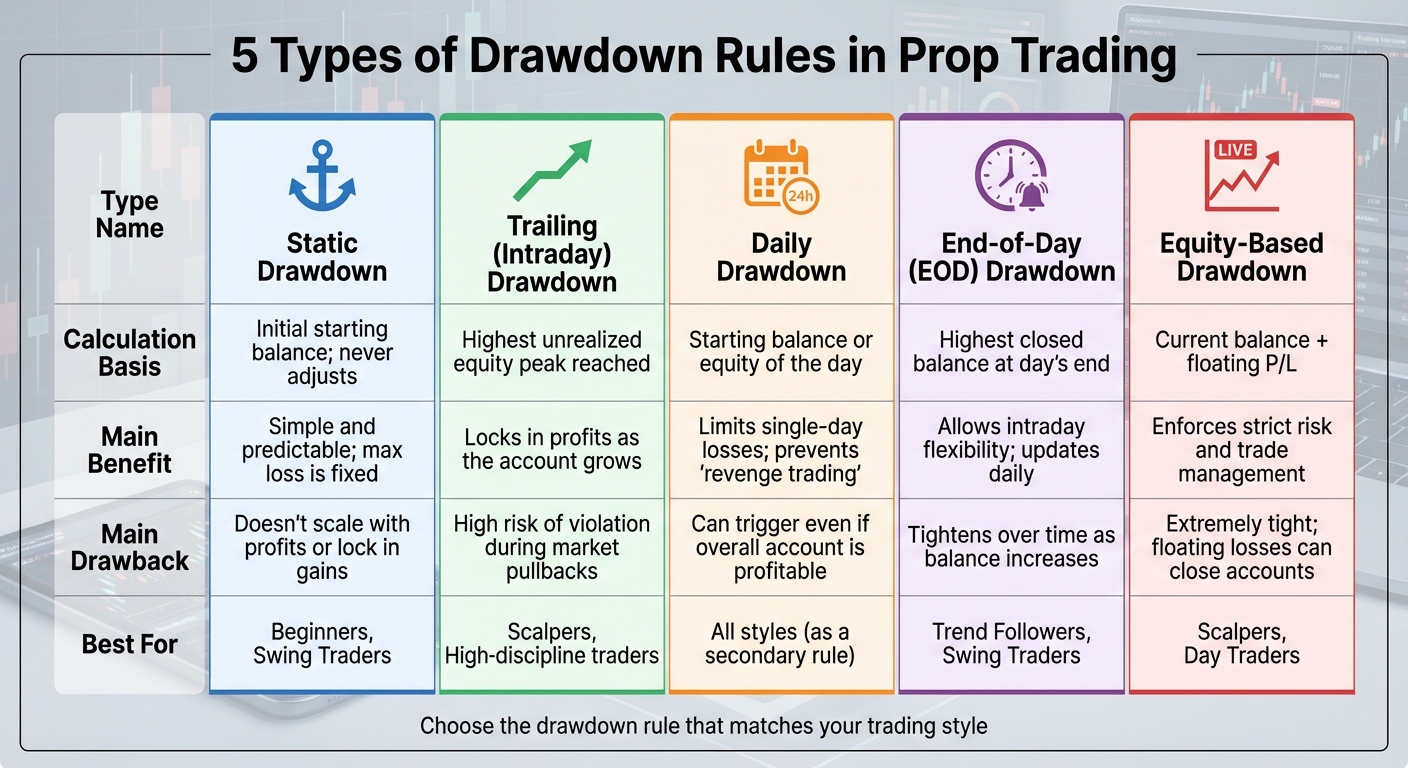
5 Types of Drawdown Rules in Prop Trading Compared
Understanding Prop Firms – Drawdown Types
sbb-itb-46ae61d
1. Static Drawdown
Static drawdown, often referred to as fixed drawdown, establishes a set loss limit based solely on the initial account balance. For instance, if you start with a $100,000 account and the static drawdown is set at $5,000, the breach level is fixed at $95,000 for the duration of the account [6][10].
"Static Accounts never trail the drawdown value. They remain at the level where you begin." – Prop Firm App Team [5]
What makes static drawdown unique is that this threshold doesn’t move, even as your account grows. For example, if your balance increases to $110,000, the $95,000 breach level stays the same, effectively giving you a larger profit cushion. Let’s break down how this fixed threshold is calculated.
Calculation Basis
The formula is simple:
Initial Balance – Fixed Amount = Breach Level.
Some firms base this calculation on your closed balance, while others use real-time equity, which includes open trades. Knowing which method your firm applies is crucial because floating losses could trigger a breach, even if your closed balance seems safe.
Key Advantage
One of the main benefits of static drawdown is its clarity. The unchanging risk threshold makes it easier to plan your trades and manage your positions. As your account balance grows, the gap between your current balance and the fixed breach level increases, offering a larger safety buffer.
"Static drawdown is one of the most predictable, stable, and trader-friendly risk models in the funded trading industry." – thePropTrade [8]
This stability is particularly helpful for swing traders holding positions overnight or through the weekend. Temporary fluctuations in equity won’t push the breach level closer to your balance, giving you more flexibility to manage trades without unnecessary stress.
Key Risk
The downside of static drawdown is that it doesn’t protect your gains. Even if your account grows significantly, say from $100,000 to $120,000, a major loss could still bring your balance all the way back down to the fixed breach level [2]. Unlike trailing drawdown models, which adjust upward as profits increase, static drawdown leaves your profit cushion vulnerable. This can sometimes encourage traders to take on aggressive risks early on [9].
Best For
Static drawdown works well for traders who value a consistent and straightforward risk model. It’s particularly suited for:
- Swing traders who need flexibility for multi-day positions.
- Beginners who prefer a simpler risk framework.
- Systematic traders using fixed risk-per-trade strategies.
Several futures prop firms incorporate static drawdown into their programs. For example, thePropTrade uses it in their Classic 1-Step and Classic 2-Step accounts, while TradingFunds applies it in their 2-step evaluations [8][9]. Maven Trading also uses an 8% static drawdown on their 2-step accounts, meaning a $100,000 account has a breach level set at $92,000 [11]. This fixed approach encourages disciplined and calculated trading, which is essential for managing risk effectively in the prop trading world.
2. Trailing Drawdown
Trailing drawdown offers a dynamic approach to managing risk by adjusting with your account’s performance. As your account hits new profit highs, the drawdown threshold moves upward but stays fixed during declines.
Formula:
Highest Account Peak (Balance/Equity) – Maximum Allowed Loss = Breach Level [1][5].
This system creates a "ratchet effect." When your account value rises, the threshold locks in those gains and prevents them from being lost [4]. Let’s dive into how it’s calculated, its perks, risks, and the types of traders it best suits, including those seeking the best instant funding prop firms.
How It’s Calculated
Different firms calculate trailing drawdowns in unique ways. Some use intraday trailing, which updates in real-time based on your highest floating equity during a trade. This is the strictest approach [2][5]. Others employ end-of-day (EOD) trailing, which only updates at the daily reset, using your closed balance or equity. This method provides more flexibility during active trading [2][5].
Certain firms also include a feature where the drawdown locks at your starting balance once breakeven is achieved. This essentially converts the trailing drawdown into a static one [4].
Calculation Basis
The specifics of trailing drawdown parameters vary by market. Best futures prop firms, for instance, often enforce around a 3% intraday limit [1].
- Apex Trader Funding: Uses a "Breakeven Trailing Drawdown" that follows your peak balance until it reaches your starting balance, then stops moving [4].
- Elite Trader Funding: Implements a "Trailing Balance Only" model, which adjusts based on closed trades rather than unrealized equity [4].
Why Traders Like It
The biggest draw of trailing drawdown is its ability to lock in profits automatically. As your account grows, the system raises the stop-out level, encouraging disciplined trading and gradual growth [2][5]. This mechanism not only helps traders maintain their gains but also protects the firm’s capital by limiting potential losses from peak equity levels [4].
"It effectively tells you: ‘Congratulations on your profits, now don’t give them back! If you give back too much of your gains, you prove you can’t manage risk.’"
- Prop Trading Pros [7]
The Risks Involved
One major downside is the unrealized profit trap. In equity-based models, a trade that temporarily spikes in profit can push your drawdown limit higher, even if the position hasn’t been closed [1][9]. If the trade then reverses, you could breach the limit despite being overall profitable [4][7].
Additionally, external factors like news events or overnight price gaps can cause your equity to spike and then reverse, triggering a breach without warning [2].
"The tricky thing with intraday trailing drawdowns is that they also consider unrealized profits in their calculation. This means if you have a profitable trade that does exceptionally well… you might lose your trading challenge if that open position bounces back."
- Prop Firm App Team [5]
Who Benefits the Most?
Trailing drawdown works best for traders who are disciplined and focused on consistent, steady growth. It’s ideal for those who carefully manage their positions and avoid overly aggressive strategies. However, these traders must keep a close eye on both their equity and balance, as floating profits can prematurely raise the drawdown limit.
To navigate volatility, using hard stop-losses (rather than mental stops) is crucial [7]. For example:
- InstantFunding: Their plan locks the drawdown at the starting balance once a 5% profit is hit [7].
- Blusky: Implements a "Hard Trailing Drawdown" that continuously follows equity peaks throughout the challenge [4].
This setup rewards consistent, methodical trading while penalizing reckless or overly aggressive behavior.
3. Daily Drawdown
Daily drawdown sets a cap on your losses for each trading day, resetting at a specific time – often midnight UTC or 5:00 PM EST. Most prop firms enforce this limit at 3% to 5% of your starting equity for the day [1][13]. Unlike static or trailing drawdown rules that focus on cumulative losses, this rule strictly monitors daily performance.
Calculation Basis
The daily drawdown can be calculated using a flat dollar amount (e.g., $1,000) or as a percentage of your starting equity, typically between 3% and 5%. Both realized and unrealized losses count toward this limit [1][13]. The reset time is crucial: if you’re holding a $3,000 floating profit at reset, the next day’s equity basis adjusts to that peak. However, if the trade reverses, you might breach the daily limit despite still being profitable overall [1][7].
Key Advantage
The primary benefit of daily drawdown is that it prevents a single bad trading day from causing catastrophic losses or jeopardizing your funded account [13].
"Daily drawdown limits are not just guardrails for the company’s money, they encourage a culture of responsibility."
This rule also helps curb emotional trading. By imposing a hard stop, it forces you to pause and rethink your strategy, reducing the chance of revenge trading and compounding losses [13]. However, it’s not without challenges.
Key Risk
The strict enforcement of daily drawdown means even a minor breach results in immediate account closure [3][13]. Market volatility can make this especially tricky. Sudden news events or liquidity gaps can cause sharp equity swings, potentially breaching your limit before you have time to respond [13]. Since the drawdown includes floating losses, keeping a close eye on your positions is critical [1][3].
"If you hit your personal threshold, step away. Overtrading is one of the leading causes of daily cap violations."
- TradeFundrr [13]
Best For
Daily drawdown rules are ideal for traders who struggle with overtrading or making emotional decisions [13]. If you tend to chase losses or make impulsive trades after a losing streak, this rule provides a safety net. To add an extra layer of protection, consider setting your own daily loss limit tighter than the firm’s cap. For instance, if the firm allows a $1,000 loss, you could stop trading once losses reach $500 to $700 [12]. Always use hard stop-loss orders instead of mental stops, as these limits are enforced in real time based on your equity [7].
Daily drawdown plays a vital role in a prop firm’s overall risk management strategy, working alongside static drawdowns and trailing drawdown rules to maintain control.
4. End-of-Day Drawdown
End-of-day (EOD) drawdown introduces a unique way to manage risk by focusing on your account balance at the close of a trading session, rather than during the day. Unlike static or intraday rules, this approach accommodates temporary market fluctuations by calculating limits only after the session ends.
EOD drawdown determines your maximum allowable loss based on the account balance or equity at the session’s close – typically 4:00 PM EST or midnight UTC, depending on the firm. Intraday volatility and unrealized profits or losses are ignored until the session officially concludes.
How It’s Calculated
The drawdown limit is updated at the end of each trading session. If a new closing high is reached, the limit adjusts upward by the realized profit but will never exceed the initial account balance. For instance, on a $50,000 account with a $2,000 EOD limit, the failure threshold is $48,000 and remains capped at $50,000, no matter how much profit is made.
Some firms base this calculation on your closed account balance, while others include equity, factoring in floating profits or losses from open positions at the close. Unlike intraday trailing drawdown, which reacts to unrealized profit peaks, EOD drawdown ignores temporary swings during the day. This separation makes it distinct from other drawdown methods.
"End of day (EOD) drawdown is calculated based on your account balance after the trading session closes, not during the day. Open trade fluctuations do not matter unless they are realised by the close."
- FunderPro Futures
Why Traders Like It
The biggest advantage of EOD drawdown is the flexibility it offers during the trading day. For example, if a trade spikes $1,000 into profit but is closed for $500, the drawdown limit moves up by $500 – not the temporary $1,000 high. This feature allows traders to focus on letting their trades develop without the stress of breaching limits due to intraday fluctuations.
"Overall, I think the end-of-day (EOD) drawdown is the best choice for proprietary traders. Thats because only the end-of-day balance causes changes in the overall maximum stop loss level."
- Prop Firm App Team
Firms like TopStep, Earn2Trade, and MyFundedFutures incorporate EOD drawdown during their evaluation phases, offering a balance between risk control and trader flexibility.
The Catch
EOD drawdown isn’t without risks. One common pitfall is overtrading during the day, believing there’s more room for error than there actually is. A large realized loss close to the session’s end can still lead to breaching the limit. This is a frequent reason funded traders lose their accounts.
Timing is critical, too. Knowing your firm’s specific market close – whether it’s 4:00 PM EST, 4:15 PM EST, or midnight UTC – is essential, as that’s when your account is assessed. Open positions with floating losses at the cutoff can unexpectedly push you over the limit.
Who Benefits Most?
EOD drawdown is ideal for swing traders or anyone using strategies that rely on intraday price swings. If you prefer not to be penalized for unrealized gains that vanish before you close a trade, this rule provides the breathing room you need.
To minimize risks, consider setting a personal loss limit slightly above your firm’s EOD threshold to account for slippage or overnight spreads. Monitor your equity peaks at the daily reset time – a higher close will lock in a new drawdown floor for the next day. And if possible, reduce open positions before the session closes to secure realized gains.
5. Equity-Based Drawdown
Equity-based drawdown is considered one of the strictest risk management rules in prop trading. It calculates your risk limit based on real-time equity, which is your account balance adjusted for any floating (unrealized) profits and losses. The formula is straightforward:
Equity = Account Balance + Floating Profit – Floating Loss [7].
This means every market movement of an open trade impacts your drawdown status instantly. Unlike static or trailing drawdowns, this rule integrates live, floating results into risk management, providing a dynamic approach to monitoring risk.
Calculation Basis
The drawdown is calculated from the highest equity point your account reaches, often referred to as the "high-water mark" [7]. For example, if you have a $50,000 account with a $2,500 drawdown limit, your breach threshold starts at $47,500. However, if an open trade increases your equity to $51,200, the new high-water mark adjusts your drawdown floor to $48,700. If your equity dips below this level – even if your closed balance remains above $47,500 – you will breach the limit.
Several firms, including FunderPro, Funding Pips, and The5ers, utilize this model to enforce real-time risk control [14]. This approach highlights the importance of vigilant risk management and maintaining trading consistency, which will be explored further in the advantages and risks outlined below.
Key Advantage
Much like trailing drawdowns, equity-based models lock in gains. However, they go a step further by accounting for every unrealized change in equity in real time. This constant monitoring encourages disciplined trading by requiring quick action to prevent losses from spiraling out of control. Since floating losses are immediately reflected, traders are forced to address adverse trades promptly, reducing the likelihood of "risk snowballing." As George Milios, a Contributor at Start Business Online, explains:
"Equity-based drawdown models reward discipline and advanced risk management. While more difficult to navigate, these challenges can mold traders into more methodical and consistent performers." [14]
Key Risk
One significant risk of this model is the "trailing trap." For instance, a temporary spike in floating profit can raise your drawdown floor. If the trade then reverses, you could breach the limit even if your account shows an overall profit [7]. Prop Trading Pros cautions:
"Ignoring your floating PnL is the fastest way to fail" [7].
In volatile markets or during major news events, rapid equity shifts can lead to sudden breaches. This makes it crucial to implement safeguards like platform-enforced stop-losses instead of relying solely on mental stops. Regularly monitor your peak equity and consider closing trades or using trailing stops to secure gains before a reversal occurs [7]. Avoid holding positions during high-impact news events or overnight, as unexpected price gaps can erode equity quickly [14].
Best For
Equity-based drawdown is ideal for scalpers and day traders who use tight stop-losses and maintain short trade durations. If you’re comfortable with actively managing positions and constantly monitoring your trades, this rule can help refine your risk discipline. However, traders who prefer holding positions for longer periods may find this approach too restrictive.
Drawdown Rules Comparison
Here’s a quick side-by-side comparison to help you evaluate which drawdown rule best fits your trading strategy. The table below outlines how each rule is calculated, its main advantages and disadvantages, and the types of traders it suits.
| Drawdown Type | Calculation Basis | Main Benefit | Main Drawback | Best Trading Style |
|---|---|---|---|---|
| Static | Initial starting balance; never adjusts | Simple and predictable; max loss is fixed | Doesn’t scale with profits or lock in gains | Beginners, Swing Traders |
| Trailing (Intraday) | Highest unrealized equity peak reached | Locks in profits as the account grows | High risk of violation during market pullbacks | Scalpers, High-discipline traders |
| Daily | Starting balance or equity of the day | Limits single-day losses; prevents "revenge trading" | Can trigger even if overall account is profitable | All styles (as a secondary rule) |
| End-of-Day (EOD) | Highest closed balance at day’s end | Allows intraday flexibility; updates daily | Tightens over time as balance increases | Trend Followers, Swing Traders |
| Equity-Based | Current balance + floating P/L | Enforces strict risk and trade management | Extremely tight; floating losses can close accounts | Scalpers, Day Traders |
Each type of drawdown rule has its own strengths and challenges. Static drawdowns are simple and beginner-friendly, providing a fixed safety net but lacking flexibility as your account grows. Trailing drawdowns, while great for locking in profits, demand strict discipline since even minor pullbacks can breach the rule. Daily drawdowns act as a universal safeguard, limiting single-day losses regardless of your overall performance. End-of-day trailing rules, which update only at the close of the market, offer more leeway for intraday fluctuations. Meanwhile, equity-based drawdowns are the most rigid, monitoring every tick of unrealized profit and loss, making them ideal for highly disciplined traders.
When deciding on a prop firm, it’s critical to understand the drawdown rules they enforce. For example, firms like FTMO and E8 Funding often use static rules, while Apex Trader Funding and Take Profit Trader lean toward trailing models. Knowing these differences helps you align with a firm that matches your trading style and risk tolerance.
Conclusion
Getting a handle on static, trailing, daily, end-of-day, and equity-based drawdown rules is key to finding a prop firm that matches your trading approach and risk appetite. Static drawdowns offer consistency, which can be a relief for swing traders navigating market ups and downs. On the other hand, trailing drawdowns demand sharp discipline since the limit adjusts upward as your profits grow. Daily drawdowns act as a safeguard, capping single-day losses, while equity-based rules continuously adapt based on your open positions.
Misunderstanding these rules is one of the main reasons traders fail prop firm challenges [8][3]. For example, trailing drawdowns can unexpectedly trigger violations, even during a winning trade. Knowing the nuances of these rules is essential for crafting a solid risk management plan.
DamnPropFirms makes it easier to compare these drawdown policies across leading futures prop firms like Apex Trader Funding, Take Profit Trader, Tradeify, and Topstep. The platform highlights often-overlooked details – like whether a trailing drawdown is based on open equity or closed balance – and monitors real-time updates to policies, so you’re always informed [2][7]. With tools like the Consistency Rule Calculator, verified reviews, and exclusive discount codes, DamnPropFirms equips you with the insights needed to choose a firm where your trading strategy can flourish.
Pick a firm with drawdown rules that align with your trading style for the best shot at long-term success.
"Clarity beats guesswork. When you understand the rules, you give yourself the best chance to win." – TradingFunds [9]
FAQs
What are the different types of drawdown rules in prop trading, and how do they affect traders?
Drawdown rules in prop trading are essential for managing risk and guiding how traders execute their strategies. Two of the most common types are static drawdowns and trailing drawdowns.
Static drawdowns set a fixed loss limit based on the initial account balance. If a trader exceeds this limit, their account is terminated. This requires strict discipline, as the limit doesn’t change, no matter how much the account grows.
Trailing drawdowns, however, are more dynamic. They adjust as the account reaches new equity highs, creating a moving safety margin. This allows traders to grow their accounts while still adhering to risk restrictions.
Other rules include daily drawdowns and end-of-day drawdowns, which cap losses within specific timeframes. These limits help traders manage risk during volatile sessions and prevent overexposure.
Knowing and following these rules is key to creating strategies that align with a prop firm’s expectations. It not only helps traders stay compliant but also increases their chances of long-term success and securing funding.
What are the benefits and risks of a trailing drawdown in prop trading?
A trailing drawdown is a tool designed for dynamic risk management, adapting as your account grows. Essentially, as your account hits new highs, the maximum loss limit adjusts upward, giving traders the chance to lock in profits while still pursuing larger targets. It strikes a balance between flexibility and maintaining solid risk controls.
That said, this system isn’t without its challenges. Because the drawdown limit tracks your account’s peak value, even a single significant loss could trigger a breach, potentially undoing a stretch of profitability. This means traders must practice strict discipline and fully understand how the rule works. Without careful management, a misstep could lead to losing a funded account or failing a challenge, even after periods of success.
What type of drawdown rule works best for swing traders?
The trailing drawdown works particularly well for swing traders because it adjusts alongside the account’s peak performance. This shifting limit gives traders more room to operate during profitable stretches while still keeping risk under control.
Since the drawdown limit increases as profits grow, swing traders can aim for bigger market movements without feeling constrained by fixed thresholds.