Choosing between Apex Trader Funding and Alpha Futures depends on your trading style and goals. Here’s a quick breakdown:
- Apex Trader Funding:
- Allows up to 20 funded accounts with a combined capital of $6M.
- Offers 100% profit on the first $25,000 per account, then a 90/10 split.
- Uses an intraday trailing drawdown, which updates in real time.
- Frequent discounts (up to 90%) on evaluation fees.
- Alpha Futures:
- Capped at 3 accounts with a total allocation of $450,000.
- Employs an end-of-day trailing drawdown, offering flexibility during intraday volatility.
- Profit splits range from 70% to 90%, depending on the account type.
- Subscription-based pricing with plans starting at $79/month.
Quick Comparison
| Feature | Apex Trader Funding | Alpha Futures |
|---|---|---|
| Profit Split | 100% (first $25k), then 90% | 70%-90% (varies by plan) |
| Drawdown Type | Intraday Trailing | End-of-Day Trailing |
| Accounts | Up to 20 | Up to 3 |
| Evaluation Cost | One-time fee (as low as ~$17.70) | Monthly fee (starts at $79) |
| Scaling | Horizontal (multiple accounts) | Vertical (higher contract limits) |
| News Trading | Allowed | Restricted (Standard/Zero plans) |
Key Takeaway: Choose Apex if you want to scale across multiple accounts and maximize early payouts. Opt for Alpha Futures if you prefer flexible drawdown rules and structured plans tailored to different trading needs.
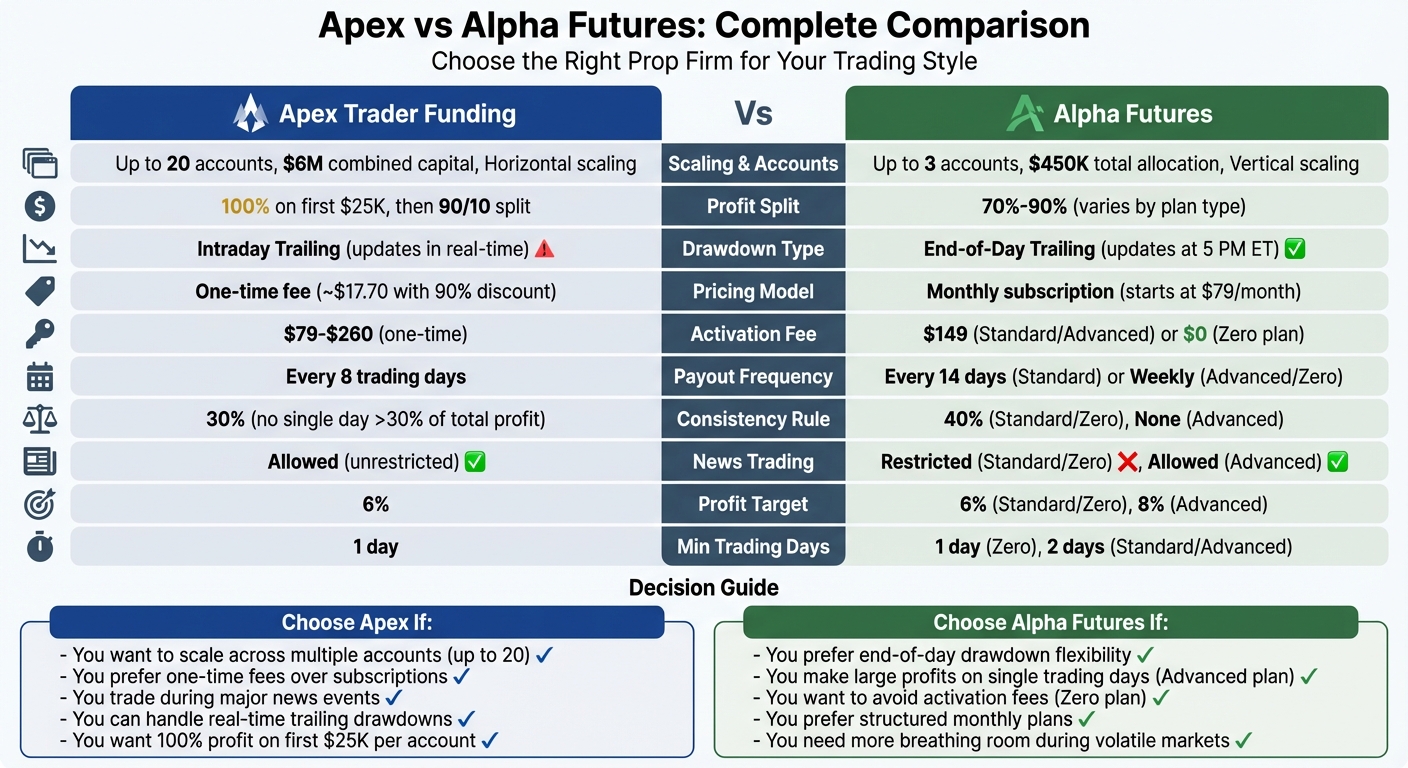
Apex Trader Funding vs Alpha Futures Complete Comparison Chart
Top Futures Prop Firms Compared | What Actually Works
sbb-itb-46ae61d
Apex Trader Funding Overview

Apex Trader Funding, established in 2021, has made a name for itself in the futures proprietary trading world. The firm focuses on trading futures across major exchanges like CME, COMEX, NYMEX, and CBOT, covering indices, energies, metals, and currencies. Since 2022, Apex has paid out over $500 million to traders, including an impressive $2.5 million payout to a trader known as JadeCap [9].
The company operates on a straightforward one-step evaluation model. Traders pay a monthly fee – sometimes as low as ~$33 with discounts – to access a simulated trading account. Once they meet the profit target without breaking the trailing drawdown rule, they’re awarded a funded Performance Account (PA). The profit split structure is designed to reward strong early performance, making it a standout feature.
One particularly attractive option is the ability to copy trades across as many as 20 funded accounts at once. For example, managing 20 accounts with $50,000 each gives access to $1 million in capital. With an approximate setup cost of $3,468 (including discounted evaluations and activation fees), a trader could potentially withdraw $40,000 in their first payout cycle – translating to an impressive return of about 11.5× [7].
Main Features
Apex offers account sizes ranging from $25,000 to $300,000, along with a $100,000 Static account for traders seeking a fixed risk ceiling. To pass the evaluation, traders must hit their profit target within a minimum of 7 trading days while staying above the trailing drawdown limit. A key advantage is the absence of a daily loss limit, allowing traders the flexibility to recover from intraday losses, provided their equity remains above the trailing threshold [7].
| Account Size | Profit Target | Trailing Drawdown | Max Contracts (Minis) | Monthly Fee | Promo Price (80% Off) |
|---|---|---|---|---|---|
| $25,000 | $1,500 | $1,500 | 4 | $147 | ~$30 |
| $50,000 | $3,000 | $2,500 | 10 | $167 | ~$33 |
| $100,000 | $6,000 | $3,000 | 14 | $207 | ~$41 |
| $150,000 | $9,000 | $5,000 | 17 | $297 | ~$60 |
| $300,000 | $20,000 | $7,500 | 35 | $677 | ~$135 |
After passing the evaluation, traders pay a PA activation fee, which can be either $85 to $105 monthly or a one-time lifetime fee of $145. Payouts are available every 8 trading days, and the platform supports popular tools like NinjaTrader 8, Tradovate (with TradingView integration), R|Trader Pro, and WealthCharts. Traders can also operate during major news events, such as the FOMC, NFP, and CPI, without restrictions – making it a great option for those who thrive on market volatility [7].
Who Apex Works Best For
Apex is an excellent fit for experienced, disciplined futures traders with proven strategies and the ability to manage the psychological challenges of a trailing drawdown. It’s particularly appealing for those looking to scale quickly, thanks to the copy trading feature that allows for managing up to 20 accounts simultaneously. Traders frustrated by strict daily loss limits at other firms may find Apex’s trailing drawdown model more accommodating [7].
The platform also suits scalpers, high-frequency traders, and news traders who rely on rapid execution and capitalize on market-moving events. However, all positions must be closed by 4:59 PM ET, as overnight trading is not allowed. This makes Apex less ideal for swing traders or beginners who aren’t yet comfortable managing real-time risk.
One thing to keep in mind: no single trading day can account for more than 30% of your total profit, or your payout may be denied. To avoid this, consider building a profit buffer – set your trailing drawdown at your starting balance plus $100 – before scaling up. Starting with Micro contracts (MES/MNQ) is also a smart way to establish consistency before moving on to E-minis. And don’t forget to take advantage of frequent 80–90% discount promotions on evaluations [7].
This overview lays the groundwork for diving into comparisons of evaluation challenges and pricing in the next section.
Alpha Futures Overview
Alpha Futures uses an end-of-day (EOD) trailing drawdown model, which differs from tracking intraday equity highs. Instead, the Maximum Loss Limit (MLL) is determined by your 5:00 PM ET closing balance. This approach gives traders more flexibility during periods of market volatility [8].
Similar to Apex, Alpha employs a single-step evaluation process. However, the structure and conditions vary. Traders can choose from three account options – Standard, Advanced, and Zero. To secure funding, you must hit a profit target (6% or 8%, depending on the plan) while staying within the MLL. Alpha Futures has earned a 4.9/5 rating on Trustpilot from over 2,600 reviews as of February 2026 [8].
"The EOD daily-balance trailing drawdown is the single best drawdown model in the industry for active intraday traders."
– Paul, Author, PropTradingVibes [8]
Alpha Futures also incorporates a Daily Loss Guard (DLG), which locks your account for the day after a 2% loss, rather than terminating it outright. The firm offers a payout cap of $15,000 per request and profit splits of up to 90% for Advanced and Zero accounts. Traders can manage up to three accounts simultaneously, with a combined allocation limit of $450,000. Supported platforms include Tradovate, NinjaTrader, Quantower, and TradingView (via Tradovate). News trading is allowed during evaluations, but Standard and Zero funded accounts enforce a 2-minute buffer around high-impact news events. Advanced accounts do not have these restrictions [2].
Main Features
Alpha Futures offers three account options tailored to different trader needs:
- Standard: Starting at $79/month for a $50,000 account, this plan requires a 6% profit target. There’s a $149 activation fee after passing the evaluation. Profit splits begin at 70% and increase to 90% after your first payout.
- Advanced: With a monthly fee of $139 for a $50,000 account, this plan requires an 8% profit target. It eliminates the funded-stage consistency rule and allows unrestricted news trading, offering a 90% profit split from day one.
- Zero: Removes the activation fee entirely. Fees start at $99/month for a $50,000 account (or $199 for $100,000). The profit target is 6%, and the profit split is 90%, though it retains the 40% consistency rule and a 2-minute news buffer during the funded phase.
| Account Type | Monthly Fee ($50K) | Activation Fee | Profit Target | Profit Split | Funded Consistency Rule |
|---|---|---|---|---|---|
| Standard | $79 | $149 | 6% | 70% → 90% | 40% |
| Advanced | $139 | $149 | 8% | 90% | None |
| Zero | $99 | $0 | 6% | 90% | 40% |
The Maximum Loss Limit is set at 4% (3.5% for Advanced accounts) and stops trailing once it reaches the starting balance. Withdrawals reduce the MLL dollar-for-dollar, so withdrawing all profits can leave little margin for error [2].
Alpha Futures also has minimal trading requirements. The Zero plan can be completed in a single day, while Standard and Advanced accounts require only two trading days. All positions must be closed by 4:59 PM ET. However, the firm prohibits tick scalping (trades under 2 minutes or 10 ticks), high-frequency trading (100+ trades per day), and the use of automated trading systems like expert advisors or bots.
Who Alpha Futures Works Best For
Alpha Futures is ideal for active intraday traders who thrive in volatile markets. The EOD trailing drawdown model is particularly helpful for traders dealing with sharp intraday swings.
The Advanced plan caters to experienced news traders who focus on events like CPI, FOMC, or NFP releases, thanks to its unrestricted news trading and absence of a funded-stage consistency rule. On the other hand, the Zero plan is a great option for traders who want to minimize upfront costs and complete evaluations quickly without paying an activation fee.
"Alpha Futures has the highest payout cap in the industry at $15,000."
– NickDoesFutures [11]
However, Alpha Futures may not be the best choice for overnight or swing traders due to its mandatory intraday close policy. Additionally, the subscription-based pricing can become costly if the evaluation phase drags on. Standard and Zero funded accounts also enforce a rule where no single trading day can contribute more than 40% of your total profit. Exceeding this limit could lead to a denied payout, so building a profit cushion early can help.
For traders aiming for a long-term career in prop trading, Alpha Futures offers a progression path called Alpha Prime, which transitions successful traders into live trading with a 60% profit split and a structured monthly salary.
Next, we’ll dive into how Alpha Futures compares to other firms in terms of evaluation challenges and pricing.
Evaluation Challenges and Pricing Comparison
How Evaluations Work
Both Apex Trader Funding and Alpha Futures use a single-step evaluation process, but their approaches differ in key ways. Apex sets a 6% profit target that can be achieved in as little as 1 trading day, with no consistency rules during the evaluation period [12]. However, Apex employs an intraday trailing drawdown, which adjusts in real time as your account equity fluctuates. This can make trading during volatile market conditions particularly tricky.
Alpha Futures also has a 6% profit target for its Standard and Zero accounts, while the Advanced account requires 8%. The minimum trading days vary: Zero accounts can be completed in 1 day, while Standard and Advanced accounts require 2 days [2]. A significant difference lies in Alpha’s end-of-day (EOD) trailing drawdown, which only updates based on your account balance at the 5:00 PM ET close. This allows for more flexibility during intraday trading swings. However, Alpha enforces a 40-50% consistency rule for Standard and Zero accounts, meaning no single trading day can contribute more than half of your total profit [2].
"Intraday Trailing Drawdown is incredibly hard to maneuver as an analyst… At Alpha, we offer more drawdown than other firms AND it only trails EOD balance."
– Alpha Futures [13]
These evaluation differences can significantly impact how traders approach their strategies and manage risk when comparing the best futures prop firms.
Costs and Discounts
The cost structure for evaluations and account maintenance varies greatly between the two firms.
Apex Trader Funding offers a one-time fee model after March 1, 2026. For example, a 25K Rithmic Intraday Trail account costs $118 upfront, but discounts of up to 80–90% can reduce this to about $17.70 [12]. Once you pass the evaluation, activation fees range from $79 for a 25K account to $260 for a 150K account [12][14]. This activation fee covers 30 days of account activity with no recurring billing.
Alpha Futures, on the other hand, uses a monthly subscription model. Standard accounts begin at $79/month for a 50K account and go up to $239/month for a 150K account. Advanced accounts are priced higher, starting at $139/month (50K) and reaching $419/month (150K) [2]. Both Standard and Advanced accounts require a $149 activation fee once the evaluation is passed. The Zero plan eliminates the activation fee but still charges a monthly fee – starting at $99/month for a 50K account or $199/month for a 100K account [2].
| Feature | Apex Trader Funding | Alpha Futures (Standard) | Alpha Futures (Advanced) |
|---|---|---|---|
| Profit Target | 6% | 6% | 8% |
| Min. Trading Days | 1 Day | 2 Days | 2 Days |
| Drawdown Type | Intraday | End-of-Day | End-of-Day |
| Max Drawdown | 3.3% – 4% | 4% | 3.5% |
| Consistency Rule | None (Evaluation) | 40-50% | None |
| Pricing Model | One-Time Fee | Monthly Subscription | Monthly Subscription |
| 50K Account Cost | ~$118 (~$17.70 with discount) | $79/month | $139/month |
| Activation Fee | $79 – $260 | $149 | $149 |
If you fail an evaluation with Alpha Futures, the monthly fee continues until you cancel. With Apex, your financial loss is limited to the initial one-time fee and activation cost. These pricing structures and evaluation rules play a crucial role in determining which firm might better suit your trading style and budget.
Payouts and Profit Splits
How Profits Are Split
Apex offers a profit split that starts at 100% on the first $25,000, switching to a 90/10 split after that [7][15]. This structure prioritizes retaining more profits early on, rewarding strong initial performance.
Alpha Futures, on the other hand, tailors its profit splits by account type. The Standard account uses a tiered system: 70% for the first two payouts, 80% for the next two, and 90% from the fifth payout onward [6]. Meanwhile, both the Zero and Advanced accounts provide a flat 90% split from the start [6]. If you’re looking for a consistently high split without waiting for a tiered increase, the Zero or Advanced accounts are great options.
When it comes to consistency rules, Apex applies a 30% consistency requirement, while Alpha’s Standard and Zero accounts enforce a stricter 40% rule [6][7][15]. However, Alpha’s Advanced account skips this rule entirely, making it more forgiving for traders who might have occasional high-profit days.
Let’s now look into how each company handles withdrawals.
How Payouts Work
The payout schedules and processes further set Apex and Alpha Futures apart. Apex allows traders to request withdrawals every 8 trading days, with a minimum withdrawal amount of $500 [7]. However, the first five payouts are capped depending on the account size – for instance, a 50K account has a cap of $2,000 per payout [7]. After the fifth payout, these caps are removed. Payments are processed through Rise, with Apex typically completing withdrawals within 1–3 business days [15].
Alpha Futures operates on different payout timelines based on the account type. Standard accounts allow withdrawals every 14 days, while Zero and Advanced accounts offer weekly payouts, provided you’ve logged 5 winning days [6][8]. Minimum withdrawal amounts vary: $200 for Standard and Zero accounts, and $1,000 for Advanced accounts [6]. Maximum payout caps also differ – $5,000 per cycle for Standard accounts and $15,000 per cycle for Advanced accounts [6]. A key detail to note: for Standard and Zero accounts, each withdrawal reduces your Maximum Loss Limit by the same amount, which could shrink your safety net and even risk account termination [8]. Advanced accounts, however, are exempt from this reduction [8].
| Feature | Apex Trader Funding | Alpha Futures (Standard) | Alpha Futures (Zero) | Alpha Futures (Advanced) |
|---|---|---|---|---|
| Profit Split | 100% (1st $25k), then 90% [7] | 70% → 80% → 90% (Tiered) [6] | 90% Flat [6] | 90% Flat [6] |
| Payout Frequency | Every 8 trading days [7] | Every 14 days [6] | Weekly (after 5 winning days) [6] | Weekly (after 5 winning days) [6] |
| Min. Payout | $500 [7] | $200 [6] | $200 [6] | $1,000 [6] |
| Max. Payout (Early) | $1,000–$3,500 (Capped 1st 5) [7] | $5,000 per cycle [6] | $1,500–$3,000 per request [6] | $15,000 per cycle [6] |
| Consistency Rule | 30% [7] | 40% [6] | 40% [6] | None [6] |
Trading Rules and Drawdown Policies
Drawdown Limits
Apex and Alpha Futures take very different approaches to drawdown limits, and these differences can heavily influence your trading strategy.
Apex uses an intraday trailing drawdown, which adjusts in real time as your account grows. For example, on a $50,000 account with a $2,500 trailing drawdown, your floor starts at $47,500. If your account equity peaks at $51,000 during the trading day, the floor immediately moves up to $48,500. Once the floor reaches $50,100, the trailing stops entirely [7]. The catch? A single bad trade after a strong run can still breach your account, so precision is critical.
Alpha Futures, on the other hand, applies an end-of-day trailing drawdown tied to your Maximum Loss Limit (MLL). For instance, on a $100,000 account with a 4% MLL ($4,000), your floor begins at $96,000. Even if your equity hits $102,000 during the day but closes at $100,000, the floor remains at $96,000. The floor only adjusts based on your closing balance at 5 PM ET [6]. This approach gives traders more flexibility during intraday fluctuations. Other firms, such as TradeDay Prop Firm, also offer EOD drawdown options to provide similar breathing room.
Additionally, Alpha Futures enforces a 2% Daily Loss Guard for Standard and Zero accounts. If you hit this limit, your account is locked for the rest of the session, but it’s not permanently breached [6][10]. Apex, in contrast, doesn’t impose a strict daily loss limit during evaluations. However, funded accounts must adhere to a 30% open loss rule, meaning unrealized losses on any single trade can’t exceed 30% of your profit balance [16].
These rules shape how traders manage risk throughout the trading day.
What You Can Trade
Both Apex and Alpha Futures require traders to close all positions by approximately 4:59 PM ET daily, and neither allows weekend trading [7][10]. However, their policies on news trading differ significantly.
Apex takes a hands-off approach, allowing unrestricted news trading (often available at a discount with an Apex Trader Funding 80% OFF Code) [15]. Alpha Futures, on the other hand, enforces a 4-minute trading pause around key news releases for its Standard and Zero accounts, encouraging caution during high-volatility periods [10]. Traders using Alpha’s Advanced account don’t face this restriction [6][10].
| Feature | Apex Trader Funding | Alpha Futures (Standard/Zero) | Alpha Futures (Advanced) |
|---|---|---|---|
| Drawdown Type | Intraday Trailing [7] | EOD Trailing (MLL) [6] | EOD Trailing (MLL) [6] |
| Daily Loss Limit | None (Eval); 30% Open Loss (Funded) [16] | 2% Daily Loss Guard [6][10] | 2% Daily Loss Guard [6][10] |
| News Trading | Allowed [15] | Restricted (4-min buffer) [10] | Allowed [6][10] |
| Overnight Positions | Not allowed (close by 4:59 PM ET) [7] | Not allowed (close by 4:59 PM ET) [10] | Not allowed (close by 4:59 PM ET) [10] |
| Weekend Trading | Not allowed [7] | Not allowed [10] | Not allowed [10] |
If you trade high-volatility assets like NQ during major news events, Apex’s unrestricted policy or Alpha’s Advanced account might be better suited to your needs than Alpha’s Standard or Zero accounts. These differences highlight how each firm tailors its rules to manage risk while offering traders varying levels of flexibility.
Scaling Plans and Account Management
How Accounts Scale
Scaling is a key factor in growing trading capital, and Apex and Alpha Futures take different approaches to this. Apex emphasizes horizontal scaling, which involves managing multiple funded accounts rather than increasing the size of a single account. With Apex, you can operate up to 20 funded accounts simultaneously using copy trading software, giving you access to a significant pool of combined capital [7].
Alpha Futures, on the other hand, opts for vertical scaling with its Standard and Zero accounts. Here, your contract limits increase as your account balance grows through realized profits, allowing you to trade larger positions over time [17]. However, Alpha’s Advanced accounts skip the scaling process altogether – these accounts let you trade at full position sizes right from the start [6][8].
These distinct scaling methods shape how traders can deploy and grow their capital effectively.
Managing Multiple Accounts
Apex provides the option to use trade copying tools across multiple accounts, making it easier to scale payouts. After your 6th payout, Apex removes withdrawal caps entirely, giving you unrestricted access to your profits [7].
In contrast, Alpha Futures takes a more focused approach by capping total funding at $450,000 across its three account types (Standard, Zero, Advanced) [8]. This setup may suit traders who prefer to concentrate their efforts on one or two well-maintained accounts instead of managing many accounts at once.
Platforms, Assets, and Instant Funding
Let’s break down the platforms, supported assets, and funding options provided by each firm.
Both firms offer access to NinjaTrader and Tradovate, two popular trading platforms. However, Alpha Futures goes a step further by supporting Quantower and integrating with TradingView via Tradovate [8]. Apex, on the other hand, includes free access to NinjaTrader and covers real-time data fees (a $130 value) in its evaluation plans [12]. Notably, Alpha Futures discontinued its proprietary AlphaTicks platform in early 2026 after ProjectX became exclusive to Topstep [8].
For advanced traders, Alpha Futures provides native Quantower support, ideal for tasks like footprint charting and volume profiling [8]. Meanwhile, Apex primarily relies on NinjaTrader and Tradovate. Both firms use Tradovate for web-based execution and mobile trading, making it a reliable option for on-the-go traders. These platform differences cater to varying trading styles and strategies.
When it comes to assets, Apex offers a broader selection, including Micro Bitcoin, Micro Ethereum, and Eurex‘s DAX [12]. Alpha Futures, however, focuses on major futures from CME, CBOT, NYMEX, and COMEX, relying on CQG data feeds [8]. Apex also allows unrestricted scalping and news trading, while Alpha Futures prohibits micro-scalping (trades under 2 minutes or 10 ticks) and bans automated strategies altogether [8].
As for funding, neither firm provides true instant funding. Apex has teased "Instant PAs" as a feature "coming soon" (as of March 2026) [12]. Alpha Futures, on the other hand, offers its Zero account, which enables funding within a day and skips activation fees, though it still requires passing an evaluation [8].
These distinctions in platforms, assets, and funding timelines highlight the unique offerings of each firm, catering to different trader preferences and needs.
Strengths, Weaknesses, and Best Fit
Pros and Cons
Apex Trader Funding stands out with its potential for massive scaling. Traders can manage up to 20 funded accounts at once using trade copiers, and the payout structure is enticing: 100% of the first $25,000 per account before transitioning to a 90% profit split. Payouts are processed every 8 trading days, and frequent promotions can reduce evaluation costs by as much as 80–90%, making it more accessible for traders starting out [7][18]. However, there are a few challenges. Apex enforces a 30% consistency rule, meaning no single day can account for more than 30% of total profits at payout. Additionally, its intraday trailing drawdown can be tricky to navigate, and a "safety net" is required for the first three payouts [7][18].
Alpha Futures, on the other hand, offers more flexibility with its end-of-day (EOD) trailing drawdown, which adjusts only at the close of the trading day – helpful during volatile market conditions [6]. The firm also boasts a high Trustpilot rating, reinforcing its reputation [6]. Its Zero account eliminates activation fees entirely, while the Advanced account removes consistency rules during the funded stage, making it a great fit for traders who rely on large, asymmetric profit days [6][8]. Additionally, Alpha Prime provides a clear path to live trading with a monthly salary [6]. That said, Alpha Futures comes with stricter consistency rules for its Standard and Zero plans, charges $149 activation fees for most accounts, and restricts news trading on all but the Advanced accounts [6].
| Feature | Apex Trader Funding | Alpha Futures |
|---|---|---|
| Best Strength | 20-account scaling + 100% first $25K split | EOD drawdown + no consistency rule (Advanced) |
| Biggest Weakness | 30% consistency rule + intraday drawdown | 40% consistency rule (Standard/Zero) + news restrictions |
| Trustpilot Rating | 4.5/5 from 15,000+ reviews [7] | 4.9/5 from 2,995+ reviews [6] |
These factors highlight key differences to consider when making your decision.
Which Firm Should You Choose?
The right choice depends on your trading style and how you handle risk.
Apex Trader Funding might be your best bet if you’re comfortable managing intraday trailing drawdowns and are looking to scale aggressively with multiple accounts. High-volume traders using trade copiers to replicate strategies across accounts will especially benefit from Apex’s 100% profit split on initial earnings and its frequent, deep discounts on evaluations.
Alpha Futures (Advanced) is a strong option if your trading style includes large, asymmetric profit days that could trigger consistency rules elsewhere. The EOD trailing drawdown is particularly helpful for avoiding premature stops during intraday volatility.
"The EOD daily-balance trailing drawdown is the single best drawdown model in the industry for active intraday traders."
– Paul, PropTradingVibes [8]
For those wanting to avoid activation fees, Alpha’s Zero account is worth exploring. It even allows the possibility of passing an evaluation in just one day. Beginners might find the Standard account appealing, with its lower monthly entry cost starting at $79 for a 50K account.
Both firms offer clear paths for growth. Apex focuses on scaling capital across multiple accounts, while Alpha Futures provides a progression to live trading desks through Alpha Prime. Your decision should weigh the benefits of scaling opportunities against the practicalities of managing drawdowns and consistency rules.
Conclusion
After analyzing their evaluation processes, pricing structures, and risk management tools, here’s a quick breakdown to help you decide between Apex and Alpha Futures.
Choose Apex if you want to manage multiple accounts and aim for aggressive scaling. Choose Alpha Futures if you prioritize flexible rules and controlled drawdowns.
Apex stands out with its scaling model, allowing traders to manage up to 20 accounts with access to $1.5 million in total capital [3][19]. Traders can keep 100% of the first $25,000 in profits per account [3][1], and the firm has paid out over $538 million since 2022 [20]. However, its intraday trailing drawdown and 30% consistency rule may limit large single-day profits [3][5].
Alpha Futures, on the other hand, uses an end-of-day drawdown of 3.5–4%, which can offer more breathing room during volatile markets [2]. The Advanced account eliminates consistency rules once funded, making it ideal for traders who rely on occasional big profit days [2][1]. With weekly payouts and compatibility with platforms like Quantower and ProjectX, Alpha Futures provides flexibility. However, scaling is capped at $450,000 across three accounts, and automated trading isn’t allowed [2].
"Apex exposes weaknesses quickly and rewards discipline with speed and scale. Alpha Futures is a strong option for traders who want different rule frameworks under one brand."
– Select Prop Firms Editor [19][1]
For traders who can handle multiple accounts and stricter drawdown rules, Apex’s scaling potential and promotional discounts (up to 80–90%) may be appealing [3][19]. On the other hand, those who prefer flexibility, wider platform options, or less rigid drawdown triggers might find Alpha Futures’ Advanced or Zero accounts a better fit [2][1].
Both firms have strong reputations, with Apex earning a 4.9/5 rating on Trustpilot from over 2,100 reviews [4], and Alpha Futures maintaining a similarly high rating [2]. If aggressive scaling and fast payouts excite you, Apex could be the way to go. If you value flexibility and platform variety, Alpha Futures might align better with your trading style. Ultimately, the best choice depends on your personal trading approach and risk preferences, as detailed in this comparison.
FAQs
Which drawdown model is safer for my strategy?
Alpha Futures provides a risk management model that aligns with various trading styles and risk tolerances. Their approach is designed to be flexible and straightforward, with clearly defined rules to help traders manage risks and avoid significant losses. This setup encourages disciplined trading while allowing room for growth, making it a strong option for those prioritizing risk control. The ideal choice, however, will always depend on your individual trading goals and risk thresholds.
How do consistency rules affect my payouts?
Consistency rules play a key role in determining your payouts by establishing specific conditions you need to meet. These might include maintaining steady profitability or staying within drawdown limits. Such rules are designed to promote disciplined trading. However, failing to meet them could result in delays or restrictions on your payouts. Sticking to these guidelines is crucial if you want to ensure smooth and timely profit withdrawals.
Which plan costs less if I fail and retry?
The cost largely hinges on the evaluation and funding policies set by each firm. Alpha Futures stands out with its one-step evaluation process and payouts of up to 90%, which can lead to lower costs if you need to retry. On the other hand, Apex Trader Funding has varying fees and policies, making it crucial to carefully examine their evaluation fees and drawdown rules. Overall, Alpha Futures tends to be more budget-friendly for retries due to its straightforward approach, but it’s always a good idea to double-check the details to ensure accuracy.