If you’re looking to make trading a full-time income, Apex Trader Funding offers a unique opportunity. Here’s the key takeaway: You can trade with no personal financial risk while accessing significant capital. Apex allows traders to keep 100% of their first $25,000 in profits per account and then offers a 90/10 profit split beyond that. With Apex, you can manage up to 20 accounts simultaneously, scaling your earnings significantly.
Key points to know:
- Evaluation Process: Pass in as little as one day if profit targets are met.
- Funded Account Rules: Follow the 50% consistency rule and meet minimum profit thresholds for payouts.
- Risk Management: Stick to strict stop-losses and a 5:1 risk-to-reward ratio.
- Payouts: Weekly requests are now available for 2026 accounts, with caps easing over time.
- Scaling: Manage up to $6 million in trading capital using multiple accounts and trade-copying tools.
The secret to success? Discipline, risk management, and following Apex’s rules. By building consistent habits, you can generate steady income and grow your trading operations over time.
How to Succeed with Apex Trader Funding & Earn $10K+/Month | Complete Guide
sbb-itb-46ae61d
Apex Trader Funding Rules and Requirements
If you’re aiming to turn Apex into a steady source of income, understanding their evaluation phase and funded Performance Account rules is key. Breaking the rules can reset your progress, so it’s essential to stay informed. Here’s how the requirements shift once your account is funded.
The Evaluation Process
As of March 2026, Apex has dropped the minimum trading day requirement for evaluations. This means you can pass in just one day if you hit your profit target without exceeding the drawdown limit [1][6]. For instance, a $50,000 account requires a profit of $3,000 while keeping drawdown under $2,000. You have 30 calendar days to complete the evaluation, and no extensions are provided [1][6].
Apex offers two distinct drawdown models: End-of-Day (EOD) and Intraday Trailing. EOD accounts calculate drawdown at the market close and apply it to the next session, while Intraday accounts adjust the threshold in real time based on your peak unrealized balance [1]. EOD accounts also include a Daily Loss Limit (DLL) – if you hit this limit, trading pauses for the day, but your account doesn’t fail [1][6]. Once you complete the evaluation, you’ll have 7 calendar days to activate your Performance Account [1].
Funded Account Rules
Once funded, the rules get tighter. The 50% consistency rule applies to all new accounts in 2026, meaning no single profitable day can account for more than 50% of your net profit since your last payout [1][6]. This encourages traders to distribute their profits across multiple sessions instead of relying on one big trade.
Additionally, you’ll need 5 qualifying days to request a payout. Each of these days must meet a minimum profit threshold – $100 for a $25,000 account or $300 for a $150,000 account [1]. For your first three payouts, your balance must remain above the Safety Net – calculated as your starting balance plus the drawdown limit plus $100 – if you want to withdraw more than the $500 minimum [1][4]. Other key rules include closing all positions by 4:59 PM Eastern Time daily and avoiding simultaneous long and short positions in correlated instruments like ES and NQ [5].
Risk Management for Consistent Profits
Passing the evaluation is one challenge – staying funded is a whole different game. The key to long-term success lies in effective risk management, as most failures stem from poor control rather than flawed strategies [9]. By sticking to the evaluation and funded account guidelines, these practices help protect your capital and keep profits steady. Following a funded account checklist can help ensure you’ve covered all bases before your first trade.
Stop-Losses and Risk-Reward Ratios
Apex enforces a strict 5:1 risk-to-reward ratio for every trade [2]. Simply put, risking $500 to aim for $100 is fine, but risking $500 to gain just $50 isn’t.
"Apex expects traders to maintain a maximum 5:1 risk-to-reward ratio on trades… This rule keeps traders from scalping tiny wins while taking huge risks." – DamnPropFirms [2]
To stay within these limits, use hard stop-loss orders. These prevent market spikes from triggering excessive drawdowns. If your setup requires wider stops, adjust your contract size to keep the total risk under control. For example, if you usually trade 3 contracts with a $400 stop, but your current trade setup demands a $600 stop, reduce to 2 contracts. This adjustment caps your total risk at $1,200 instead of $1,800.
At the start of every session, calculate and visibly display your maximum allowable loss as a constant reminder [8].
Staying Within the 30% Negative P&L Rule
Managing open trade losses is just as important as setting stop-losses. The 30% Negative P&L Rule – often called Maximum Adverse Excursion (MAE) – limits the unrealized losses you can have on open trades, aligning with Apex’s guidelines [8]. Unlike general consistency rules, MAE zeroes in on the drawdown a single active trade can experience.
For instance, if you have a $4,000 profit balance, your open trades shouldn’t exceed $1,200 in unrealized losses (30%) [8].
"The #1 way traders break this rule is by adding contracts (scaling in / DCA) but leaving the original stop too wide, or not recalculating the combined position’s open risk." – Prop Trading Deals [8]
Monitoring unrealized losses in real time is essential – don’t just rely on closed P&L [8]. If you’re scaling into positions, recalculate your combined stop-loss level every time you add contracts. For example, if scaling increases your risk so that the original stop now represents a $1,000 loss, and this exceeds 30% of your profit balance, you’re breaking the rule – even if the trade hasn’t been closed yet.
After requesting a payout, it’s smart to reduce position sizes and avoid risky setups until the funds are withdrawn. Falling below the minimum balance during this period could result in your payout being denied [7].
How to Maximize Payouts
Now that you’ve got risk management under control, it’s time to focus on increasing your profits with Apex’s payout system. The platform has already paid out over $500 million to traders, and understanding how to navigate its payout structure can significantly impact your earnings [2].
Payout Structure: First $25,000 and Beyond
Apex allows you to keep 100% of the first $25,000 in profits for each account. After that, profits are split 90/10 [10]. Here’s where it gets interesting: with the option to maintain up to 20 active Performance Accounts, you could theoretically hold on to the full first $700,000 in combined profits before any split kicks in [10].
Additionally, new EOD and Intraday accounts now offer 100% payouts on approved amounts, thanks to updated compliance rules [1]. Keep in mind, payout requests must meet a minimum withdrawal amount of $500, and traders are required to satisfy consistency requirements [10].
Payout Timelines and Limits by Account Size
The frequency and limits of payouts depend on your account type and how long it’s been funded. For legacy accounts, payouts can be requested twice a month during specific windows: the 1st to the 5th and the 15th to the 20th. Meanwhile, new 2026 accounts allow weekly payout requests once eligibility criteria are met [10][1].
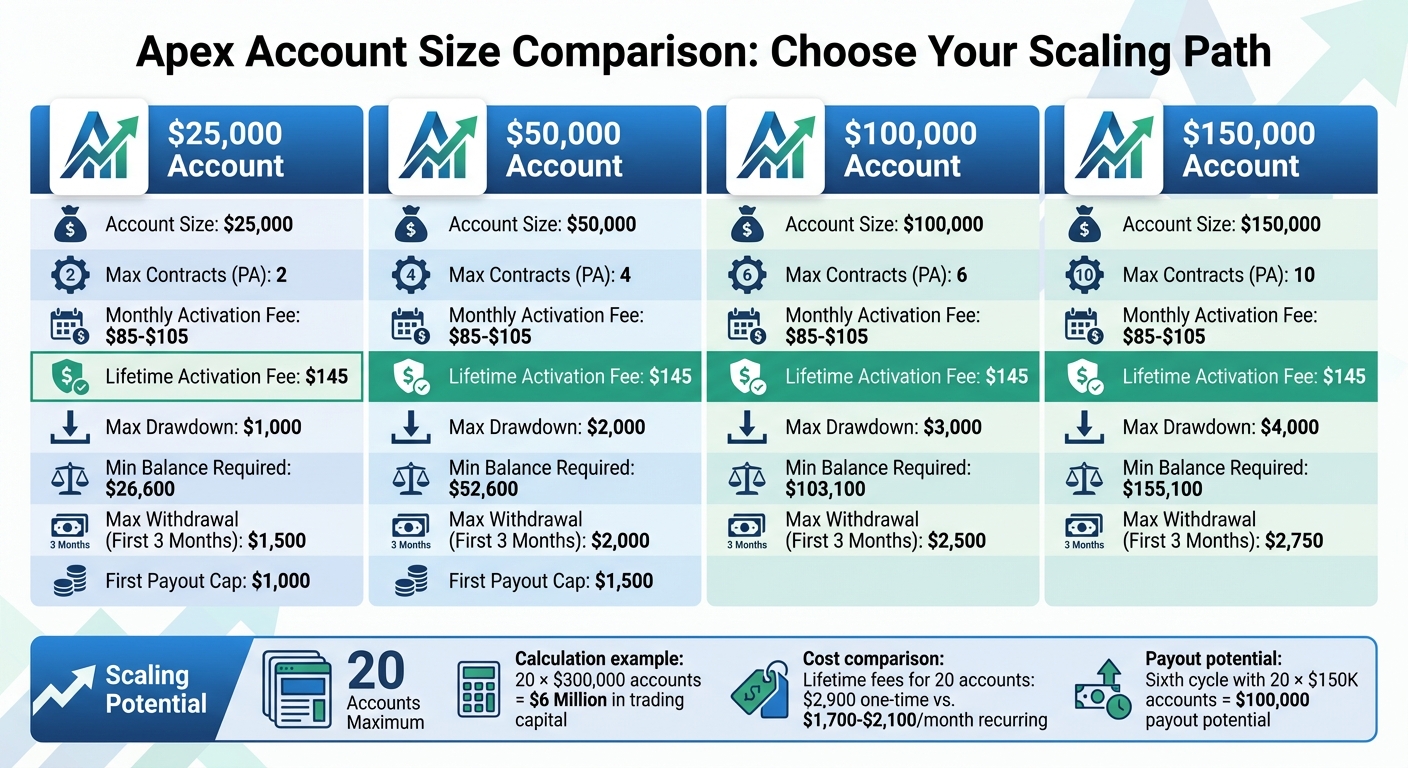
During the first three months (or first six payouts), withdrawal caps are tied to your account size. Here’s a breakdown:
| Account Size | Min Balance Required | Max Withdrawal (First 3 Months) |
|---|---|---|
| $25,000 | $26,600 | $1,500 |
| $50,000 | $52,600 | $2,000 |
| $100,000 | $103,100 | $2,500 |
| $150,000 | $155,100 | $2,750 |
| $300,000 | $307,600 | $3,500 |
After the fourth month or sixth payout, these limits typically disappear, giving you the freedom to withdraw larger amounts more frequently [10]. For 2026 accounts, the payout process works a little differently. For instance, a $25,000 account starts with a $1,000 cap for the first payout, while a $50,000 account might begin with a $1,500 limit. These caps increase over time, with a $50,000 account reaching around $3,000 by the sixth payout [1]. As you demonstrate consistency, these restrictions ease, allowing for greater flexibility.
To avoid forfeiting your payout in the early stages, maintain a balance equal to your trailing drawdown plus $100 during the first three payouts [1][10]. If your balance drops below this threshold while a payout request is pending, the request will be canceled. However, once the payout is marked as Approved, the funds will be sent even if the account is later blown [10].
Timing and Consistency Requirements
Before requesting your first payout, ensure you’ve completed 8–10 trading days, with at least 5 days meeting minimum profit targets [10]. Timing is also crucial – submit your payout request after 6:00 PM EST on your final required trading day to ensure it’s processed correctly [11].
Scaling With Multiple Funded Accounts
Apex Trader Funding Account Sizes: Fees, Limits, and Scaling Potential
Once you’ve nailed down your risk management strategy, the next step is scaling up your trading operations to achieve full-time income potential. Apex gives traders the ability to manage up to 20 active Performance Accounts at the same time, allowing you to replicate successful strategies across multiple accounts effortlessly [1][3]. Instead of juggling trades manually across accounts, many professional traders rely on trade copying platforms. These tools, like SyncFutures, ensure that entries, exits, and stop-losses are synced in real time with millisecond precision, reducing the chances of input mistakes or price slippage [12][13].
Managing Up to $6 Million in Trading Capital
Running 20 accounts doesn’t just multiply your trading capital – it can also significantly boost your payout potential. For instance, a single $150,000 account has a payout cap of $5,000 in its sixth cycle. Multiply that by 20 accounts, and you’re looking at a $100,000 payout for the same cycle [1]. At the $300,000 funding level, you could be managing $6 million in total trading capital [14].
To scale effectively, start small. Focus on mastering a single account for at least three months before expanding. Consistent discipline is key to sustainable growth [14][15].
For a smoother scaling process, consider using a VPS located near the CME exchange in Chicago to avoid disruptions caused by local outages [12][13]. When configuring your trade copier, use ratio-based scaling. For example, if your master account is $150,000, you could set it to trigger 0.33 contracts on a $50,000 account to maintain proportional risk [13][14]. Additionally, keep an eye on each account’s Daily Loss Limit (DLL) through a dashboard that tracks both individual and aggregate drawdowns. This will help you avoid excessive losses and stay within safe limits [12][14]. A well-thought-out scaling strategy, combined with a clear understanding of fees, will help you grow your trading operations efficiently.
Account Size and Fee Comparison
Your choice of account size should align with your trading strategy and budget. Smaller accounts come with lower fees and drawdown limits, while larger accounts provide more room for higher contract allocations and larger payouts. Here’s a breakdown of the different tiers:
| Account Size | Max Contracts (PA) | Monthly Activation Fee | Lifetime Activation Fee | Max Drawdown |
|---|---|---|---|---|
| $25,000 | 2 | $85 – $105 | $145 | $1,000 |
| $50,000 | 4 | $85 – $105 | $145 | $2,000 |
| $100,000 | 6 | $85 – $105 | $145 | $3,000 |
| $150,000 | 10 | $85 – $105 | $145 | $4,000 |
The $145 lifetime activation fee per account is a one-time payment that eliminates recurring monthly fees, making it a more cost-effective option for long-term traders [3]. If you’re scaling to 20 accounts, the upfront cost would be $2,900, which is far more economical than paying $1,700 to $2,100 per month in recurring fees.
Strategies for Long-Term Consistency
Building a full-time income with Apex requires developing consistent and disciplined trading habits. Successful traders rely on tools like daily checklists, tracking systems, and automation to stay on top of balances, trailing drawdowns, payout schedules, and consistency metrics [7]. As Mike Christensen, CFOA, puts it:
"The traders who last are not the ones with the fanciest setups, they are the ones who build checklists, templates, and automation that make breaking Apex Trader Funding funded account rules almost impossible by design." [7]
This structured approach ensures you can effectively use Apex’s tools while refining your trading habits. By combining disciplined routines with Apex’s built-in risk controls, you can trade within the rules while steadily growing your income.
Using Apex’s Tools and Features
Automation tools like TradersPost and TradeSyncer are invaluable for maintaining discipline. These tools can enforce fixed stops, daily loss caps, and consistent position sizing automatically [7]. Before starting your trading session, it’s helpful to run through a pre-session checklist. This should include comparing your current balance to the trailing drawdown, calculating the buffer needed to avoid breaching account limits, and confirming the gap required for your next payout [7].
To meet Apex’s 50% consistency rule, balance out any unusually large profit days with several smaller, steady winning sessions. This helps dilute the percentage and keeps you compliant [16]. Maintaining a daily spreadsheet to track key metrics – like account balance, drawdown thresholds, safety net distance, and your consistency ratio – can help reinforce these habits.
Building a Disciplined Trading Routine
While automation and tools are essential, your personal trading routine is the foundation of long-term success. Focus your activity during high-volume periods, such as the US market open from 9:30 AM to 12:00 PM ET. These times often offer tighter spreads and clearer price movements [16]. Set modest daily profit goals – such as $400–$600 on a $100,000 account – to build steady results over time rather than relying on a single big win [16].
It’s also wise to establish a personal daily loss limit that’s well below the official Daily Loss Limit (DLL). One trader shared their approach:
"One bad day can erase weeks of work. I stop trading for the day after losing $500-$700, well before the $1,500 DLL triggers." [16]
When you request a payout, treat those funds as if they’ve already left your account. Continuing to trade based on your pre-payout balance can lead to falling below minimum thresholds and potentially losing the payout [7]. By sticking to these principles, you can turn Apex from a short-term opportunity into a reliable, long-term income source.
Conclusion
Turning Apex Trader Funding into a reliable full-time income requires mastering the firm’s rules, managing risk effectively, and building habits that can be repeated consistently. Since 2022, Apex has paid out over $500 million to traders, showing that earning a sustainable income is achievable when you treat your funded account like a business rather than a gamble [2][3].
Success starts with understanding Apex’s drawdown models and consistency requirements. Whether you opt for the End-of-Day (EOD) or Intraday Trailing Drawdown, maintaining a Safety Net buffer and adhering to the 30% or 50% consistency thresholds is critical [1][2]. Traders who last in the program are those who practice smart risk management – using fixed stops, enforcing strict daily loss limits, and scaling their position sizes carefully [9].
The payout structure is designed to reward discipline. Traders keep 100% of their first $25,000 per account and 90% of earnings beyond that [1][17]. With the ability to scale up to 20 Performance Accounts, there’s significant potential to grow your income.
Consistency over the long term comes down to creating disciplined routines, leveraging automation, and sticking to checklists. Modest daily profit targets – such as $400–$600 on a $100,000 account – help maintain steady progress. It’s also important to leave a buffer above your trailing drawdown after making withdrawals [16][17]. Tracking every metric in a daily spreadsheet ensures compliance and helps avoid rule violations. These habits are the foundation for turning Apex into a sustainable, full-time trading career.
FAQs
Which Apex account type should I choose (EOD vs Intraday)?
Choosing between EOD (End-of-Day) and Intraday accounts comes down to how you trade and manage risk.
- EOD accounts: These update trailing drawdowns at the close of each trading day. They’re a great fit if you prefer to evaluate and manage your risk based on daily performance rather than real-time fluctuations.
- Intraday accounts: These provide more flexibility since thresholds adjust throughout the trading day. This setup works well for active traders who keep a close eye on their positions during market hours.
Your choice should align with how you approach trading and your comfort with managing risk.
How do I avoid failing the 50% consistency rule?
To stay compliant with Apex Trader Funding’s 50% consistency rule, it’s important to ensure that your most profitable trading day accounts for no more than 30% of your total profit or profit target. This rule is designed to promote steady, consistent growth rather than relying on risky, high-stakes trades. Tools like the Apex Consistency Calculator can help you monitor your performance and ensure that your best trading day stays within the 30% limit. Staying mindful of this threshold can help you avoid violations and maintain your trading progress.
What’s a realistic monthly income with 1–20 accounts?
A realistic monthly income with 1–20 Apex funded accounts varies based on the size of the accounts, trading performance, and how well risk is managed. With a single account, traders commonly make anywhere from a few hundred to several thousand dollars each month. Expanding to 20 accounts can significantly increase earnings, assuming consistent performance. Many traders report monthly earnings ranging from a few thousand dollars to over $10,000 across multiple accounts, though this heavily depends on market conditions and adherence to trading rules.