Recovering from a drawdown is tough – but making the wrong moves can make it even harder. Here are the five most common mistakes traders make during drawdown recovery and how to avoid them:
- Revenge Trading: Emotional trading to "win back" losses often leads to bigger setbacks. Stick to your rules and take a break after losses.
- Over-Leveraging: Increasing position sizes to recover faster amplifies risk. Keep risk per trade low (1–2%) and focus on consistency.
- Ignoring Trading Rules: Breaking your own rules during losses creates a cycle of poor decisions. Follow your plan and set strict loss limits.
- Switching Strategies Mid-Drawdown: Abandoning a proven strategy during tough times can be costly. Review execution, not just the strategy.
- Aggressive Recovery Without a Plan: High-risk trades without a clear plan rarely work. Focus on smaller, controlled trades to rebuild confidence.
Key takeaway: Recovery isn’t about rushing – it’s about discipline, patience, and sticking to a structured process. Avoid these mistakes, and you’ll be on the right path to long-term success.
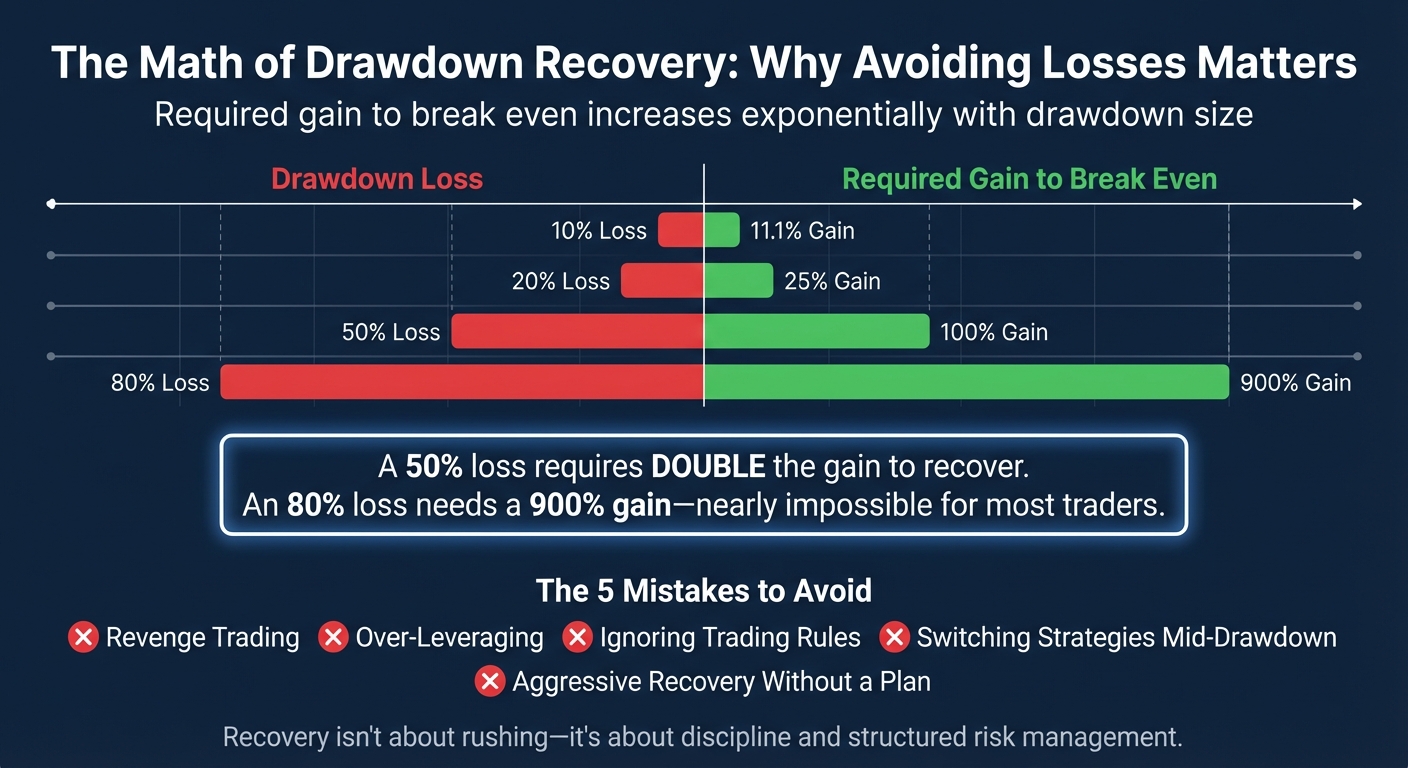
Drawdown Recovery Math: Loss vs Required Gain to Break Even
How to Handle Trading Drawdowns (Step-by-step process)
Understanding how different firms calculate risk is essential, especially when dealing with unrealized trailing drawdown rules that can trigger liquidations unexpectedly.
sbb-itb-46ae61d
1. Revenge Trading
Revenge trading is one of the quickest ways to derail your recovery after a drawdown. It happens when frustration and anger take over, leading you to abandon your trading rules or increase position sizes in an attempt to "win back" losses immediately [4][5]. Unfortunately, this reaction often leads to even greater losses.
"Revenge trading is the urge to immediately ‘win back’ losses, often by increasing size or abandoning rules. That behavior usually amplifies losses and creates a negative spiral." – John McDowell, Lead Content Strategist, TradingSim [5]
When losses occur, emotional triggers like the affect heuristic and recency bias can cloud your judgment, making irrational decisions feel justified [2]. These biases push traders to overcommit, but they have no foundation in sound market strategy.
For instance, doubling your position size after a loss might feel like a way to recover quickly, but it significantly raises your risk. At firms like Apex Trader Funding and Take Profit Trader, this approach can lead to breaching daily loss limits faster [2][1]. What starts as a manageable 10% drawdown, requiring an 11.11% gain to recover, can snowball into a 50% loss, which would need a staggering 100% gain to break even [2][1].
Revenge trading also builds a dangerous mindset. By chasing losses and hoping for a quick win, you train yourself to rely on luck rather than a disciplined, well-thought-out strategy. This cycle of impulsive decision-making often results in deeper losses [2].
The solution? While simple in theory, it requires discipline. Set strict daily loss limits and consistency rules, step away from trading after significant losses, and reduce your position sizes to regain control [4][5][2]. These steps can help you break the cycle and get back on track.
2. Over-Leveraging to Recover Faster
Over-leveraging often tempts traders looking for a quick recovery, but it’s a risky move that undermines proper risk management. When faced with a losing account, increasing position sizes in an attempt to bounce back faster only amplifies risk. It also ignores the brutal math of trading losses, where a manageable setback can spiral into a massive drawdown.
Here’s the reality: drawdown recoveries don’t follow a straight path. For instance, a 20% loss demands a 25% gain to break even, while a 50% loss requires doubling your account. If you hit an 80% drawdown, you’d need a staggering 900% gain just to recover. This exponential risk makes over-leveraging a dangerous game [2].
"What starts as a relatively benign and manageable loss can then spiral into a catastrophic drawdown, wiping out a significant portion of their account in a single, avoidable event." – Elior Manier, Market Analyst, OANDA [2]
For traders using funded accounts through firms like Apex Trader Funding, Take Profit Trader, or FundedNext Futures, the risks are even higher. A single oversized trade can breach risk limits and result in an immediate account wipeout [1].
These trades often depend on sheer luck rather than solid strategy. And as most experienced traders know, luck doesn’t last [2]. The way forward? Stick to disciplined risk management. Keep your risk per trade at 1–2%, or even scale it back temporarily after a drawdown. This approach isn’t just safer – it’s proven to help you avoid the pitfalls of over-leveraging [1][2].
3. Ignoring Trading Rules and Limits
When you’re hit with a drawdown, sticking to your trading rules can feel almost impossible. But those rules are exactly what you need to prevent a manageable loss from spiraling into something catastrophic – like wiping out your entire account.
The emotional toll of a losing streak can push you toward impulsive trades that don’t align with your strategy. Breaking your own rules often leads to a vicious cycle of bad decisions and worse outcomes.
Occasional wins while breaking the rules can be especially dangerous. For example, landing a profitable trade after ignoring your stop-loss or position sizing might feel like validation, but it’s not. Instead, it reinforces bad habits, making you more likely to repeat those mistakes. Unfortunately, luck doesn’t last forever, and relying on it is a fast track to failure [2].
For traders using funded accounts with platforms like Apex Trader Funding, Tradeify, or Alpha Futures, breaking the rules carries even greater risks. These accounts come with strict daily and total drawdown limits, such as end-of-day drawdown, and a single mistake can result in immediate termination.
To regain control, shift your focus from the outcome to the process. Instead of measuring success by how much money you made, evaluate your performance based on how well you followed your trading plan and risk management rules. Set firm daily and weekly loss limits to stop trading before your emotions take over. If you’ve experienced a significant loss, reduce your position sizes. Trading smaller not only protects your remaining capital but also helps rebuild your confidence [3][6].
"Focusing solely on the ‘win’ without evaluating the process is a recipe for disaster." – Elior Manier [2]
4. Changing Strategies Mid-Drawdown
When you’re facing a string of losses, sticking to your established strategy becomes even more critical. It’s tempting to abandon your approach when things aren’t going well, but this is often a mistake. Most of the time, the issue isn’t your strategy – it’s either your execution or the current market conditions [9].
A common pitfall for traders is giving up on a strategy at the worst possible time. Take the example of traders using a profitable RBOB futures bias strategy in October 2020. Those who abandoned it during a rough patch missed out on the strategy’s recovery and the substantial gains that followed. By 2022, traders who stayed the course saw profits soar to $100,000, while those who bailed early ended up with just $55,000 in total profit. The takeaway? Sticking with a proven strategy through tough periods often pays off in the long run [8].
"Your system didn’t change. The market did." – SetupAlpha [7]
Switching to a new strategy during a drawdown is risky. You’re more likely to make decisions fueled by emotion, and it becomes harder to evaluate whether your original strategy still has an edge. Before making drastic changes, take the time to review at least 50 trades. This will help you determine whether the issue lies with the strategy itself or your execution [9]. Execution is key – if you’re not following your own rules at least 80% of the time, the focus should be on improving discipline, not scrapping your strategy [9].
If you do decide a change is necessary, test it in a simulated environment first. Never introduce untested adjustments into a live account while you’re in a drawdown. Keep in mind the math of recovery: a 10% loss requires an 11.1% gain to break even, and a 50% loss demands a 100% return. Making impulsive changes can deepen your losses and make recovery even harder [9].
5. Recovering Too Aggressively Without a Plan
Jumping into aggressive recovery trades without a clear plan is like throwing fuel on a fire – it only increases the risk. Much like revenge trading or over-leveraging, this approach is driven by emotion, not logic, and it can quickly spiral into bigger losses. Attempting to make up for losses by enlarging position sizes is a dangerous gamble that often backfires.
This emotional reaction to losses leads to high-risk trades, which rarely pay off. In fact, statistics show that these trades succeed only 20% of the time and often result in losses that are 2–3 times larger than the original risk. The pressure to recover quickly creates a "recovery gap", where you’re forced to perform well beyond your usual capabilities – a recipe for disaster[9]. To counter this, it’s crucial to revise your strategy immediately after a setback.
"Trying to recover the drawdown emotionally usually deepens it mathematically. The fastest way back is almost never the most aggressive way back." – Gary M., Founder, TradersSecondBrain[9]
The real risk isn’t just the immediate losses. Even if an aggressive recovery happens to succeed, it can reinforce bad habits. This false sense of confidence in reckless trading can lead to even greater losses down the line when luck inevitably runs out. A safer and more effective strategy? Cut your position size by at least 50% after a significant loss, limit yourself to just 2–3 trades per day, and stick strictly to setups that meet every item on your checklist[9]. This disciplined approach aligns with the earlier strategies for managing drawdowns and helps you regain control of your trading mindset.
Conclusion
Recovering from a drawdown isn’t about rushing to make up for losses – it’s about maintaining discipline. The five common mistakes we’ve discussed – revenge trading, over-leveraging, ignoring rules, switching strategies, and overly aggressive recovery – stem from prioritizing emotions over a structured approach. Each of these missteps doesn’t just hinder progress; they can make recovery even harder. As the FTM Team at Funded Trader Markets aptly puts it:
"Drawdown is not the enemy of a funded account. Undisciplined risk expansion is."[12]
The math of recovery is unforgiving. For example, a 10% loss requires an 11.1% gain to break even, while a 50% loss demands a staggering 100% recovery[10]. These numbers highlight why every mistake makes the road back longer. Stories like those of traders Zeeshan Ali and Selcuk Ozgen show that structured risk management is the key. In March 2026, Ali faced 18 consecutive losses in a Funded Trader Markets 2-Step $100k program but still earned a $3,240 reward by sticking to his plan and avoiding risk escalation[12]. Similarly, Ozgen recovered from a 7.4% drawdown ($92,646 balance) to achieve a 13.9% recovery and a $5,544 payout, relying on consistent position sizing instead of aggressive tactics[12].
The path to recovery is built on a disciplined mindset. It’s not about a single big win but about regaining confidence through small, deliberate victories. Reduce your position size to 0.25R or 0.5R, limit yourself to 2–3 trades per session, and only take A-grade setups with a documented positive edge[10]. Automated daily stop-losses set at 80% of your firm’s limit can also eliminate emotional decision-making[11].
When trading with a prop firm, it’s essential to follow their specific drawdown rules and risk limits. Tools like the Consistency Rule Calculator from DamnPropFirms can help you stay on track. They also provide verified reviews and comparisons for firms such as Apex Trader Funding, Tradeify, and Take Profit Trader, helping you find a firm that fits your recovery strategy. For additional support, you can connect with over 4,500 traders in their Discord community, offering real-time advice during tough times.
Discipline, patience, and structure are more than just tools for recovery – they are the building blocks of long-term success. As Brett Simba from Tradeify wisely says:
"Confidence does not return with a single winning trade – it returns through the consistent application of a structured process."[10]
Stick to your plan, and the recovery will come naturally.
FAQs
How do I know if I’m revenge trading?
Revenge trading occurs when traders act impulsively, attempting to recover losses after a setback without careful analysis. Common signs include emotionally increasing position sizes, excessive trading, or feeling desperate to "win back" losses right away. These actions are driven by emotions, not a sound strategy, and often result in even greater losses. To avoid this pitfall, it’s essential to stay disciplined and stick to your trading plan.
What’s a safe position size during recovery?
Reducing your trade size during a drawdown recovery is a smart move. Cutting your position size by about 50% and limiting the number of trades can help protect your capital and reduce the risk of deeper losses. Focus on high-quality setups and steer clear of full-size positions until you’ve strung together consistent winning days. This approach can boost your chances of bouncing back successfully.
When should I change my strategy after losses?
When you experience significant drawdowns, it’s time to reassess your approach. Start by cutting your position size in half – this helps minimize further losses. Limit yourself to just two trades per day for a week, and stick to a clear, structured recovery plan.
Whatever you do, avoid revenge trading. Chasing losses often leads to bigger setbacks. Instead, focus on achieving consistent positive results. For example, aim for five consecutive profitable days before even thinking about increasing your risk levels again.
Remember, losing streaks happen to everyone. The key is to protect your capital and rebuild your confidence by trading with discipline and patience.