If you’re serious about algo trading, you’ve got to backtest properly. And for that, API access is a game-changer. It lets you pull historical data, test strategies, and transition to live trading without rewriting a ton of code. But not all prop firms are built for this. Some have clunky APIs, bad data access, or rules that crush your strategy. In this guide, I’ll break down the best firms for API-based backtesting, what to look for, and which ones I’d actually use myself.
What to Look for in Prop Firms with API Access
When it comes to prop firms offering API access, the details matter. The quality of their documentation, the depth of historical data, and how well their API integrates with your tools can make or break your backtesting and trading strategy. Let’s break down the key things you should look for.
API Documentation and Support
Good API documentation is non-negotiable. It should clearly explain how to authenticate, access data, place orders, and understand any technical limitations. The best firms go a step further by offering pre-written code libraries in popular languages like Python, Java, or C++, as well as sandbox environments where you can safely test your algorithms before going live [5].
Also, check for rate limits. These define how many trades or data requests you can make per minute before hitting a cap. If you’re running high-frequency strategies, this is critical. And don’t underestimate the value of responsive technical support. When you hit a snag – especially during off-hours – you’ll want a team that knows APIs inside and out. Testing the API on a demo account for a few weeks is a smart move to avoid nasty surprises later [5].
Historical Data Access
Historical data is the backbone of any solid algorithmic trading strategy [6]. While basic OHLCV data (Open, High, Low, Close, Volume) might work for simple setups, serious algo traders need more. Think tick data, bid/ask spreads, and even order book snapshots to properly account for slippage and market impact [13, 14]. For example, Forex Tester Online provides over 20 years of tick-by-tick data for more than 70 assets [7].
If you’re building high-frequency strategies, you’ll want data that spans various market conditions – from volatile spikes to calmer stretches. This ensures your backtesting reflects reality. Keep in mind, though, that handling large datasets can be resource-intensive. Just 500,000 lines of 1-minute OHLCV data (about five years’ worth) can eat up around 700 MB of RAM when loaded into lists [6].
Platform Integration Options
Your prop firm’s API should play nicely with the platforms you use. Common ones include MetaTrader 4/5 for Expert Advisors, cTrader for C# cBots, and NinjaTrader 8 for futures strategies [2, 3]. Many firms now also support web-based tools like TradeLocker and DXtrade, as well as TradingView webhooks for executing alerts [2, 3].
"cTrader stands out as an advanced and highly reliable trading platform, perfectly aligned with our mission to provide traders with a professional trading experience." – BrightFunded [1].
For futures traders, integration with platforms like Rithmic or Tradovate is a must for accessing dedicated data feeds and achieving low-latency execution [2, 3]. And if you’re a quant researcher, look for compatibility with Python-based libraries like Zipline or Alphalens, or platforms like QuantConnect, which supports both C# and Python [6, 16].
Finally, consider how the firm’s drawdown model aligns with your strategy. For example, Apex Trader Funding offers both End of Day (EOD) and intraday trailing drawdown options. EOD drawdown only updates at market close, while intraday drawdown adjusts in real time based on your peak balance. This matters a lot if you’re running scalping or mean-reversion strategies [3, 7]. For more insights and reviews, check out DamnPropFirms, where you’ll find the latest updates and discount codes to help you choose the right firm.
sbb-itb-46ae61d
Top Prop Firms for API-Based Backtesting
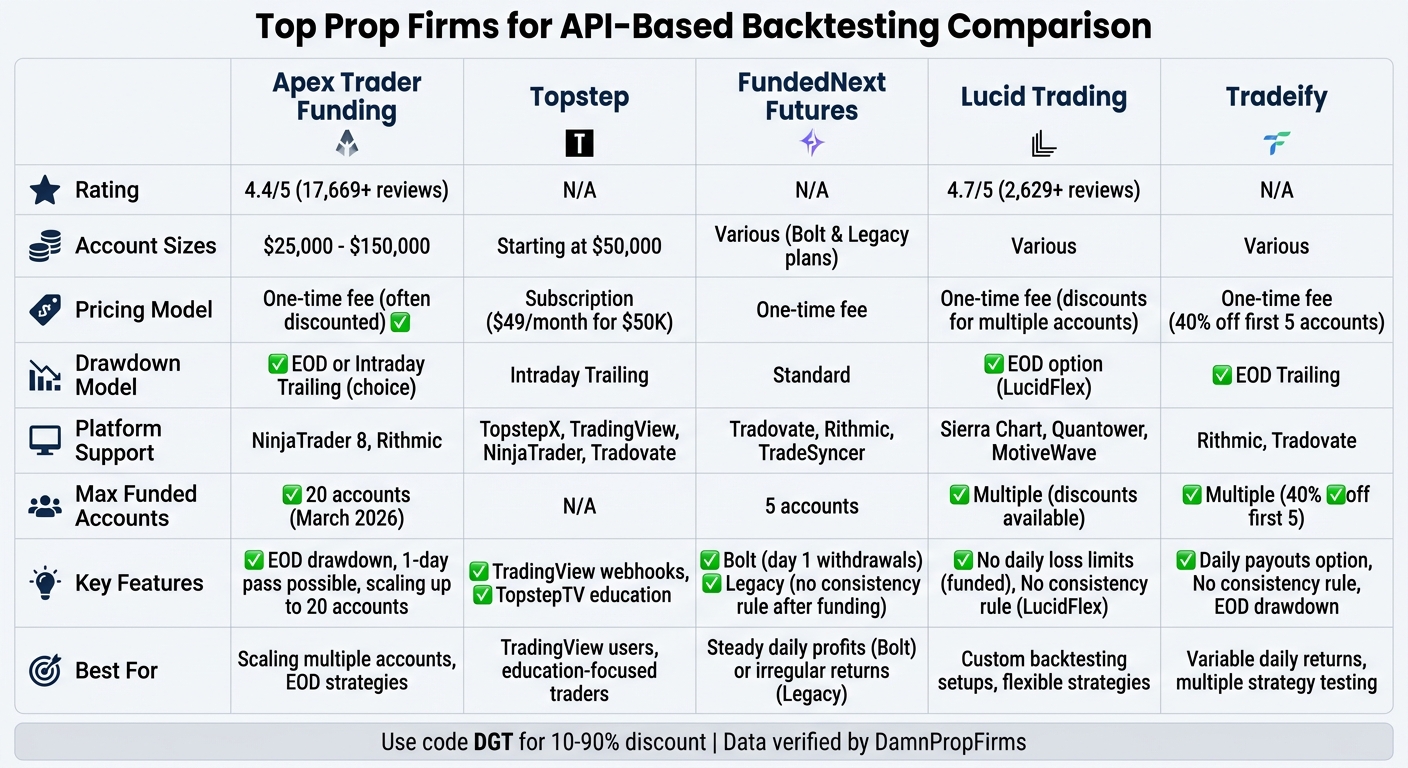
Top 5 Prop Firms for Algorithmic Trading API Comparison Chart
If you’re an algorithmic trader, finding a prop firm with solid API access can make or break your backtesting process. Here’s a rundown of the best futures prop firms that deliver on this front.
Apex Trader Funding
Apex is a standout for algo traders looking to scale. Starting March 2026, you can manage and copy trade up to 20 funded Performance Accounts at the same time – way above the industry norm. Their recent update gives you the choice between End-of-Day (EOD) and Intraday Trailing Drawdown models. For backtesting, the EOD model is a game changer. It calculates drawdown at the end of the trading day, so you don’t get stopped out by midday volatility. Apex works with NinjaTrader 8 and Rithmic, offering account sizes from $25,000 to $150,000. Fees? They’re often discounted, and if you hit the profit target and respect drawdown limits, you could pass the evaluation in just one day. Apex has earned a 4.4/5 rating from over 17,669 reviews [3].
Topstep
Topstep does things differently with its subscription-based model. Instead of a one-time fee, you pay monthly – starting at $49 for a $50,000 account. Their TopstepX platform integrates seamlessly with TradingView via Tradovate, perfect for webhook-based strategies. If you’re after more advanced setups, NinjaTrader and Tradovate are also supported, giving you the data feeds you need for precise backtesting. Beyond the tech, Topstep is big on education with its TopstepTV ecosystem. They use an intraday trailing drawdown, so you’ll need to manage unrealized profits carefully [1].
FundedNext Futures
FundedNext stands out with its Bolt and Legacy plans. The Bolt plan allows withdrawals from day one – ideal for algos that churn out steady daily profits. The Legacy plan, on the other hand, removes the consistency rule after funding, which is perfect for strategies with uneven returns. Both plans make backtesting smoother by accommodating irregular profit distributions. FundedNext supports Tradovate and Rithmic APIs and works with tools like TradeSyncer for syncing strategies across multiple accounts. While you’re capped at five accounts, the no-consistency-rule funding stage gives you more freedom to test and execute algorithms [4].
Lucid Trading
Lucid Trading is all about speed and flexibility. They support APIs for Sierra Chart, Quantower, and MotiveWave – great if you’re building custom backtesting setups outside the usual NinjaTrader or MT5. Their LucidFlex account is a big draw, eliminating daily loss limits and consistency rules in the funded phase while offering an End-of-Day drawdown option. These features let your algorithm breathe a bit more. Lucid has a 4.7/5 rating from over 2,629 reviews and offers competitive challenge fees with discounts for multiple accounts. Depending on your strategy, you might even pass the evaluation in a day or opt for instant funding [10, 19].
Tradeify
Tradeify keeps things simple and flexible. Their Select plan lets you choose between daily payouts or a flex-funded model after passing the evaluation. It also uses an End-of-Day trailing drawdown without a consistency rule, making it a solid choice for strategies with variable daily returns. Plus, they offer 40% discounts on your first five accounts, which is perfect for testing multiple strategies or account sizes. Like others on this list, Tradeify integrates with Rithmic and Tradovate [4].
Each of these firms has something unique to offer. Whether you’re scaling up, testing strategies with lumpy returns, or building custom backtesting setups, there’s a platform here to match your needs. For more details and updated rules, check out DamnPropFirms.
How DamnPropFirms Helps You Compare Prop Firms
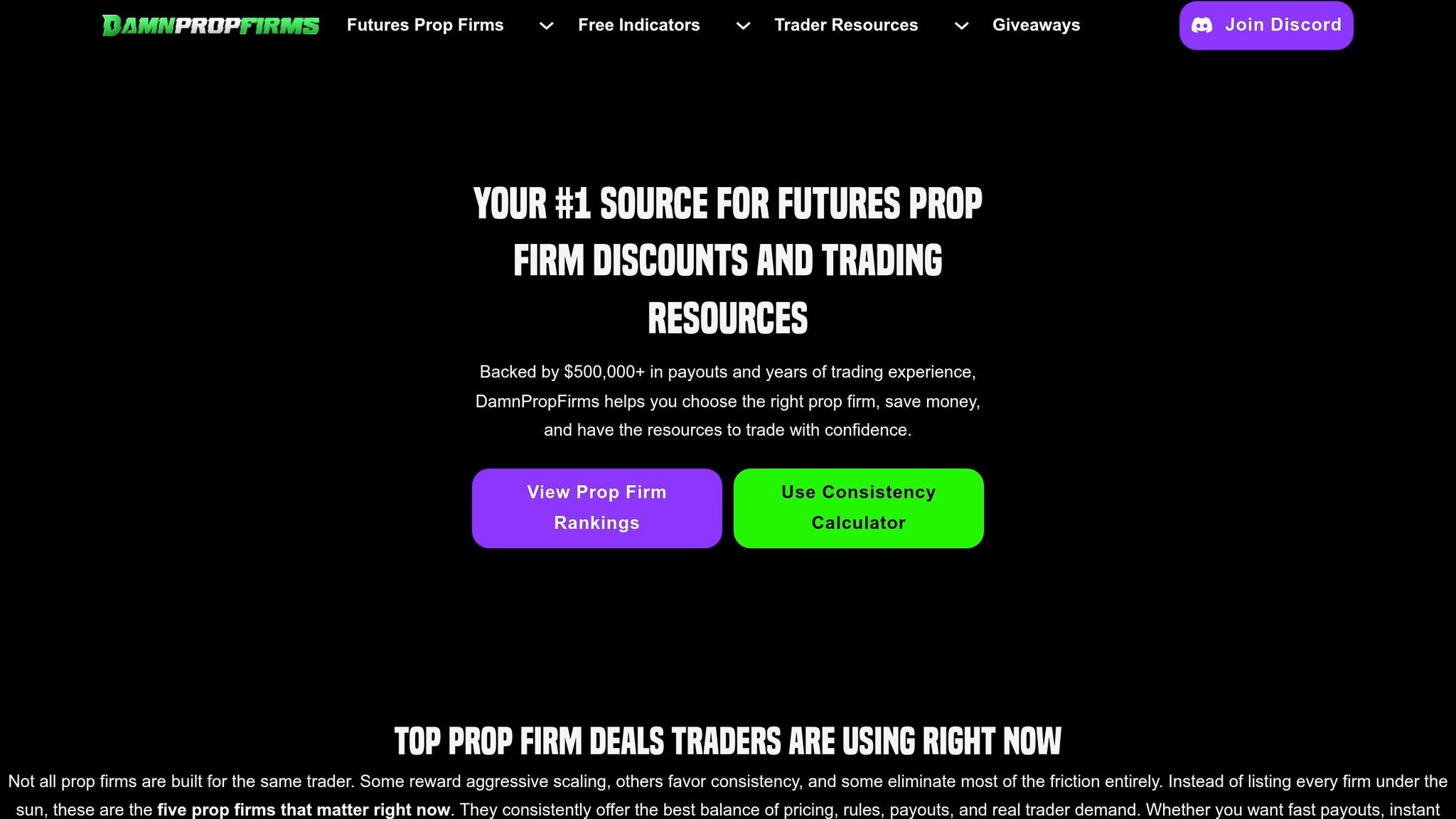
Picking the right prop firm for API-based backtesting means digging into the details – drawdown models, consistency rules, platform latency, and payout structures. DamnPropFirms simplifies this process by breaking down key rules, fees, and features so you can find the best fit. This guide expands on earlier insights with verified reviews, discount codes, and essential tools to make smarter decisions.
Current Reviews and Discount Codes
Every review on DamnPropFirms is manually verified, covering payout speeds, rule structures, and potential risk factors. The platform has documented over $1,000,000 in payouts to back its credibility [4]. Plus, you can save big with the universal discount code DGT, offering discounts from 10% to as much as 90% on evaluation accounts [4].
Free Comparison Tools
DamnPropFirms doesn’t just stop at reviews – it also gives you tools to make your trading life easier. For algo traders, the site offers free calculators tailored to specific needs. The Consistency Rule Calculator is a game-changer if you’re planning to request a payout. It ensures your bot’s profit distribution aligns with rules like Apex’s 50% daily maximum or Alpha Futures’ 40% threshold [4]. Other tools, like the Futures Prop Firm Payout Estimator and Apex Payout & Scaling Calculator, help you calculate net earnings and visualize scaling across multiple accounts [3][4].
Detailed Prop Firm Reviews
Each firm gets a deep dive review, covering everything from updated rules to platform compatibility. For instance, the Apex Trader Funding review highlights its March 2026 updates, including the new end-of-day drawdown option and the ability to manage up to 20 funded accounts simultaneously [3]. Meanwhile, the Lucid Trading review focuses on its support for Sierra Chart, Quantower, and MotiveWave – great platforms for custom backtesting setups [8].
You’ll also find head-to-head comparisons, like Apex vs. Topstep or Apex vs. Lucid Trading, which break down differences in drawdown models, pricing, and API support [3]. On top of that, DamnPropFirms’ Discord community, with over 4,500 traders, provides real-time feedback on payout speeds and platform stability. This gives you reliable insights – what they call "trust signals" – before you decide where to commit your capital [4]. With these resources, you’ll have everything you need to confidently choose the right API-based backtesting platform.
Conclusion
This guide broke down how API features and prop firm rules can make or break your backtesting workflow. Picking the right prop firm for API-based backtesting comes down to three main things: drawdown rules, platform compatibility, and clear guidelines. Go for firms with End-of-Day (EOD) drawdown, like Lucid Trading or the EOD option from Apex Trader Funding, so you’re not caught off guard by intraday swings [3]. Also, make sure the firm supports tools like NinjaTrader or Tradovate if those match your coding setup [2]. And don’t forget – prop firm rules shift frequently, like Apex’s March 2026 update, so staying on top of changes is a must [3].
Before putting real money on the line, double-check that your strategy fits their consistency rules. Use DamnPropFirms’ Consistency Rule Calculator to see if your bot’s profit distribution meets limits like Apex’s 50% daily max or Alpha Futures’ 40% cap. Their in-depth reviews also help you confirm platform compatibility and check payout speeds in real time [4]. These steps keep your testing setup solid and compliant.
One last thing: use the DGT discount code to slash 10% to 90% off evaluation accounts. It’s a great way to lower the risk when testing new strategies [4]. Whether you’re working with 10 years of tick data or running live bots across multiple funded accounts, picking the right prop firm is a game-changer. Head over to DamnPropFirms to compare drawdown models, platform integrations, and everything else you need.
FAQs
Do I need tick data to backtest my algo accurately?
Tick data is a must-have for precise backtesting of algorithmic strategies. It records every price change and trade execution, giving you a detailed view of market activity. This level of detail is especially important for strategies like high-frequency trading or scalping, where even the smallest price movements can make or break the strategy. Without tick data, your backtests might overlook critical market fluctuations, leading to results that don’t reflect real-world performance. If you’re testing complex algorithms, using tick data ensures your results are as realistic as possible.
Which drawdown model is better for bots: EOD or intraday trailing?
End-of-Day (EOD) trailing drawdown models are popular because they reset at the end of each trading day, keeping things straightforward and avoiding the chaos of intraday volatility. This makes them a great fit for bots running steady, consistent strategies.
Intraday trailing models, however, provide ongoing risk management throughout the day. They’re perfect for bots that require constant tweaks and thrive on active, fast-paced trading.
The right model depends on how your bot operates. If you’re running a stable strategy, EOD is probably the way to go. But if your bot’s all about quick moves and adaptability, intraday might be the better fit.
How can I confirm an API will work with my platform before paying?
If you want to make sure an API works with your platform before spending any money, test it out using the prop firm’s demo environment or their API access. Most firms let you try their API before you commit, so take advantage of that to confirm it fits seamlessly with your trading setup.