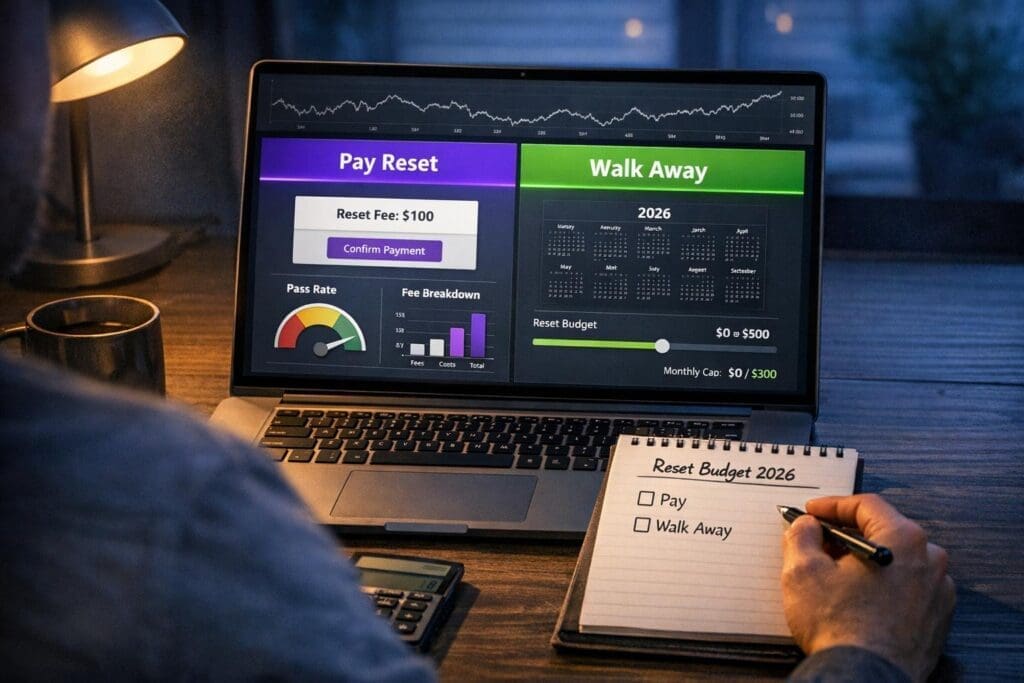
If you’ve already burned through $300+ on resets and still haven’t passed, stop. You’re probably just repeating the same mistakes instead of using proven strategies to pass prop firm challenges. Reset fees are a trap for most traders, turning a $40 evaluation into a $480 money pit before you even get funded. This guide breaks down when paying the reset makes sense and when it’s time to walk away. We’ll cover the real costs, pass rates (spoiler: 90% fail their first challenge), and how to avoid funding the firm’s business model instead of your trading goals. Let’s get into it.
What Are Prop Firm Reset Fees?
Reset Fee Basics
Reset fees are what you pay to restart a failed evaluation account from scratch. Let’s say you break a rule – maybe you hit your daily loss limit or exceed the trailing drawdown. Instead of waiting for your subscription to renew or buying a new account at full price, you can pay a reset fee. This resets your balance and drawdown limits to their original state, giving you another shot at passing.
For traders, it’s like getting a discounted do-over. For prop firms, it’s a solid revenue stream. Because so many traders fail evaluations (often two or three times before passing), reset fees add up fast for these companies [1].
Most reset fees fall between $59 and $169, depending on the firm and account size. For example, Apex Trader Funding charges $60, which is on the lower end. Bulenox charges $78, Tradeify comes in at $99, and FundedNext Futures charges $132 [1]. Some firms, like Tradeday, adjust their fees based on the account tier, ranging from $59 to $99 [1].
While reset fees are a big part of the cost picture, they’re not the only expense you’ll face.
Reset Fees vs Other Prop Firm Costs
Reset fees are just one piece of the puzzle. Here’s how they compare to other common charges you’ll encounter during a prop firm challenge:
| Cost Type | When You Pay | Purpose | Typical Range |
|---|---|---|---|
| Evaluation Fee | Upfront / Monthly | Entry to the challenge | $59–$350 |
| Reset Fee | After a rule violation | Restart a failed challenge | $59–$169 |
| Activation Fee | After passing | Set up live/funded account | $0–$300 |
| Data/Platform Fee | Monthly | Access to market data and platforms | $0–$140/mo |
The evaluation fee is your starting cost – what you pay to enter the challenge. Some firms, like Apex or TakeProfitTrader, charge this as a one-time fee. Others, like Alpha Futures or Tradeday, use a subscription model, where you pay monthly to keep your account active until you pass (or cancel) [1].
The activation fee kicks in only after you pass the evaluation, unlocking your funded account. This can range widely, from $0 at firms like Tradeify and FundedNext Futures to $140 at Apex Trader Funding [1].
Lastly, data and platform fees cover things like market data feeds (CME, CBOT) or platform licenses. These fees might be included during the evaluation but are often charged separately once you’re funded [2].
Here’s a tip: if you’re with a subscription-based firm and fail mid-cycle, waiting for your next renewal might save you the reset fee. But if you’re eager to jump back in, the reset is usually cheaper than paying for another full month [1].
sbb-itb-46ae61d
How Multiple Resets Affect Your Budget
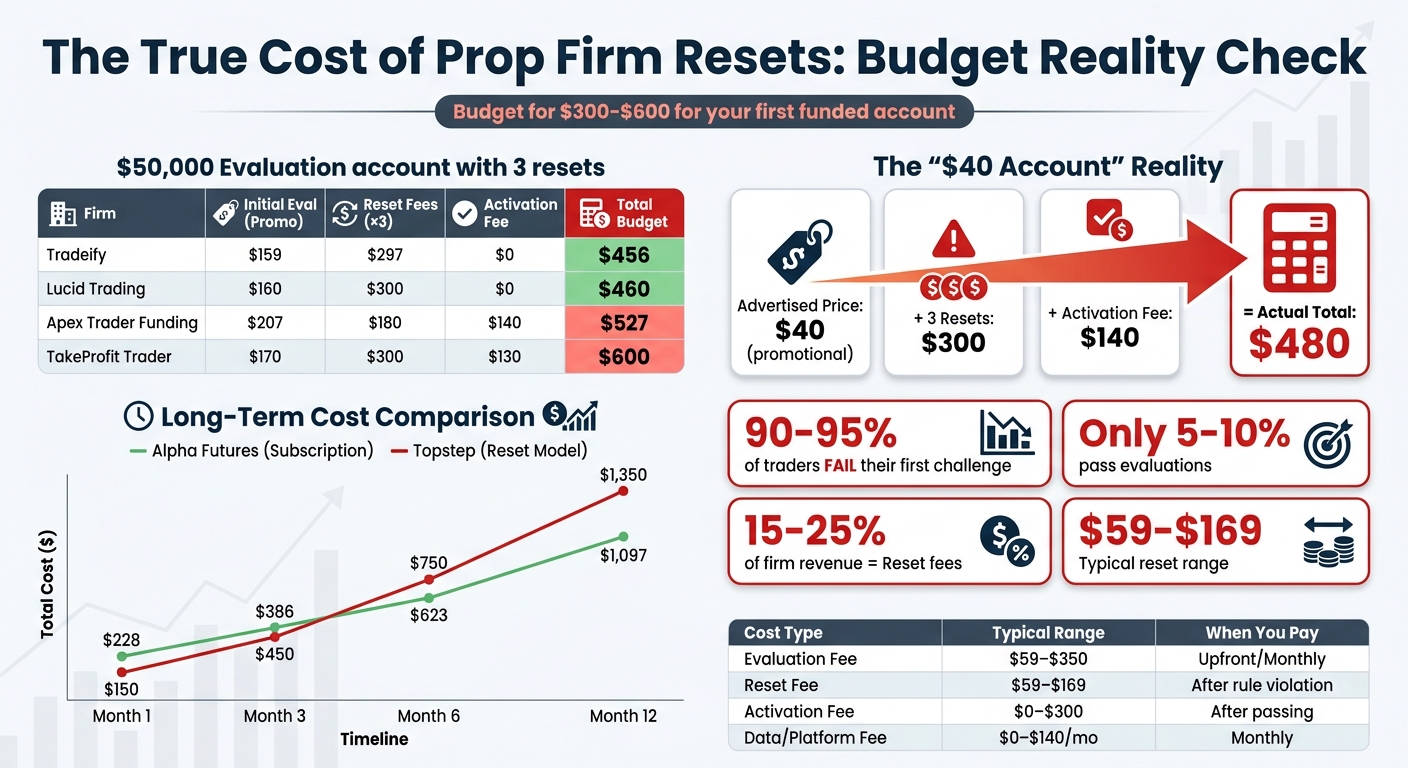
Prop Firm Reset Fees Cost Comparison: Total Budget Breakdown Across Major Firms
Total Cost Examples
Reset fees might seem harmless, but they add up fast. Take a $40 promotional entry fee – after three resets and an activation fee, you’re looking at around $480 [1].
Here’s a breakdown for a $50,000 evaluation account across different firms, assuming you need three resets before passing:
| Firm | Initial Eval (Promo) | Reset Fees (x3) | Activation Fee | Total Budget |
|---|---|---|---|---|
| Tradeify | $159 | $297 | $0 | $456 |
| Lucid Trading | $160 | $300 | $0 | $460 |
| Apex Trader Funding | $207 | $180 | $140 | $527 |
| TakeProfit Trader | $170 | $300 | $130 | $600 |
Tradeify and Lucid Trading stand out by skipping activation fees, keeping the total lower. On the other hand, Apex Trader Funding and TakeProfit Trader tack on $130–$140 when you pass. If you’re just starting out, expect to budget $300–$600 for your first funded account. That’s a far cry from the tempting promotional fees alone [1].
It’s also worth noting that most traders don’t pass on their first try; two or three attempts are pretty common. Planning for at least two resets is just being realistic [1]. The costs can pile up, and when you factor in the low pass rates, it’s clear this isn’t an easy game.
Understanding Pass Rates
The challenge multiplies when you consider how few traders actually succeed. Only 5–10% of traders pass their evaluations [1]. It’s not just about skill – it’s about navigating strict rules, managing risk under pressure, and adapting to each firm’s drawdown and consistency requirements.
This struggle often leads to what’s called the "just one more" loop. You convince yourself one more reset will do it, but before you know it, you’ve spent hundreds on a single evaluation. Prop firms are well aware of this cycle, and their fee structures capitalize on it [1]. If you’re resetting multiple times without addressing the underlying issues in your strategy, you’re essentially funding the firm’s business model.
If you’re on your third or fourth reset and hitting the same roadblocks, it’s probably time to step back and rethink your approach. Knowing your budget limits and the odds you’re up against can help you decide whether to reset again or call it quits. In the next section, we’ll dive into the warning signs that it’s time to walk away.
When Paying for a Reset Is Worth It
Comparing Reset Costs to Alternatives
Paying for a reset can sometimes be the smarter financial choice, but it all comes down to comparing the cost of the reset with your other options. Let’s break it down.
Take Alpha Futures, for example. Their monthly subscription costs $79. If you fail in week three, you’ve got two choices: wait for the next cycle and get a free reset, or pay $79 to restart immediately. As Ashley Akin, CPA, explains:
It can be beneficial to pay the reset in case you want to quickly complete the new challenge for a lower reset fee compared to your monthly subscription price [2].
If you’re confident you’ll pass on the next try, paying $79 now saves you the time and hassle of waiting – and you’re spending the same amount either way.
Now, let’s look at one-time evaluation firms like Apex Trader Funding. Their reset fee is just $60, which is among the lowest in the industry [1]. Compare that to starting a fresh $50,000 evaluation for $207 (even with discounts), and the reset option clearly saves you money. But here’s a pro tip: always check for promo codes before resetting. Sometimes a discount can drop the price of a new evaluation to $104, which might make more sense than paying for multiple resets [1].
To get a clearer picture, here’s a cost breakdown over time:
| Pass Month | Alpha Futures (Subscription) | Topstep ($150 + $150 Reset) |
|---|---|---|
| Month 1 | $228 (incl. activation) | ~$150 |
| Month 3 | $386 | ~$450 (2 resets) |
| Month 6 | $623 | ~$750 (4 resets) |
| Month 12 | $1,097 | ~$1,350 (8 resets) |
The takeaway? Resets are a great option if you’re passing quickly. But if you’re dragging it out over several months, subscription models might be cheaper – or it might be time to rethink your approach altogether. This cost-first perspective helps you decide whether resetting is the right move for your trading journey.
What to Evaluate Before Resetting
Cost isn’t the only factor to consider. Your trading strategy and mindset are just as important when deciding if a reset is worth it. Ask yourself some tough questions before paying for another shot.
First, are you sticking to your trading system, or are you forcing trades to meet the firm’s rules? If you’ve abandoned your strategy, a reset won’t solve anything – you’ll likely fail again [3].
Next, think about your track record. If you’ve already spent over $1,000 on three or more attempts, the expected value of another reset probably isn’t in your favor [3]. Data shows most traders who succeed usually pass within 2–3 tries [1]. If you’re way past that point and still hitting the same roadblocks, it might be time to take a break.
Also, check your mindset. Are you trading scared? Repeated failures can mess with your confidence, leading to second-guessing or cutting winners short. If fear is driving your decisions, you’re setting yourself up to fail again. Fix your mindset before paying for that reset, or you’re just burning cash [3].
Finally, have you practiced enough with the firm’s rules? Use a demo account to simulate their daily loss limits, consistency rules, and time constraints. If you can’t pass in demo, you’re not ready for the real thing. Budget for 2–3 resets ($150–$400) on top of your initial fee, and if you’re still stuck after that, it’s probably time to walk away [1].
When to Stop Resetting and Walk Away
Warning Signs You Should Quit
Knowing when to stop throwing money at resets is crucial. Here’s when you know it’s time to step back and rethink your trading game:
Spending too much with no results. If you’ve burned through over $1,000 without getting funded, it’s time to take a hard look at your approach. Diego Arribas Lopez puts it bluntly:
If your pass rate is below 20% and you’ve spent more than $1,000 on challenges, stop. The math doesn’t work. You’re a customer, not a trader-in-training. [3]
Failing three or more challenges for every success means the odds are stacked against you. Another reset isn’t going to magically fix that.
Breaking the same rules repeatedly. If you’ve hit the daily loss limit three times in a row, it’s not just bad luck – it’s a discipline problem. A reset won’t solve it.
Trading scared. By the fourth attempt, fear often creeps in. Scared trading – second-guessing entries, cutting profits too soon, or forcing trades because of a looming deadline – is a recipe for losses. As Lopez points out, fear-driven trading rarely ends well [3].
Warping your strategy. If you’re tweaking your trading edge just to fit the firm’s rules – rushing exits, changing position sizes, or forcing trades to hit profit targets – you’re no longer trading your plan. You’re gambling under pressure.
Here’s a quick cheat sheet:
| Warning Sign | What It Means |
|---|---|
| Total spend exceeds $1,000 | You’re funding the firm, not learning to trade. |
| Breaking the same rule 3+ times | It’s a discipline issue, not market conditions. |
| Trading emotionally | Revenge trading or fear-based decisions are taking over. |
| Strategy tweaks | You’re abandoning your edge to pass the challenge. |
| Time-driven trades | Rushing trades because the clock is ticking. |
These signs not only show when it’s time to quit but also reveal how prop firms profit from your resets.
How Prop Firms Make Money
Understanding how prop firms make their cash helps explain why resets are more beneficial to them than to you. Lopez doesn’t mince words:
The business model of most prop firms is to make money from challenge fees. That’s it. There’s nothing more to it. [3]
Here’s the breakdown: for every 100 traders who buy a challenge, 90–95% fail and lose their fees. Only a small fraction – 5–10% – make it through both evaluation phases. Reset fees alone make up about 15–25% of a firm’s revenue [1]. And some firms even boot highly profitable traders because they’re a risk to the firm’s capital.
Think about this: a "$40 account" can end up costing way more. In a 2025 analysis, a trader who jumped on a flash sale spent $480 before placing a single live trade. That included the $40 initial fee, three resets at $100 each, and a $140 activation fee [1]. That’s a massive markup, and the firm pockets those fees whether you succeed or not.
While some traders do get funded, if you’re on your fourth or fifth reset, you’re just padding the firm’s bottom line. If the math worked in your favor, firms wouldn’t be so eager to offer another reset. Set a hard limit before you start – maybe two resets or a total spend of $500 – and stick to it. Once you hit that cap, stop paying and work on your strategy in a risk-free environment.
Prop Firm Models That Reduce Reset Costs
Different Funding Models
If you’re tired of spending on resets, there are top futures prop firms that can help cut those costs while you work on improving your trading game.
Some prop firms now offer account setups that either lower or eliminate reset fees altogether. These can save you a ton of money, especially if you’re still honing your skills.
One-Time Payment (OTP) models let you pay once upfront to cover everything – evaluation, activation, and lifetime access to a funded account. For instance, Phidias charges $116 for a 50K account with no additional fees[5]. These are a solid option if you think it’ll take you a few months to pass the evaluation[5].
Static drawdown accounts come with a fixed drawdown limit that doesn’t change over time. This setup gives you a consistent risk level, but the smaller buffers (e.g., $500 on a $25K account vs. $1,000) mean you’re less likely to get caught in a reset due to normal market swings[5][6].
Subscription models like Tradeify Select charge a monthly fee (e.g., $159 for a 50K account). They also include a reset fee (e.g., $95) but skip the activation fee[4]. While the recurring fee can add up if you take multiple attempts, it does spread out the cost of resets.
Each of these models has its pros and cons. Here’s a quick breakdown of how they stack up:
| Feature | One-Time Payment (OTP) | Subscription Model | Traditional Reset Model |
|---|---|---|---|
| Upfront Cost | Higher (e.g., $116+) | Lower (e.g., $79–$159/month) | Moderate (e.g., $150–$300) |
| Activation Fee | $0 | $0 | $100–$169 |
| Reset Cost | Cost of a new account | Included or reduced (e.g., $95) | $59–$169 per attempt |
| Time Pressure | None | High (monthly billing cycle) | Moderate |
| Best For | Traders needing 4+ months to pass | Traders expecting 2–3 attempts | Experienced traders seeking one clean attempt |
What You Give Up
No funding model is perfect – each comes with its own compromises. OTP models, for instance, require a bigger upfront payment, which can sting if you don’t pass early.
Static drawdown accounts offer clarity on risk limits, but the smaller buffers (like $500 on a 25K account) leave you with less room to navigate volatile markets[5][6].
No-activation-fee models might sound appealing, but firms often make up for the waived fees by imposing stricter trading rules. For example, they might lower your maximum drawdown or tighten daily loss limits. As Phidias explains:
Activation fees create a toxic psychological environment that undermines disciplined trading. When you pay $149 to activate your funded account, you immediately feel pressure to ‘recover’ that cost. [5]
Instant-funded models, like Tradeify Lightning, charge a one-time fee (e.g., $469 for a 50K account) but don’t offer a reset option. If you fail, you’ll need to buy a new account at full price[4].
Choosing the right model depends on your trading strategy and how much risk you’re comfortable taking. Take the time to weigh the options and pick what works best for you.
How to Prepare Before Paying for a Reset
Don’t waste $60–$169 on another reset without fixing the mistakes that got you here. If you dive back in without addressing the root issues, you’re just setting yourself up to fail again.
Take a breather. At least one full day off after a failed challenge can help you avoid emotional "revenge resetting" and give you the clarity to reassess what went wrong[9]. Use this time to reflect and set yourself up with better risk management and a stronger trading plan.
Review Your Failed Trades
Pull up your logs and charts, and figure out where things went off the rails. Break down your mistakes into two categories: technical errors (like bad entry timing or a strategy that didn’t work) and emotional errors (like FOMO, revenge trading, or impatience)[9].
Pay close attention to the specific rule you broke. Was it the daily loss cap, the max drawdown, or the consistency requirement? These three limits are where most traders fail their prop firm challenges, with about 90% of traders not making it through[1]. Find the exact trade or decision where you crossed the line and analyze what led to it[9].
For example, if you hit your daily loss limit because your position sizes were too big for the account’s volatility, that’s a clear sign you need to scale down. Understanding these patterns is key to adjusting how you size your trades and manage risk.
Fix Your Risk Management
Once you’ve pinpointed your mistakes, it’s time to tighten up your risk management. If big drawdowns killed your last attempt, start smaller next time. Shrink your position sizes until you can trade consistently without blowing up[9].
TopStep’s advice on this is straightforward:
To avoid breaching the daily loss limits during evaluations, it’s recommended to keep risk per trade between 0.5% and 1.0%[8].
Most prop firms set daily loss limits at 3–5%, so keeping your risk per trade low gives you some breathing room. A few losses won’t immediately put you out of the game.
Before you shell out for another reset, test your new risk rules on a demo account[9]. If you can’t stick to your plan when there’s no real money at stake, you’re not ready to jump back into a live evaluation. Once you’ve got your risk controls dialed in, it’s time to formalize your approach with a solid trading plan.
Write a Clear Trading Plan
Your trading plan should be crystal clear about what you’re doing and why. Outline your exact entry and exit rules, the setups you’ll trade, stop-loss levels, and profit-taking strategies[9].
Include operational details like your trading hours (e.g., 18:00–16:10 EST), how you’ll handle news events, and whether you’ll hold positions overnight[7]. Also, set rules for walking away when markets are slow or choppy[9].
Here’s what your plan should cover:
| Plan Element | Purpose | Recommended Action |
|---|---|---|
| Position Sizing | Protects against drawdown | Reduce size until win-rate stabilizes[9] |
| Daily Loss Limit | Prevents account blowing | Set a "soft breach" limit below firm’s hard cap[4] |
| Consistency Rule | Ensures sustainable gains | Avoid single days exceeding 30–40% of total profit[4][8] |
| Trading Window | Avoids low-probability setups | Focus on high-volume sessions like London/NY overlap[7] |
Use the insights from your failed trades to refine these parameters. As TradeFundrr puts it:
Resetting should be approached with intention. Treat it as a chance to pause, review your methodology, and build new routines for success[9].
Focus on process-oriented goals instead of just hitting profit targets. For example, aim to follow all your rules for five straight days. That mental shift – from chasing profits to sticking to a process – is often what separates traders who pass from those who keep burning money on resets[9].
FAQs
How do I set a hard cap on reset spending before I start?
To keep reset spending under control, start by setting a firm budget that aligns with your trading plan and risk tolerance. Most prop firms charge around $60–$80 per reset, so factor that into your calculations. For example, if you set a $200 budget, you’re looking at 2–3 resets max. Keep track of these expenses, either manually or in a simple spreadsheet, to make sure you don’t overspend.
Should I reset now or wait for my subscription to renew?
If you’re stuck deciding between hitting the reset button or waiting it out, it really comes down to timing and cost. If your renewal date is just around the corner, waiting is often the smarter move. Resets won’t change your billing cycle, so by holding off, you can squeeze more value out of your subscription. Plus, you might catch a promo or discount when it’s time to renew or grab a new account. Reset fees usually fall between $65 and $160, depending on your account size.
What’s the fastest way to fix the rule I keep breaking?
If you break a rule, how you handle it depends on your prop firm’s rules. Here are your main options:
- Pay for a reset: Most firms let you pay a fee (usually $60–$80) to start over without losing your progress.
- Wait for a rebill or begin again: If resets are too pricey or not offered, waiting for your next billing cycle or starting from scratch might be the better move.
Make sure to check your firm’s reset policy to know what works best for you.